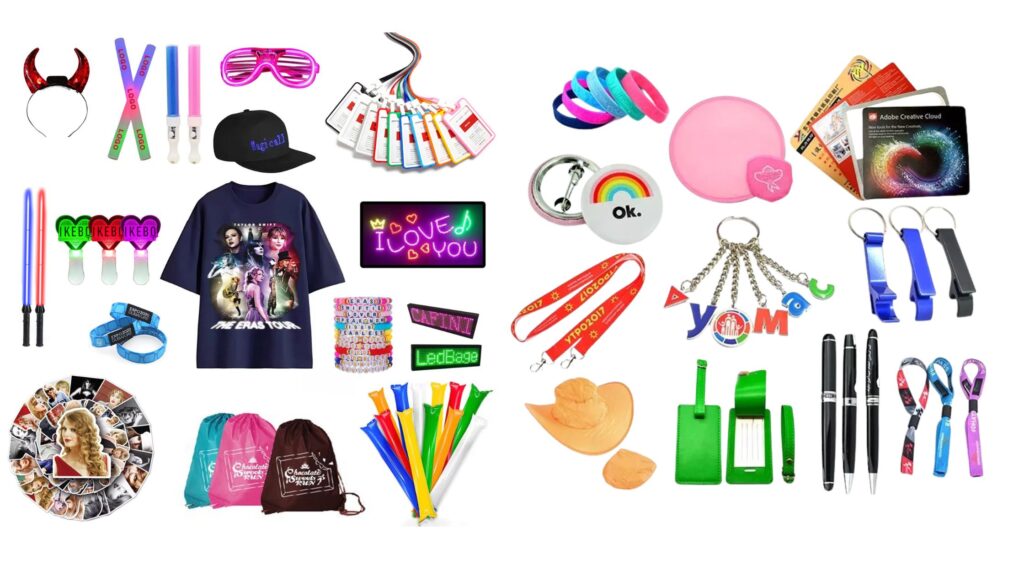
Almost every list of the best promotional items to give away names the same five things. A water bottle. A tote bag. A pen. A cap. A power bank. Then the list stops, because nobody writing it has to justify the order.
This one does. Below you get eighteen categories, ranked with numbers you can check: how many times each item gets seen, how long people keep it, and what every one of those views costs you. The figures come from ASI’s 2026 Ad Impressions Study and from PPAI’s consumer research.
Here is the short answer first. The best promotional items to give away are the ones people keep, use where other people can see them, and that cost you a fraction of a cent per impression. On ASI’s own numbers, bags win outright — 4,900 impressions at one tenth of a cent each, with 84% of people keeping them for at least a year. But the ranking does shift once you buy at factory prices instead of distributor prices, and we will come to that.
What Makes a Giveaway “Best”? Three Numbers, Not One
Before ranking the best promotional items to give away, you need the test. “Useful” is not a measurement. Every supplier blog calls its own product useful. Three numbers actually separate a good giveaway from a bad one.
Impressions. How many times will somebody see your logo over the item’s whole life? ASI measures exactly this. A tote bag gets seen 4,900 times. A notebook gets seen 500 times. The average across all products is 3,300.
Keep rate. What share of people still have it a year or two later? An item binned on day one has delivered one impression, whatever the study says.
Cost per impression. Your landed unit cost, divided by the impressions. This is the number that decides whether the whole thing was worth doing.
All three have to move together. A fleece jacket earns 9,000 impressions, which looks like a win until you divide by the $30 it cost you.
Why Do So Many Giveaways End Up in the Bin?
Because of how they feel, not what they are. PPAI’s 2025 consumer study found that over 60% of people reject a promotional item immediately because the material or build feels cheap. Boring, generic design pushes away 38%. And 37% say they already own too many of the same thing.
That last figure matters more than it looks. It is the reason the cheapest item per impression is also the riskiest one.
The 18 Categories, Ranked by What Each Impression Costs You
All figures below are from ASI’s 2026 Ad Impressions Study, its most recent edition. Cost per impression is ASI’s own figure, and it is built on U.S. distributor prices. Hold that thought — it matters later.
| Category | Lifetime impressions | Kept 1 yr+ | More likely to buy | Cost per impression |
|---|---|---|---|---|
| Bags | 4,900 | 84% | 77% | 1/10 cent |
| Writing instruments | 1,900 | 65% | 77% | 1/10 cent |
| Magnets | 800 | 67% | 63% | 1/10 cent |
| Caps and hats | 4,000 | 64% | 72% | 1/3 cent |
| Buttons, lanyards, stickers | 600 | 62% | 67% | 1/4 cent |
| T-shirts | 3,500 | 80% | 69% | 1/3 cent |
| Housewares | 1,200 | nearly half keep 5 yr+ | 79% | 1/3 cent |
| Fleece and jackets | 9,000 | 87% | 85% | 4/10 cent |
| Polo shirts | 2,900 | 73% | 72% | 7/10 cent |
| Umbrellas | 2,300 | over half keep 5 yr+ | 76% | 7/10 cent |
| Power banks | 1,800 | 85% | 81% | 7/10 cent |
| Drinkware | 1,300 | 80% | 74% | 1 cent |
| Desk and office accessories | 1,200 | 77% | 83% | 1 cent |
| Health and safety products | 400 | 64% | 82% | under 1 cent |
| Blankets | 1,200 | half keep 5 yr+ | 87% | under 2 cents |
| Calendars | 550 | not stated | 64% | 1 cent |
| Notebooks | 500 | 61% | 75% | under 1 cent |
| USB drives | 400 | nearly half keep 5 yr+ | 71% | under 2 cents |
Read that table twice. It does not match the five-item list you have already seen ten times.
Which Giveaways Cost the Least Per Impression?
Three sit in the cheapest band at one tenth of a cent: bags, pens and magnets. Only one of them is a serious giveaway.
Bags win outright. They cost the same per impression as a pen but deliver 4,900 impressions instead of 1,900, and 84% of people keep them for at least a year. Across the whole study, the average product gets 3,300 impressions and 78% of people think better of the advertiser. Bags beat both.
Which Giveaways Get Seen the Most Times?
Fleece and jackets, at 9,000 impressions — nearly three times the average. Then bags at 4,900, caps at 4,000, and T-shirts at 3,500.
But look at the price of that fleece. It costs four tenths of a cent per impression, four times what a bag costs, and the unit price is in jacket territory. More impressions is not the same as a better deal.
Why Does Drinkware Look So Bad in This Table?
Because ASI priced it at U.S. distributor retail. Drinkware shows only 1,300 impressions and a cost per impression of 1 cent, which puts it near the bottom.
Now look at the other two columns. 80% of people keep drinkware for more than a year, and 77% use it at least once a week. PPAI’s Product Power 2026 study, run among more than 5,000 U.S. consumers, found that 73% use a branded bottle or tumbler every single day — more than any other daily-use item in that research.
So drinkware is not a weak giveaway. It is an expensive one to buy at retail. That is exactly the gap factory pricing closes, and we will do that maths below.
If you want to go deeper on the drinkware side, our guide to custom drink glasses with a logo covers the printing methods. Our pages on what a beer mug is and how much people know about beer mugs cover the shapes.
Why Is the Cheapest Item Also the Riskiest?
Because everyone is already handing out pens. PPAI’s end-user survey of 5,674 people in the U.S. and Canada found writing instruments are the most-received promotional product of all, at 72.8%.
Now pair that with the 37% who say they throw items away because they already have too many of the same thing. A pen is the fastest route into that pile. Cheap per impression only pays if the impression actually happens.
Which Giveaway Fits Which Moment?
The best promotional items to give away change with the setting. The right item depends on where the hand happens. A trade show tote and a bar-top handout solve different problems.
| Where you hand it out | Best item | Why it works | Backup |
|---|---|---|---|
| Trade show booth | Tote bag | Cheap, flat to ship, carries everything else you give away | Metal pen |
| Bar or taproom | Can cooler | Used on the spot, fits in a pocket on the way out | Coaster |
| Festival, outdoors | Cap | Worn all day, in every photo | Cooler bag |
| Direct mail | Coaster or flat card | Postage kills anything bulky | Sticker sheet |
| With a purchase | Branded glass | Lifts the thing they just bought | Bottle opener |
| Staff onboarding | Tumbler + tee kit | Daily use, builds belonging fast | Notebook |
| Client or VIP gift | Growler or stein | Heavy means valuable | Pitcher or ice bucket |
Two things are worth pulling out of that table.
Flat and light wins for mail. If you are posting it, the freight can cost more than the item. Our coaster material guide shows which options stay flat and cheap, and this coaster comparison lines them up side by side.
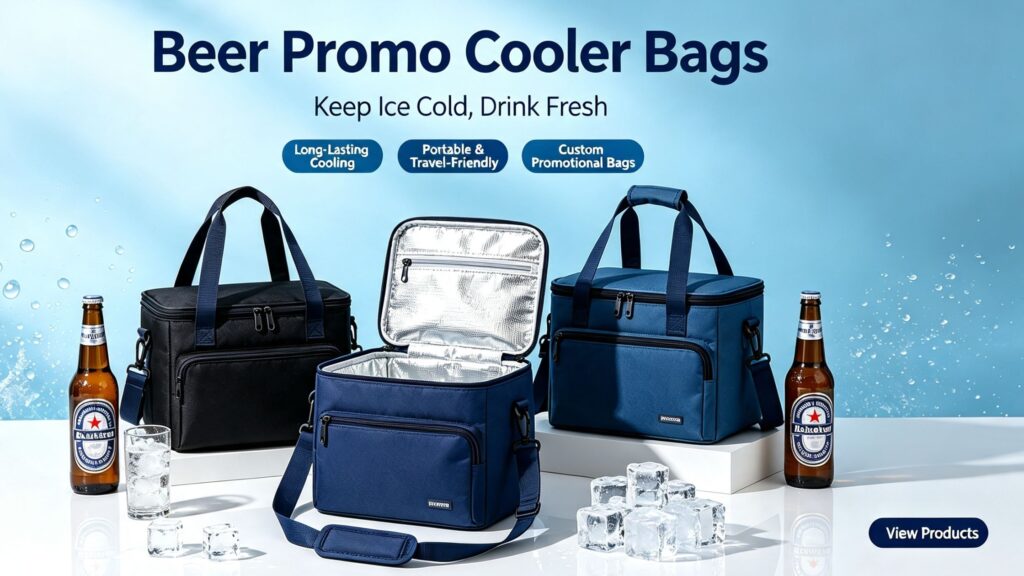
Cold-chain items win outdoors. A can cooler or a cooler bag is not just branded, it is doing a job. Our cooler bag types page breaks down which construction suits which event, and this explainer on what a cooler actually is covers the insulation basics. The cooler bag brands page and our page on beer promo cooler bags are worth a look if you are comparing builds.
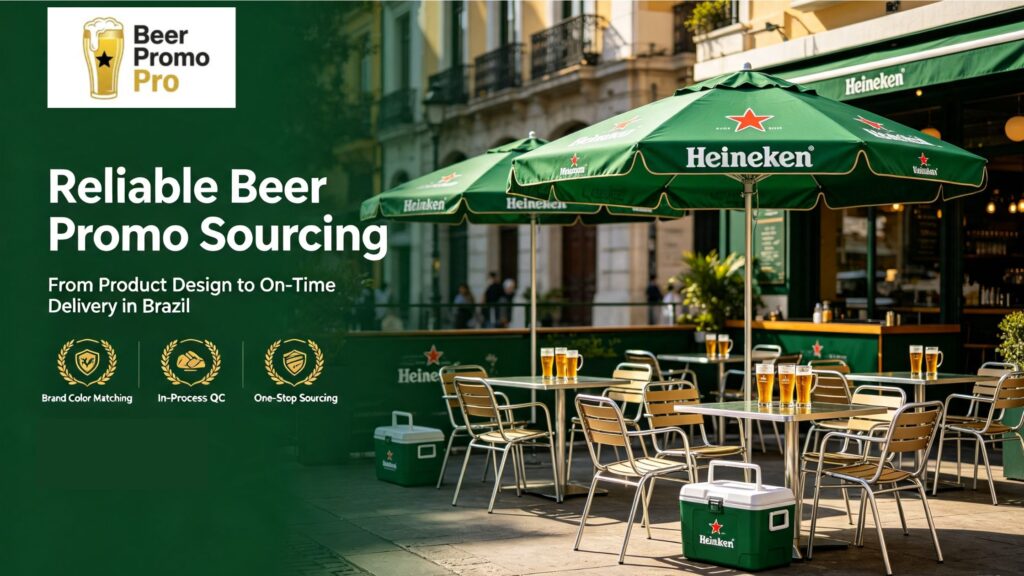
Outdoor sites need shade and seating too. If you are kitting out a festival space as well as handing things out, start with outdoor event gear, then check canopy tent sizes and the tent buying guide before ordering. Our patio umbrella size chart and beach mats page cover the rest.
Signage is not a giveaway, but it ships on the same order. If your campaign also needs site branding, see brewery signs, tin beer signs, table tents and beer display ideas. Our guide to choosing beer POSM explains how to size that part of the order.
Should Glassware Go Home with the Customer, or Stay in the Bar?
This is where most giveaway advice gets it wrong for drinks brands.
Glassware left behind the bar is not a giveaway. It is semi-permanent brand space, and the venue owns it. A custom beer mug or a run of branded glassware earns its keep by being poured from every night for six months.
Give the same mug to a customer in a box and it becomes a take-home item, with the 80% keep rate working for you. Both are good. They are not the same campaign, and they are not the same budget line.
Our full category guide to branded promotional items goes deeper on the venue-owned side, including bar mats, tap handles, serving trays and napkin holders. The bar serving supplies page and the barware buying guide cover the rest of that kit.
Gift, Giveaway, Freebie, Premium: What Are You Actually Buying?
These terms get used as if they mean the same thing. They do not, and mixing them up is how budgets get approved for the wrong product.
| Term | Who gets it | What it costs you | What it is for |
|---|---|---|---|
| Freebie | Anyone who walks past | Lowest unit cost | Raw reach, mass handout |
| Giveaway | Anyone, often at an event | Low unit cost | Reach plus goodwill |
| On-pack gift | Someone who just bought | Low, folded into margin | Lifting sell-through |
| Gift | A named person | Mid to high | A relationship, not a crowd |
| Premium | Someone who did something | Highest unit cost | Rewarding an action |
The distinction that trips people up most is giveaway versus premium. A giveaway is free to anyone and judged on cost per impression. A premium is earned — sign up, buy six, collect four tokens — and judged on whether it changes behaviour. Same product, completely different success test.
What Do These Items Cost to Make in China?
Prices below are rough bands for custom orders made in China, at 1,000 pieces or more, checked in October 2026. Treat them as a rough guide, not a promise. Material, print method, artwork and quantity all move the final number.
| Item | Band | Typical MOQ | What to watch |
|---|---|---|---|
| Sticker sheet, paper coaster | $ | 500–1,000 | Print colour count |
| Can cooler, neoprene sleeve | $ | 500–1,000 | Seam quality, neoprene thickness |
| Metal pen | $ | 500–1,000 | Ink, engraving depth |
| Non-woven tote bag | $ | 500–1,000 | Handle stitching |
| Ceramic mug, beer mug | $$ | 500–1,000 | Food-contact papers, carton drop test |
| Baseball cap | $$ | 500–1,000 | Embroidery vs print, panel count |
| Cotton T-shirt | $$ | 500–1,000 | Fabric weight, size grading |
| Insulated tumbler | $$$ | 500–1,000 | Lid seal, FDA / LFGB test report |
| Insulated lunch box | $$$ | 500–1,000 | Food-contact papers, hinge strength |
| Cooler bag | $$$ | 500–1,000 | Liner weld, zip brand |
| Stainless ice bucket | $$$$ | 300–500 | Wall thickness, lid fit |
Bands: $ under about $1 · $$ about $1–3 · $$$ about $3–8 · $$$$ $8 and up, FOB China.
On top of the unit price you carry tooling, samples, freight, duty, and the payment terms. Most factories in this space work on a 30% deposit with the balance before shipment, by T/T. Get the Incoterms in writing on the quote, because FOB and EXW are not the same number.
Our pages on MOQ for custom promotional products and lead times from China cover both in detail.
Does Buying from China Change the Ranking?
Yes, and this is the part most giveaway articles never touch.
Every cost-per-impression figure in the table above is built on U.S. distributor retail prices. That is what ASI measured, and it is the right benchmark if you are buying from a local distributor. It also means the ranking above is a ranking at retail, not a ranking at the factory gate.
Now take the drinkware row, which looked worst in the table. ASI puts it at 1 cent per impression because the item is priced at retail. Buy the same tumbler at a China factory price and the unit cost drops sharply, while the impression count does not move at all. The cost per impression falls with the price.
That is the real trade, and it is the one worth remembering. You are not buying a cheaper item. You are buying a better item on the same budget. A tumbler with an 80% keep rate becomes affordable at a cost per impression that rivals a pen — and a pen keeps 65% of recipients, not 80%.
What you pay for it is time and complexity:
- 30–45 days of production, plus shipping. See the lead time breakdown.
- A minimum order, usually 500 to 1,000 pieces per item.
- Freight and duty, which can add more than the unit price on heavy items like glass.
- Quality risk, which is why a pre-shipment check is not optional.
If your event is in three weeks, buy local. If it is in three months and you need 2,000 pieces, the maths changes completely.
How Many Should You Order?
Work from reach, not from budget.
Count the people you will actually reach. For an open handout table, plan on well under everyone walking past. For a staffed hand-to-hand giveaway, plan higher, because a person offering something converts far better than a table.
Watch the price breaks. Unit cost normally steps down at 500, 1,000 and 5,000 pieces. Ordering 900 often costs nearly as much as 1,000, so ask for both quotes before you settle.
Keep a buffer. Ten percent extra covers damaged cartons, a last-minute venue addition, and the people you forgot.
For a bar campaign, a useful working number is one item per expected customer per night, multiplied by the nights you are running it. Our beer promotion case studies show how real campaigns sized their orders.
What Goes Wrong When You Order Giveaways from China?
Five things, in the order they usually bite.
The sample is better than the shipment. This is the single most common complaint. Approve a gold sample, keep it, and check the bulk against it. Our supplier questions page has the exact wording to use.
Anything touching a drink needs food-contact papers. Mugs, tumblers, growlers and ice buckets all need test reports, usually FDA for the U.S. and LFGB for the EU. Ask before you pay for samples, not after.
Freight and duty were never in the quote. Glass and stainless are heavy, and weight is what you pay for. Our guide to importing bar supplies walks through the landed cost.
You do not own the mould. If you paid for tooling, get it in writing that it is yours, or exclusive to your campaign.
The artwork does not survive the print method. A logo that looks fine on screen can fall apart in embroidery or on a curved cup. This is where a design check saves a whole production run.
If you have not sourced this way before, start with the full sourcing process, then use this page on finding suppliers for names. If you would rather see before you buy, our guide to China’s bar wholesale markets lists the physical markets worth a day.
You can read more about who we are and see past work on the brand wall.
Frequently Asked Questions
What are the best promotional items to give away at a trade show?
A tote bag first, then a pen. The bag carries everything else the visitor collects, so your logo walks the whole floor. At 0.10 of a cent per impression, it is also the cheapest thing you can put in someone’s hands.
What are the best promotional items to give away at a bar or festival?
A can cooler or a coaster. Both are used on the spot, both survive a wet table, and both are small enough to leave with. A cap works well outdoors, where it gets worn all day.
What are the best promotional items to give away on a tight budget?
A tote bag. It sits in the cheapest band at one tenth of a cent per impression and still delivers 4,900 impressions. Pens cost the same per impression but only deliver 1,900, and everyone already has a drawer full of them.
Which giveaway do people keep the longest?
Fleece and jackets, at 87% kept for more than a year. Power banks are next at 85%, then bags at 84% and drinkware at 80%. For the really long run, more than half of recipients keep an umbrella for five years or more, and nearly half keep a houseware item that long.
Are promotional products still worth it compared with digital ads?
On cost per impression, yes by a wide margin. ASI puts the cheapest categories at one tenth of a cent per impression, and across all products 78% of people say they view the advertiser more favourably after getting one. Try getting that from a banner ad that lasts two seconds.
How much should a giveaway cost per unit?
There is no right number, only a right ratio. Work out what you can spend per person reached, then pick the item with the best keep rate inside that number. In practice, most handout campaigns land in the $1 to $5 band.
What is the minimum order for custom giveaways from China?
Usually 500 to 1,000 pieces per item. Some items run lower. See the MOQ page for the detail by category.
How far ahead should I order?
Allow 30–45 days for production, plus shipping. For a fixed festival or holiday date, add a buffer. The lead time page breaks it down by item.
Can I mix several items in one shipment?
Yes, and it usually saves money on freight. The catch is that every item has its own factory and its own MOQ, so the slowest one sets your ship date.
Do branded drinkware and coolers need safety certification?
Yes. Anything with food contact needs a test report — FDA for the U.S. market, LFGB for the EU. Ask for the report number and check it against the shipment.
Get a Shortlist for Your Campaign
Tell us three things: who receives it, how many people, and the date it has to land. We will come back with two or three items that fit your budget, the real MOQ for each one, and a landed cost you can compare.