To source beer promotional products from China, define your campaign requirements, compare suppliers against the same specifications, approve physical samples, and agree on inspection and delivery terms before production. For breweries, beer distributors and promotional agencies, the goal is usable, correctly branded products delivered before the campaign starts—within the full budget.
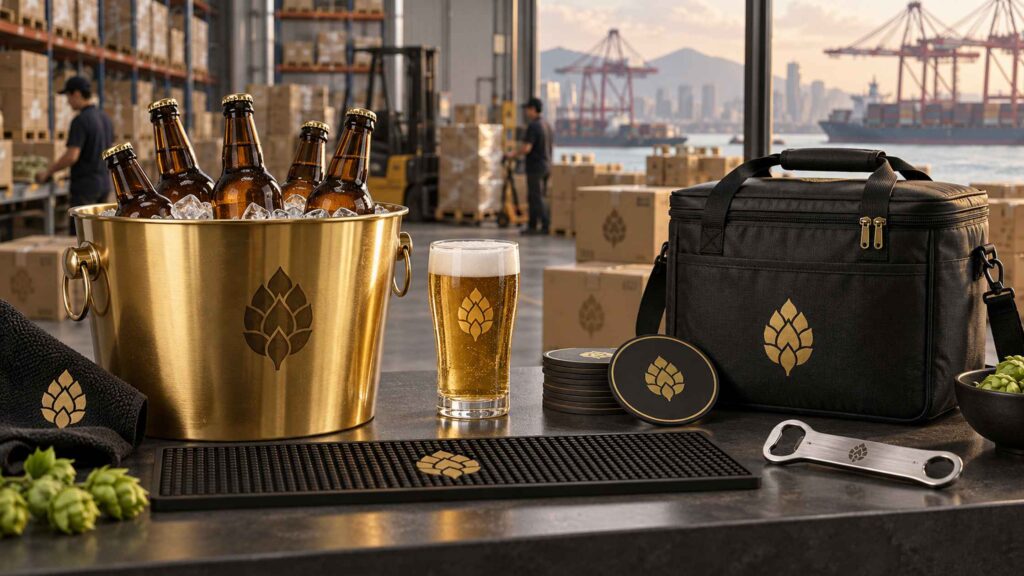
This guide covers branded merchandise and point-of-sale materials, often called POSM: items such as beer buckets, bar mats, bottle openers, drinkware, cooler bags and displays. It follows the buying process from the first brief to delivery and reordering.
1. Start with the Campaign, Then Choose the Products
Before browsing supplier catalogs, decide where the products will go and what they need to do. A bucket for table service, a giveaway for festival visitors and a display for a retailer require different specifications and distribution plans.
| Campaign | Products to consider | What should guide your choice? |
|---|---|---|
| Bar and restaurant promotion | Beer buckets, bar mats, serving trays, coasters, openers | Counter space, cleaning, repeated use and visibility during service |
| Brewery taproom or merchandise shop | Branded beer mugs, drinkware, opener sets, cooler bags | Finish, packaging, product usefulness and resale margin |
| Outdoor festival or beach activation | Can coolers, cooler bags, flags, umbrellas, event furniture | Carrying weight, weather exposure, assembly and venue requirements |
| Distributor rollout across venues | Coordinated bar kits and replacement stock | Quantities per venue, carton labeling and easy replenishment |
| Retail promotion | Table tents, approved displays and gift-with-purchase items | Retailer dimensions, campaign wording and permitted promotional use |
Build quantities from the distribution plan. For example, 120 venues × 4 buckets = 480 buckets, before adding any agreed reserve. This is more useful than ordering 500 simply because that quantity appears on a supplier page.
For a first campaign, concentrate on a small set of products with a clear role. Every extra item adds another sample, specification and delivery dependency. Browse the BeerPromoPro product range after you know the campaign setting and required function.
When does buying from China make sense?
Consider direct overseas sourcing when customization, repeat volume or a coordinated product range justifies the development and shipping work. Compare a local supplier when you need a small quantity immediately or can use stock products with simple decoration.
The useful comparison is the total cost of ready-to-use stock by your deadline. Include your team’s time for managing approvals and deliveries. A lower factory price is less valuable if it requires rush freight or arrives after the promotion.
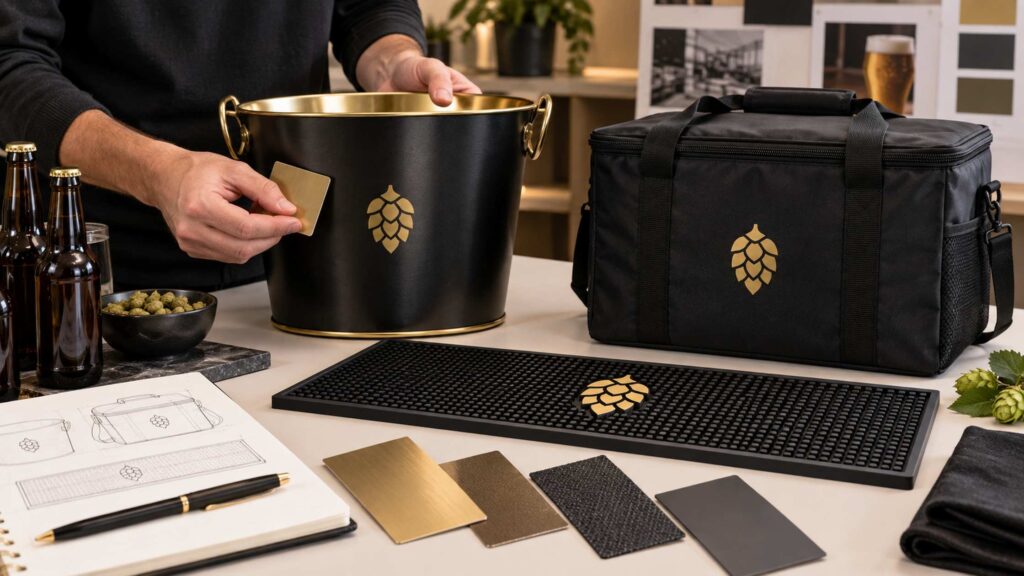
2. Turn Product Photos into Written Specifications
A reference photo communicates appearance. It does not define material, thickness, strength, logo durability or packing. Give every product a specification sheet so competing suppliers quote the same requirement.
Include dimensions, material, color, artwork, quantity per design, intended use, packing and destination. Ask the supplier to identify any proposed substitution explicitly.
| Product | Specify before requesting a firm quote | Practical sample check |
|---|---|---|
| Beer bucket | Base material, dimensions, wall construction, handle attachment, finish and packing | Load your actual bottles or cans with ice; check carrying, stability and leakage |
| Bar mat | Exact surface and backing materials, dimensions, thickness, drainage structure and logo method | Place it on the intended counter; assess stability, cleaning and logo readability |
| Beer mug or glass | Material, usable fill volume, dimensions, decoration position and care method | Check rims, stability, serving volume and the intended washing routine |
| Bottle opener | Metal specification, opening geometry, edges, finish and logo location | Open the intended bottle caps repeatedly using an agreed test procedure |
| Cooler bag | Outer fabric, insulation, lining, dimensions, seams, handles and closure | Load the actual cans plus cooling packs; check handle attachment and leakage if claimed |
| Coaster | Material, thickness, size, print, absorbency requirement and pack quantity | Use a cold glass; check moisture handling, curling and print transfer |
These are procurement checks, not substitutes for required laboratory testing.
Beer buckets: specify bottle capacity with ice
A stated liter capacity does not tell you how many bottles fit comfortably with ice. Bottle diameter, shoulder shape, bucket taper and handle clearance all affect usable space.
Ask for a sample demonstration using your bottle dimensions and the intended serving arrangement. Also distinguish a bucket used to cool sealed bottles from a container used to hold ice that will be added to drinks. That difference belongs in the intended-use specification.
For metal buckets, identify the base metal and coating separately. “Metal bucket” leaves too much open. Ask how seams are sealed, how nested buckets are separated during transport, and what cleaning instructions apply to the finished product.
Bar mats: resolve the material name
Do not approve a description such as “PVC rubber silicone mat.” Request the exact material of each part. A molded drainage mat and a printed fabric runner can both carry a beer logo, but their surfaces, artwork possibilities and cleaning requirements differ.
For custom bar mats, choose the construction around the venue’s work area and artwork. Bold lettering may suit molded relief; detailed illustrations may need a printable surface. Approve the result on a physical sample.
Drinkware and cooler bags: describe real use
For custom beer mugs, distinguish brimful capacity from the intended serving level. Tell the supplier whether the item will be repeatedly washed in a commercial setting.
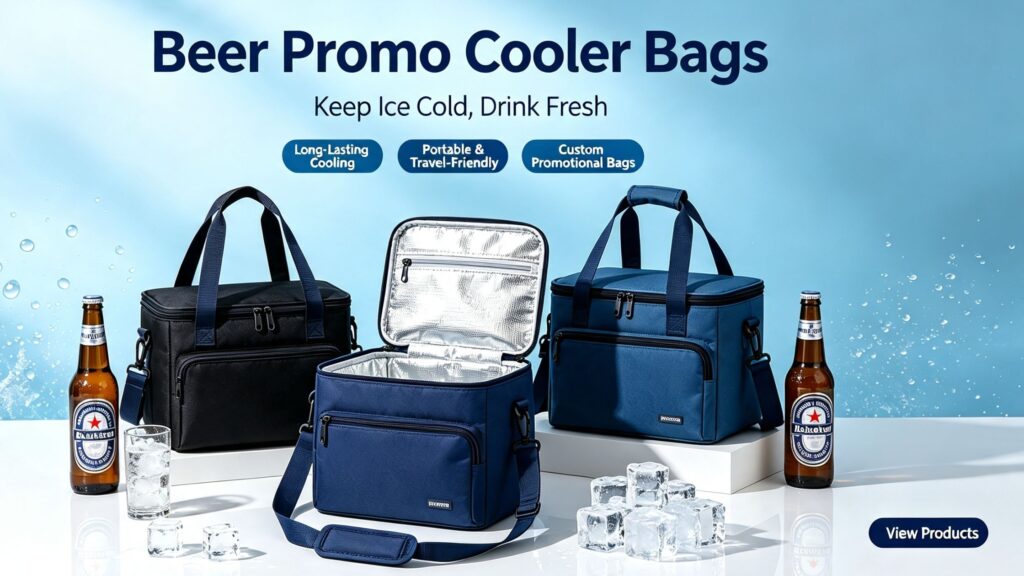
For custom cooler bags, “holds 12 cans” needs a can size and an allowance for cooling packs. If you require a cooling-duration claim, agree on a test method covering starting temperature, ambient temperature, contents and opening frequency.
3. Choose a Sourcing Route and Verify Who Does the Work
You can approach manufacturers, export suppliers or a sourcing partner. The right route depends on your product range and how much coordination your team can manage.
| Route | When it can fit | What you need to verify |
|---|---|---|
| Direct manufacturer | A defined product category with repeat orders or substantial customization | Relevant production processes, subcontracting, export support and quality controls |
| Trading or export supplier | Several related products and a need for export administration | Who manufactures each item and who owns sample, quality and delivery decisions |
| Sourcing or campaign partner | Multiple product categories, matched branding and consolidated shipments | Scope, fees or pricing structure, factory access, inspection responsibility and remedies |
| B2B marketplace | Discovering candidates and comparing available product formats | The company behind the listing, actual specifications and written order terms |
A mixed campaign may involve different manufacturing processes: metal forming, rubber or plastic molding, sewing and printing. Ask who coordinates these operations. One contact is useful only if responsibility is clear.
Where to look for candidates
Use product-specific searches on Alibaba.com, manufacturer websites and trade-fair exhibitor directories. Search for the item and process—such as “custom galvanized beer bucket” or “molded PVC bar mat”—rather than relying only on “beer promotional products supplier.”
If you explore 1688, prepare to verify export arrangements, product documentation and communication responsibilities separately. A domestic listing is a starting point for discussion, not a complete export quotation.
Shortlist suppliers whose product examples match your specifications. Avoid comparing a standard stock item from one supplier with a fully customized item from another.
What to ask before paying for development
Request the supplier’s registered company name, business address and business license. Confirm which entity will sign the order and receive payment. If an export company handles the transaction, ask the supplier to explain that relationship in writing.
Then investigate the actual work:
- Which processes are performed in-house, and which are subcontracted?
- Can the supplier show relevant production equipment and similar unbranded products?
- Who approves artwork, controls materials and releases finished goods?
- Will an independent inspector be allowed to check the order?
- Can the supplier provide documents that identify the proposed product and material?
For a substantial first order, consider an independent factory assessment. A polished catalog or photographs of famous beer logos do not establish manufacturing capability or permission to reproduce those brands.
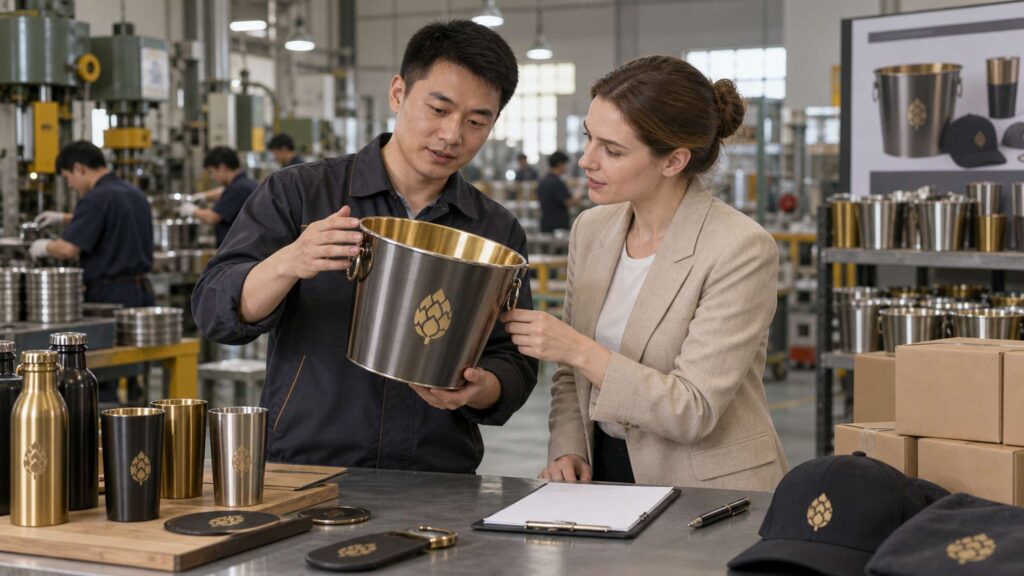
4. Compare Quotes by Specification and Full Cost
Send the same request for quotation, or RFQ, to each shortlisted supplier. Require separate prices for the product, customization, tooling, packaging and delivery scope.
Ask what the MOQ actually covers
MOQ means minimum order quantity. Clarify whether it applies per product, material color, logo design, mold or packaging version.
An order for 3,000 pieces divided among six logos may involve six smaller production runs. A listing’s stock MOQ may also differ from its custom-color or custom-packaging MOQ.
If the minimum is too high, ask about an existing shape, standard material color, fewer artwork versions or simpler packaging. Compare the saving against the effect on the campaign. Do not buy unwanted stock solely to reach a cheaper price tier.
Build a complete cost comparison
Calculate your delivery budget from:
Products + tooling and setup + samples + packaging + testing and inspection + origin handling + freight and insurance + destination charges + applicable duties and taxes + final distribution.
Check inclusions to avoid counting the same charge twice. Track recoverable import tax separately with your finance team: it can affect cash requirements differently from permanent product cost.
Consider this hypothetical example, not a supplier quote or market price:
| Cost for 1,000 buckets | Quote A | Quote B |
|---|---|---|
| Products | $2,400 | $2,650 |
| Logo setup and protective packing | $450 | $150 |
| Freight and handling allowance | $850 | $650 |
| Comparable subtotal | $3,700 | $3,450 |
Quote B has the higher product price but the lower subtotal. This example assumes equivalent approved specifications; it still excludes testing, inspection, duties, taxes and final venue delivery. Obtain those figures before treating either option as a complete budget.
For campaign planning, also ask: How many usable units will be available on time? Shortages and rejected goods affect the quantity you can actually distribute, even if the invoice quantity stays the same.
5. Check Destination Requirements Before Finalizing the Product
There is no single certificate that covers all beer promotional products worldwide. Requirements depend on the item, material, intended use and country where it will be supplied.
Give your importer and testing laboratory the proposed specifications before committing to materials and artwork. Ask them to confirm the applicable rules, required documentation, labeling and test scope for that market.
Food-contact products
Beer glasses and drinking cups contact beverages directly. Other items need an intended-use assessment: for example, whether a bucket holds consumable ice or only sealed bottles.
In the EU, food-contact materials fall under Regulation (EC) No 1935/2004 and applicable manufacturing requirements. Some materials have additional EU rules; national provisions can also matter. Plastic food-contact articles have specific requirements, including compliance documentation. Use the current rules and amendments for the selected material. European Commission food-contact legislation.
For US-bound drinkware, provide the beverage type, alcohol content, temperature and contact duration. FDA’s food-contact guidance distinguishes beverage categories and conditions of use, so a generic water-use statement may not answer your beer-use question. FDA food types and conditions of use.
General safety and electrical products
CE marking applies only where the relevant EU product legislation requires it. Treat an ordinary bar accessory and an illuminated sign as separate compliance assessments; a CE symbol on a supplier listing is not a universal quality approval. EU guidance on CE marking.
Free giveaways can also fall within EU product-safety rules. For products covered by the General Product Safety Regulation, check safety documentation, traceability and the responsible economic operator in the EU. Official GPSR summary.
For Latin American campaigns, specify the individual destination country at the quotation stage. Have the local importer confirm applicable product, labeling and import requirements for each item; avoid approving a shipment against “Latin America compliant” as a general description.
Product compliance and promotion approval are separate
Have the campaign owner check whether the proposed merchandise, retailer support and promotional wording are permitted locally. For example, US alcohol trade-practice rules can restrict how promotional support is furnished to retailers. TTB guidance on retail promotional programs.
When reviewing a test report, check the product identification, material, photographs, test conditions and scope. Ask whether your chosen coating, color or decoration is covered. A report for a different model should trigger a question, not automatic approval.
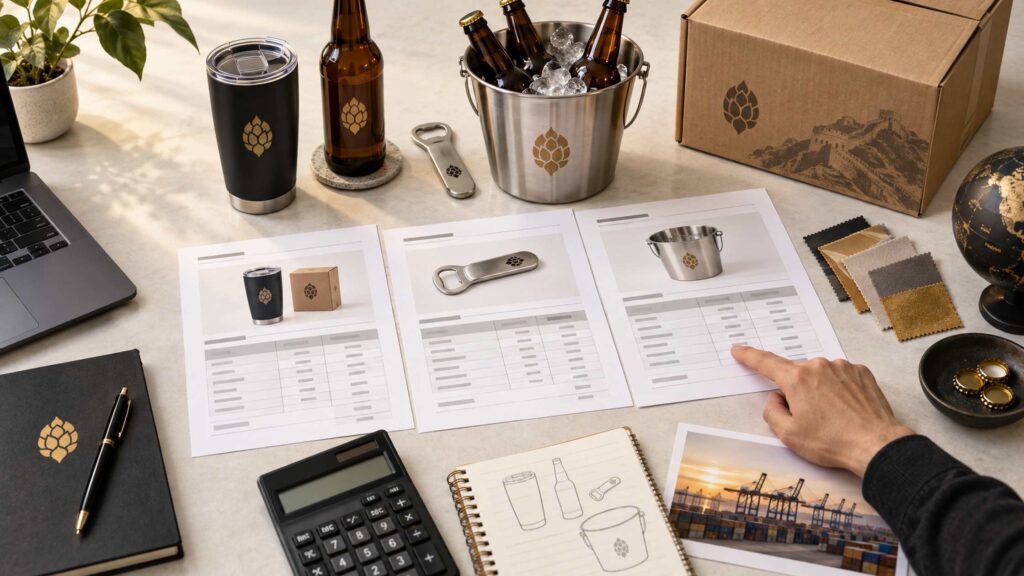
6. Approve Physical Samples and Lock the Artwork
Use each sample stage for a specific decision:
| Sample stage | What it helps you assess | What it does not establish by itself |
|---|---|---|
| Existing stock sample | Basic construction, size and general finish | Your final material, artwork or packaging |
| Digital artwork proof | Logo position, wording, layout and dimensions | Real color, texture, durability or product function |
| Custom pre-production sample | The agreed product with proposed branding and finish | Consistency across the entire production batch |
Keep an approved reference sample, often called a golden sample, and give it a version number. Record approval of dimensions, colors, logo placement, performance checks and packaging. List any remaining differences between that sample and the planned production process.
Match brand colors across the complete kit
The same color reference can appear different on metal, fabric, molded plastic and coated paper. Send vector artwork and approved color references, then review the items together under consistent lighting.
For a coordinated kit, do not approve the bucket, mat and bag in isolation. Check whether the overall brand presentation is acceptable. Where color is critical, agree on a measurable tolerance or approved physical reference with the supplier.
Also check the details a mockup can hide: small lettering, curved-surface distortion, logo visibility when the item is in use, and whether artwork crosses a seam.
After approval, require written authorization for changes to materials, artwork, factory, finish or packing. If a supplier proposes a substitute to save time, review its effect on appearance, testing and performance before accepting it.
7. Put the Order, Payment and Remedies in Writing
Make the approved specification and sample reference part of the purchase order or supply agreement. Record quantities per design, unit prices, tooling ownership, packing, inspection requirements, delivery milestones and the agreed shipping term.
Avoid vague acceptance language such as “good quality.” Define what counts as an unacceptable defect, who can approve a deviation, and what happens if inspection fails.
Negotiate payment milestones around the project. For example, discuss an initial payment for production and a balance linked to agreed inspection and shipping documentation. This is a negotiating structure, not a universal payment rule.
Before payment, verify the beneficiary against the contracting arrangement. Confirm unexpected bank-detail changes through an established contact channel.
For custom molds or artwork, state ownership, storage, permitted use and whether the supplier may display your project publicly. Agree on claim deadlines, evidence requirements and remedies for shortages or defects—including who pays replacement freight. A replacement after the event may have little practical value.

8. Inspect the Production Batch Against the Approved Standard
Sampling checks the proposed product. Production inspection checks what was actually made.
For a new or demanding product, schedule an early production check while corrections are still possible. Arrange final inspection at an agreed readiness stage, with enough packed stock available to assess packaging and quantities.
An independent pre-shipment inspection can include dimensions, appearance, quantities, packing and markings. Give the inspector your specifications and reference sample rather than expecting a generic checklist to capture the campaign’s requirements. SGS pre-shipment inspection scope.
Build checks around how the item can fail
- Buckets: sharp edges, unstable bases, weak handle connections, leakage, dents and scuffing between nested units.
- Bar mats: wrong dimensions or material, uneven surfaces, unclear logos and performance under the agreed cleaning method.
- Drinkware: chipped rims, poor stability, incorrect decoration and packaging that lets pieces strike one another.
- Openers: sharp finishing, ineffective opening geometry and damage during the agreed repeated-use check.
- Cooler bags: weak stitching, handle attachment, zipper function, incorrect internal size and unsupported leakproof claims.
- Campaign kits: missing components, wrong logo versions, incorrect pack counts and destination-label errors.
Agree on test loads, durations, cleaning conditions and acceptance criteria beforehand. These checks should be reproducible; “the handle seems strong” is difficult to enforce.
If using an AQL acceptance-sampling plan, have the inspection provider document the sample size, defect categories and acceptance/rejection limits. Sampling does not examine every unit or guarantee that the whole shipment is defect-free. Do not treat it as permission for safety defects.
If goods fail, agree on correction and reinspection before release. Keep the inspection report, approved deviations and shipment-release decision with the order records.
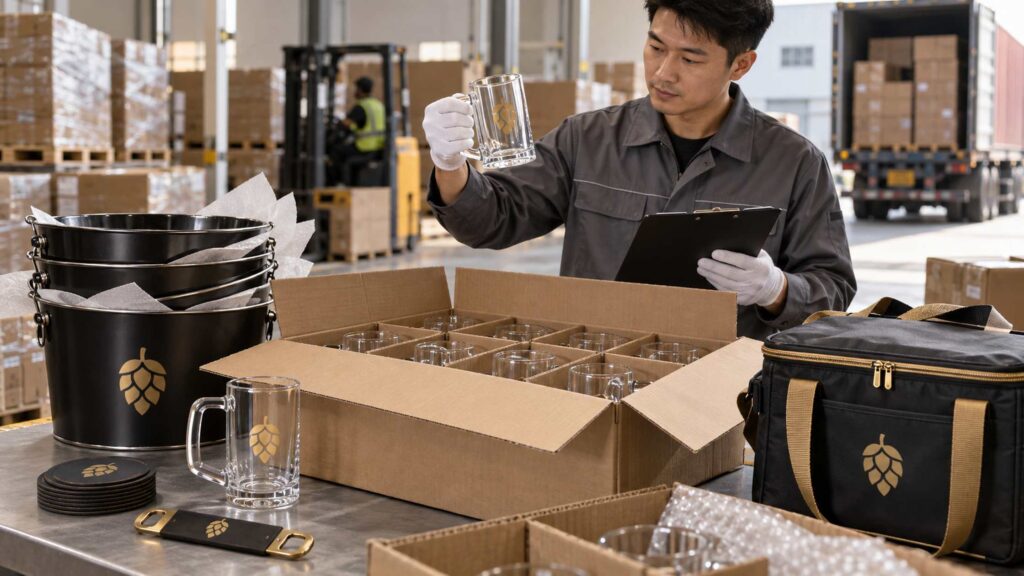
9. Plan Packaging, Shipping and Customs Together
Ask for packing details while comparing quotes: units per carton, carton dimensions, gross weight, pallet requirements and protective materials. Bulky merchandise can change the transport budget substantially.
For example, a carton measuring 0.60 × 0.40 × 0.40 meters occupies 0.096 cubic meters. One hundred such cartons occupy 9.6 cubic meters, before allowing for pallets or other shipping arrangements. This is a volume calculation, not a freight quote; ask your forwarder how the shipment will be charged.
For buckets, test protective nesting. For glassware, approve partitions and the relevant transport-packaging test. For venue kits, decide whether items should arrive packed by product or packed as complete kits. Complete kits can simplify local distribution, but may use more space or complicate packing at origin.
Choose the delivery responsibility clearly
Write the agreed Incoterm, named place and version into the order—for example, the relevant term followed by a precise location and “Incoterms® 2020.”
FOB is a sea/inland-waterway term with risk transferring when goods are on board the vessel. Where containerized goods are handed to a carrier earlier, ICC advises considering FCA. Ask the forwarder which term matches the actual handover. ICC Incoterms rules.
With DAP, the buyer handles import clearance; with DDP, that responsibility sits with the seller. Both generally deliver ready for unloading. Before accepting DDP, confirm that the seller can legally arrange import clearance and identify the importing entity. ICC explanation of DAP and DDP.
Have your broker review the product descriptions and proposed customs classifications before shipment. For mixed kits, ask whether items require separate treatment. Request a destination-specific duty and tax calculation instead of applying one assumed rate to all promotional products.
Prepare the commercial invoice, packing list and transport documents, plus any origin or product documents required for the shipment. Descriptions should identify the actual goods and materials, rather than simply “promotional gifts.”
Choose the transport mode after receiving packed dimensions, weight and the required arrival date. Sea freight, air freight and courier services need project-specific comparisons. If a deadline is tight, price a small early shipment separately—but include the extra handling and clearance costs.
10. Work Backward from Venue Delivery and Close the Order Properly
Your campaign deadline is the date products must be ready to use at the venues. Build the schedule backward from that point.
Include:
- Local receiving, allocation and venue distribution.
- Customs clearance and destination handling.
- International transport and booking cutoffs.
- Final inspection, possible correction and reinspection.
- Production and packing.
- Sample delivery, testing and approval.
- Artwork, specifications and any tooling development.
Some activities can overlap; others depend on approval. Ask the supplier to show which conditions start the production clock, and confirm factory closures and actual shipping availability for your order dates.
Keep factory-ready, departure, port-arrival, warehouse-delivery and venue-delivery dates separate. A production estimate does not include all the stages that follow it.
On receipt, check carton counts and visible damage, photograph discrepancies and inspect products promptly within the agreed claim period. Keep batch references so a quality issue can be traced to the relevant production lot.
For reorders, retain the final artwork, specification, sample reference, packing instructions and any approved changes. Share useful venue feedback with the supplier: what broke, what was difficult to clean, and which pack quantities made distribution easier. Use that evidence to improve the next order.
11. Copy This RFQ Template for Your First Inquiry
Subject: RFQ — Custom Beer Promotional Products for [Campaign / Country]
We are sourcing branded products for [brewery / distributor / promotional agency]. Please quote against the requirements below and identify any alternatives separately.
- Products and quantities: [Item list; quantity per logo, color and design]
- Campaign use: [Bar service / giveaway / retail / outdoor event]
- Specifications: [Material, dimensions, capacity, construction and reference images]
- Artwork: [Vector logo, color references and print positions]
- Destination: [Country, city, postal code and delivery point]
- Required arrival date: [Warehouse or venue deadline]
- Budget: [Target range; state whether product-only or delivered]
- Compliance: [Market and intended use; known testing/document requirements]
- Packaging: [Units per pack, protective packing, carton marks and kit allocation]
- Samples: [Stock or custom sample; required approval process]
Please confirm:
- MOQ per product, color, logo and packaging version.
- Unit price, currency, quantity breaks and quotation validity.
- Tooling, printing setup, sampling and packaging charges.
- Sample and production schedules, including what starts each stage.
- Carton quantity, dimensions, gross weight and proposed shipping term.
- Manufacturing location and any subcontracted processes.
- Relevant product documents and proposed inspection arrangements.
- Payment milestones, defect remedies and replacement-freight responsibility.
Please highlight any requirement you cannot meet before preparing the sample.
Frequently Asked Questions
Can I order a small batch before committing to a larger campaign?
Ask for a pilot batch using an existing product shape and a simple decoration method. Confirm whether it will use the same materials and production process as the larger order. A pilot is less informative if the later batch changes the construction or print process.
Can one order include several beer brands or regional logos?
Yes, if the supplier accepts the separate production runs. Request MOQ and setup charges for each artwork version, and provide a packing allocation sheet so different brands are not mixed during distribution.
What if a supplier cannot make the sample exactly like mass production?
Ask for a written list of differences. Decide which can be approved provisionally and which need a production-process sample or an early production check. A hand-finished sample should not silently become the standard for a different manufacturing method.
Can I use a famous beer-brand design shown in a supplier’s catalog?
Use artwork you own or are authorized to reproduce. A catalog image does not establish permission. If you are sourcing for a client, obtain the approved files and brand-use instructions from that client.
How should I evaluate an “eco-friendly” product option?
Ask the supplier to replace the broad claim with a specific, documented attribute: for example, a stated recycled-material content or a defined reduction in packaging. Confirm what the evidence covers and have your brand team approve any environmental wording before it appears on the product or campaign.
Build Your Order Around a Clear Campaign Brief
For your first China order, choose products your team can specify, test and distribute confidently. Approve the physical result, compare the complete delivery cost, and assign responsibility for every step between production and the venue.
BeerPromoPro supplies custom beer promotional products for breweries, distributors and beverage campaigns. Send your campaign brief to BeerPromoPro with your product list, quantities per design, destination and required arrival date. Include your logo or reference images so the discussion can start with suitable product options and a project-specific quotation.