Custom Patio Umbrellas with Your Logo for Beer Gardens and Terraces
Shade is the largest piece of branding on any terrace. BeerPromoPro is a China-based manufacturer and wholesale supplier of custom patio umbrellas built for beer gardens, taproom terraces, distributor outlet programs and festivals. Order in bulk and supply every outlet on your route from a single production run.
OUR PRODUCT
Choose the Right Custom Patio Umbrella for Your Program
An umbrella is a sail on a stick, and the specification that decides whether it survives is span, pole and base. Compare canopy size, pole diameter, rib count, fabric weight, and how much ballast your site can realistically hold.

Center-Pole Market Umbrellas
— 2.0 m to 3.0 m The workhorse format for cafe tables and four-top beer garden tables. A 2.0 to 2.5 m canopy runs a 38 mm pole and needs roughly 20 to 30 kg of base; stepping to 2.7 to 3.0 m moves you to a 48 mm pole and 40 to 50 kg. Six ribs for round, eight for square.
Large-Span Umbrellas
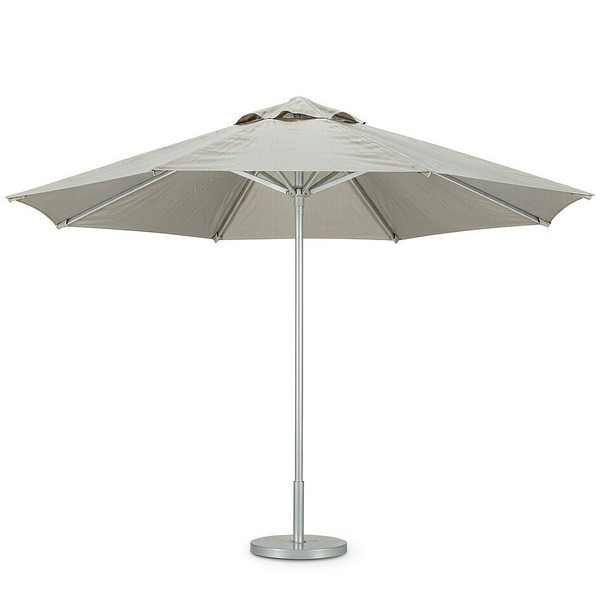
— 3.5 m to 4.0 m For long communal beer garden tables and pool decks. Expect a 70 to 76 mm pole, eight ribs, and 60 to 80 kg of ballast or a ground anchor. Specify a crank, not a push-up: lifting a 4.0 m canopy by hand is how ribs get bent in the first week. Rib count is eight.
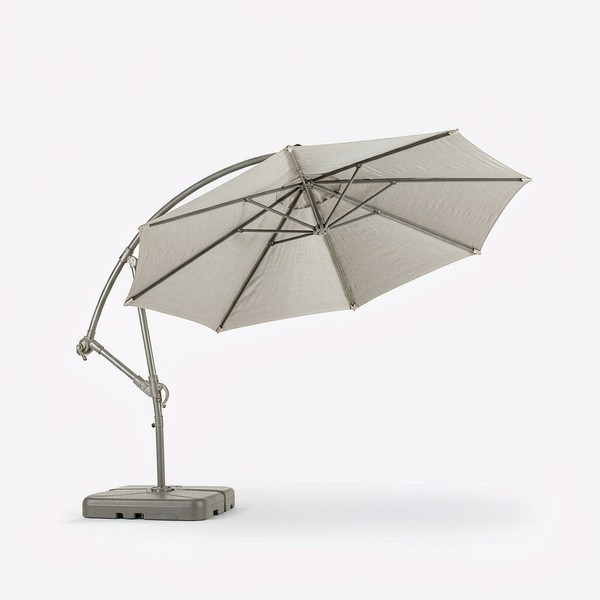
Cantilever and Offset Umbrellas
The offset arm clears the pole out of the seating area, which is why restaurants use it over dining sets. The arm adds leverage, so ballast rises to roughly 1.5 to 2 times a center-pole figure and the base should be a gusseted plate or bolted down. On an exposed rooftop, choose a canopy instead.
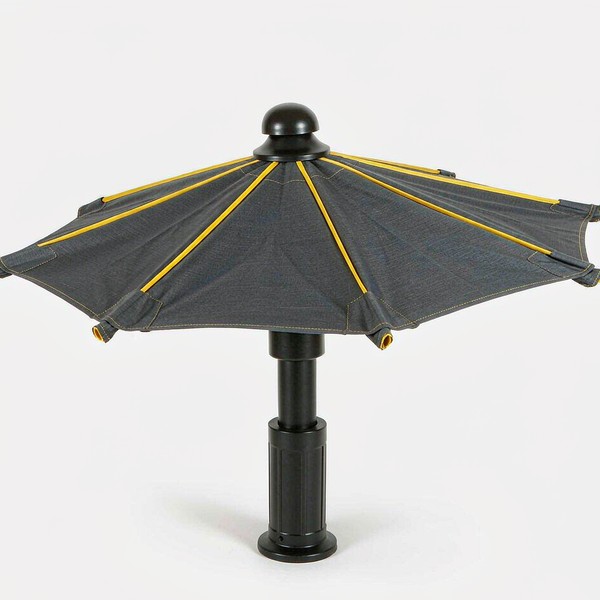
Square and Rectangular Umbrellas
Square canopies tile against each other with no dead corners, so a row of them shades a long terrace more completely than rounds. They run eight ribs and a 38 or 48 mm pole. Rectangular spans above 3.0 m catch more wind per kilogram of ballast than a square of the same area.
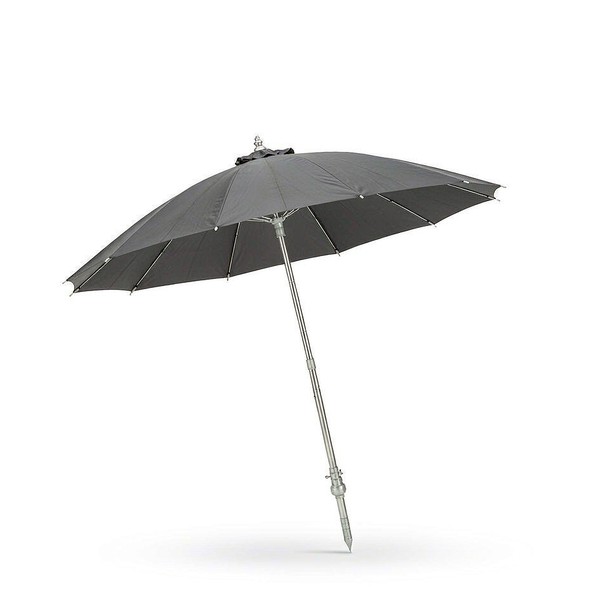
Beach and Festival Umbrellas
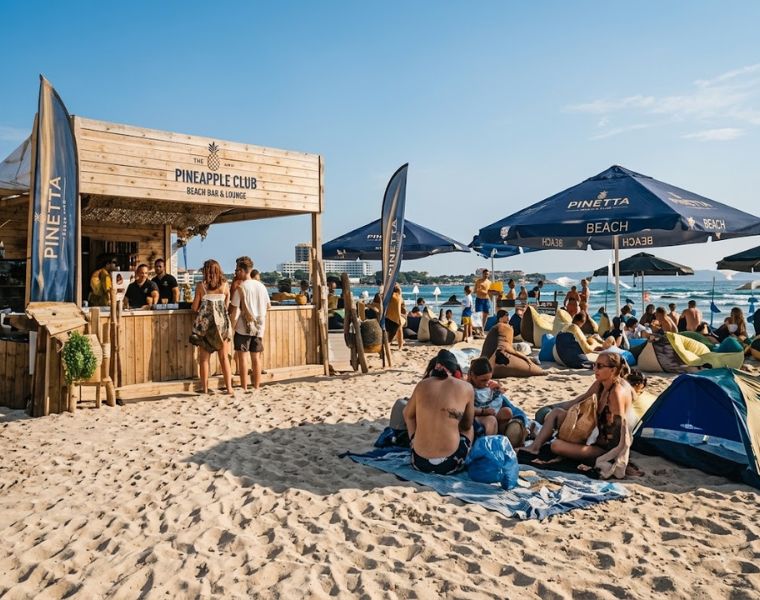
Aluminum pole, fiberglass ribs and a pointed end that drives into sand — the format for beach activations and one-day festivals. Fiberglass ribs flex and return where steel ribs stay bent. Add a screw-in sand anchor; a 2.0 m umbrella in a 15 kg base will walk across a beach in an onshore breeze.
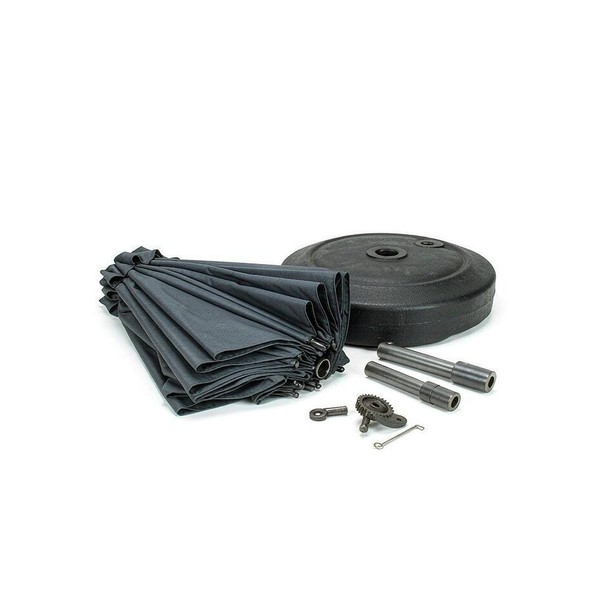
Replacement Canopies, Bases and Spare Parts
Fabric is the first thing to fail and the easiest thing to replace. Order spare canopies with the original run, because a later batch is a different dye lot and your terrace ends up with two shades of the same brand color. Stock rib ends, crank gears and tilts — rib length has to match the old frame exactly.
TAG
Branding and Customization
Canopy artwork is seen from across a street and from underneath at arm’s length, so both distances have to read. We check the panel layout, seam positions and print method against the fabric before sampling, because not every fabric takes every ink.
Screen Printing on Canopy Panels
The default for one- to three-color brewery marks repeated panel by panel. Ink sits on the fabric surface, so heavy fill areas stiffen the panel and can crack along fold lines after a season. Keep the mark inside the panel and away from the rib pocket seams.
Dye-Sublimation Full-Color Canopy Printing
Use when the artwork carries gradients, photography or edge-to-edge coverage. Sublimation needs polyester: the ink bonds into the fiber, so there is no layer to crack and the canopy still folds. It does not work on solution-dyed acrylic — if you want photo artwork, you must accept polyester fabric.
Pantone-Matched Panel Sequencing and Piping
Alternating brand-color panels give a strong canopy without any print cost at all, and piping in a contrast color outlines the silhouette against the sky. This route suits long runs and repeated outlet programs. Acrylic gives the widest color range here; polyester runs close behind.
Printed Valances and Scalloped Borders
The valance is the hanging border at eye level and the most-seen surface on the whole unit. Print it, and repeat the mark so it reads from every side. A scalloped valance adds edge flutter in wind and another seam to fail — specify a straight valance for exposed sites.
Branded Base Covers and Carry Bags
The base is a large unbranded block sitting in every photograph of your terrace. A fitted cover in canopy fabric carries a logo and hides scuffed plastic or chipped cast iron. Covers need a drain grommet at the bottom or they hold rainwater like a bucket.
Match the Span to the Base Before You Choose the Fabric
Start with physics, not artwork. A 2.0 to 2.5 m span runs a 38 mm pole, 2.7 to 3.0 m needs 48 mm, and 3.5 to 4.0 m needs 70 to 76 mm — under 1.0 mm wall in that size flexes visibly. How much ballast can the site carry? The working rule is about 10 kg per meter of canopy diameter in a sheltered courtyard, up to 20 kg per meter on an exposed or coastal terrace; a cantilever multiplies that by 1.5 to 2. Does the pole pass through a table? Then the hole is 38, 48 or 51 mm with a reducer ring, and the pole must reach the base. And who closes it at the end of every shift? Nobody does it reliably, so the honest answer is that a branded umbrella must be closed whenever sustained wind passes roughly 30 km/h.
How to Specify an Umbrella Order That Quotes Cleanly
Buyers who get fast quotes send six things every time: canopy size and shape, pole diameter and finish, rib count and material, fabric type and weight, artwork with the panel layout marked, and destination port. What moves unit price most is fabric — polyester at 180 to 240 gsm versus solution-dyed acrylic at 260 to 300 gsm is the biggest single line — followed by pole gauge, crank versus push-up and print method. Freight is driven by pole length, not canopy area: a two-section pole halves the carton length and can cut shipping more than any fabric change. Order spare canopies in the same run as the umbrellas, because a reprint later carries a new setup and a new dye lot. Plan backward from the activation date — seven days for a sample, twenty-five to thirty-five days for bulk, then ocean freight.
Frequently Asked Questions About Custom Patio Umbrellas
Most umbrella programs start from 100 to 300 pieces per size. Custom panel layouts, Pantone-matched fabric and printed valances can raise the minimum. Stock canopies with decoration only are available below standard MOQ.
Typical projects fall between USD 25 and 120 per unit. Fabric choice, span, pole gauge, crank or push-up mechanism and print method all move the number. Bases are quoted separately and are rarely included in the unit price.
Yes. Sampling takes approximately seven days. Open and close the sample ten times, weigh the base it ships with, and leave it out overnight before you approve the bulk run.
Treat roughly 10 kg of ballast per meter of canopy diameter as the sheltered rule and up to 20 kg per meter on exposed or coastal sites. Most units are rated for sustained wind near 29 to 38 km/h. Above that, close it — no umbrella is designed to stand open in a storm.
Solution-dyed acrylic carries color through the fiber and generally holds its shade longer under strong sun, at roughly 260 to 300 gsm. Polyester at 180 to 240 gsm costs less and takes full-color sublimation. Ask for the lightfastness test report with the order.
A physical sample takes about seven days and bulk production twenty-five to thirty-five days. We ship from China to Europe, the Americas, the UK, Australia and Japan by sea, air or rail, with consolidation for mixed POSM orders.