Custom Beer Display Racks for Retail and Wholesale Programs
Display racks decide whether a shopper meets your beer at eye level or walks past it. BeerPromoPro is a China-based manufacturer and wholesale supplier of custom beer display racks — corrugated floor units, counter displays and metal fixtures — serving breweries, distributors and retail category teams. Buy in bulk and let one production run supply every store on your list.
OUR PRODUCT
Choose the Right Custom Beer Display Rack for Your Program
Start from what it has to carry and for how long. Board grade, not board color, is what keeps a fixture standing in week six.

Corrugated Floor Display Racks
Free-standing units run B-flute single wall for 15 to 25 kg per tier, or BC double wall where a shelf must carry 50 kg. Typical footprints sit near 400 x 400 mm at 1.4 to 1.7 m tall. A chilled aisle changes the specification: standard kraft loses about 30 percent of compression strength at 80 percent relative humidity.

Counter Display Units
Counter units live at the till, so footprint rules. Most occupy 250 x 300 mm to 400 x 350 mm and assemble from pre-glued panels in 30 to 60 seconds. E-flute holds 5 to 10 kg per tier, which covers can multipacks and small bottle formats. Anything heavier belongs on the floor rather than beside the register.

Metal Wire and Tube Racks
Powder-coated steel tube and wire racks take 15 to 25 kg per tier and run five to eight years in store, which suits permanent placements. They knock down flat but never as flat as corrugated — expect a carton three to four times the volume of a comparable board unit, and freight quoted accordingly.

Acrylic and PETG Display Stands
Acrylic in 3 to 5 mm gives clarity at the shelf edge and takes UV flatbed print directly, with edges flame-polished rather than left raw. PETG costs roughly the same and resists impact better, which matters in a self-service aisle. Both scratch under dry-cloth cleaning — specify PETG where bottles are pulled by the neck.

Wooden and MDF Crate Racks
Pine crates and MDF risers carry the rustic read of a taproom into retail at 8 to 20 mm wall thickness, and a two-shelf crate easily carries 40 kg. Wood usually ships assembled, so freight is the usual objection, and untreated pine stains under spilled beer in an on-premise setting.

Pallet Displays and Dump Bins
Warehouse club formats build on a half or full pallet footprint, roughly 1200 x 800 mm in Europe and 1200 x 1000 mm across much of the Americas, carrying 200 to 500 kg in total. Case-stack panels that wrap the pallet face are read from ten meters, so type below about 40 mm cap height is wasted effort.
TAG
Branding and Customization
Print method follows board grade and run length. We will tell you where your artwork loses detail before you pay for tooling.
Litho-Laminated Offset Printing
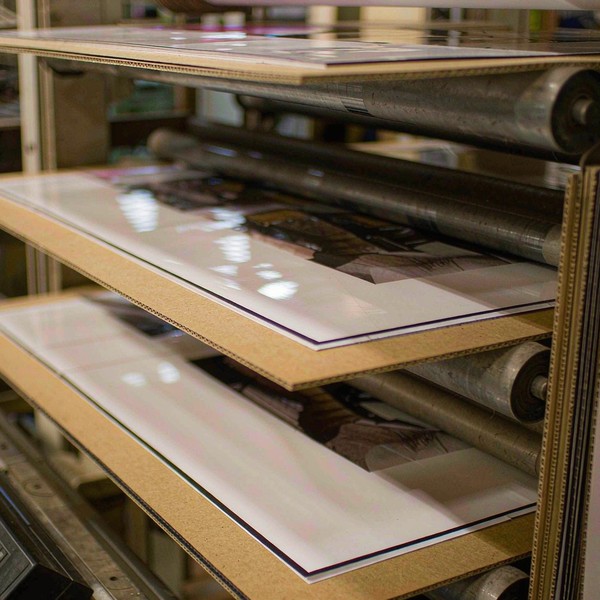
A pre-printed sheet is laminated to the board before die-cutting, giving photographic quality and consistent color across a long run. It needs plates and typically 500 units or more to amortize them; below that, digital wins on total cost even at a higher unit price.
Flexographic Post-Print
Ink prints directly onto the corrugated sheet after it is formed, in one to four colors. It is the volume route for simple marks, tolerating coarser detail than litho — halftones below roughly 30 lpi do not hold, and fine keylines should be thickened before release.
Digital and UV Flatbed Printing
Digital printing versions one run into several languages or SKUs down to about 100 units per version with no plate change. UV flatbed also prints rigid sheets — PVC foam, acrylic, aluminum composite — used in semi-permanent fixtures, at a higher cost per square meter.
Screen Printing on Metal, Wood and Acrylic
Screen print lays an opaque film that covers dark or textured substrates where digital struggles, including powder-coated steel and stained pine. Registration runs near ±1 mm, each color adds a pass, and large photographic coverage is not its job — use it for brand marks and single lines.
Header Cards, Risers and Structural Detail
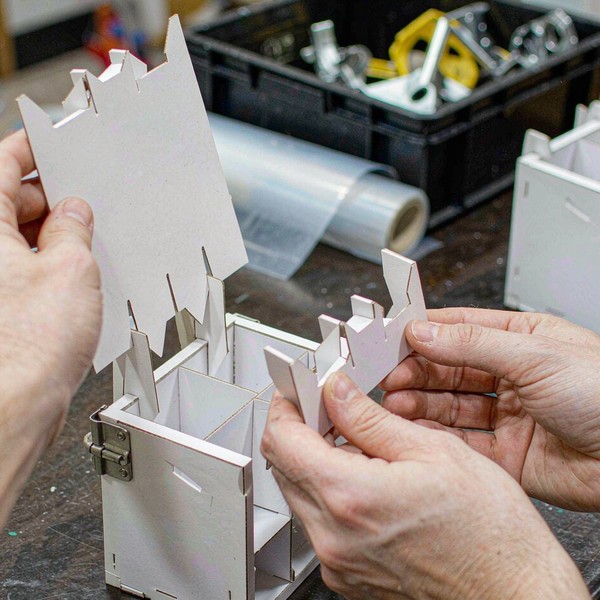
A header card lifts the message to 1.4 to 1.7 m eye level and is sized to the unit width, typically 280 x 150 mm to 560 x 180 mm. Die-cut shelves, locking tabs and risers cost nothing extra in ink but add tooling, so we test them in a white sample first.
Decide What It Carries Before What It Looks Like
Start with arithmetic, not artwork: unit weight times units per facing times facings per tier gives the per-tier load to rate. A tray of 24 x 330 ml cans is around 8 kg and a case of 500 ml bottles nearer 16 kg, and those two figures point at different board grades. Then the environment. Corrugated is semi-disposable by design: standard grades serve one to eight weeks, and litho-laminated board stretches that to three to twelve months. It is the wrong choice for a unit that must hold chilled cases, get wet-mopped underneath, or stay loaded for a year — specify powder-coated steel tube or wire instead, because extra flute will not substitute. Finally check retail compliance: many chains publish maximum footprints, aisle clearances and per-tier load certificates, and failing them keeps a display off the floor.
What Unit Price and Freight Actually Depend On
Send unit and case dimensions, unit weight, facings per tier, tier count, expected life in store, whether the unit ships loaded or empty, chain name, quantity and destination port. Price moves with board grade and flute, print method and coverage, lamination, die tooling, and how many artwork versions split the run — five languages cost more than one language at five times the volume. Minimums sit near 100 units for counter formats and 200 for floor units, with digital versioning down to about 100 per version. Freight deserves attention: flat-packed corrugated ships at roughly 8 percent of assembled volume, five to ten units per carton, which is why programs accept a few minutes of store assembly. Allow seven days for a white sample and twenty-five to thirty-five days for bulk, then sea freight from China.
Frequently Asked Questions About Custom Beer Display Racks
Standard minimums are about 100 units for counter and PDQ formats, 200 for floor-standing units, and 50 for pallet displays. Digital printing versions one run down to roughly 100 units per version without plate charges. Below those numbers, die tooling dominates and unit price climbs steeply.
A printed counter unit runs USD 2.5 to 9, a floor-standing corrugated unit USD 8 to 35, a powder-coated steel rack USD 25 to 90, and an acrylic fixture USD 12 to 45. Board grade, print coverage, lamination and quantity per version move that number most.
Yes. A white sample takes about seven days and ships flat so you can check whether the unit assembles in your target time and holds real product. Load it to the rated per-tier figure and leave it 48 hours before signing off — that is where weakness shows.
Standard corrugated is engineered for one to eight weeks; litho-laminated board stretches that to three to twelve months. The real enemy is humidity — standard kraft loses about 30 percent of compression strength at 80 percent relative humidity, which is why chilled aisles need a barrier-coated liner.
How much weight can each shelf hold, and can you prove it?
Board grade sets the number: E-flute shelves carry 5 to 10 kg, B-flute 15 to 25 kg, and BC double wall up to 50 kg. We rate every unit with a documented per-tier figure and validate it at 1.5 times load over 48 hours; test documentation is available on request.
A white sample takes about seven days and bulk production twenty-five to thirty-five days after artwork approval. Everything ships flat-packed, five to ten units per carton, by sea from China to Europe, Latin America, the UK, Australia and Japan, with racks consolidated alongside other POSM in one container.