Custom Event Flags and Banners for Beer Festivals
Flags and banners are the signage a festival crowd reads from forty meters away. BeerPromoPro is a China-based manufacturer and wholesale supplier of custom event flags and printed banners built for breweries, distributors, festival agencies and retail activation teams. Buy in bulk and supply every gate and tent from one run.
OUR PRODUCT
Choose the Right Custom Event Flag for Your Program
Flags are judged at forty meters and at two meters. Start from the ground you will drive into, and from whether the crowd approaches from one direction or all four.

Feather (Blade) Flags
Feather flags give the tallest silhouette per dollar. Standard pole sets assemble to 2.6 m, 3.1 m, 4.1 m and 5.0 m with panels from roughly 2000 x 630 mm up to 4100 x 800 mm. The concave top edge holds its curve with almost no air, so word marks stay legible in a still tent.

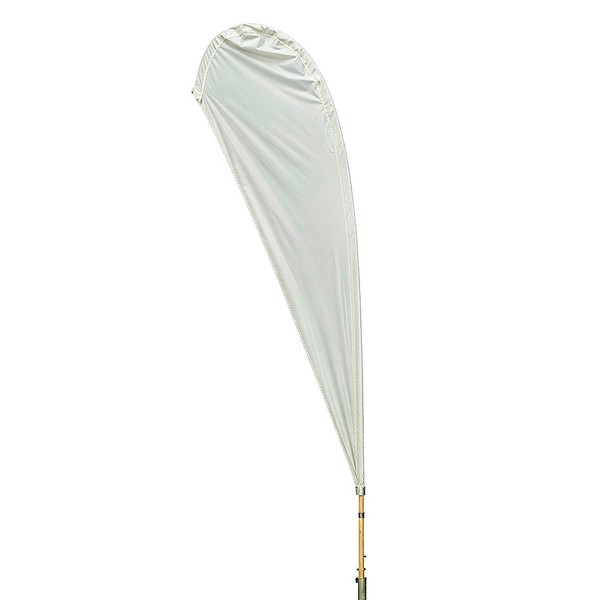
Teardrop Flags
Teardrop flags cover heights of 2.3 m to 4.5 m with panels from about 1660 x 700 mm to 3500 x 1300 mm. The sleeve holds the graphic under constant tension, so it stays readable in a still trade hall where a feather flag droops. The top third narrows sharply, so stacked logos beat wide word marks.
Rectangular and Portrait Flags
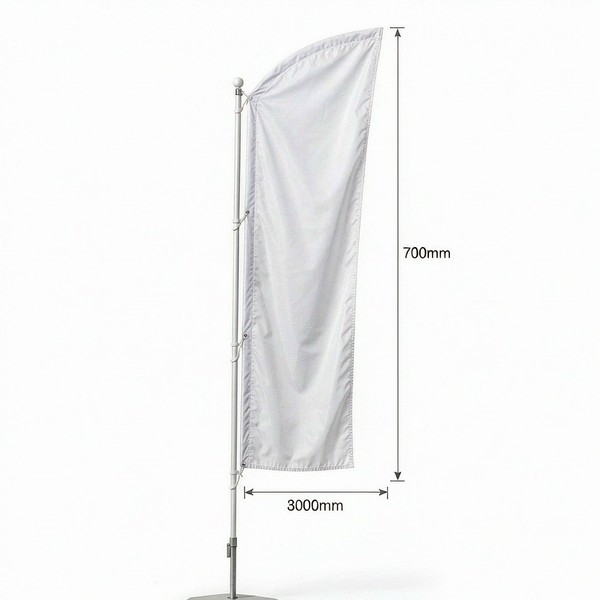
Rectangular and portrait flags offer the largest usable rectangle: common panels are 1680 x 700 mm, 2550 x 700 mm and 3450 x 700 mm at 2.7 m, 3.3 m and 4.3 m. That suits a horizontal lockup or a six-word campaign line. The straight trailing edge flaps harder in gusts and wears the hem first.
PVC Vinyl Event Banners
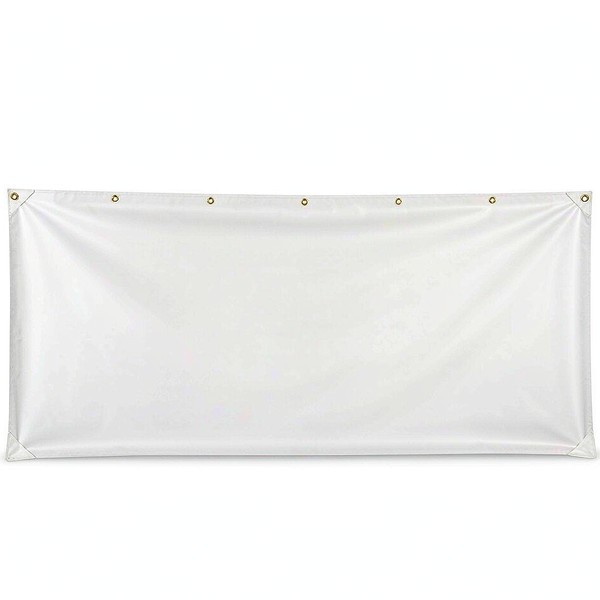
Stage fronts, fence lines and building fascias take 440 gsm (13 oz) or 510 gsm (15 oz) frontlit PVC. Panels join by RF welding instead of stitched seams, then carry a welded hem and brass grommets every 300 to 500 mm. The sheet is fully opaque, so a fence banner also acts as a sail.

Mesh Banners for Windy Sites
· PVC-coated polyester mesh around 270 gsm leaves roughly half the surface open, so gusts pass through rather than loading the scaffold it is lashed to. It is the specification for coastal festivals and open perimeters. It is the wrong choice for a close-quarters trade booth where people read at arm's length, or for any panel carrying text under about 40 mm cap height.

Retractable Roll-Up and X-Banner Stands
Retractable stands carry an 85 x 200 cm or 80 x 200 cm graphic inside an aluminum cassette that sets up in about ninety seconds. Economy sets put a thin fiber pole over a light base and are indoor-only. X-banners at 60 x 160 cm cost less, but corner tension curls the edges within weeks.
TAG
Branding and Customization
Flag artwork fails in three ways: it was drawn for the wrong shape, the pole sleeve was not accounted for, or the print method does not suit the fabric.
Dye-Sublimation Fabric Printing
Heat transfer puts dye into polyester fiber instead of laying a film on it, so panels fold without cracking. Color is CMYK; give us Pantone numbers to protect brand reds, which drift furthest. Fine gradients and 8 mm text hold from 110 gsm upward.
Single-Sided vs Three-Layer Double-Sided
A single panel is about 95 percent show-through, so the reverse reads as a mirror image. Where footfall comes from two directions we print two 68 gsm panels sewn back to back over a blackout interlining. That kills the mirror read and roughly doubles weight.
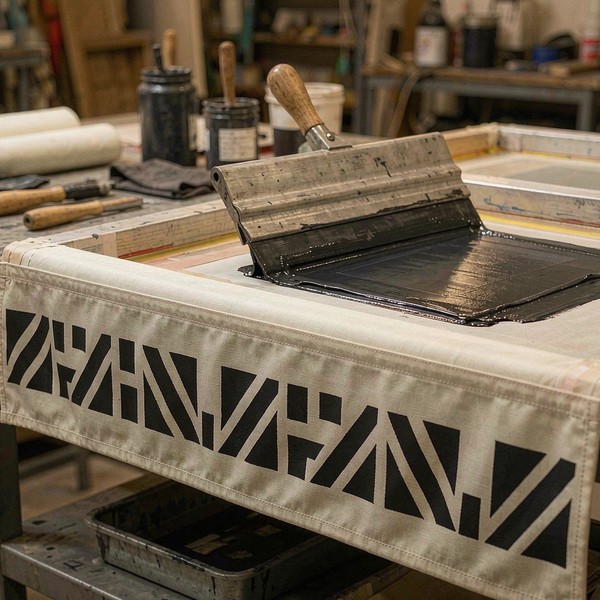
Screen Printing for Repeat Banners
Screen print suits one or two flat brand colors on an order you reorder every season. Ink sits thicker than dye-sub. Every extra color is another screen and setup, so it stops paying past four colors or below roughly 50 panels per design.
Hem, Sleeve and Grommet Finishing
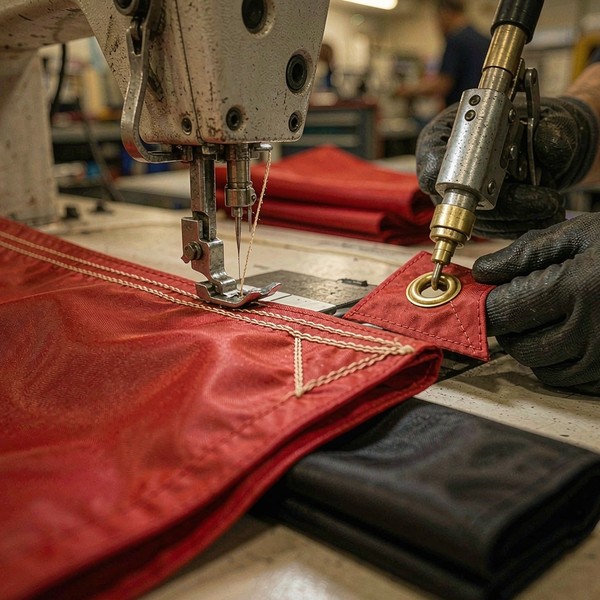
The free edge takes the beating. Every flag hem is double-stitched with UV-resistant thread, and the pole channel is a black polyester sleeve so it does not read through the print. Banner corners get reinforced patches, and grommet spacing tightens above three meters.
Pole Sets, Bases and Carry Hardware
Poles come in sectional epoxy fiberglass, aluminum or carbon composite. A 12 in steel spike suits grass; a cross base around 84 cm wide with a water bag suits concrete. Carry bags are 600D polyester, and each set packs into one flat carton.
Decide Where the Pole Ends Before It Gets Windy
Every flag failure we see is the base, not the print. Start with the ground: grass takes a 12 in steel spike; hard standing needs a cross base weighted with a water bag or 10 kg plate, and a course with nothing to drive into needs screw-in spikes or a gazebo mount. Then check the sky, because a 4.1 m flag meets tree canopies, awnings and string lights — walk the site with a tape before ordering tall. Then the wind: a weighted cross base holds near 30 km/h sustained, and past 40 km/h the pole flexes while the sleeve abrades at the top joint, so brief crews to take flags down rather than re-stake them. Finally decide which way the crowd comes; one direction tolerates a single panel, two needs three layers.
What to Send So Your Quote Does Not Come Back as Questions
Buyers who get numbers back quickly send six things: flag shape, assembled height, single or double-sided, whether poles and bases are included, quantity per design, and destination port. Send vector artwork with Pantone references — a 2 MB raster logo will not print across five meters. Unit price moves with fabric gsm, three-layer construction instead of one panel, pole material, base type and print method; welded PVC is priced per square meter. Freight is its own conversation: panels ship flat and light, while pole sets and bases do not, so a hundred complete kits can cost more to move than a thousand replacement graphics. Allow seven days for a sample, twenty-five to thirty-five days for bulk, then sea, air or rail from China.
Frequently Asked Questions About Custom Event Flags
Digital dye-sub flags start from one to ten sets per design, and replacement graphics from ten pieces. Screen-printed fabric starts at 50 per design because of setup, welded PVC banners at 10 pieces, and pole-and-base hardware sets at 100. Each additional artwork version restarts the count.
A printed flag with pole and base runs USD 18 to 60 depending on height and fabric; three-layer double-sided adds 40 to 60 percent to the panel. Welded PVC banner runs USD 8 to 22 per square meter, and a roll-up stand with graphic USD 25 to 75.
Yes. Physical sampling takes about seven days, and we suggest assembling the sample on the ground you will actually use. Check the sleeve against the pole sections, read the reverse side in daylight, and fold the panel while wet once to see whether it marks or the hem curls.
Dye-sublimated polyester flags hold color for roughly six to twelve months of continuous outdoor exposure, with reds and deep blues fading first. UV-cured ink on PVC banner lasts about twelve to twenty-four months. Nothing here is permanent in direct sun, and we will say so rather than stretch it.
Yes, on the reverse. One panel is around 95 percent show-through, so the back carries a mirrored image at roughly 70 percent strength. Where footfall comes from two directions, order three layers with a blackout interlining — it costs more and flies flatter, but nothing else fixes it.
A physical sample takes about seven days, and bulk production twenty-five to thirty-five days after artwork approval. We ship from China by sea, air and rail to Europe, Latin America, the UK, Australia and Japan, consolidating flags and banners with other POSM into one container.