To import bar supplies from China, define each product, confirm destination requirements, approve samples, and agree who handles freight and customs. Before shipping, make sure the goods, labels and documents match. For beer distributors and hospitality buyers, that preparation turns a factory purchase into stock your venues can actually use.
This guide focuses on beer buckets, bar mats, drinkware, openers, serving accessories and promotional merchandise. Refrigeration equipment, powered appliances and alcohol require separate product-specific planning.
Start with a Shipment You Can Manage
A first import does not need every item in a bar catalog. Select a group of products with clear uses, manageable specifications and enough demand to justify the shipping and administration.
For example, a distributor may need buckets for table service, mats for pouring stations and openers for staff. Those items form a coherent buying brief. Adding illuminated signs introduces electrical specifications and documentation that may require a separate approval process.
Decide whether products will be delivered to one warehouse, sold individually, or distributed as venue kits. That choice affects packaging before it affects freight. A warehouse may prefer cartons separated by item; a rollout team may prefer one complete kit per carton.
Browse BeerPromoPro’s bar and promotional products with your distribution plan in hand. Record what each product must do, rather than selecting only by appearance.
1. Create a Product Record for Every SKU
A SKU is your identifier for a particular product version. Use the same identifier on the quotation, artwork approval, purchase order and packing list.
| Field | What to record | Why it matters for importing |
|---|---|---|
| Product identity | SKU, description, photograph and quantity | Connects the physical goods to documents |
| Material and construction | Base material, coating, dimensions and components | Helps product assessment and customs classification |
| Intended use | Beverage contact, bottle cooling, counter use or giveaway | Defines which performance and safety questions to ask |
| Decoration | Logo version, colors and print position | Prevents regional or brand versions getting mixed |
| Packaging | Units per inner pack/carton, protection and labels | Supports freight planning and receiving |
| Market | Destination country and intended customer | Directs compliance and labeling review |
Descriptions should distinguish a glass drinking vessel from a plastic drinking vessel, and a bottle-cooling bucket from a container for consumable ice. “Bar supplies” is useful as a buying category, but too broad for detailed product review.
Where you have several logos on the same base item, keep the versions separate in your records. Customs may not need a different classification for each logo, but your receiving team needs to identify the correct stock.
2. Identify the Importing Business Before Ordering
Confirm which legal entity will import the goods and appoint the customs broker or clearance representative. Ask that party to check registration requirements before the supplier starts packing.
For EU commercial imports, review the importing business’s EORI status. EORI is the EU customs identification system; it does not replace product compliance checks. European Commission EORI guidance.
For a Latin American destination, give the local broker the specific country, product list and importing company details. Ask which registrations, documents and local-language markings apply. An arrangement that works for one country should not be assumed to work for another.
Give the broker enough time to review the proposed shipment. Discovering a missing registration after the goods arrive leaves fewer options and may create storage costs.
3. Check Product Requirements Before Approving Materials
Sort your order by use, not just supplier:
- Food-contact items: drinking glasses, mugs and other products intended to contact beverages or consumable ice.
- General bar accessories: items whose safety assessment follows their actual construction and use.
- Electrical items: illuminated signs and powered products requiring their own assessment.
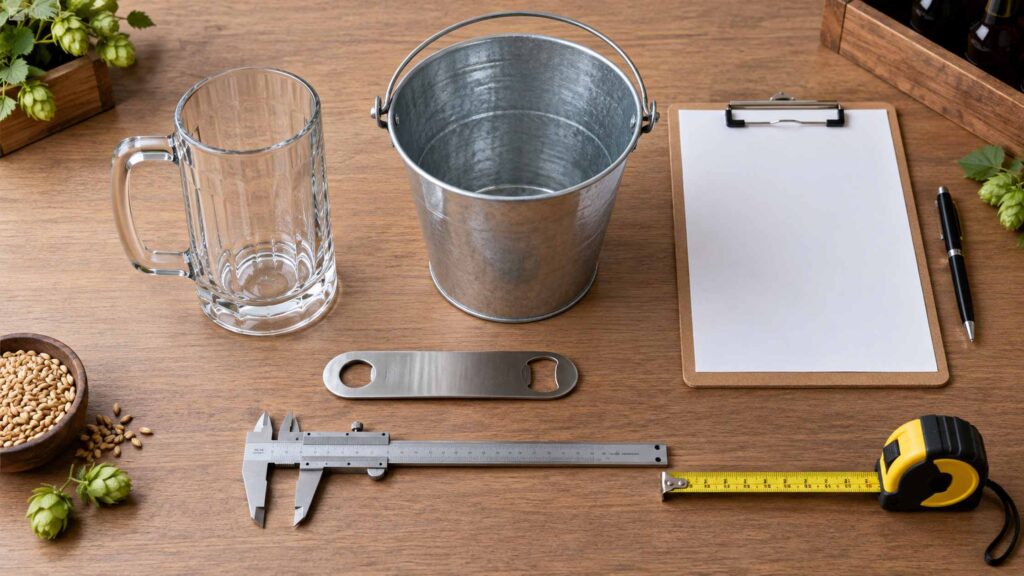
For EU food-contact products, the framework includes Regulation (EC) No 1935/2004, manufacturing requirements and applicable material-specific or national provisions. Ask a qualified laboratory or compliance specialist to identify the documents and tests for your selected product. European Commission food-contact legislation.
Do not request “all certificates” without specifying the market and use. Instead, ask: “Which requirements apply to this finished item, and what evidence covers this material, coating and decoration?”
Similarly, CE marking is required only for products covered by relevant EU legislation. It is not a general certificate for every bar accessory. EU CE-marking guidance.
Keep approved care instructions and labeling with the SKU record. This gives the supplier, inspector and importer one agreed reference.
4. Approve the Product and the Packing Sample
An attractive sample does not establish whether the export packing will protect it. Approve both.
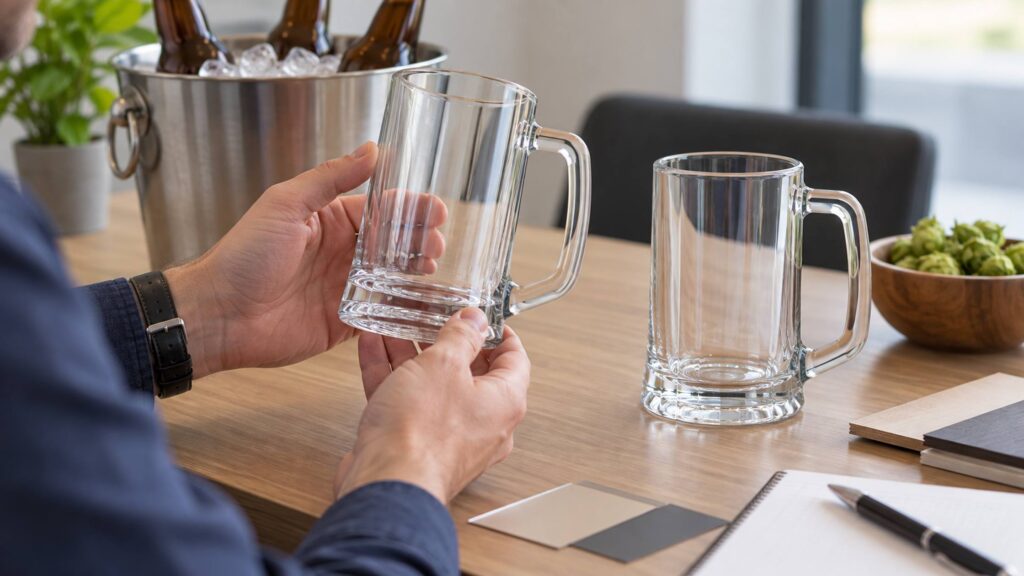
For custom beer mugs, review the rim, stability, serving volume, decoration and intended cleaning method. Then check how the mugs are separated inside the carton.
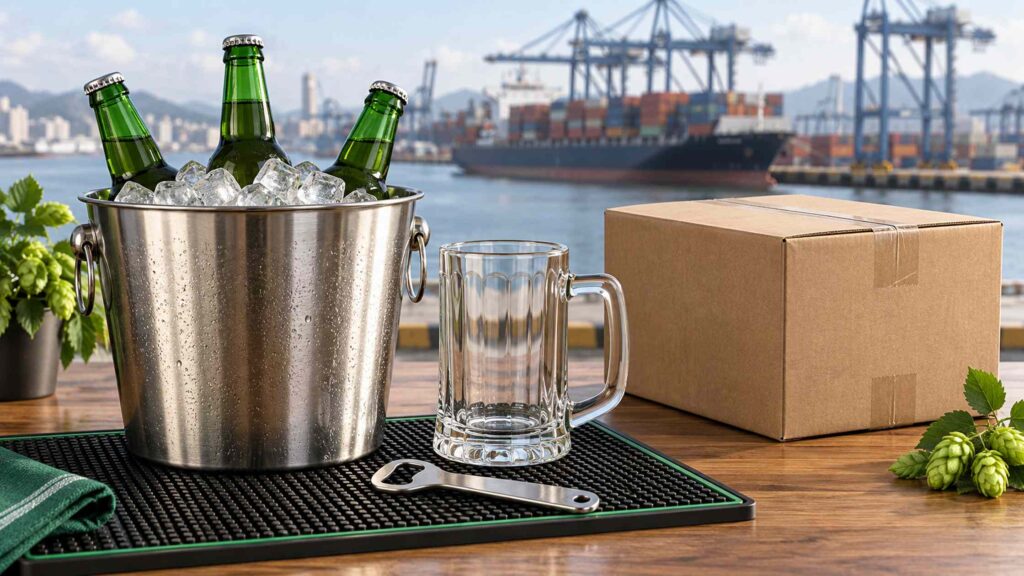
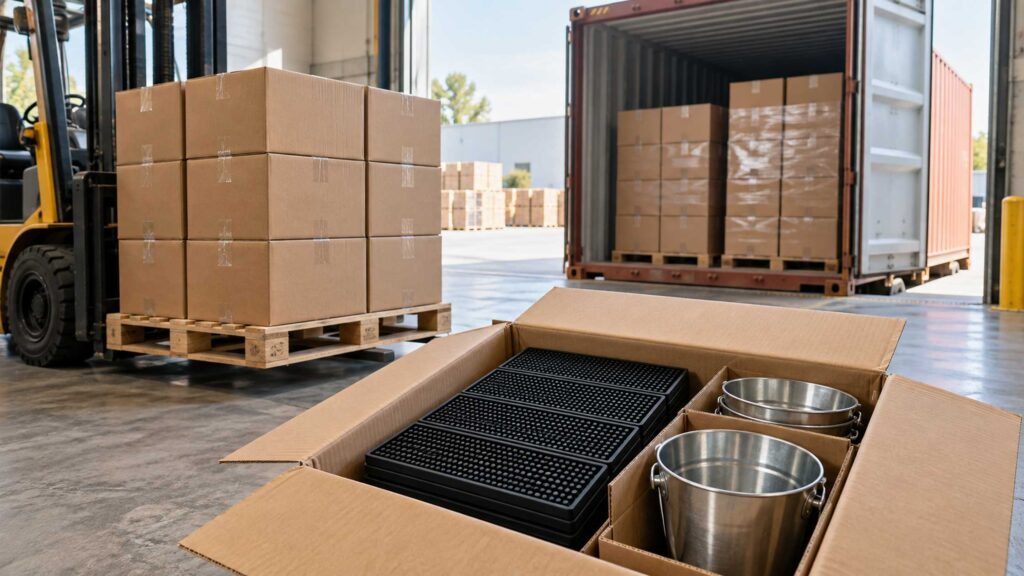
For buckets, check carrying and leakage under agreed use conditions, plus protection between nested units. For custom bar mats, confirm dimensions, material and whether packing leaves the mat flat and usable.
Ask the supplier to provide a packed-carton sample or documented packing trial appropriate to the item. Where transport testing is needed, agree on a method suited to the route and distribution channel. A short video of an unspecified drop is not a defined test report.
Retain the approved sample version and packing instructions. Any later change should be reviewed before shipment, especially if it changes carton size or protection.
5. Compare Delivery Costs on the Same Basis
Request a cost breakdown that identifies what the supplier includes and what you must arrange separately.
Your budget may include product cost, decoration, tooling, samples, testing, inspection, export handling, freight, insurance, destination handling, duties, taxes and warehouse delivery. Count each charge once.
Use the actual packed dimensions and gross weight when asking a forwarder for a freight quote. Estimated product weight alone can miss the space taken by protective packaging.
For example, 80 cartons × 0.075 cubic meters = 6 cubic meters before any additional pallet space. This is a hypothetical packing calculation, not a freight rate. Ask the forwarder to confirm the chargeable volume or weight and the validity period of its quotation.
Have the broker review customs classification and calculate applicable duties and taxes. Different materials can lead to different classifications. Do not copy a competitor’s HS code simply because the product has the same marketing name.
6. Agree on the Shipping Term and Exact Delivery Point
An Incoterm allocates specified delivery responsibilities, costs and risks. It does not replace your product specification, payment agreement or defect remedies.
| Arrangement to discuss | Practical question for your order |
|---|---|
| FCA at a named handover point | Who arranges the main transport after the carrier receives the goods? |
| FOB at a named shipping port | Does the actual shipment involve the agreed on-board delivery? |
| DAP at a named destination | Is your importer ready to handle customs and applicable import charges? |
| DDP at a named destination | Can the seller perform the import responsibilities, and through which entity? |
FOB is for sea or inland-waterway transport. When containerized goods are handed to a carrier before loading onto the vessel, ICC advises considering FCA. ICC’s FOB guidance.
DAP and DDP differ in import-clearance responsibility: the buyer handles it under DAP, the seller under DDP. Confirm the importing arrangement rather than relying on the phrase “door to door.” ICC’s DAP/DDP explanation.
Record the exact destination address or handover location and the applicable Incoterms version. A city name alone may leave important local transport work unresolved.
7. Review Draft Documents Before Dispatch
Ask your broker to review the shipment documents while corrections are still straightforward.
| Document or record | Check against the actual order |
|---|---|
| Commercial invoice | Seller/buyer details, goods descriptions, quantities, values, currency and agreed terms |
| Packing list | SKU quantities, carton numbers, dimensions and net/gross weights |
| Transport document | Consignee, notify party where relevant, route and shipment references |
| Product documentation | Correct model, materials, intended use and destination requirements |
| Origin documentation, if required | Applicable form and accurate origin information |
| Inspection and release records | Approved lot, outstanding deviations and release authority |
Ask the forwarder which shipping or security filings are needed and when the data must be supplied. Requirements depend on the route and destination.
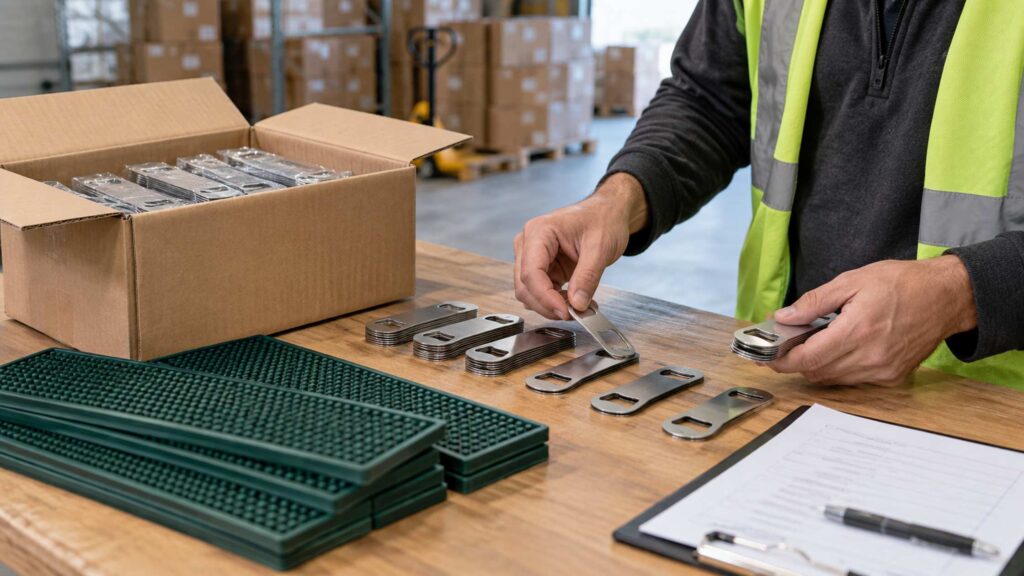
For mixed cartons, retain a carton-level allocation list. If cartons 1–20 contain one logo and cartons 21–40 contain another, that information should be available to the warehouse without opening every carton.
8. Track Arrival, Clearance and Final Delivery Separately
Confirm the shipment has actually departed, then track its expected arrival. A booking confirmation and a departure confirmation answer different questions.
Before arrival, make sure the clearance party has the required documents and knows how to contact you. Confirm the warehouse’s receiving hours, unloading arrangements and appointment rules with the delivery provider.
Build venue distribution time into the campaign schedule. Arrival at a port does not mean a bar can start using the products that day.
At receiving, count cartons, record visible damage and check samples of the contents promptly. Keep photographs, carton labels and the agreed inspection records for any claim. Report discrepancies within the relevant contractual and carrier deadlines.
Frequently Asked Questions
Can I combine bar supplies from several factories in one shipment?
Yes, if a supplier or forwarder agrees to consolidate them. Confirm the receiving location, latest arrival dates, storage charges and who checks quantities. A late product can hold up the whole shipment, so agree beforehand whether it may ship separately.
Is courier shipping suitable for my first order?
It can be useful for samples or a small shipment, but compare the packed dimensions, weight and delivery requirement. Confirm customs responsibilities and charges; using a courier does not remove the need for accurate product information.
Can I pack different products as a retail gift set?
Plan the set with the supplier and broker before final packing. The broker should review classification treatment, while the product specialist checks each component’s applicable requirements. Keep an itemized contents record even when the set is sold as one unit.
Should every imported product have the same label?
Use a consistent identification system, but confirm the information needed for each product and destination. A drinking vessel, textile bag and electrical sign may need different information. Avoid using one generic label as a substitute for that review.
Prepare Your First Bar-Supplies Import
A manageable first shipment starts with an accurate SKU list, an identified importer and approved product and packing samples. Resolve the document and delivery responsibilities before the goods leave China.
Send BeerPromoPro your bar-supplies list with quantities, destination and intended use. Include the required warehouse arrival date so product options and packing can be discussed around a workable import plan.