Custom promotional products from China do not have one reliable door-to-door lead time. Your schedule must include artwork, samples, approval, production, inspection and transport. For a beer campaign, plan backward from when the products must reach the venues, and ask suppliers to confirm the conditions behind every date.
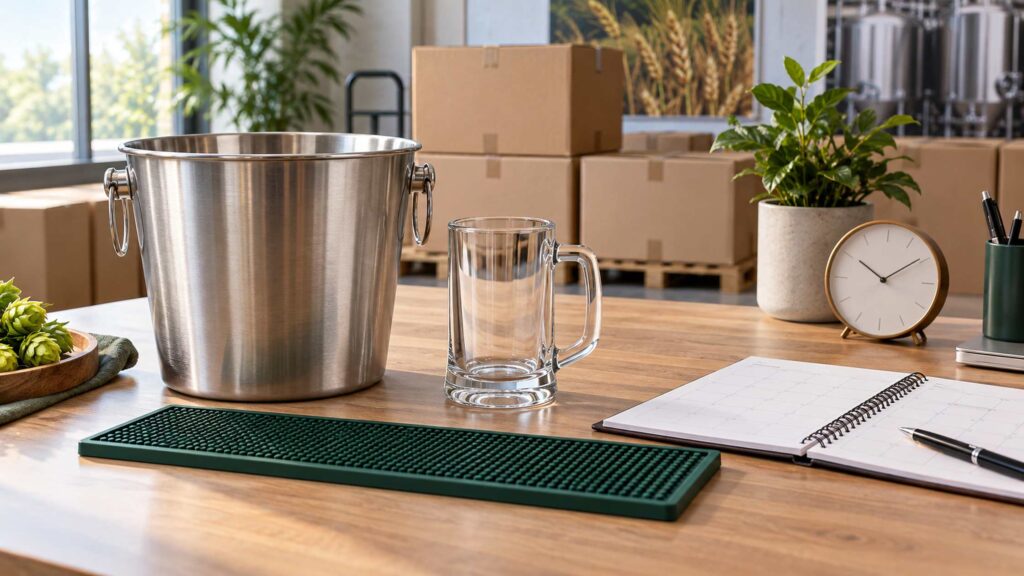
BeerPromoPro’s custom bar-mat page gives general guidance of approximately seven days for sampling and 25–35 days for bulk production, with project-dependent qualifications. Those figures are a starting point for discussion, not a complete delivery schedule or a promise for every product.
First, Define Which Lead Time You Mean
“Delivery in 30 days” can describe several different things. Ask the supplier to name the start and end points.
| Term | What you should confirm |
|---|---|
| Artwork preparation | Time to turn your files into an approvable production layout |
| Sample production | Time to make the sample after required inputs are accepted |
| Sample delivery and approval | Shipping to the reviewer, checking, testing and decision time |
| Bulk production | Time to make and pack the agreed quantity after start conditions are met |
| Inspection and release | Readiness, inspection, report review and any corrective action |
| International transport | Actual route, departure availability and estimated transit |
| Final delivery | Clearance, warehouse receiving and movement to the venues |
Also clarify whether the supplier counts working days or calendar days. A schedule using different calendars can look shorter than it is.
For your internal plan, use named milestones such as “sample approved,” “goods ready for inspection” and “warehouse received.” These are easier to track than one broad delivery date.
What Determines the Schedule for Your Product?
Existing item or new development
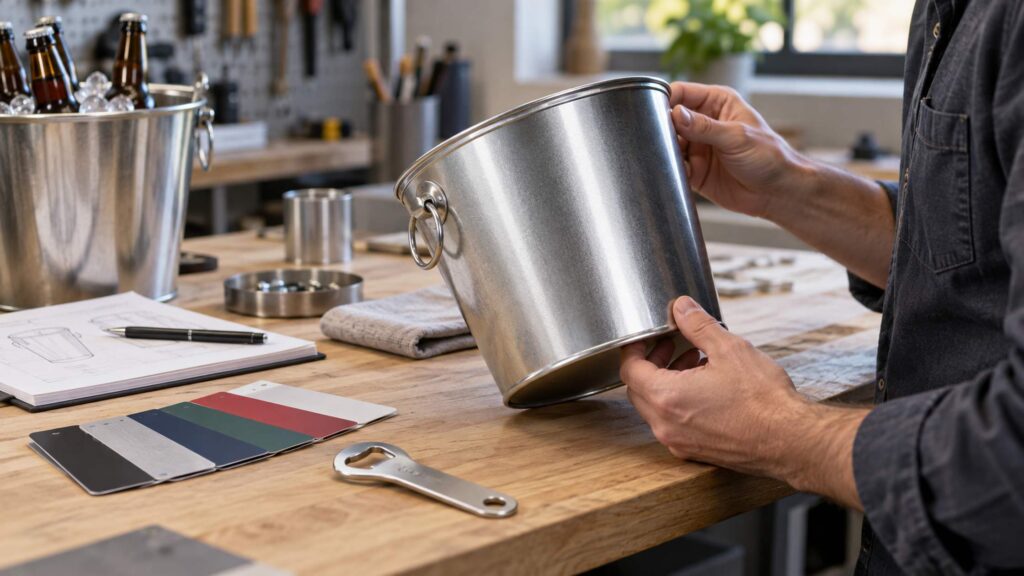
An existing product with new decoration has a different starting point from a new shape. A custom bucket shape or molded mat may require development and tooling before a representative sample is available.
Ask whether the quote assumes existing stock, existing tooling or a new production run. If stock is involved, confirm its quantity and whether it is reserved for your project.
Artwork readiness
A logo file is not always production-ready. The supplier may need vector artwork, exact print dimensions, color references and adjustments to details that are too small for the chosen process.
For beer-brand projects, identify who has authority to approve these adjustments. Waiting for a regional brand owner can become a schedule dependency even when the factory is ready.
Material and component availability
Special fabrics, colors, handles, linings or packaging may need separate procurement. Ask which components are available and which must be ordered.
For a custom cooler bag, the outer fabric and the packaging may be on different schedules. The finished item cannot be dispatched until the required parts are ready.
Quantity and production allocation
Ask the supplier to distinguish production duration from the wait for an available production slot. Confirm the planned start date and what happens if your approval arrives later.
A quoted manufacturing duration is less useful without that starting point.
Build the Schedule Around Approval Gates
An approval gate is a decision that must be completed before the next activity begins.
Useful gates include:
- Specification agreed: material, dimensions, quantity and use are clear.
- Artwork approved: the correct version is authorized for sampling.
- Sample and required evidence accepted: the product is approved for production.
- Production authorized: commercial and technical start conditions are satisfied.
- Shipment released: inspection results and documents have been reviewed.
Assign one decision owner to each gate. If several people must review a sample, arrange their review window before it arrives.
Record approval conditions rather than relying on a casual message such as “looks good.” If approval covers the logo but not the material or packaging, the schedule should show what remains open.
A Worked Example: Plan Backward from the Event
The following hypothetical planning exercise uses 17 weeks. It is not a standard lead time, freight forecast or BeerPromoPro quotation. Its purpose is to show how separate allowances add up; replace every duration with confirmed project inputs.
| When, relative to the event | Allowance in this example | Work to complete |
|---|---|---|
| 17–16 weeks before | 1 week | Finalize brief, specifications and artwork inputs |
| 16–14 weeks before | 2 weeks | Produce and deliver samples |
| 14–13 weeks before | 1 week | Review samples and complete planned evidence/approval work |
| 13–9 weeks before | 4 weeks | Produce and pack the order |
| 9–8 weeks before | 1 week | Inspect, review and complete any correction that fits the allowance |
| 8–7 weeks before | 1 week | Complete origin handling and departure arrangements |
| 7–3 weeks before | 4 weeks | International transport allowance |
| 3–2 weeks before | 1 week | Clearance and warehouse receiving |
| 2–1 weeks before | 1 week | Allocate and deliver to venues |
| Final week | 1 week | Remaining contingency before the event |
The review and correction allowances in this example may be inadequate for a complex product or failed test. Do not force the real work into the table. Adjust the plan when the laboratory, supplier or forwarder provides a different duration.
This method produces a latest approval date, not just an order date. If a critical approval slips past that point, you need a revised plan rather than the original promise.
Run Independent Tasks in Parallel, but Respect Dependencies
Some work can proceed at the same time. While the product sample is being made, your broker can review preliminary product details and your team can prepare venue allocation information.
Other work depends on the final product. Packing dimensions may need the actual sample; testing may need the approved material and decoration; bulk production may require sample acceptance.
For a kit with several items, the schedule follows the slowest required component plus the time for assembly and release. If three items take three, four and six weeks in parallel, you do not add those durations to get thirteen weeks. But the kit cannot be completed in four weeks if the six-week item is essential.
Ask the coordinator to identify that controlling item. If it becomes late, determine whether the campaign can use a partial kit or needs the complete set.
Common Delays and the Decisions That Prevent Them
Repeated artwork revisions
Get internal brand approval before sending artwork for production review. Keep one version number and one person responsible for releasing changes.
If a change arrives after sampling, ask which completed work must be repeated. A small visual revision can still affect setup or color approval.
A sample that proves less than expected
Confirm in advance whether the sample includes the final material, decoration and packaging. Otherwise, you may discover that a second sample is needed after the first arrives.
Where a sample differs from the production process, require the differences in writing and schedule the additional verification.
Required testing starts too late
Have the product specialist define the required sample and documentation before the testing appointment. An unsuitable sample or missing material information can delay the review.
Book timing around the laboratory’s actual requirements. Do not assume all testing can fit into the same short approval window.
Factory closures and capacity changes
Ask for the factory’s actual closure and restart dates for your production period, plus the cutoff for material orders. A public holiday calendar alone does not define a factory’s operating schedule.
Confirm whether the supplier’s planned start date is still valid when you release the order.
Packaging or shipping information is unfinished
Approve pack quantities and artwork alongside the product. Prepare the destination address, importing party and receiving information early enough for booking and document review.
Treat a booking as a milestone with its own conditions. Confirm the required cargo-ready date with the forwarder.
If the Schedule Is Too Tight, Change the Right Variable
Ask the supplier to show which change would actually shorten the controlling stage.
| Option | What it may shorten | What you must still check |
|---|---|---|
| Use an existing shape | Development/tooling | Product fit and available construction |
| Use standard material colors | Material sourcing | Brand acceptance and sample appearance |
| Reduce artwork versions | Setup and approvals | Required regional or client differences |
| Use simpler packaging | Pack development | Protection, labeling and channel fit |
| Split the shipment | Time to receive an essential portion | Extra freight, clearance and packing costs |
| Change transport mode | Transit portion | Availability, packed size, cost and customs timing |
Paying for air freight cannot recover time if the goods are not finished. Similarly, skipping inspection does not solve a production defect; it moves discovery closer to the campaign.
Get an updated schedule and price before accepting an acceleration plan. Record what changes and what remains dependent on approvals.
Use a Weekly Status Record with Evidence
Keep updates short and specific:
| Milestone | Original date | Current forecast | Evidence | Decision needed |
|---|---|---|---|---|
| Sample ready | Agreed date | Updated date | Sample photos/tracking | Reviewer availability |
| Production start | Agreed date | Updated date | Start confirmation | Outstanding approval |
| Inspection readiness | Agreed date | Updated date | Completion/packing status | Inspection booking |
| Departure | Planned date | Updated date | Forwarder confirmation | Document release |
| Warehouse delivery | Target date | Updated date | Transport/clearance update | Receiving appointment |
If a date moves, request the cause, impact on the final deadline and recovery option. “On schedule” without a named milestone tells you little.
Frequently Asked Questions
Will a reorder always arrive faster?
It may require less development if specifications and artwork remain unchanged. Confirm material availability, tooling condition and production allocation before assuming the previous schedule still applies.
Can I approve photos instead of receiving a physical sample?
Photos can help approve layout or identify visible issues, but they do not let you assess weight, feel, fit or performance. Decide what evidence each approval requires; do not treat a photo as proof of characteristics it cannot show.
What if one item in a kit is late?
Compare waiting, substituting an approved alternative or splitting the delivery. Include assembly, transport and clearance effects in the decision. Have the campaign owner confirm whether a partial kit is still useful.
When should the event deadline be communicated?
In the first inquiry, together with the required warehouse or venue arrival date. The supplier needs that information before proposing a product and manufacturing route, not after the order is confirmed.
Give Your Supplier a Deadline It Can Plan Against
A useful lead-time answer names the start conditions, intermediate milestones and final delivery point. Build those into a shared schedule and update it when decisions change.
Send BeerPromoPro your campaign dates, product list, quantities and artwork status. Specify when the goods must be at the warehouse or venues so the proposed sample and production plan can be assessed against the real deadline.