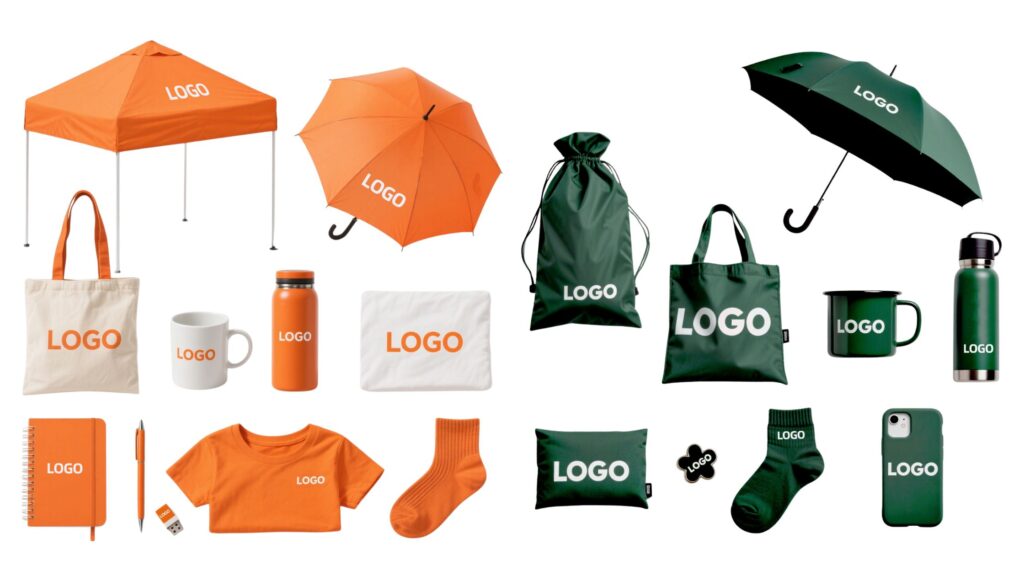
Branded promotional items are one of the few marketing channels where your logo physically stays in someone’s hands. But beer brands buy them under a different set of rules than a tech company or a bank. This guide maps the full category landscape — bar and serving gear, outdoor and event equipment, and retail POSM — with what each one costs, how long it lasts, and which campaigns it actually suits.
Why Branded Promotional Items Work Differently for Beer Brands
Most promotional product advice is written for offices: pens for the reception desk, tote bags for the trade show, USB drives for the client gift. Beer campaigns do not run in offices. They run on bar counters, in supermarket aisles, and at outdoor festivals — and that changes what “a good promotional item” means.
Three differences matter most:
1. The venue owns most of it
When a brewery puts a bar mat on a counter, the bar keeps it. Your logo lives in that venue for months, seen by every customer who orders a drink. That is not a giveaway — it is semi-permanent brand real estate. So the buying criteria shift from “will someone keep this?” to “will the venue keep this out, and will it survive six months of service?”
2. It has to survive real use
A branded glass goes through a commercial dishwasher dozens of times a week. A patio umbrella sits in UV and rain all summer. A cooler bag gets dragged across grass and sand. Novelty items that look good in a mockup and fall apart in week three do not just waste budget — they damage the brand in front of the exact audience you were trying to reach.
3. It is tied to a calendar you do not control
Beer promotion is seasonal: summer festivals, Oktoberfest, Christmas gifting, a new SKU launch, a distributor’s quarterly push. Lead times are real, and missing a festival window by two weeks means the entire order sits in a warehouse for eleven months.
Note on the numbers in this guide: MOQ and unit-cost bands reflect typical ranges for custom-manufactured items from China. Your actual figures depend on material, print method, packaging and factory load — always confirm against a live quote before you budget.
The Three Families of Beer Promotional Items
Every branded item a beer brand buys falls into one of three families. Knowing which family you are buying in tells you roughly who ends up with it and how long it should last.
| Family | Where it lives | Typical lifespan | Who keeps it |
|---|---|---|---|
| Bar & Serving | Bar counter, table, back bar | 6–24 months | The venue |
| Outdoor & Event | Festivals, beer gardens, beaches, terraces | 1–3 seasons | Consumer or brand team |
| Retail Display & POSM | Shelf, aisle end, storefront, taproom wall | 1–12 months | The retailer or venue |
12 Categories, and What Each One Actually Does
Bar & Serving
1. Beer glasses, mugs and steins. The highest-visibility item on the list, because the customer holds it for the entire drink. Soda-lime glass is the cost-effective default; tempered glass resists thermal shock and breakage in busy venues. Logo methods: screen print (most durable for volume), pad print, laser etch, or full-colour digital for photographic artwork. Standard shapes usually carry a lower minimum than a bespoke mould. Watch dishwasher durability — a cheap print starts fading inside a few hundred cycles.
2. Bar mats. Printed artwork is sealed under a PVC surface over a nitrile rubber base, which is why bar mats outlast almost everything else on the counter. Typical sizes run from roughly 60 × 10 cm up to 90 × 25 cm. They are cheap per unit, flat to ship, and the venue actually wants them because they protect the bar top. Best value-for-money item on this list.
3. Ice buckets. Galvanised steel and stainless for on-premise; acrylic, PP plastic and neoprene for events and retail gift-with-purchase. The choice is mostly about weight and whether it will be carried outdoors. Logos go on by screen print, laser etch on metal, or a wrap-around print on soft-sided versions.
4. Bottle openers. Small, cheap, and genuinely kept. Zinc alloy and stainless steel are standard; the shape can be die-cut to a bottle silhouette. MOQs usually sit higher than the item’s unit price suggests, because they run on shared tooling. Excellent as a mass giveaway or a case insert.
5. Tap handles. The single most brand-defining item in a draft program — it is what a customer looks at while deciding what to order. Wood, resin, and cast zinc alloy are the usual builds, often with a printed or domed badge. Lower volume than most categories, higher unit cost, and worth it if draft is core to the account.
6. Coasters. Paperboard for one-off events, cork and PU leather for bars that want something reusable, absorbent stone or ceramic for premium venues. Full-colour print is cheap at volume, which makes coasters the classic way to get campaign artwork onto every table.
7. Serving trays and napkin holders. Round or rectangular trays in ABS, PP, metal or wood; napkin holders in metal, acrylic or wood. Both sit on the table throughout service, so they earn impressions for the whole visit rather than a glance.
8. Pitchers. Glass for on-premise, food-grade plastic for outdoor and festival service where breakage is a liability. Large printable area, carries a group-sized order, and works well for share-format promotions.
Outdoor & Event
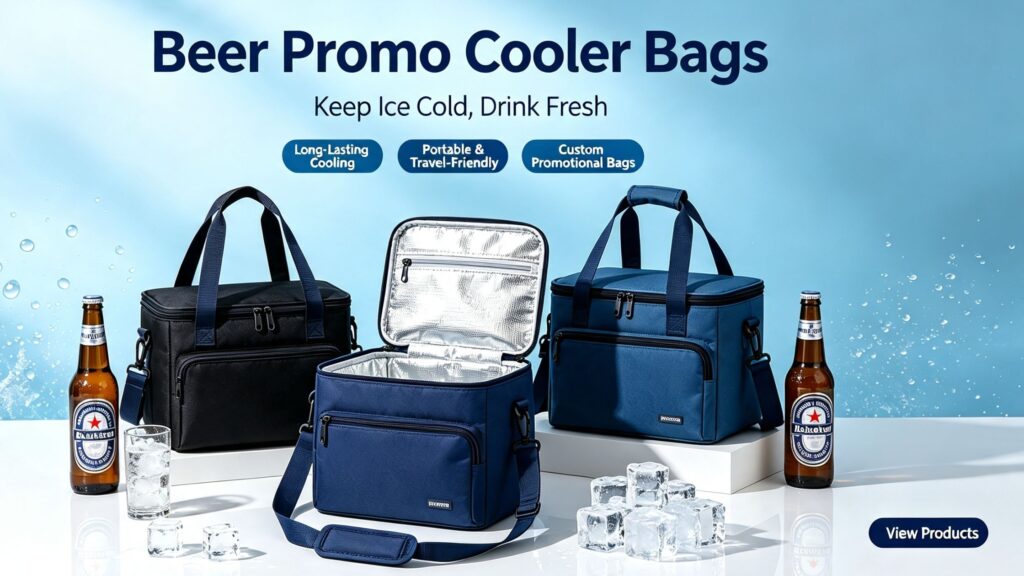
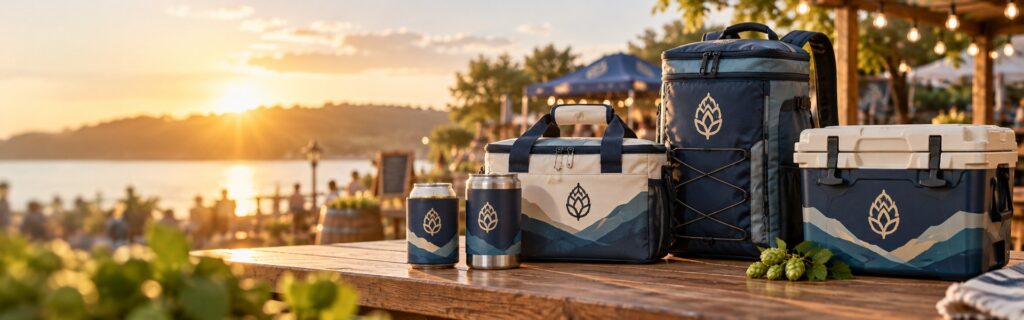
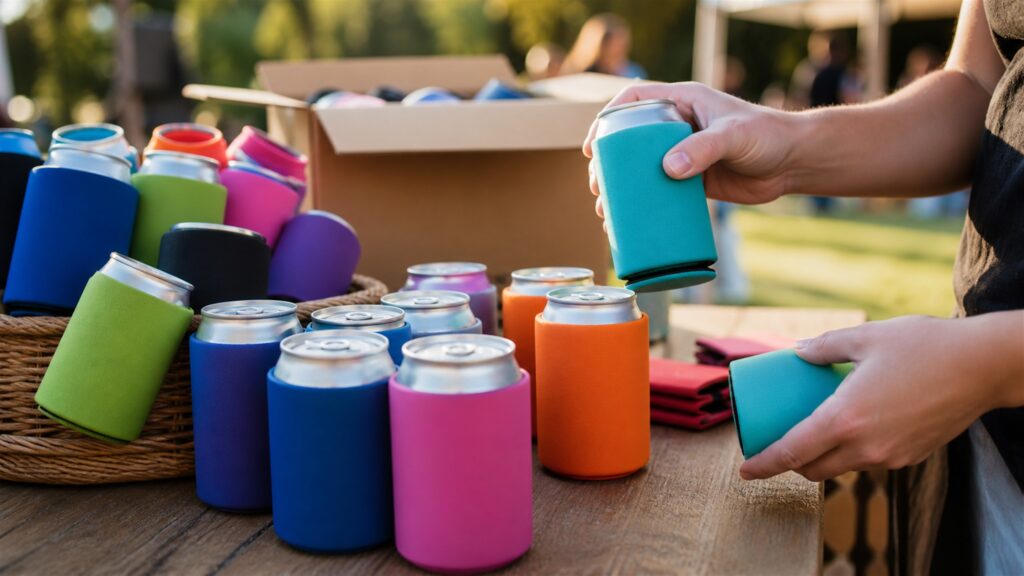
9. Cooler bags and can coolers. The item most likely to go home with a consumer and stay in use for years. Look at the lining (PEVA or aluminium foil), insulation thickness, and whether the outer fabric is 600D polyester or something lighter. Branding is usually a print panel or an embroidered patch. Also the category where retail gift-with-purchase programs perform best.
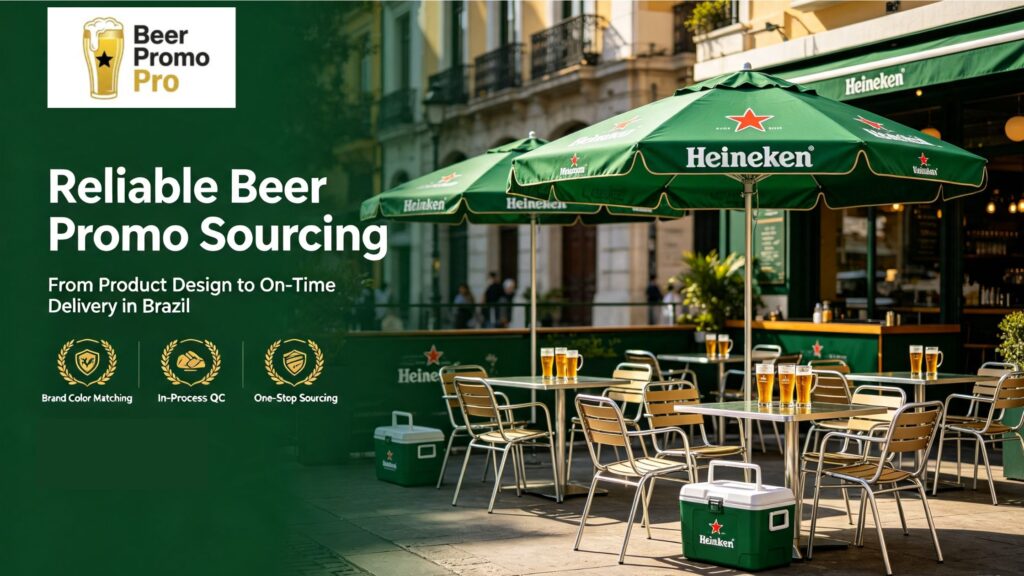
10. Canopy tents, patio umbrellas and flags. This is how a brand physically owns a space at a festival or beer garden. Standard canopy sizes are 3 × 3 m and 3 × 6 m, on steel or aluminium frames with a printed polyester canopy. Umbrellas typically run 2.7–3 m. Feather and teardrop flags give you visibility above a crowd at low unit cost. Check frame weight and wind rating — this is the category where cheap construction gets physically dangerous, not just ugly.
11. Beach mats, chairs and beer garden sets. Polyester or acrylic beach mats, folding chairs and matching tables. Strong for summer campaigns, brand activations and venue fit-outs, and the photo-sharing value at events is disproportionate to the cost.
Retail Display & POSM
12. Tin signs, tin tackers, neon signs, display racks, table tents, shelf talkers and brand walls. This is the family that drives off-premise sell-through, and it behaves differently from everything above: the retailer has to agree to install it. Tin signs and tin tackers are litho-printed tinplate — durable, flat-packed, and the classic bar-wall format. LED neon flex signs deliver the back-bar look without glass neon’s fragility or shipping cost. Display racks, shelf talkers and infographics fight for shelf-level attention in liquor stores and supermarkets. Table tents work on bar and restaurant tables. Brand walls are the large-format statement piece for a flagship venue.
The rule across this family: design for the space the retailer actually has, not the space you wish they had. A display rack that does not fit the shelf depth gets left in the stockroom.
Match the Item to the Campaign Objective
| If your objective is… | Start with | Why |
|---|---|---|
| Launch a new SKU in bars | Glassware, tap handles, table tents | Sits exactly where the ordering decision happens |
| Drive off-premise sell-through | Shelf talkers, display racks, tin signs | Works at the shelf without needing staff involvement |
| Own a festival or beer garden | Canopy tents, flags, cooler bags, beach mats | Becomes the physical landmark people navigate by |
| Reward the trade and staff | Bar mats, openers, serving trays, apparel | Practical for the venue, so it stays out |
| Reach consumers at home | Cooler bags, glassware sets, beach mats | Consumer-owned, so it keeps working after the campaign |
| Build a flagship venue presence | Brand wall, neon sign, tap handles, bar mats | Long-life installations that reset the whole space |
Five Rules for Promotional Items People Actually Keep
1. Put it where the beer is. Context beats novelty. A branded item used while drinking outperforms a clever item used twice and forgotten. If it does not belong within arm’s reach of a drink, question the brief.
2. Specify for the abuse it will take. Commercial dishwashers, spilled liquid, UV, sand, and being stacked in a van. Tell your supplier the use environment before you approve materials — not after the first shipment comes back faded.
3. Brand it for the distance it is seen from. A tap handle is read from two metres; a coaster from thirty centimetres; a festival tent from across a field. Logo size, colour count and placement should follow viewing distance, not a single brand guideline applied to everything.
4. Match the item’s life to the campaign’s life. Paperboard coasters for a one-weekend activation. Tempered glass and PVC bar mats for a permanent account. Spending permanent-item money on a two-week campaign is the most common budget leak in this category.
5. Do not let unit price eat durability. The cheapest quote is usually cheaper because of thinner material, fewer print passes, or a weaker frame. On items that sit in a venue for a year, the per-use cost of the durable option is almost always lower.
What Branded Promotional Items Cost
| Unit cost band | Typical items | What you give up |
|---|---|---|
| Under $1 | Coasters, bottle openers, can coolers, stickers | Short life, limited print area |
| $1–$5 | Bar mats, serving trays, beer glasses, napkin holders | Standard shapes rather than bespoke tooling |
| $5–$20 | Cooler bags, ice buckets, pitchers, tin signs | Higher minimums on custom versions |
| $20 and up | Tap handles, display racks, umbrellas, tents, neon signs | Longer lead time, freight matters more |
Freight is the line item people forget. Outdoor furniture, tents and glassware are bulky — on a large order, shipping can move the landed cost more than a unit-price negotiation does.
Where MOQ, Lead Time and Quality Control Fit
Three topics deserve their own deep treatment, and they have it already:
- Minimum order quantities — why one order can carry several different minimums, and how to ask for a lower one without trading away quality: read MOQ for Custom Promotional Products in China.
- Lead times — sampling, tooling, production and freight, and what realistically compresses: read Custom Promotional Products from China: Lead Times.
- Quality control — what to inspect before a shipment leaves, and how to catch print-durability problems early: read Quality Control for Promotional Products from China.
- Choosing a supplier — see How to Find Promotional Product Suppliers in China and Questions to Ask Before You Commit.
Common Mistakes
- One item for every venue. A bar, a supermarket and a beer garden need different things. Brief per channel, not per brand.
- Logo too small or too complex. A detailed crest reduced to 2 cm on a coaster turns into a smudge.
- Ignoring wash and UV durability. The item looks great in the sample photo and fades in month two.
- Retail POSM the retailer will not install. Measure the space first. Get the buyer’s agreement before you tool up.
- Ordering against the festival calendar instead of the production calendar. Work backwards from the event date, including freight.
- No spare units. Order a small buffer. Items break, go missing, or a venue reopens a second location.
Frequently Asked Questions
What are branded promotional items?
Physical products printed or embossed with a company’s logo and used for marketing rather than sold. For beer and beverage brands they usually fall into three families: bar and serving items, outdoor and event equipment, and retail display or POSM.
What is the most effective promotional item for a beer brand?
It depends on the objective.
- For on-premise visibility, bar mats and branded glassware deliver the most impressions per dollar because they stay on the counter and in customers’ hands.
- For consumer retention, cooler bags last the longest.
- For off-premise sell-through, shelf-level POSM outperforms anything the customer takes home.
How many items should I order for a bar campaign?
Count venues, not people. Multiply the number of accounts by the units each one needs to run properly (glasses per venue, mats per bar position), then add a buffer for breakage and reorders. See our MOQ guide for how minimums are set per product.
Can I mix different items in one shipment?
Yes, and consolidating is usually how you make freight economics work. The constraint is timing: the whole shipment moves at the speed of the slowest item, so confirm all production schedules line up before you commit to a single container.
Do promotional items need food-contact or safety certification?
Anything that touches a drink or food — glassware, pitchers, ice buckets, coasters in some uses — should carry the relevant food-contact documentation for your market, such as EU framework compliance or LFGB for Germany, plus general product-safety requirements. Electrical items like LED neon signs need their own certification. Ask for documentation before production, not at import.
How far ahead should I order for festival season?
Work backwards from the event date and include freight, not just production. Sea freight alone can take several weeks, and custom items need sampling and approval before the production run starts. Our lead time guide breaks the schedule down stage by stage.
Plan Your Next Campaign
We have supplied beer promotional products and POSM for global brewers, distributors and beverage brands for 14 years — from bar counters to beer festivals, across bar and serving, outdoor and event, and retail display.
Send us your campaign brief — channels, venues, quantities and dates — and we will come back with a category shortlist, materials and a landed-cost estimate. Request a quote, or see how we handled a Heineken campaign in Brazil.