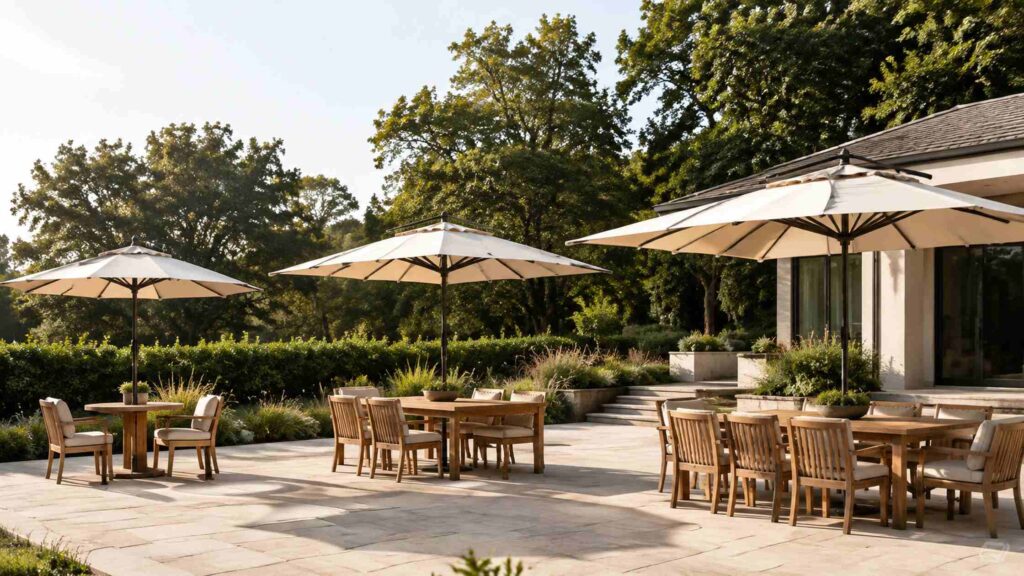
Choosing the wrong umbrella size can create weak shade coverage, misleading product listings, avoidable returns, and costly project changes. This patio umbrella size chart helps brands, importers, retailers, and hospitality buyers match common canopies with real furniture layouts—and turn that first estimate into a complete supplier specification.
Quick Patio Umbrella Size Chart
Use the table as an initial planning guide. Dimensions refer to the approximate canopy diameter or width, not pole height. Furniture designs and published recommendations vary, so confirm every final selection against the supplier’s drawing and installation instructions.
| Table or furniture footprint | Typical seating | Suggested canopy size | Common commercial application |
|---|---|---|---|
| Up to 30 in / 76 cm | 2 | 6–6.5 ft / 1.8–2.0 m | Bistro sets, balconies, café pairs |
| 30–36 in / 76–91 cm | 2–4 | 7–7.5 ft / 2.1–2.3 m | Compact residential and café sets |
| 36–48 in / 91–122 cm | 4 | 8–9 ft / 2.4–2.7 m | Core residential dining assortment |
| 48–54 in / 122–137 cm | 4–6 | 9–10 ft / 2.7–3.0 m | Family dining and conversation sets |
| 54–60 in / 137–152 cm | 6 | 10–11 ft / 3.0–3.4 m | Larger dining and hospitality layouts |
| 60–72 in / 152–183 cm | 6–8 | 11–13 ft / 3.4–4.0 m | Large tables, poolside, contract projects |
| Over 72 in / 183 cm | 8+ | Project-specific or multiple umbrellas | Long tables and large commercial zones |
Many published guides begin with approximately 2 ft of canopy beyond each table edge. That produces a useful formula:
Table width or diameter + about 4 ft = starting canopy size
This is a merchandising and layout rule, not an engineering standard. Sun angle, canopy height, furniture spacing, exposure, base design, and frame geometry all change the usable result. Published charts also differ at the boundaries, which is why ranges are more honest than a single supposedly universal answer (PatioUmbrellas.com; published selection chart).
What Does Patio Umbrella Size Mean?
Patio umbrella size normally describes the canopy. Round and octagonal models are sold by a diameter-like nominal size. Square umbrellas use side length, while rectangular models use length × width.
The nominal label is not always the exact horizontal shade span. A published measurement example calculates a nominal 9 ft umbrella from two 53 1/8 in ribs plus a 2 in hub. Its straight open span is shown as approximately 101–103 3/4 in, depending on how far the umbrella is opened (measurement guide).
For a retailer, that distinction affects product-page accuracy. For a private-label buyer, it affects comparison among quotations. For a replacement-canopy program, it can determine whether a cover fits at all.
Ask the supplier to identify the measurement method on the technical drawing. Useful fields include nominal canopy size, straight open span, rib length, hub width, side dimensions, overall height, and crank height.
Which Patio Umbrella Sizes Belong in Your Assortment?
A useful product line does not need every possible size. It needs a deliberate SKU ladder matched to your channels and customer furniture.
6 to 6.5 ft: Compact and Add-On Friendly
This range suits bistro tables, two-chair sets, balconies, and small café placements. It can work as an entry-price or space-saving SKU for ecommerce and urban retail.
The commercial advantage is a manageable footprint and a clear use case. The risk is overpromising: a compact canopy should not be pictured over a wide four- or six-person dining set. Merchandising images should show the furniture scale honestly.
7 to 8 ft: Small Dining Sets
Seven- to eight-foot umbrellas bridge compact bistro products and full-size residential dining. They fit many two- to four-seat sets and give retailers a step-up option without moving immediately to a 9 ft package.
Before adding this band, check whether it creates meaningful differentiation in your market. If its table compatibility, carton size, and price sit too close to your 9 ft model, it may add inventory complexity without a clear buyer reason.
9 ft: A Core Residential Format
A 9 ft market umbrella is a practical anchor SKU for many 36–54 in tables and four- to six-person layouts. It is large enough to demonstrate useful shade but still familiar to residential retailers and ecommerce buyers.
For a 9 ft listing, make the pole diameter, table-hole compatibility, crank height, tilt mechanism, base requirement, and actual open span easy to find. A buyer should not have to infer these details from lifestyle photographs.
10 ft: A Useful Bridge Size
A 10 ft canopy can cover larger dining sets while remaining below the visual and logistical scale of many 11–13 ft products. It may help a supplier separate mid-size market umbrellas from premium cantilever collections.
Evaluate this SKU by channel. A specialist patio retailer may value the extra step. A general ecommerce seller may prefer fewer, clearer choices if 9 ft and 11 ft already cover the main use cases.
11 ft: Large Dining and Lounge Coverage
An 11 ft canopy suits larger tables, conversation sets, poolside layouts, and hospitality applications. At this size, the buyer is no longer selecting the canopy alone. Frame construction, lift system, base or mounting method, packed dimensions, handling, and operating clearance become more important.
Do not position every 11 ft product as interchangeable. An 11 ft center-pole market umbrella and an 11 ft cantilever solve different layout problems and impose different support requirements.
12 to 13 ft: Project and Premium Applications
Large canopies can address broad seating zones, premium residential settings, restaurants, resorts, and event spaces. They also create greater consequences if the layout or support system is wrong.
Treat these models as specification-led products. Request a complete installation drawing, base or anchoring instructions, clearance envelope, component weights, packed dimensions, and replacement-part plan. For a long dining area, two smaller umbrellas may sometimes fit changing table configurations better than one large canopy.
Match Canopy Shape to the Furniture Layout
The nominal width is only one part of coverage. Shape controls where that coverage falls.
Round and Octagonal Canopies
Round and octagonal umbrellas pair naturally with round tables and compact conversation sets. They are easy for retailers to explain and photograph, which makes them suitable for broad residential assortments.
Square Canopies
Square umbrellas use space efficiently over square tables and modular lounge arrangements. For product listings, state the side length clearly. Do not substitute the diagonal, which can make the canopy appear larger than the dimension buyers expect.
Rectangular Canopies
Rectangular canopies follow long dining tables more closely and can shade end seats better than a round canopy of similar width. Record the size as length × width and keep that order consistent across drawings, cartons, catalogs, and online listings.
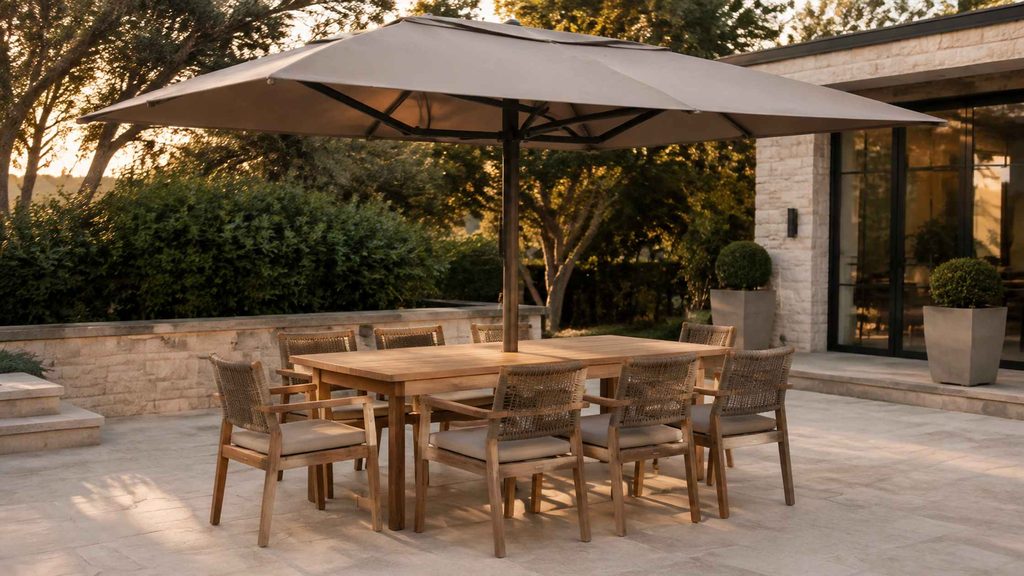
For long commercial tables, compare the canopy footprint with the complete occupied furniture footprint. Include chairs pulled out for use, not only the tabletop.
Choose the Frame Layout Before Finalizing Size
Center-Pole Market Umbrellas
A market umbrella positions the pole beneath the canopy center. It works well with a dining table that includes an umbrella hole and generally gives buyers a simple, recognizable installation.
Check three interfaces before ordering:
- The pole must pass through the table opening.
- The crank or lift control must remain usable above the tabletop.
- The lower pole must fit the specified base or in-ground sleeve.
Cantilever or Offset Umbrellas
A cantilever umbrella places its mast and base beside the shade area. It is useful over sectionals, loungers, pools, and tables where a center pole would obstruct the layout.

Its product size does not communicate the whole installation envelope. Request the mast position, horizontal arm reach, base footprint, rotation area, tilt range, and opening clearance. A canopy can fit over the furniture while its base blocks a walkway or its arm conflicts with a wall.
Why Base Weight Should Not Be Inferred From Size Alone
A larger canopy generally needs more support, but a generic pounds-per-foot formula is not a wind rating. Required support depends on the umbrella model, frame layout, base design, whether the pole passes through a table, the anchoring method, and site exposure.
Published charts can help buyers compare product categories, but the manufacturer’s model-specific requirement should control the final selection. Cantilever systems often use dedicated cross bases, fillable ballast, bolt-down plates, or in-ground mounts rather than a generic market-umbrella stand.
For B2B documentation, connect each umbrella SKU to its approved base or mounting options. State whether the quoted product includes the base, requires separate ballast, or needs permanent installation. This prevents a distributor from treating the base as an optional styling accessory.
No patio umbrella should be marketed as safe for severe weather merely because it has a heavy base. Include clear operating and closure instructions supplied for the specific model.
Turn the Size Chart Into Better Product Listings
A useful product page should let a customer verify fit before purchase. Include:
- Nominal canopy size and measurement convention
- Actual open span or side dimensions
- Canopy shape and rib count
- Pole diameter or cantilever mast dimensions
- Overall height and crank or lift-control height
- Suggested furniture footprint, presented as guidance
- Compatible base, ballast, sleeve, or mounting options
- Required operating and overhead clearance
- Open and closed product dimensions
- Carton dimensions and packed weight where relevant
- Links or part numbers for replacement canopies and components

Use both imperial and metric units if you sell internationally. Convert from one controlled master specification instead of remeasuring independently for each catalog. Label diagrams consistently so “width,” “diameter,” “span,” and “rib length” are not treated as synonyms.
How to Specify Patio Umbrella Sizes in an RFQ
Do not send a supplier only a request for “9 ft patio umbrellas.” A useful RFQ should identify:
- Canopy shape and nominal size
- Measurement method and required actual dimensions
- Center-pole or cantilever frame type
- Table, furniture, or project footprint to be shaded
- Pole or mast dimensions and overall height
- Crank height, tilt, rotation, and operating clearance
- Base or installation method
- Rib count, frame material, and canopy attachment details
- Required unit system and dimensional tolerances
- Color, fabric, branding, packaging, and replacement-part requirements
- Dimensioned drawing, sample, and approval process
Ask the supplier to return a marked drawing with the quotation. When exact compatibility matters, approve a physical sample before bulk production. Keep the approved drawing and sample reference with the purchase order so repeat orders are checked against the same definition.
Common B2B Sizing Mistakes
Treating Published Charts as Universal Standards
Size charts are useful planning tools, but their recommended bands vary. Use them to shortlist a size, then verify the exact model and application.
Building the Range Around Diameter Alone
Two same-size umbrellas may differ in pole position, height, tilt, base footprint, carton length, and usable shade. Those differences affect channel fit and landed handling.
Showing a Canopy Over Unrealistic Furniture
Lifestyle images create size expectations. Pair each SKU with furniture it can plausibly shade, and supplement the photograph with a dimensioned top view.
Mixing Nominal and Actual Measurements
A product title may use a rounded nominal size while a technical drawing shows a smaller horizontal span. Both can be valid if the measurement method is clear. Problems arise when catalogs, quotations, and inspection documents use the numbers without labels.
Applying One Base Recommendation to Every Installation
Through-table, freestanding, cantilever, bolt-down, and in-ground installations behave differently. Link the support requirement to the exact frame and site instructions.
Ignoring Packaging Until the Purchase Order
Larger ribs and poles can change carton length, handling, storage, and fulfillment options. Compare packed dimensions when deciding whether an extra canopy size deserves its own SKU.
Frequently Asked Questions
What is the most practical patio umbrella size for a core retail range?
A 9 ft model is a strong candidate for many residential assortments because it matches common four- to six-person layouts. The final core size should still reflect your furniture range, channel, carton limits, and customer data.
What size patio umbrella fits a 48-inch table?
An 8–9 ft canopy is a useful starting range. Check the chair footprint and actual open span before publishing compatibility.
What size umbrella should be paired with a 60-inch table?
A 10–11 ft canopy is a common starting point. Table shape, chair placement, canopy height, and sun angle can change the practical coverage.
Should a rectangular table use a rectangular umbrella?
Often, yes. A rectangular canopy can distribute shade more efficiently along a long table, but a sufficiently large round or square model may also work when the installation and furniture layout support it.
Can one patio umbrella size chart be used for every supplier?
No. Use a general chart to narrow the choice, then rely on the selected supplier’s dimensioned drawing, base requirement, and operating instructions.
What should a buyer confirm for a private-label umbrella?
Confirm actual canopy dimensions, the measurement convention, frame and pole details, compatible support system, operation clearances, tolerances, packaging, branding placement, spare parts, and the approved sample.
Does a bigger umbrella always create a better product offer?
No. More coverage also brings a larger installation envelope, stronger support needs, longer components, and potentially more complex handling. Add a larger SKU only when it serves a clear customer and channel need.
Build the Range Around Applications, Not Just Numbers
A patio umbrella size chart should begin the decision, not finish it. Use 6–8 ft models for compact settings, 9–10 ft models for mainstream dining, and 11–13 ft products for larger residential, lounge, or project applications. Then validate shape, frame layout, furniture footprint, support system, clearance, and packaging.
For a commercial order, send one controlled specification, request a returned dimensioned drawing, and approve a sample before production. That workflow turns a simple size label into a product your sales team, supplier, inspector, and customer can all understand consistently.