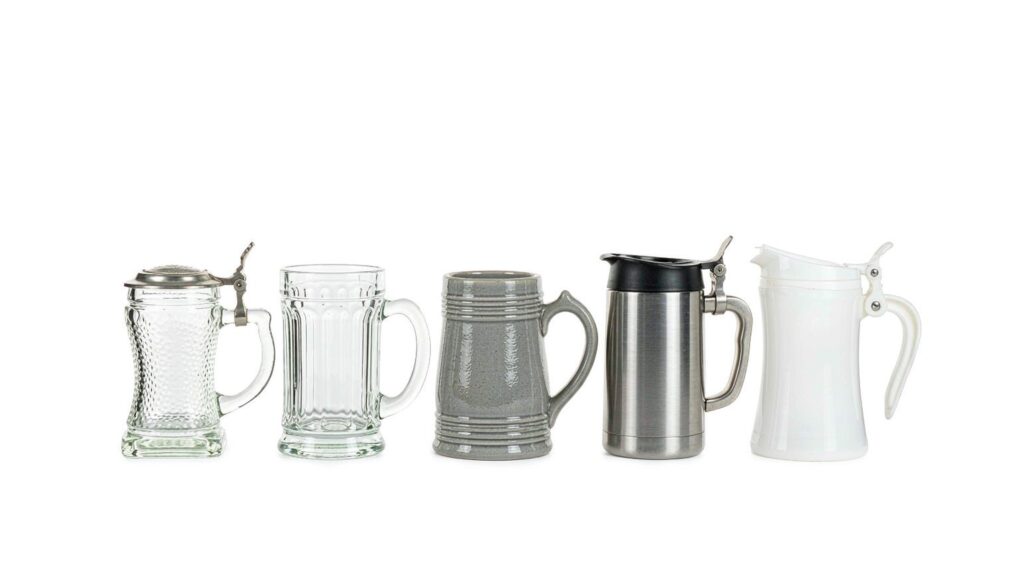
A beer mug is a handled drinking vessel built for beer. That is the whole definition, and it is also where most product pages stop. In practice a beer mug is five parts. They are the body, the handle, the base, the lid and the fill line. Each part changes how the beer tastes, how heavy the parcel is, and what you can print on it.
The word “mug” is also the loosest term in this category. A glass dimpled stein, a 0.5 L seidel, a pewter-lidded tankard and a plastic festival cup can all be sold as a “beer mug” by four different factories. Here is what actually separates them.
What Are the Parts of a Beer Mug?
Five parts, and buyers should be able to name all of them before they talk to a factory.
| Part | What it does | What changes if you change it |
|---|---|---|
| Body | Holds the beer | Sets capacity, material, weight and print area |
| Handle | Keeps your hand off the glass | Decides grip, cost, and whether it survives stacking |
| Base | Stands the mug up | Wide bases stop tipping; thin glass bases chip |
| Lid | Covers the pour | Adds cost, adds weight, changes the ritual |
| Fill line | Marks the measured volume | Decides how much beer the venue actually pours |
The body is the part buyers argue about and the part buyers under-specify. Capacity, material and wall thickness all live here, and all three change the price and the freight weight at once.
The handle is not decoration. It exists so your palm does not warm the glass, and so a full mug stays controllable when it weighs two kilos. It is also the most fragile part of a glass mug and the first thing that breaks in transit.
The lid is a German tradition that became a global accessory. A pewter or plastic hinged lid keeps dust and foam out. It also adds a hinge, a pin and about 60 to 120 g of extra weight per mug.
The fill line is the least visible and most misunderstood. A German Maßkrug is measured to a calibrated line below the rim. A US pint glass is measured to the brim. Same product description, two different volumes. We go deep on this in what each beer mug size actually holds.
Is a Beer Mug the Same Thing as a Beer Stein?
Often sold as the same product, but they started in different places and they are not identical today.
| Word | Where it comes from | What it usually means now |
|---|---|---|
| Mug | English, 16th century, from a Scots and northern word for an earthenware pot | Any handled drinking cup. The broadest word |
| Stein | German, from *Stein*, stone | Traditionally a lidded stoneware jug. Today often an open glass |
| Seidel | German, Bavarian and Austrian | The open glass mug, no lid |
| Maßkrug | German, *Maß* means measure | A mug with a certified fill line, usually 0.5 L or 1 L |
| Tankard | English, from a Middle English word for a large tub | A tall handled cup, often with a hinged lid |
Three differences matter when you order.
The word stein started as a promise about material. It comes from the German word for stone and originally meant a stoneware jug, not glass. Modern German does not use it for a drinking glass at all. Germans say *Krug* or *Humpen*, and Bavarians and Austrians say *Seidel*. Most mugs sold in English as “steins” today are open glass seidels.
The lid is tradition, not definition. A stein traditionally had a hinged pewter lid. A seidel does not. When a supplier writes “stein”, ask which one you are getting, because the lid is roughly a quarter of the unit price on a ceramic version.
A tankard is a shape word. A tankard is a tall, roughly cylindrical cup with one handle and often a hinged cover. Glass tankards with straight or inward-sloping sides are still everyday items in the UK. The word comes from a Middle English term for a large tub, which is why it feels bigger than “mug” to an English ear.
There is also a naming trap that costs buyers money: the dimple mug. A dimpled mug has concave pockets moulded into its body, and those pockets are usually described as grip. They are not. Dimples are decorative, they cut the printable area, and they make the glass harder to clean.
Our personalized beer steins guide covers how each of these gets made and printed once you have picked a name.
Which Materials Are Beer Mugs Made From?
Five materials cover almost all production, and they differ more in shipping weight than in taste.
| Material | Typical feel | Weight, 0.5 L | Breakage | Best for |
|---|---|---|---|---|
| Glass | Cold, hard, clear | Light | High | Taprooms, photo moments, tasting |
| Stoneware or ceramic | Solid, warm to hold | Heavy | Medium, chips rather than shatters | Heritage ranges, merchandise |
| Pewter or tin | Heavy, decorative | Very heavy | None | Heritage gifts, awards |
| Stainless steel | Modern, insulated | Medium | None | Outdoor events, festivals |
| Plastic | Light, cheap | Lightest | None | Mass giveaways, outdoor programmes |
Two practical notes. First, glass is the cheapest per unit and the most expensive to ship, because breakage and volumetric weight both scale with volume. Second, ceramic is heavier than glass at the same capacity. So a 1,000-unit ceramic order costs noticeably more in freight than a 1,000-unit glass order of the same size.
A note on safety if you choose ceramic or pewter. Ceramic ware for food contact must pass lead and cadmium release testing, and so must the glaze and any decoration. UK rules set the limits in The Materials and Articles in Contact with Food Regulations, which test a sample in 4% acetic acid. Pewter was historically a lead risk, and the acidity of cider made that worse in English cider-drinking areas. Modern pewter is widely lead-free, but ask for the paper rather than trusting the word.
Why Does a Beer Mug Have a Handle?
Because your hand warms the glass, and because a full mug is heavy.
The handle is a thermal device first and a grip device second. Wrap your palm around a plain glass and you start raising the beer’s temperature within a minute. Grip the handle and the beer stays near the temperature it was poured at. This matters most for pale lagers and for any beer whose character fades as it warms.
Handle styles also tell you what the factory is used to making:
| Handle style | Shape | Where you see it |
|---|---|---|
| Strap handle | Flat loop pulled close to the body | Standard tankards, dimple mugs |
| Basket handle | Wide loop set away from the body | Ceramic and stoneware steins |
| Stude handle | Loop with a thumb rest on top | Large German steins, 1 L and up |
| Double handle | Two handles opposite each other | Very large festival mugs |
A wide loop takes more glass or ceramic to make, so it costs more per unit. If you are comparing two quotes at the same capacity, the handle is often the difference.
How Do You Order a Beer Mug That Arrives the Way You Meant It?
Turn the vague description into six locked specifications. Most first orders go wrong because the buyer wrote “500 ml beer mug with logo” and got a shape nobody on their team had seen.
1. Capacity in millilitres, plus the fill line. Say whether that number is to the line or to the brim. Never order by “pint” or “20 oz” alone. 2. Material and wall thickness. Glass, stoneware, steel or plastic. Wall thickness decides both the feel and the survival rate. 3. The name you actually want. Mug, seidel, Maßkrug or tankard, and whether it has a lid. See the table above for why these are not interchangeable. 4. Handle style and whether it is part of the tooling. A new handle shape usually means new tooling. 5. Decoration route and print area. Screen print, laser engraving, pad print, decal or ceramic sublimation. Curved surfaces need pad printing; dimpled bodies need the print position decided before artwork is finalised. 6. Empty weight, full weight and carton quantity. These three numbers drive your freight quote more than the unit price does.
Then confirm the sample against the specification rather than against the photo. Ask for one filled physical sample. A 3D proof shows shape; only a filled sample shows how it pours and how heavy it feels.
How Long Does a Beer Mug Order Take?
Budget three stages, and remember the first one is not production. Artwork and proofs take 3 to 7 days, longer if the supplier has to rework vector files. A physical sample takes another 5 to 10 days to approve. Production runs 10 to 20 days for glass and 20 to 25 days for ceramic.
Then add shipping. Sea freight from China to a US or European port runs roughly 25 to 40 days door to door. Air freight is 5 to 10 days and can cost three to five times as much per unit on a heavy item like a filled stein.
Work backwards from your event date. If you need 3,000 mugs for a festival in eight weeks, you cannot approve artwork in week three. Lock the spec in week one. Our lead time planning guide covers the scheduling maths in more detail.
How Do Beer Mug Suppliers Handle Payment?
Most factories quote 30% deposit against the order and 70% against a passed inspection, before shipping. A few accept an open account after three or four settled orders, and that is where the better terms live.
A deposit you have already paid buys you nothing if the mugs are wrong. The inspection-before-balance clause is what protects you, so never pay the balance on a photo. Ask for inspection photos of the actual production run, with your carton marks visible. Bank charges are not the supplier’s fault, but they are your cost, so confirm who pays the fee on each side.
If you want help turning this into a specification, send us your use case and we will tell you which material and decoration route actually fit it. We also source custom beer mugs with logo, printed drink glasses and beer pitchers from the same factories, so a mixed programme ships in one container.
Frequently Asked Questions
What Is the Difference Between a Mug and a Tankard?
Shape and tradition. A mug is broad and generic; a tankard is taller and more cylindrical, with one handle and often a hinged lid. Both can be glass, and on a tap you will rarely see much difference. Specify capacity and lid and the choice becomes much easier.
Are Beer Mugs Dishwasher Safe?
It depends on the material and the decoration. Plain glass usually is. Printed glass depends on the ink. Ceramic and stoneware are safer hand-washed because the glaze can dull over many cycles. Laser engraving has no ink to wear off at all, which is one reason it suits long-running programmes.
Why Does a German Stein Have a Line Near the Top?
That line is the fill line, and it marks exactly one litre below it. The space above is for foam, which German brewing treats as part of the pour. A US pint glass is measured to the rim instead. So “1 litre mug” can mean two different liquid volumes depending on the market it was written for.
Can You Print a Logo on a Dimpled Beer Mug?
Yes, but the dimples cut your usable area. Decide the print position before artwork is finalised, and expect pad printing to work better than screen printing on a curved body. Our custom beer mugs with logo guide walks through how each decoration route behaves on each shape.
How Many Beer Mugs Should I Order?
Most Chinese glassware factories quote 1,000 units as the minimum and will mix styles inside that number. Screen printing usually starts at 500 to 1,000. Laser engraving has no plate or ink cost, so some suppliers quote from 12 to 24 units for samples and name lists. Full numbers are in MOQ on custom promotional products in China.
Is a Beer Mug a Kind of Glass?
Only one kind is. Glass is the most common material for a beer mug, but stoneware, pewter, stainless steel and plastic are all sold under the same name. This is the single biggest reason a “beer mug” order arrives as a surprise.
Turn “Beer Mug” Into a Specification You Can Order
A beer mug is a body, a handle, a base, a lid and a fill line. Once you can name those five parts, most of the confusion on a quote disappears, because every vague word gets replaced by something measurable.
Write capacities in millilitres, name the material and the lid, and get the empty weight, full weight and carton quantity. Then the unit price means something.
For minimums across a wider range of promotional items, see MOQ on custom promotional products in China. If glass is wrong for your shipping route, the barware buying guide covers the alternatives, and how to import bar supplies from China covers the logistics side. If the mugs are part of a wider event programme, our beer POSM guide covers the display and signage that goes around them.