Good beer display ideas must do more than attract attention. They also need to hold heavy packs safely, fit the store, communicate the offer quickly, and remain easy to restock. This guide gives beer brands, distributors, retailers, and procurement teams 10 practical concepts—and a framework for choosing the right one.
What Makes a Beer Display Effective?
A beer display stand is an off-shelf or enhanced-shelf fixture that presents cans, bottles, cartons, or multipacks as part of a retail promotion. It may be temporary, semi-permanent, or permanent.
The most effective concept connects five elements:
- Campaign goal: launch, seasonal event, price promotion, trial, or brand building.
- Product: pack dimensions, weight, SKU count, and whether it should be sold cold.
- Placement: entrance, action alley, endcap, aisle, cooler zone, or checkout area.
- Operations: delivery, assembly, replenishment, cleaning, and removal.
- Message: one clear reason for the shopper to stop and choose.
This last point matters. A plain pallet of cartons creates inventory visibility, but it does not necessarily create a persuasive promotion. Experienced beverage merchandisers similarly distinguish a planned, eye-catching display from simply placing cases on the floor (Molson Coors).
10 Beer Display Ideas for Retail Promotions
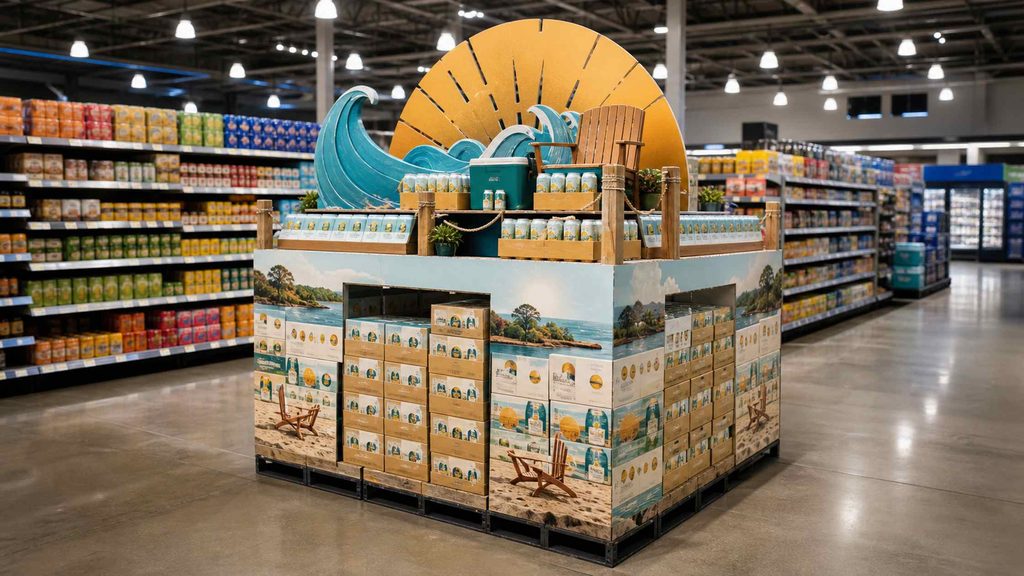
1. Turn a Pallet Display Into a Branded Island
A pallet display suits high-volume promotions involving cartons or multipacks. Add a printed pallet surround, corner panels, and a header so the stock becomes a 360-degree branded feature rather than a warehouse-style stack.
Use it for summer events, sports viewing, holidays, or value-pack promotions in supermarkets and club stores. Keep the offer readable from the main traffic direction. The structural pallet should carry the load; decorative components should not be treated as load-bearing unless engineered for that purpose.
Choose this idea when: volume, fast replenishment, and broad visibility matter more than a small footprint.
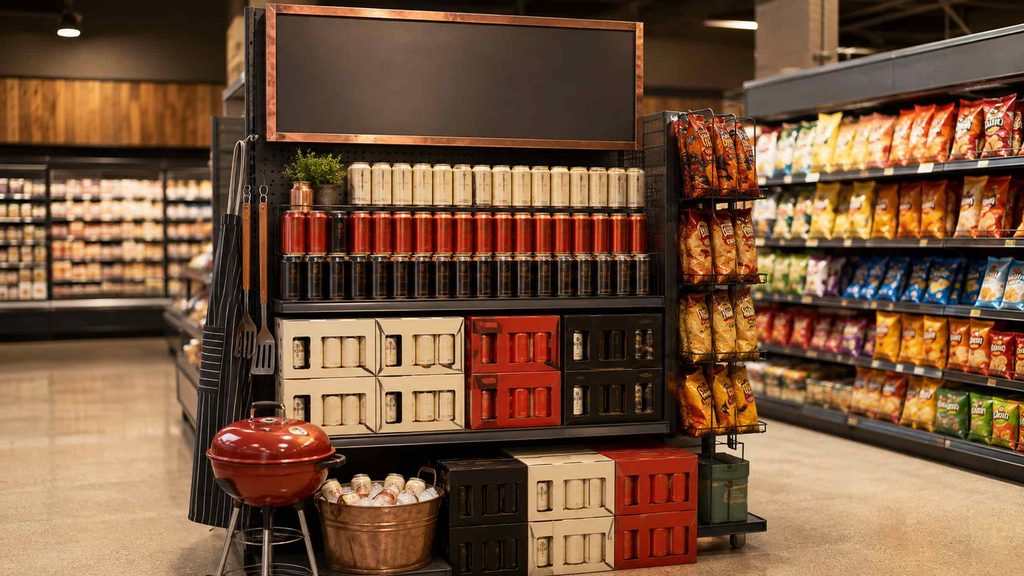
2. Build an Occasion-Based Endcap
An endcap can frame beer around a specific shopping mission: barbecue night, game day, camping, a local festival, or holiday hosting. Add complementary products only when the relationship is immediately clear and the retailer permits alcohol cross-merchandising.
One strong headline is more useful than several competing messages. Keep the beer as the visual anchor, use clear price communication, and give every participating SKU an obvious position. Retail endcaps are valuable because they reach shoppers moving through the main aisle, so an unfocused assortment wastes premium space.
Choose this idea when: the campaign has a clear occasion and the retailer offers an end-of-aisle feature.
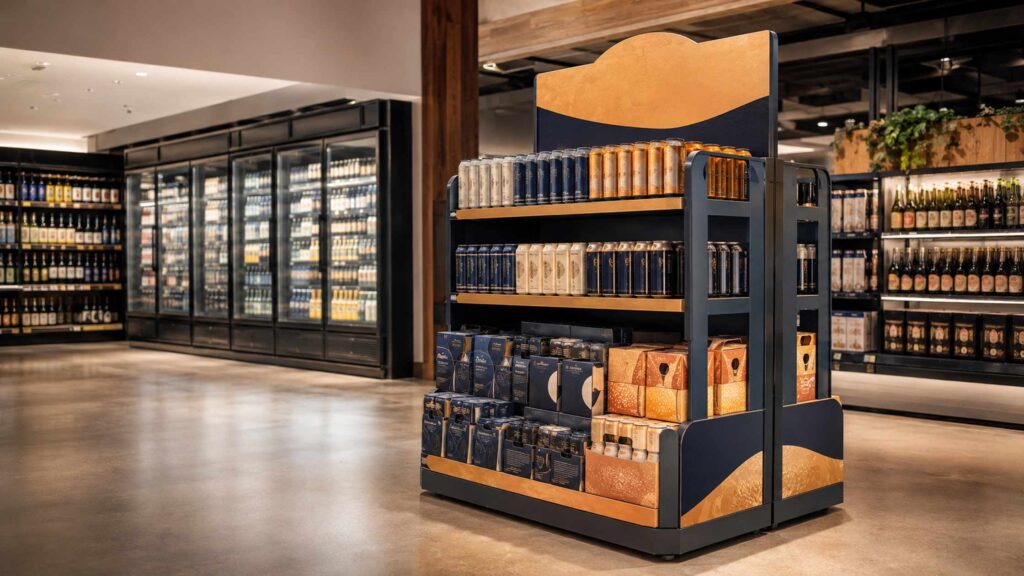
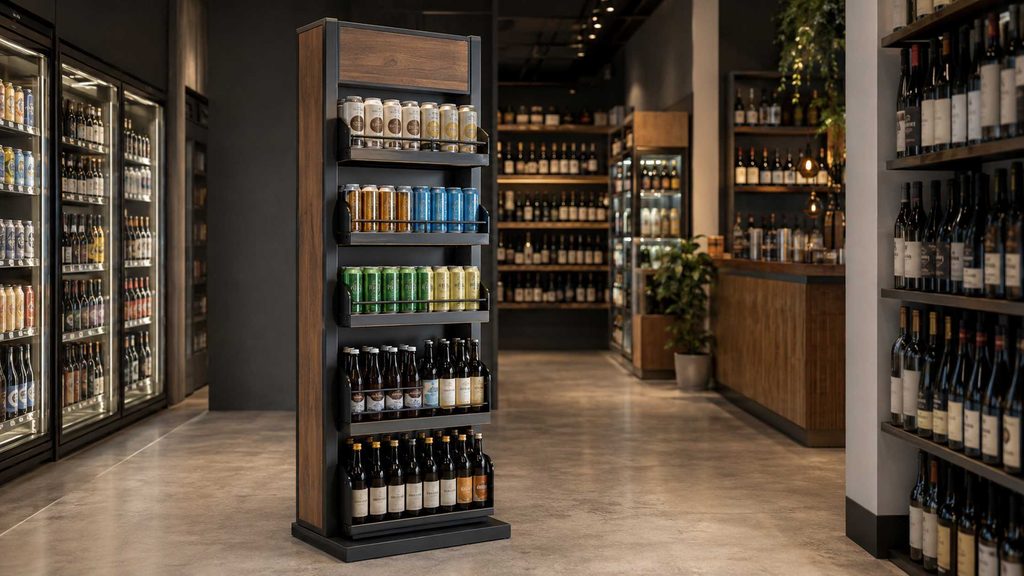
3. Use a Compact Vertical Rack in Small Stores
Convenience stores and urban liquor shops may not have space for a wide floor display. A narrow, tall rack uses vertical space and can bring cans or bottles closer to eye level.
Specify shelf pitch, front retention, base stability, and the exact loaded capacity. A metal-wire or mixed-material rack can support repeated campaigns, while replaceable headers and side graphics allow the brand to update the message without replacing the frame.
Choose this idea when: the footprint is restricted but the campaign needs several visible facings.
4. Create a Craft Beer Discovery Display
For craft, imported, or premium beer, the display can help shoppers navigate rather than simply signal abundance. Organize products by style, flavor profile, brewery, region, or food-pairing occasion—but use only one classification at a time.
Short shelf-edge descriptions can explain unfamiliar choices near the product. A mixed-SKU display also needs simple replenishment rules so one fast seller does not leave a large visual gap.
Choose this idea when: education and assortment discovery are more important than a single-SKU volume push.
5. Add a Cooler-Zone Display for Cold Purchase
When immediate consumption is part of the mission, position the promotional message at or near the refrigerated section. Options include cooler-door graphics, a slim rack beside the cooler, shelf strips, or a header that visually connects an off-shelf feature with the cold stock.
Do not block doors, ventilation, pricing, or shopper access. Materials near chilled cases should tolerate condensation and routine cleaning. POS format guides identify refrigerator-adjacent displays as a distinct beverage format because location is central to the purchase occasion (Outshinery).
Choose this idea when: “cold and ready now” is part of the offer.
6. Make the Case Stack the Creative Structure
Beer cartons can form a bold shape, wall, arch, stadium, or other campaign-relevant silhouette. This approach uses sellable inventory as much of the visual mass and adds printed signs or cutouts for meaning.
The shape must never compromise stack stability or make lower stock difficult to remove. Define a safe build plan, maximum height, replenishment sequence, and final appearance for partially depleted stock. A creative display that collapses visually after the first purchases will be hard to maintain across a rollout.
Choose this idea when: the packaging is visually consistent and store staff can execute a controlled planogram.
7. Use Modular Blocks for Multi-Store Flexibility
A modular system uses repeatable bases, shelves, headers, or cubes that can form a small unit in one store and a larger feature in another. This helps a campaign adapt to different floor plans while retaining a consistent brand language.
Number the parts, reduce tool requirements, and supply more than one approved configuration. Interchangeable graphic panels can extend the fixture across seasonal changes or product launches.
Choose this idea when: a rollout covers several store formats or the fixture will support multiple campaigns.
8. Add a Simple Interactive Element
Interaction does not need to mean a complex screen. A flavor finder, rotating selector, lift-up information panel, QR code, or voting prompt can give shoppers a reason to pause. The interaction should help a decision, not compete with the product.
For digital elements, plan power, security, content ownership, connectivity, accessibility, and maintenance before approval. Always provide a useful static message if the technology fails.
Choose this idea when: the product needs explanation or the campaign has enough dwell time to reward engagement.
9. Design a Reusable Permanent Rack With Campaign Skins
A powder-coated metal or durable mixed-material rack can create a long-term branded position in liquor stores or specialty retail. Use removable headers, magnetic panels, shelf strips, or sleeves to refresh the promotion.
Permanent fixtures usually cost more to produce and ship than temporary corrugated units. The business case improves when the frame will remain placed, survive repeated restocking, and accept future campaigns without major rework.
Choose this idea when: the brand needs a durable presence and has a plan to maintain the fixture.
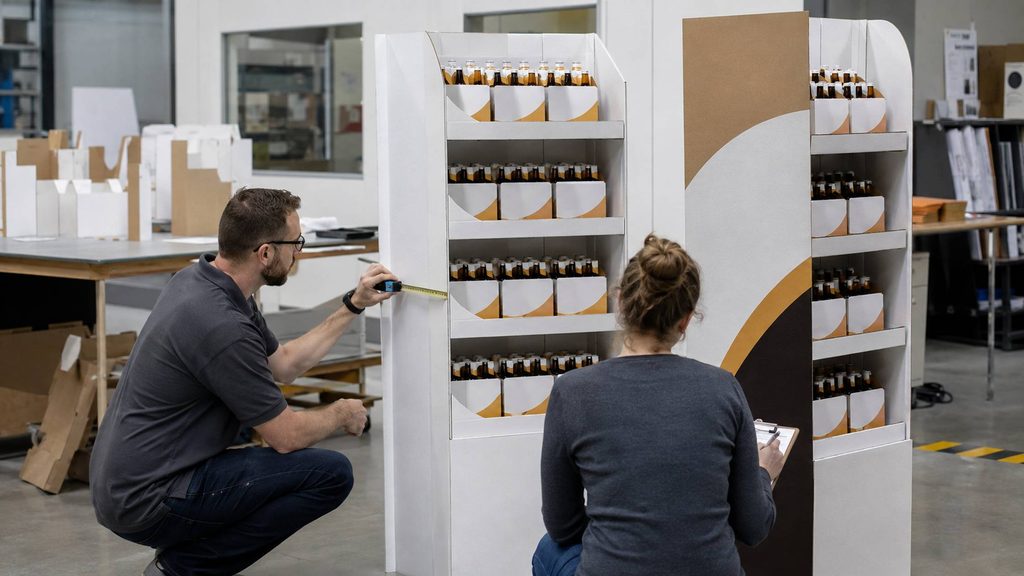
10. Design a Flat-Pack Pop-Up Display
A flat-pack corrugated display can suit a short launch, tasting event, or seasonal promotion. It offers a large printable area and can reduce shipping volume compared with a fully assembled fixture.
The tradeoff is field execution. Assembly should be intuitive, parts should be difficult to reverse, and instructions should rely on clear diagrams. For beer, structural testing with the actual packs and expected retail conditions is essential; board grade alone does not prove that the finished unit will perform.
Choose this idea when: the campaign is temporary, graphics are important, and distribution efficiency is a priority.
How to Match the Display to the Promotion
| Promotion need | Strong starting format | Main design priority | Common risk to control |
|---|---|---|---|
| High-volume multipack event | Pallet island | Stock access and 360° branding | Unstable or untidy depletion |
| Seasonal story | Endcap or floor stand | Immediate theme recognition | Too many messages |
| Small convenience store | Slim vertical rack | Capacity per square foot | A top-heavy unit |
| Craft assortment | Multi-shelf discovery display | Navigation and shelf labels | Shopper confusion or empty slots |
| Immediate cold purchase | Cooler-zone display | Product-message proximity | Obstructed doors or condensation |
| National multi-format rollout | Modular system | Repeatable configurations | Inconsistent field assembly |
| Short campaign | Flat-pack corrugated display | Fast setup and strong graphics | Moisture or overload |
| Long-term brand presence | Metal or mixed-material rack | Durability and replaceable graphics | Paying for a fixture that loses placement |
Start with the commercial objective and store restriction, not a material or a visual effect. The format should solve the placement problem before decoration begins.
Choosing Materials for a Beer Display Stand
Corrugated Board
Corrugated board offers strong print coverage, flat-pack potential, and economical production for temporary promotions. However, beer is heavy and beverage zones may be humid. Ask the supplier to engineer the structure around the actual product load, campaign duration, and environment.
Corrugated Plastic or Foam Sheet
Plastic sheet materials can offer better moisture resistance for damp floors, chilled areas, or repeated short campaigns. Confirm local recycling options and avoid broad environmental claims based only on the word “reusable.”
Metal
Steel wire, tube, or sheet construction is appropriate for repeated use and higher durability. Powder coating can provide color and surface protection. Buyers should evaluate weld quality, sharp edges, shelf deflection, anti-tip design, coating consistency, and replaceable branding parts.
Wood and Mixed Materials
Wood or wood-look panels can support a crafted or premium presentation, while a metal frame provides strength. Mixed-material fixtures may create a distinctive result but can add weight, assembly steps, shipping cost, and end-of-life separation work.
The right comparison is not simply unit price. Compare the total installed cost per campaign, including design, prototypes, production, graphics, freight, store labor, damage, storage, updates, and disposal or recovery.
What to Put in a Beer Display Sourcing Brief
A useful request for quotation should include:
- Pack type, exact dimensions, unit weight, and photos
- Number of SKUs and desired facings
- Maximum fully loaded weight and replenishment method
- Approved footprint and height by store format
- Promotion dates and intended service life
- Indoor environment, moisture exposure, and cleaning routine
- Retailer specifications and approval process
- Brand assets, required graphic zones, and changeable elements
- Assembly-time target, tools allowed, and staff skill level
- Shipping destination, pack-out limits, and labeling requirements
- Prototype quantity, test expectations, inspection criteria, and rollout volume
- End-of-campaign reuse, recycling, return, or disposal plan
Retail promotion programs can impose exact limits on footprint, SKU count, timing, artwork, and installation. For example, The Beer Store publishes fixture and campaign conditions for participating suppliers rather than accepting an unrestricted display concept (promotional guide). Obtain the current requirements from each retailer before freezing the design.
Prototype and Test Before Rollout
Begin with a white sample or structural prototype. Load it with the real product, assemble it using the intended instructions, replenish it repeatedly, and observe access from a shopper’s height. Then produce a printed sample to evaluate color, legibility, pack visibility, and store fit.
Testing should reflect the distribution method and known hazards. The International Safe Transit Association explains that different procedures address different shipment types and that some conditions may require additional consideration (ISTA). Your display supplier and test laboratory should select an appropriate protocol; naming a test without matching it to the distribution system is not enough.
Before scaling, agree on pass/fail criteria for:
- Static load and shelf deflection
- Stability and anti-tip performance
- Assembly accuracy and time
- Pack removal and replenishment
- Transport vibration, impact, and compression where relevant
- Moisture or cleaning exposure where relevant
- Print, coating, hardware, and dimensional quality
Measure the Promotion, Not Just the Display
A display should be evaluated as part of a retail program. Define the baseline and measurement window before launch. Useful measures include display compliance, on-shelf availability, units sold per store per week, sell-through, out-of-stocks, damage, replenishment time, and cost per participating store.
Compare similar stores where possible and record price changes, media support, seasonality, and distribution differences. This makes it less likely that every sales change will be credited to the fixture alone. Photo audits can also reveal whether the concept survived real store execution.
Frequently Asked Questions
What is the best display stand for beer?
There is no universal best format. Use a pallet display for high-volume cartons, a compact rack for restricted space, an endcap for an occasion-led promotion, and a durable metal fixture for long-term placement. The correct choice depends on load, location, campaign length, and retailer rules.
Can a cardboard display hold beer bottles or multipacks?
It can when the complete structure is engineered and tested for the defined load and environment. Product weight, shelf span, board specification, supports, humidity, service time, and shopper interaction all affect performance. Request a loaded prototype rather than relying on a generic capacity statement.
How early should we start a custom beer display project?
Start early enough for retailer approval, engineering, artwork, prototypes, testing, production, freight, and store delivery. There is no reliable universal lead time. Ask suppliers for a milestone schedule based on your quantity, material, destination, and approval process.
What information does a display manufacturer need for a quote?
Provide product dimensions and weight, SKU count, capacity, footprint, service period, environment, materials under consideration, branding requirements, pack-out, destinations, testing needs, and volume. Comparable quotes require every supplier to price the same brief.
How can we make a beer display easier to restock?
Provide direct access to every shelf, avoid decorative parts that block cartons, define a replenishment sequence, and test the task with store staff. Gravity-feed or front-facing features may help some can formats, but only when sized and tested for the actual pack.
Should a display include lighting or a screen?
Only when the added element supports a clear message and the store can power, secure, and maintain it. A replaceable printed header or simple interaction may deliver more consistent execution for a short campaign.
Which compliance requirements apply to beer displays?
Requirements depend on the country, retailer, material, electrical components, placement, and promotion. Confirm alcohol-advertising rules, retailer fixture specifications, accessibility and aisle-clearance requirements, and any electrical or fire-safety obligations with qualified local parties.
Turn an Idea Into a Retail-Ready Display
The strongest beer display ideas balance attention with execution. Select the format by campaign goal, product load, store footprint, environment, and service life. Then use branding and interaction to make the offer clear.
Before requesting production pricing, prepare one shared specification and ask shortlisted suppliers for a structural concept, material recommendation, prototype plan, test proposal, pack-out, and itemized quotation. That process turns an attractive sketch into a display that can work across real stores.