The best custom drink coaster material depends on how the coaster will be used. Choose absorbent pulpboard for high-volume bar promotions, cork for natural reusable sets, silicone or PVC rubber for wet and repeat-use environments, and PU leather, wood or metal when the goal is a premium gift or table-service experience. The right choice is the one that fits the campaign, not the material with the longest feature list.
For brewery marketers, distributors and hospitality buyers, a coaster has two jobs: manage moisture on the table and keep the brand visible at the moment a drink is served. This guide helps you choose a material, decoration method and specification that can do both.
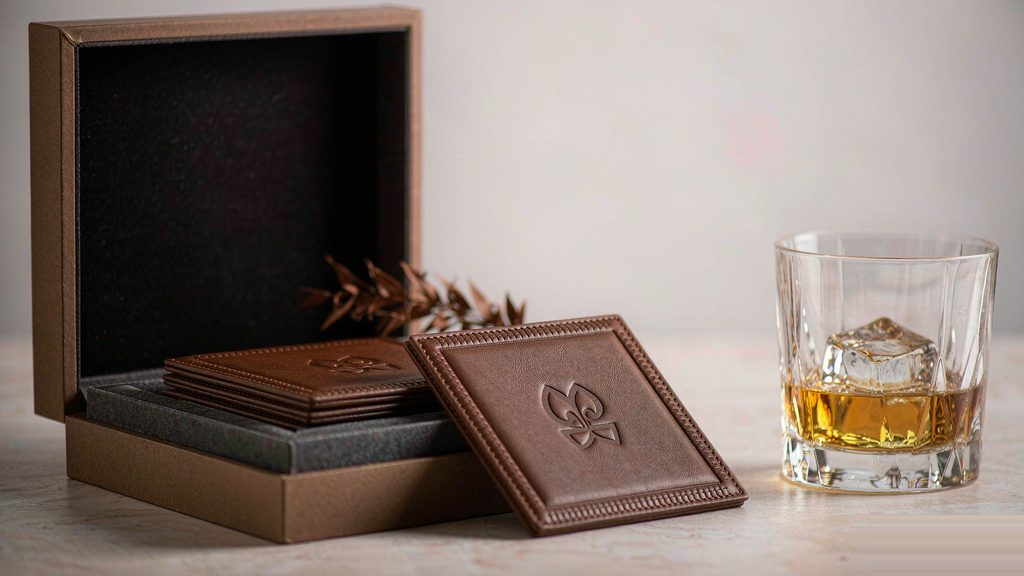
Start With the Job, Not the Material
Do not begin by asking a supplier for the “best coaster.” Give it a use case. A coaster for 10,000 cold beers at a weekend festival needs a different specification from a four-piece retail gift set.
Write down these five points before comparing samples:
- Where will it be used? A dry office, a busy bar, an outdoor activation and a home gift set expose the coaster to different amounts of condensation, handling and cleaning.
- How long should it last? Is it a single-campaign consumable, a venue item used every day, or a keepsake?
- What must the artwork achieve? Full-colour campaign art, a simple logo, a QR code, a debossed mark and a moulded relief all point to different materials and processes.
- What drinkware will sit on it? A small bottle, a pint glass, a large mug and a tumbler have different footprints. Measure the base of the actual glass rather than choosing a size by habit.
- What is the distribution route? Loose table stock, cartons to bars, individual retail packs and multi-item promotional kits need different packing and damage protection.
This brief prevents a common mistake: selecting a premium-looking hard coaster for an ice-cold beer promotion, then discovering that water collects on its surface. It also prevents the opposite mistake—using disposable board for a campaign intended to remain on tables for months.
Custom Coaster Materials at a Glance
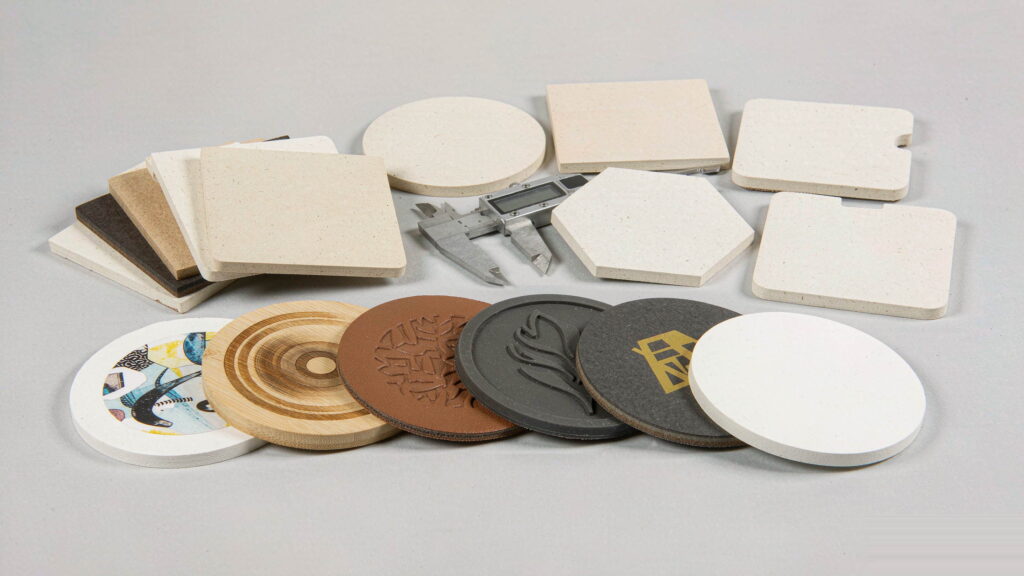
| Material | Absorbency | Reuse potential | Best brand expression | Best fit | Main limitation |
|---|---|---|---|---|---|
| Pulpboard / absorbent paperboard | High when uncoated | Low to medium | Full-colour print, campaign copy, QR code | Bars, festivals, launches, high-volume sampling | Wears out and a heavily inked face may absorb less |
| Cork | Medium | Medium to high | Natural print or laser engraving | Craft beer, tasting rooms, retail sets | Texture changes fine artwork and can stain over time |
| Silicone / PVC rubber | Low; holds water rather than wicking it | High | Moulded relief, bold spot colours | Wet venues, outdoor gear, reusable giveaways | Less suitable when condensation must be absorbed |
| PU leather / leatherette | Low | High with appropriate care | Deboss, foil, restrained print | Premium bars, client gifts, executive sets | Not a solution for heavy cold-drink condensation |
| Wood, bamboo or MDF | Low unless paired with another layer | Medium to high | Laser engraving, simple print | Gift sets, rustic hospitality, retail | Needs a stable finish and edge quality; not naturally absorbent |
| Metal, stone or ceramic | Low to variable by construction | High | Engraving, print or premium surface finish | High-perceived-value sets | Weight, breakage risk and pooled condensation can increase costs |
The table is a selection tool, not a universal specification. “Cork coaster” can mean different densities, thicknesses, printing systems and backing materials. Ask for a physical sample of the exact proposed construction.
1. Pulpboard: The Best Choice for High-Volume Beer Promotions
Pulpboard is the familiar beer coaster: a thick, porous board designed to take up condensation. It is usually the strongest option when a brand needs thousands of pieces for bars, trade shows, sampling teams or a limited-time promotion.
Why pulpboard works for campaigns
It gives you a broad printable face at a cost that can work for volume. Use the front for the master brand and the reverse for a seasonal message, serving suggestion, promotion mechanic or QR code. This makes pulpboard more than table protection; it becomes printed campaign media that staff can distribute with each drink.
Common commercial pulpboard specifications include 35, 55 and 80 pt thicknesses. Thicker board feels more substantial, but it also increases material use and carton weight. The right call is not automatically the thickest option: for a short, high-volume activation, a stable mid-weight coaster may be the sensible choice. A supplier catalogue illustrates the common 35/55/80 pt range and its production cautions.
The print-and-absorbency trade-off
Do not assume a full-coverage glossy-looking design will perform like an unprinted beer mat. High ink coverage or a sealed coating can reduce how much of the surface remains available to take up moisture. One catalogue specifically notes that greater UV-ink coverage affects pulpboard absorbency. That is an important production constraint, not a defect. See the stated limitation in the catalogue.
For a cold-beer campaign, ask the supplier for a printed sample and test it with the actual glass or bottle, condensation and expected serving time. Check both the printed face and the reverse. A beautiful proof on screen does not show how the board will behave after several wet glasses.
Choose pulpboard when
- You need broad campaign reach and frequent artwork changes.
- The coaster will be served with cold beer, soda or iced drinks.
- Full-colour imagery, a QR code or promotional copy matters.
- Replacement after the event or campaign is acceptable.
Avoid it as the sole answer for a premium gift set or a long-life outdoor item. In those situations, a reusable material often makes more sense.
2. Cork: The Best Balance of Natural Feel and Reuse
Cork gives a brewery or beverage brand a warmer, less promotional look than printed board. It works especially well for craft positioning, tasting rooms, gift boxes and small sets that should stay in use after the first visit.
What cork does well
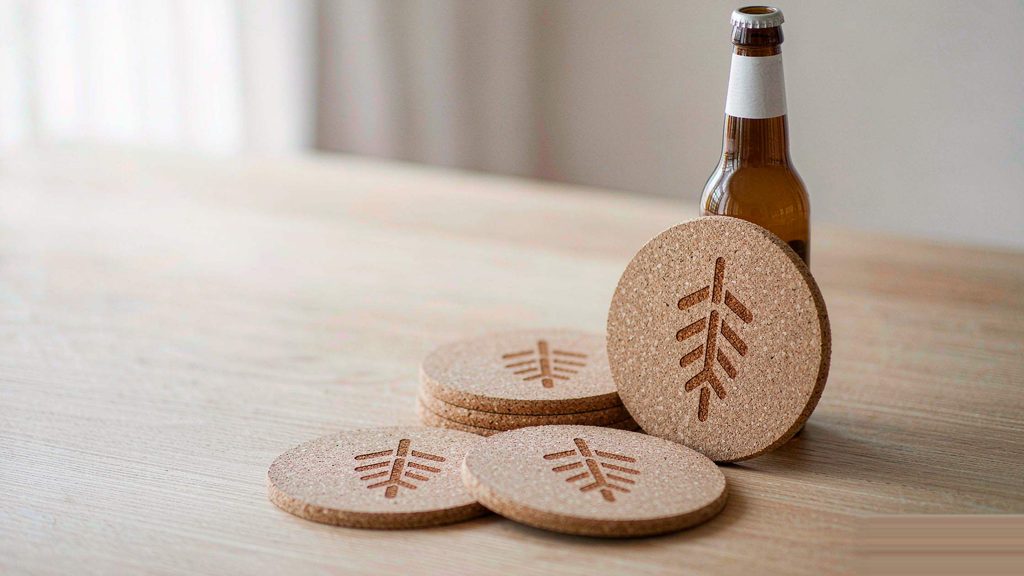
Cork is light, has a naturally tactile surface and provides some grip. Laser engraving produces a permanent tonal mark without trying to make the logo look like a photographic print. A simple icon, wordmark or hop motif usually reads better than fine type or delicate gradients.
The texture is part of the product. It can make each coaster look slightly individual, but it also means printed detail and colour can appear different from a smooth white board. A production catalogue warns that a printed image will be affected by material texture; use that as a reason to approve the actual logo on cork before mass production. The same warning appears in this coaster catalogue.
Choose cork when
- You want a reusable promotional item without moving into a luxury gift price band.
- Your visual identity suits natural texture and a simpler mark.
- The brand wants a tasting-room, craft or retail-set feel.
- You can accept that repeated cold-drink use may leave marks and require replacement over time.
For highly detailed artwork, do not approve cork based on a digital mock-up alone. Request an ink or engraving sample, viewed at normal table distance.
3. Silicone and PVC Rubber: Best for Wet, Reusable Environments
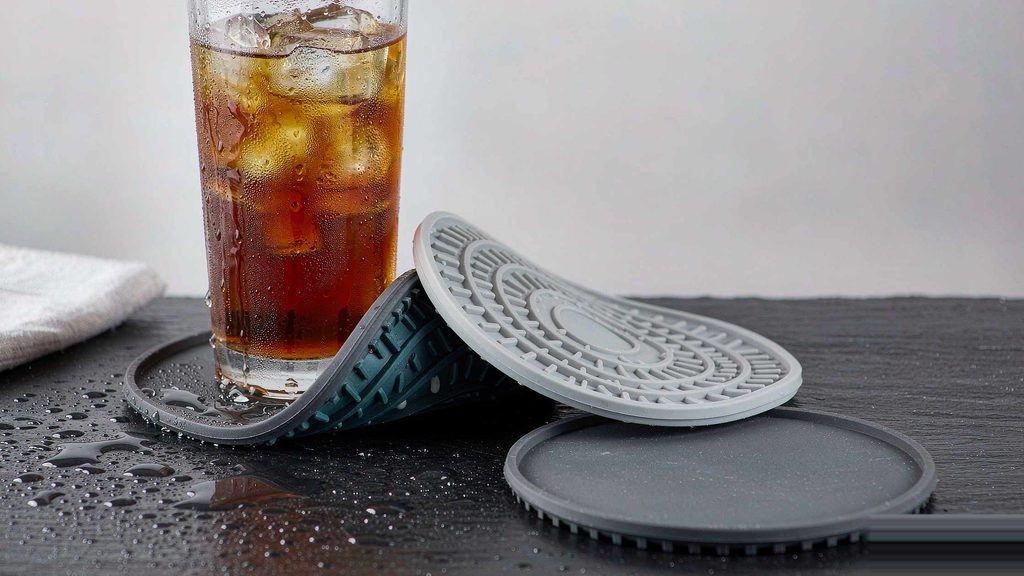
Silicone and PVC rubber are useful when the coaster must be washable, grippy and reusable. They are sensible for venue service, outdoor campaigns, beach promotions, cooler-bag kits or a branded product intended to be kept.
Understand the functional difference
These materials generally do not absorb condensation. Instead, a textured surface, raised rim or drainage pattern manages water on the coaster while the base helps it stay in place. That can be valuable in wet service areas, but it is different from a paper coaster that wicks moisture away.
The buyer question is therefore not “Is rubber waterproof?” It is: Where does the condensation go during service? Ask for a sample with the proposed surface geometry, then test it beneath a cold drink on the table surface used in your venue. A flat, non-absorbent coaster may allow water to pool or travel over the edge.
Decoration that suits rubber
Bold moulded relief, raised logos and a small number of solid colours normally fit rubber better than intricate photo art. If a campaign needs exact illustration detail or many colour transitions, use an insert, printed layer or a different material rather than forcing an unsuitable process.
Choose silicone or PVC rubber when
- The coaster needs repeated cleaning and strong grip.
- It will be exposed to outdoor, wet or high-handling conditions.
- A bold tactile logo is more valuable than fine photographic artwork.
- The campaign can benefit from a reusable item rather than disposable table media.
Specify whether you mean silicone or PVC. They are distinct materials and should not be treated as interchangeable in a quotation, sample approval or compliance review.
4. PU Leather: Best for Premium Hospitality and Client Gifts
PU leather, often called leatherette, gives the table a more deliberate, premium look. It is usually best in lounges, hotel suites, office bars, gift sets and distributor or client kits—settings where the coaster is part of the presentation rather than a high-turnover consumable.
Debossing, foil and restrained single-colour decoration normally suit this surface better than dense artwork. The material rewards a strong wordmark, monogram or simple icon. If your brand system depends on a vibrant campaign illustration, consider pulpboard for the campaign tables and PU leather only for the keepable set.
Ask for the construction, edge treatment, backing and cleaning guidance. “PU leather coaster” alone is not enough to predict the final feel or service life. Verify that the coaster sits flat and that the bottom will not scratch the target tabletop.
Choose PU leather when perceived value and a controlled premium setting matter more than absorbency. For a cold-beer promotion with constant condensation, it is often better as a gift or VIP item than as the main bar-service coaster.
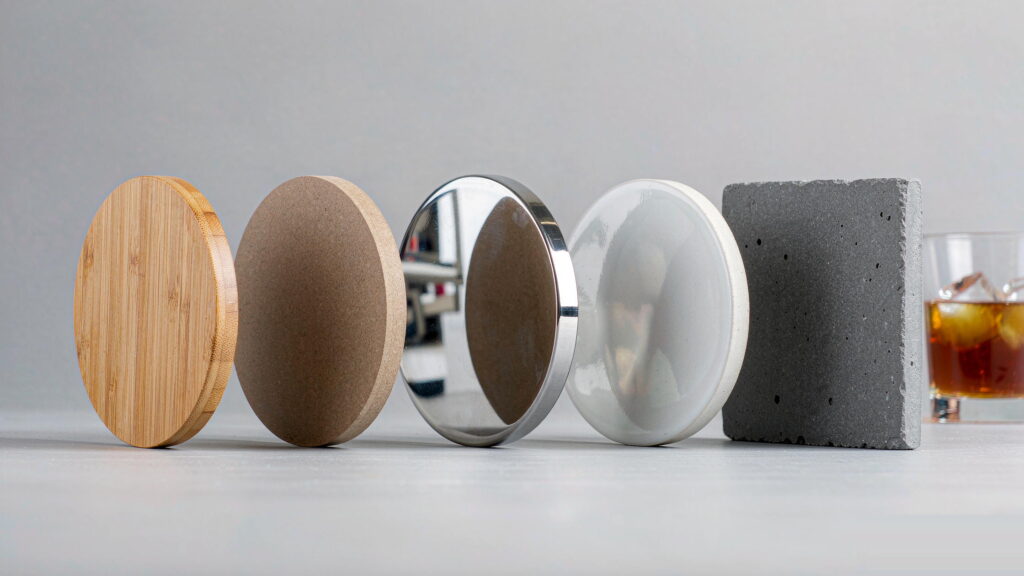
5. Wood, Bamboo, MDF, Metal, Stone and Ceramic: Best for a Specific Premium Story
These hard materials can make a strong retail or gifting statement, but they should be selected for a reason. Their higher perceived value can be offset by weight, breakage risk, thicker packing and more careful quality control.
Wood, bamboo and MDF
These options suit rustic, natural or gift-led brand stories. Laser engraving can be very effective, while a printed face needs colour and adhesion checks. Look closely at edge finishing, flatness and backing; a hard coaster that rocks on the table feels low quality even if the logo is correct.
Metal, stone and ceramic
These can feel substantial and premium, especially in a boxed set. But the functional question remains: does the selected construction absorb or retain condensation? A hard, smooth surface may protect the tabletop from heat and scratches while still leaving water beneath a cold drink. Check the underside, rim, grip and packing as part of the prototype review.
Use these materials for a defined gift, retail or premium hospitality brief. They are rarely the most efficient solution for tens of thousands of one-night bar serves.
Match the Decoration Method to the Material
The artwork is not a separate decision from the material. Ask the supplier which process is being proposed and request a proof on the actual substrate.
| Decoration method | Usually suitable for | Buyer checks before approval |
|---|---|---|
| Full-colour print | Pulpboard, coated hardboard and some cork constructions | Small text, QR readability, colour shift, ink coverage and bleed |
| Screen or spot-colour print | Cork, rubber and simple designs | Pantone target, registration, coverage on texture and rubbing resistance |
| Laser engraving | Cork, bamboo, wood and selected coated surfaces | Minimum line weight, contrast, burn variation and logo detail |
| Deboss / foil | PU leather and leatherette | Die size, depth, placement, foil adhesion and edge clearance |
| Moulded relief | PVC rubber and silicone | Relief height, colour count, drainage geometry and logo legibility |
Avoid hairline borders close to a die-cut edge. Cut-line variation becomes much more visible with a border than with a full-bleed pattern or a logo placed safely inside the trim area. Give the factory your artwork in an editable vector format where possible, and approve the final die line—not only the central logo.
Size, Shape and Thickness: The Details That Affect Daily Use
For most drink service, 3.5 to 4 inches (about 89 to 102 mm) is a practical starting range. A larger footprint helps with wide glass bases and gives campaign art more room, but it uses more material and can feel oversized with a narrow bottle. Measure the real glassware and leave a margin around its base.
Round and square coasters are efficient because they are familiar to venues and simple to pack. A custom die-cut shape can increase campaign recognition, but it creates more edge detail to protect during transit and may limit the usable area for a glass. Use a custom shape only if the silhouette still gives the drink a stable resting surface.
For multi-SKU orders, make a one-page specification sheet for every coaster version. Include material, dimensions, thickness, colour standard, decoration process, front/reverse artwork, backing, packing quantity and carton mark. This becomes the reference for the sample, purchase order, inspection and warehouse receiving check.
A Practical Selection Rule for Beer Brands
Use this decision shortcut when briefing your supplier:
| Your campaign priority | Recommended starting point | What to verify next |
|---|---|---|
| Serve many cold drinks during a short campaign | Pulpboard | Absorbency after printing, thickness, QR readability and pack count |
| Create a reusable craft-style souvenir | Cork | Logo legibility on texture, stain appearance and engraving sample |
| Use repeatedly in wet or outdoor service | Silicone or PVC rubber | Drainage, grip, cleaning method and moulded-logo detail |
| Give a premium set to distributors, VIPs or customers | PU leather, wood, metal or stone | Flatness, backing, decoration quality, unit packing and drop protection |
| Build a retail bundle with a strong natural story | Cork, bamboo or wood | Consistency, retail packaging, care information and component fit |
If your campaign needs both performance at the bar and a keepsake item, use two materials. For example, deploy pulpboard at serving points and include a cork or PU leather coaster in the take-home gift set. Trying to make one coaster satisfy every role usually produces a compromise that is too expensive for volume and not premium enough to retain.
What to Request Before You Approve a Custom Coaster Order
Before you release bulk production, request the following in writing:
- An approved pre-production sample in the final material, thickness and decoration process.
- A material description that names the actual material and construction, not only a marketing label.
- Artwork proof showing trim line, bleed, safe area, front/reverse orientation and Pantone references where relevant.
- Functional checks suited to the material: cold-drink condensation for absorbent coasters; grip, drainage and cleanability for rubber; flatness, edge quality and backing for hard coasters.
- Packaging details: quantity per inner pack and carton, retail-set protection, carton dimensions and gross weight.
- An inspection standard that defines acceptable logo position, colour variation, warping, surface marks and packing damage.
If a coaster will be marketed or used as food-contact material rather than simply supporting drinkware, identify that use before sourcing. In the EU, food-contact materials are subject to a separate framework with safety, traceability and documentation requirements; do not assume these rules apply—or do not apply—based solely on a product name. The European Commission explains the framework and its material-specific measures.
Frequently Asked Questions
What is the best material for custom beer coasters?
For high-volume cold-beer service, absorbent pulpboard is usually the strongest starting point. It manages condensation and provides a broad print area. For a reusable or gift-led product, choose cork, rubber or a premium hard material based on the use setting and artwork.
Are silicone coasters better than paper coasters?
Neither is better in every setting. Silicone is reusable and washable; paperboard is absorbent and economical for volume. Choose silicone for repeat use in wet environments and pulpboard when you need moisture absorption and flexible campaign print.
Can I print a QR code on a coaster?
Yes, but test it at final size on the actual material. Use adequate contrast, a quiet area around the code and a size that scans under realistic venue lighting. Do not place a QR code across cork texture, an embossed rubber surface or a die-cut edge without sample testing.
Should I choose a custom die-cut coaster shape?
Choose it only when the outline adds genuine campaign recognition and leaves enough stable area for the drink. Standard round or square shapes are usually easier to stack, pack and replace. A custom shape needs an approved die line and packing trial.
How do I make custom coasters feel more premium without changing the material?
Improve the parts people touch and see: increase board thickness where appropriate, simplify the design, use a carefully chosen reverse side, add a belly band or set box, and make sure the coaster lies flat. A clear specification and clean execution often add more value than a more expensive material.
Choose a Coaster Your Campaign Can Actually Use
Choose pulpboard for scalable, absorbent beer promotions; cork for natural reusable value; silicone or PVC rubber for repeat-use wet environments; and PU leather, wood or hard materials for premium sets. Then verify the exact construction with a sample, because material names alone do not tell you how a coaster will print, sit, absorb or travel.
Review BeerPromoPro’s custom drink coaster options or discuss a custom brief with the team with your venue type, drinkware size, campaign quantity, artwork and required delivery date. If your activation also needs counter protection, compare the coaster brief with a custom bar mat rather than treating the two products as interchangeable.