Cooler bags do more than carry cold drinks. In a beer promotion, they can become a reusable piece of branded gear that travels to the beach, a tailgate, a picnic, or a game day. But “cooler bag” covers a wide range of products. A simple non-woven six-can tote, a leak-resistant backpack, and a wheeled party cooler may all fit the term, yet they serve very different budgets, audiences, and branding goals.
This guide explains the main types of cooler bags and the practical questions to ask before you order branded coolers for a brewery, beverage brand, distributor, event, or retail program.
What is a cooler bag?
A cooler bag is a portable insulated bag designed to slow the warming of chilled food and drinks. Most are passive coolers: they work with ice, ice packs, or pre-chilled contents rather than a powered refrigeration system. A typical soft cooler combines an outer fabric, an insulating foam layer, and a wipe-clean inner liner.
For a promotional buyer, cooling performance is only one part of the brief. You also need to balance capacity, carry comfort, logo visibility, product weight, packing volume, expected use, and the quality level your brand promises.
The 8 main types of cooler bags
1. Non-woven insulated lunch totes
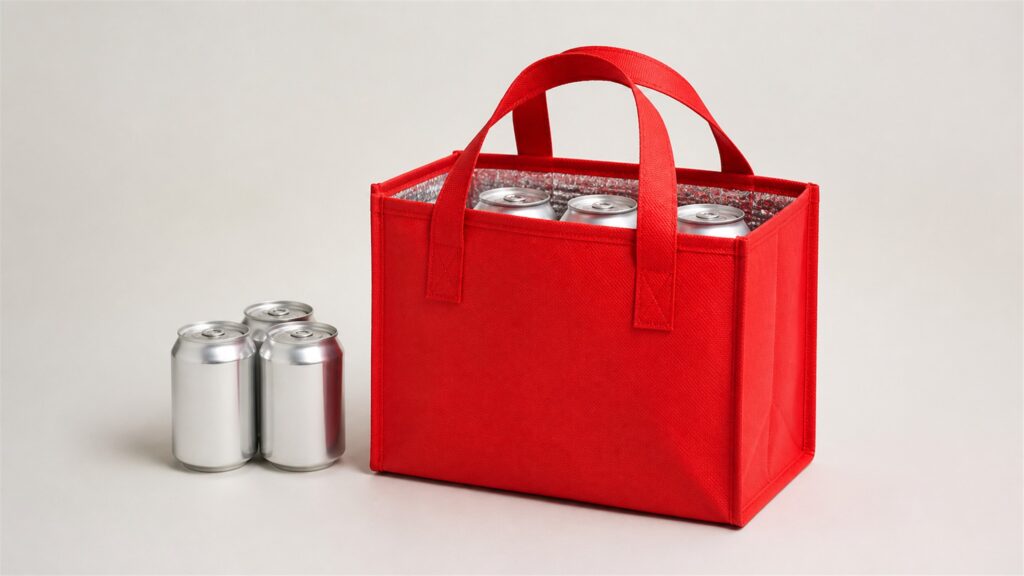
These lightweight bags usually have a non-woven polypropylene exterior, short handles, a zip or hook-and-loop closure, foam or foil insulation, and a simple lining. They are commonly used for lunch, small grocery purchases, giveaways, and short promotional runs.
Best for: sampling campaigns, staff gifts, convenience-store promotions, low-to-mid-budget giveaways, and compact six-pack programs.
Why buyers choose them: They fold flat, leave a broad surface for a printed logo, and are easy to distribute in volume. Alibaba category listings commonly group these products under terms such as non-woven, thermal, reusable, custom logo, and six-can lunch cooler.
Watch-outs: A basic foil liner and thin insulation should not be marketed as an all-day outdoor cooler. Check handle reinforcement, zipper alignment, liner bonding, and whether the bag keeps its shape after loading.
2. Insulated tote bags
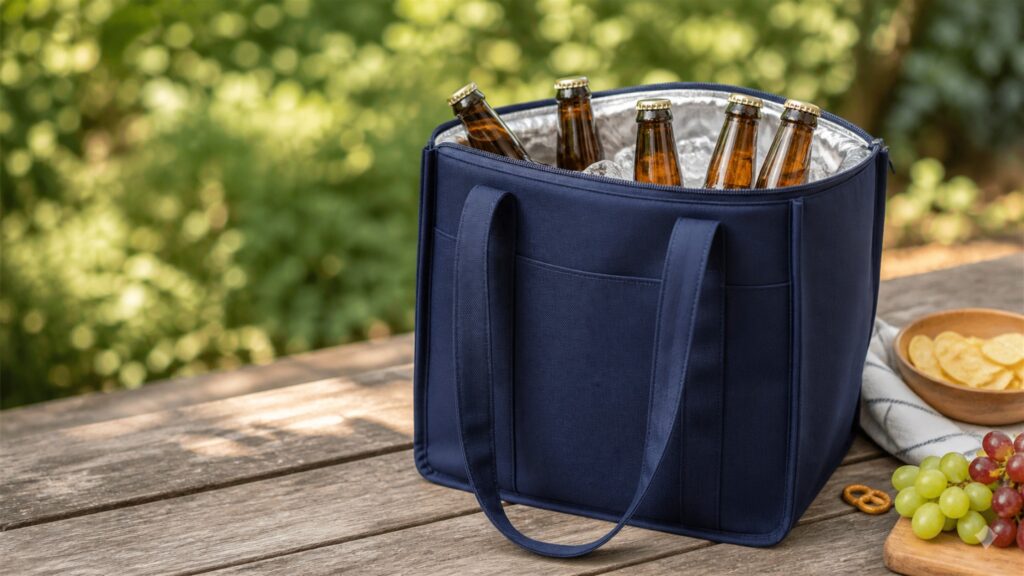
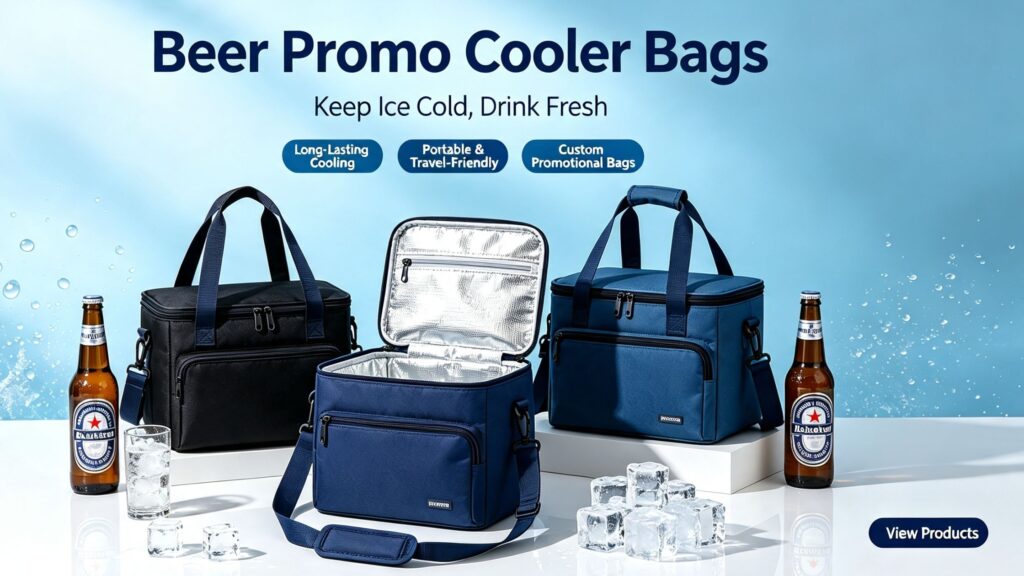
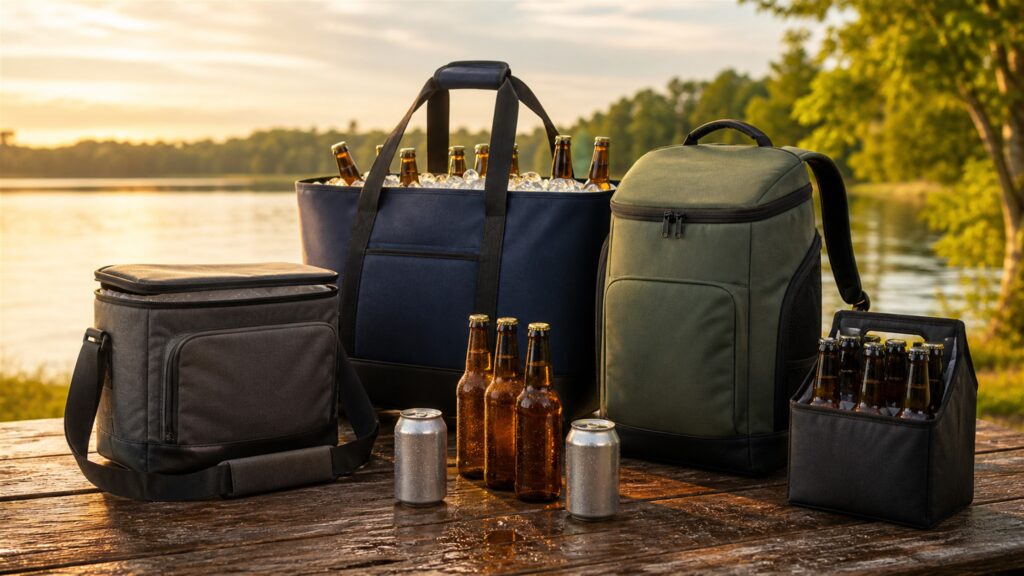
An insulated tote looks closer to a reusable shopping bag but includes insulation and a thermal liner. It can range from a simple supermarket-style tote to a structured beach or grocery cooler with a zip top, front pocket, and long shoulder handles.
Best for: brewery merchandise, lifestyle retail, grocery tie-ins, beach promotions, and branded gift bundles.
Why buyers choose them: Totes offer a generous print area and a familiar everyday shape. A well-designed version can carry snacks, cans, or bottles while remaining useful after the event, extending brand exposure.
Watch-outs: Long handles must be comfortable under load. Ask whether the base is reinforced, whether the liner is leak-resistant, and whether upright bottles are supported. A structured tote generally looks more premium but occupies more shipping space than a fold-flat style.
3. Soft-sided shoulder coolers
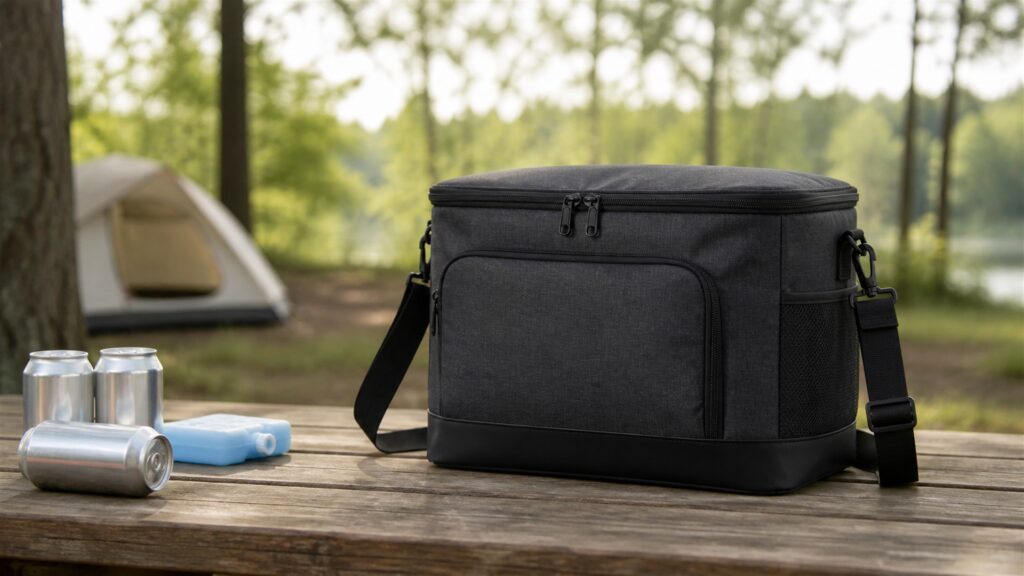
Soft-sided coolers usually have a rectangular insulated compartment, a top zipper, carry handles, and an adjustable shoulder strap. They may include exterior pockets, a removable hard base, or a front panel for branding.
Best for: beer bundles, company picnics, road trips, outdoor retail, and mid-tier promotional merchandise.
Why buyers choose them: This is one of the most versatile cooler formats. It gives customers more capacity than a lunch bag without the bulk of a hard cooler. The flexible shell can also make storage and transportation easier.
Watch-outs: “Leakproof” needs a clear definition. A sewn soft cooler with a standard zip is not the same as a fully welded, waterproof model. Request a sample with ice and water, then check seams, zipper ends, liner corners, and the bottom panel after a reasonable standing period.
4. Backpack coolers
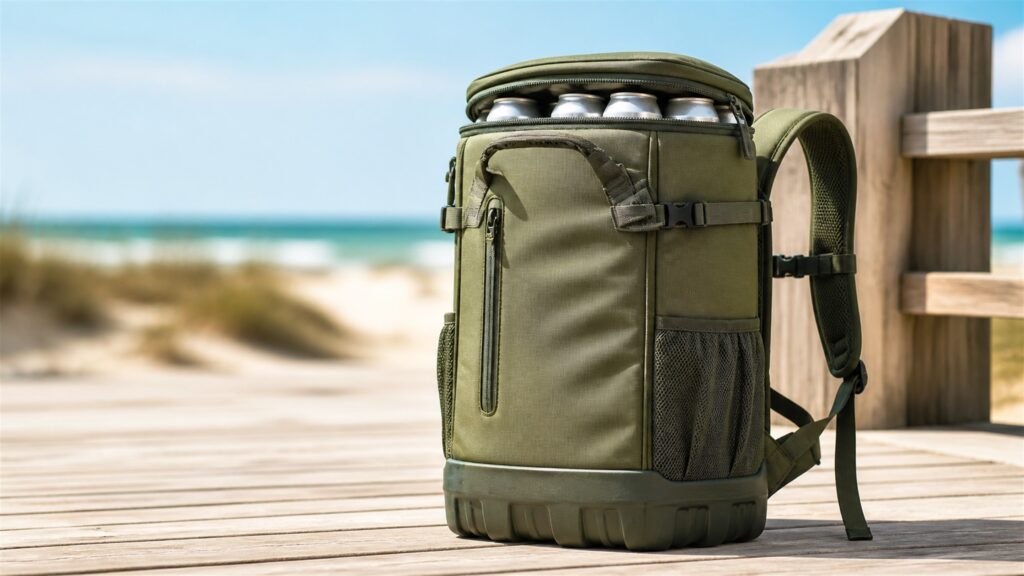
Backpack coolers put the insulated compartment on the wearer’s back. Common details include padded shoulder straps, a chest strap, side pockets, a molded base, and a separate dry-storage pocket.
Best for: beach activations, hiking and festival promotions, sports partnerships, premium beer gifts, and outdoor retail.
Why buyers choose them: Hands-free carrying is their key value. Retail buying guides identify backpack coolers as a practical soft-sided option for beach trips and hikes, where a carried chest cooler would be awkward.
Watch-outs: This style is more sensitive to comfort and construction than a basic tote. Test strap stitching, back padding, balance when full, zipper pull strength, and whether the base stays stable on wet ground. Large-capacity claims should be reviewed alongside the filled weight—not just the advertised number of cans.
5. Picnic baskets and structured coolers
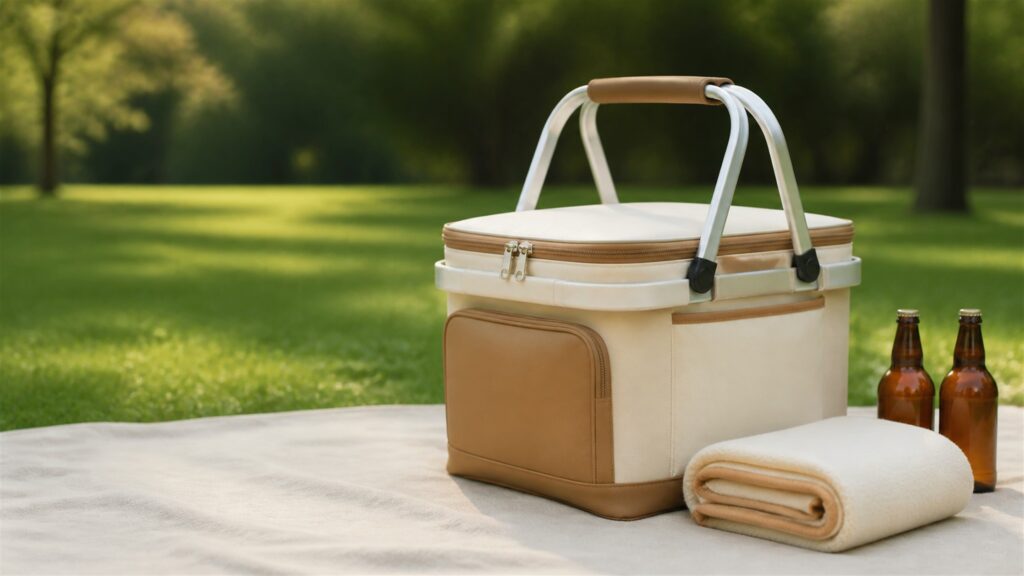
This category includes insulated picnic baskets with aluminum frames, fabric-covered hard-bottom coolers, and semi-rigid box-style bags. Some versions include place settings, bottle holders, cutting boards, or picnic blankets.
Best for: gift-with-purchase campaigns, winery or craft-beer gift sets, corporate holiday gifts, and premium seasonal retail.
Why buyers choose them: Their structure helps protect contents and creates a giftable presentation. Accessories can make the product feel more complete and support a higher perceived value.
Watch-outs: Every extra component creates another inspection point. Confirm the accessory list, spare-part policy, individual packing method, and whether glassware or hard components are protected for transit. Consider whether your artwork needs to be applied before or after the basket is assembled.
6. Collapsible cooler bags
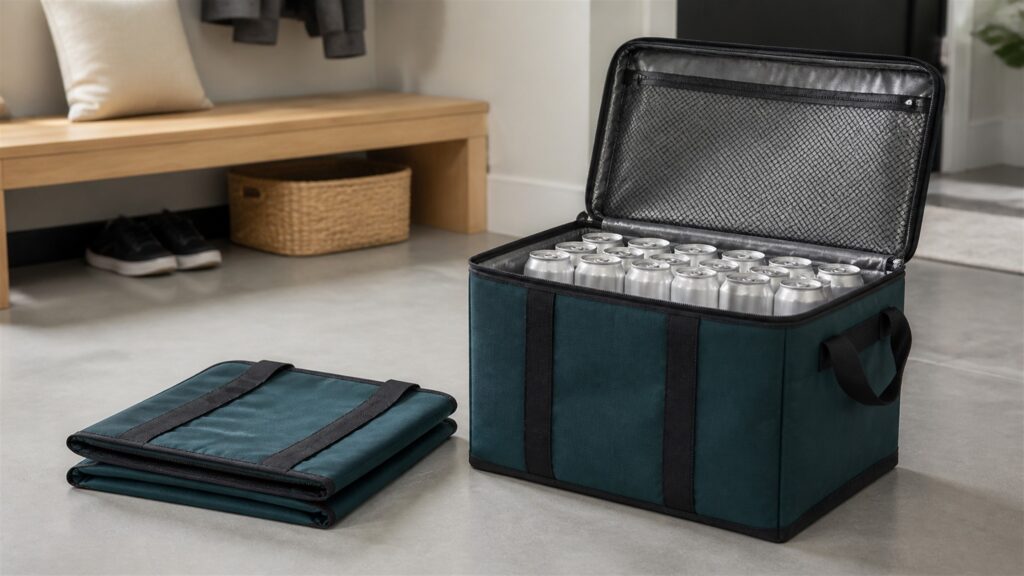
Collapsible coolers are designed to fold or flatten when empty. They may be tote-shaped, box-shaped, or fitted with a pop-up frame and reinforced base.
Best for: mail-friendly merchandise, supermarket promotions, car-trunk storage, and event giveaways where transport volume matters.
Why buyers choose them: They offer more capacity than a compact lunch bag while using less storage space when empty. This can make them appealing for consumers with limited space and for buyers planning high-volume distribution.
Watch-outs: Folding points are stress points. Check that the frame opens consistently, the base inserts correctly, and the liner does not crease or crack at the corners. Request carton dimensions both packed flat and assembled; the difference matters for freight calculations.
7. Rolling cooler bags
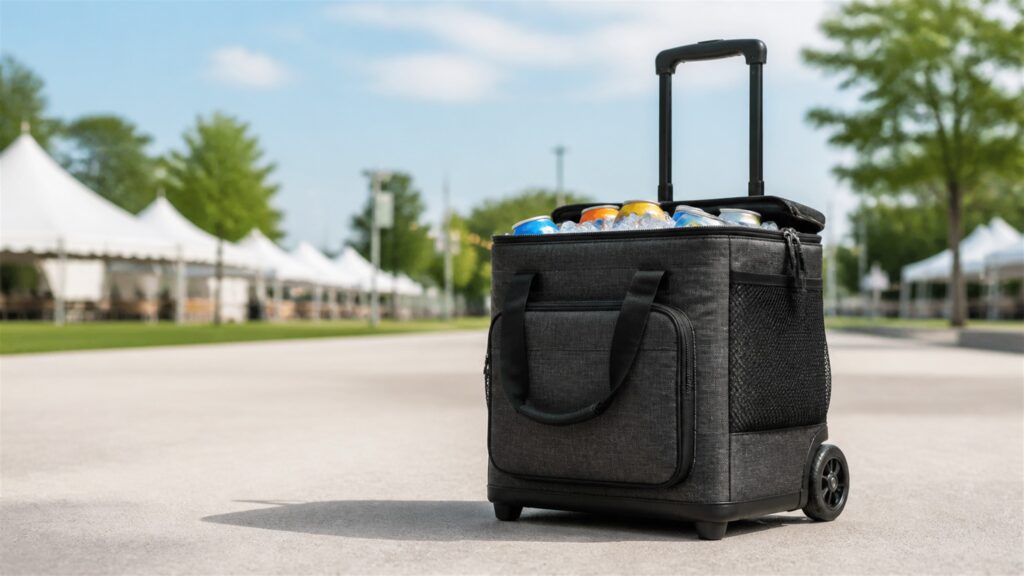
Rolling coolers combine a soft insulated body with wheels and an extendable pull handle. Some are convertible, allowing the bag to be carried when terrain is uneven.
Best for: larger event kits, tournaments, tailgates, beach retail, and premium rewards programs.
Why buyers choose them: Wheels reduce the effort of moving a heavy load over smooth surfaces. They can support a larger capacity without expecting one person to carry the full weight.
Watch-outs: Wheel and handle failures are common return risks. Test the handle extension, axle mounting, wheel clearance, and frame stability with a realistic load. Wheeled products also pack less efficiently and are less useful on deep sand, steps, or rough ground.
8. Bottle, can, and wine cooler carriers
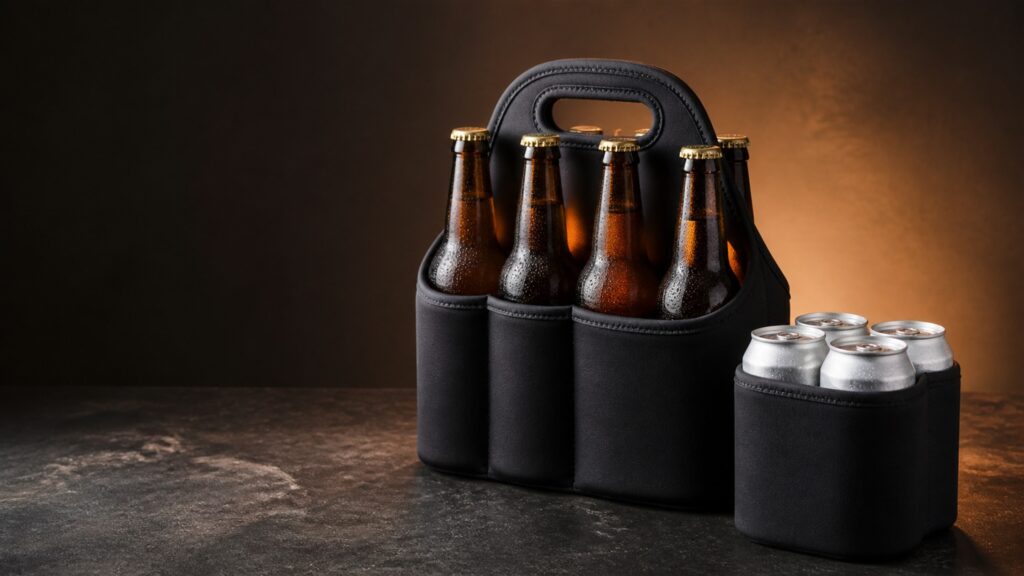
These purpose-built carriers hold one or more bottles or cans. Examples include neoprene can sleeves, six-pack carriers, two-bottle wine totes, and insulated bottle bags with dividers.
Best for: brewery releases, tasting events, holiday packs, on-premise promotions, retail add-ons, and mail-order gift sets.
Why buyers choose them: They make the beverage itself the focus. Compared with a general-purpose cooler, a bottle carrier can be smaller, more giftable, and easier to pair with a specific SKU or seasonal campaign.
Watch-outs: Match the internal dimensions to the actual package—not a generic bottle size. Ask for tests with your can, bottle, or multipack, including divider fit, handle load, and condensation resistance. For glass bottles, evaluate impact protection as well as insulation.
Soft cooler vs. hard cooler: which belongs in your promotion?
For most promotional programs, a soft cooler bag is the practical starting point. It is lighter, easier to carry, and generally more efficient to store than a rigid cooler. It also provides flexible options for printed panels, woven labels, patches, or embroidery.
Hard coolers use thicker, rigid walls and may offer stronger insulation and protection, but they are bulky, heavier, and more expensive to ship. They make sense when the campaign needs a durable premium reward, a long-duration outdoor-use message, or a large-group format. They are not simply an upgraded cooler bag; they are a different product and logistics decision.
Materials and features that change the result
When comparing quotes, do not judge a cooler by the exterior fabric alone. Ask suppliers to specify the whole construction:
- Outer material: Non-woven PP suits entry-level giveaway totes. Polyester, Oxford fabric, canvas, RPET fabric, TPU-coated fabric, and tarpaulin can support different durability, appearance, and price positions.
- Insulation: Foam type and thickness influence shape, feel, and thermal performance. Request the actual specification rather than accepting a generic “insulated” description.
- Liner: PEVA, PE, EVA, and other plastic liners are common. Ask whether the liner is easy to wipe clean, how it is joined at seams, and which documents are available for its intended use.
- Closure: Hook-and-loop closures are economical; zippers offer a more enclosed design; waterproof zipper systems are a separate, higher-specification choice.
- Base and structure: A removable base board, molded base, or hard liner can improve stability, but adds weight and packing volume.
- Carrying system: Handle webbing, strap padding, bartack reinforcement, and metal versus plastic hardware matter more as capacity increases.
Claims about cold retention should always be configuration- and test-specific. Ambient temperature, ice quantity, starting product temperature, sun exposure, and opening frequency all change the result. Avoid promising a number of hours unless the exact product has been tested under a clearly defined method.
How to select the right type for a beer promotion
Start with the campaign, not the bag style.
| If your priority is… | Start with… | Key specification to confirm |
|---|---|---|
| Large-volume sampling or a budget giveaway | Non-woven lunch tote | Print area, handle reinforcement, liner quality |
| Everyday branded merchandise | Insulated tote or soft shoulder cooler | Capacity, closure, and packed-carton size |
| Outdoor and active positioning | Backpack cooler | Strap comfort, stable base, and leak resistance |
| Gift sets and premium seasonal retail | Structured picnic cooler or bottle carrier | Accessories, presentation packaging, and product fit |
| Moving larger loads at an event | Rolling cooler | Wheel/handle durability and loaded weight |
| Shipping/storage efficiency | Collapsible cooler | Folded dimensions and crease-point durability |
Then provide your supplier with a clear brief: target capacity; which bottles, cans, or ice packs it must hold; logo artwork; preferred branding technique; destination market; target landed cost; required delivery date; and packaging needs. A photo alone rarely captures the details that determine a successful sample.
Customization ideas for branded cooler bags
The right decoration method depends on the material, artwork, order quantity, and the brand position you want to create.
- Screen printing is often suitable for bold one- or two-color artwork on flat fabric panels.
- Heat transfer can suit more detailed or multicolor artwork, subject to fabric compatibility and durability testing.
- Embroidery can give a premium look on selected fabrics, but may be less appropriate for thin insulated walls or highly detailed artwork.
- Woven labels, rubber patches, zipper pulls, and custom webbing can add subtle brand recognition without covering the entire bag.
- Custom lining, repeat patterns, and hangtags can make a retail program feel more considered, but should be approved on a production-representative sample.
For beer brands, consider how the bag will look with condensation, outdoor dust, and repeated carrying—not only in a studio photograph. Darker bases, practical wipe-clean liners, and a logo position that remains visible when the bag is full are usually more useful than a large but poorly placed graphic.
Quality-control checklist before bulk production
Approve a pre-production sample and inspect the following points before you release mass production:
- Dimensions and capacity: Test with your real cans, bottles, dividers, and an appropriate ice or ice-pack load.
- Branding: Check logo color, size, placement, and registration against approved artwork.
- Seams and liner: Inspect corners, stitching density, taped or welded areas where applicable, and loose threads.
- Closure and hardware: Open and close zippers repeatedly; check hook-and-loop alignment, buckles, pulls, and strap adjusters.
- Leak-resistance test: Use the agreed test method on the actual sample. Record what “pass” means before production.
- Load test: Lift the cooler with an agreed realistic weight and examine handles, straps, and base deformation.
- Odor and cleanliness: Check for strong material odor, liner debris, adhesive residue, or stains.
- Packaging: Confirm polybag, hangtag, insert card, barcode, master-carton marks, and carton drop protection as required for your sales channel.
Food-contact and market-compliance notes
Cooler bags may hold sealed drink containers, but some designs are also intended to hold unpackaged food. Requirements depend on the destination market, the liner material, and the intended use. If a component is intended to contact food, do not rely on a generic “food-grade” statement.
For example, the EU framework for food-contact materials requires materials not to release substances into food at harmful levels or change food’s composition, taste, or odor unacceptably. The European Commission also describes documentation and traceability expectations for relevant plastic food-contact materials. Ask for the applicable declaration, test support, and market-specific advice for your exact product; do not assume one document covers every material or destination.
FAQ
What type of cooler bag is best for promotional giveaways?
For a large-volume, cost-sensitive giveaway, a non-woven insulated lunch tote is usually the simplest option. If you want the item to feel more like reusable branded merchandise, choose an insulated tote or soft-sided shoulder cooler with stronger fabric, a zipper closure, and a more durable base.
Are backpack coolers worth the higher cost?
They can be, when hands-free portability is central to the campaign. Backpack coolers suit beach, hiking, sports, and festival audiences, but the straps, zippers, and base should be tested carefully because users will carry a heavier load than with a hand-held tote.
Can a cooler bag be customized with a full-color logo?
Often yes, but the best method depends on the fabric, artwork, print location, and order quantity. Ask for an artwork review and a physical or production-representative proof before bulk approval.
What information should I send when requesting a quote?
Send the cooler type, target quantity, size or desired capacity, beverage format, material preference, artwork, branding method if known, packaging request, destination, and required delivery date. Include your target market if you need product documentation or specific compliance support.
Choose a cooler that people will keep using
The best cooler bag for a beer campaign is not necessarily the largest or most technical model. It is the one that fits the occasion, carries the intended drinks comfortably, presents your brand well, and holds up to repeat use.
If you are planning a branded beer promotion, Beer Promo Pro can help you turn your event, retail, or gifting brief into a cooler-bag specification that is practical to produce and easy for recipients to use. Contact our team to discuss your custom cooler bag project.