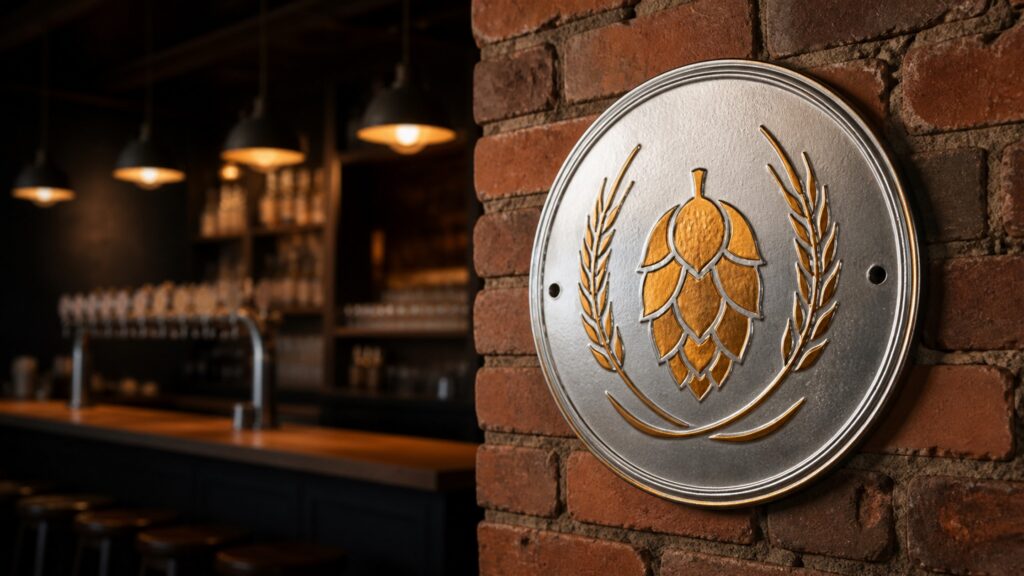
If you have visited a brewery, taproom, bar, or restaurant, you have probably seen a tin tacker. It is a lightweight branded metal sign designed to be mounted on a wall, cooler door, display, or other visible surface. Tin tackers commonly feature a logo, product artwork, promotional message, or decorative brand graphic.
Despite the name, a modern tin tacker is often made from aluminum rather than tin. The name survives because these signs were traditionally “tacked” or nailed to walls, fences, and posts. Today, they remain a familiar point-of-sale and merchandise format—especially for beverage brands that want a durable display with a vintage feel.
What does “tin tacker” mean?
A tin tacker is a printed metal promotional sign, usually supplied with pre-punched mounting holes. It can be flat or embossed, round or rectangular, and may also be made in a custom die-cut shape. The term is widely used in breweries, bars, beverage distribution, and promotional merchandise, although the same format also works for coffee, food, sports, cannabis, events, and retail brands.
The word tin describes the historical association with thin metal signage. The word tacker refers to the way the sign is attached: historically, it was tacked into place with nails or tacks. That origin is useful context, but it should not be mistaken for a universal material specification. Many current suppliers describe their products as embossed aluminum signs because aluminum is light, corrosion-resistant, and practical for printed signage.
What is a tin tacker made of?
The most common modern substrate is thin-gauge aluminum. It is easy to form, light enough for simple wall mounting, and does not rust in the way untreated steel can. Depending on the supplier and program, a sign may also use steel or another metal substrate.
Typical components and finishing choices include:
- A metal blank, often aluminum
- Full-color digital printing or spot-color screen printing
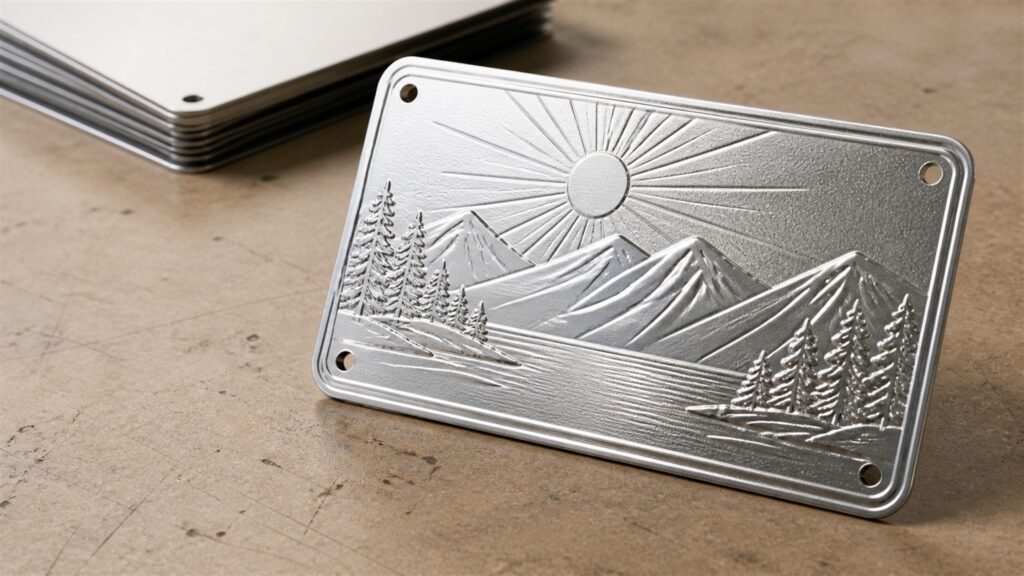
- Optional embossing to raise logos, borders, lettering, or illustrations
- Pre-punched holes for hanging
- Rounded corners, die-cut edges, or a shaped outline
- A clear protective finish or coating, where specified
Embossing is one of the details that gives a tin tacker its tactile, collectible look. A flat printed sign can communicate the same message, but raised elements catch light and add dimension. This is particularly effective for bold logos, badges, bottle-cap effects, and simple high-contrast artwork.
Tin tacker vs. other metal signs
“Tin tacker” is not a precise technical standard. It is a market term for a particular kind of branded, thin-metal display sign. When sourcing, it helps to separate the name from the specification.
| Format | Typical role | What to confirm |
|---|---|---|
| Tin tacker | Branded wall, bar, or point-of-sale sign | Material, shape, print, embossing, mounting holes |
| Flat metal sign | Informational or decorative signage | Gauge, coating, edge finish, mounting method |
| Embossed metal sign | Premium promotional or collectible display | Raised areas, artwork suitability, tooling requirements |
| Retail display | Product-facing point-of-purchase fixture | Size, placement, merchandising function, installation |
The practical distinction is purpose. A tin tacker is usually intended to be seen repeatedly in a branded environment—behind a bar, at a retail counter, on a cooler, or in a consumer’s home. It is not simply a directional sign or a compliance label.
Where are tin tackers used?
Breweries and beverage brands are the best-known users because a metal sign fits naturally into taprooms and bar backdrops. A recognizable design can help make a draft program, seasonal product, or venue feel more distinctive. Distributors and brand teams may also use tackers as account-display materials or as part of a promotional kit.
Common placements include:
- Back-bar walls and taproom interiors
- Restaurant, pub, and tasting-room décor
- Cooler doors and retail merchandising displays
- Trade-show booths and event spaces
- Brand merchandise programs and gift shops
- Home bars, garages, and collector displays
For a buyer, the key value is not only visibility. A tacker is durable décor that can stay in place after a short campaign ends. That gives the brand more opportunities to be noticed than a disposable flyer or temporary shelf card.
Common tin tacker shapes and sizes
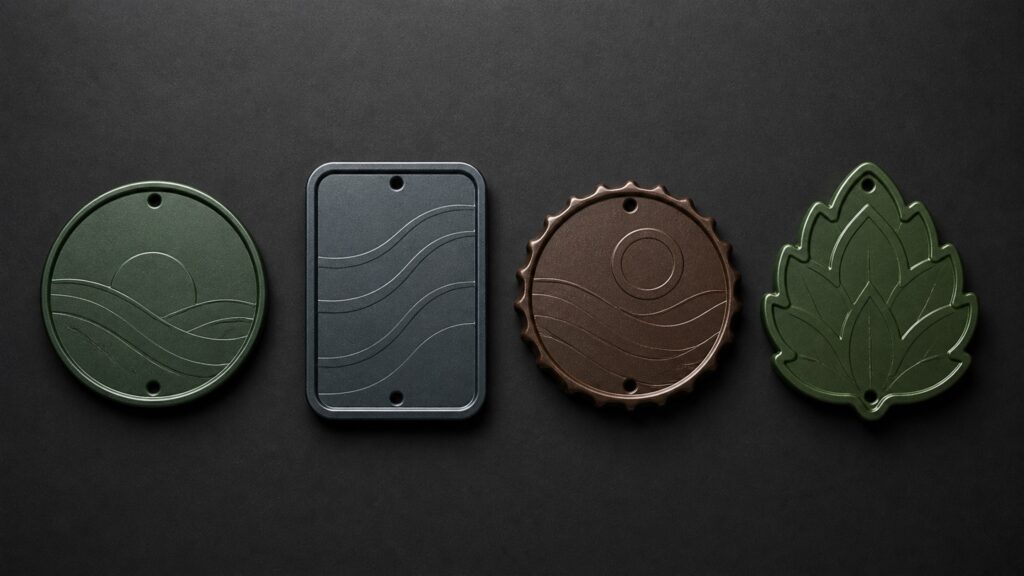
Rectangles and circles are common because they are efficient to manufacture, straightforward to mount, and easy to design for. Bottle-cap shapes are popular with beer and soft-drink brands, while custom die-cut silhouettes can reinforce a logo, package, product, or local identity.
Examples found in current supplier catalogs include 12-inch circles, 12 × 16-inch or 12 × 18-inch rectangles, larger square signs, and bottle-cap formats. These are examples—not universal standards. Your usable size should be selected based on viewing distance, wall space, shipping constraints, and artwork complexity.
Custom shapes can create stronger impact, but they may introduce tooling, packaging, or minimum-order considerations. Ask early whether the quoted price includes die cutting, embossing, holes, protective finish, individual packing, and an artwork proof.
How are tin tackers printed?
Two common approaches are screen printing and full-color digital printing. Screen printing is valued for opaque, bold color on metal and can suit graphic, spot-color designs. Digital printing can be useful for full-color artwork, gradients, and photographic detail. Production methods vary, so the right question is not which method is inherently better; it is whether the method reproduces your artwork clearly and holds up in the planned environment.
Before approval, request a digital proof and check:
- Logo accuracy and correct brand colors
- Legibility at the expected viewing distance
- Whether fine lines or small type will reproduce cleanly
- Where embossed areas will fall
- Bleed, safe area, and hole placement
- Orientation for the intended mounting position
If the sign will be exposed to sun, moisture, frequent handling, or cleaning, discuss the substrate, inks, and protective coating with the supplier. “Indoor/outdoor” claims are not interchangeable across all materials and finishes.

How to design an effective tin tacker
Treat the sign as a quick-read brand asset, not a brochure. Its strongest use is usually a simple message, bold emblem, or memorable visual that works from several feet away. Crowding it with product details can make it less effective in a busy bar or retail environment.
Start with one visual priority: a logo, product name, mascot, campaign symbol, or location cue. Use contrast to separate that element from the background, and reserve embossing for areas where added depth will matter. A raised border, badge, or central illustration can do more for perceived quality than embossing every small detail.
Also plan for the physical format. A circular sign rewards a centered composition, while a wide rectangle can support a horizontal lockup. A custom die-cut needs a silhouette that remains recognizable after it is cut and mounted.
What should buyers ask before ordering?
For a custom tin tacker project, request a clear specification rather than relying on a product name alone.
- What metal and gauge will be used?
- Is the sign flat or embossed, and which areas are raised?
- What are the finished dimensions, shape, and corner/edge treatment?
- Which print process and protective finish are included?
- How many mounting holes are included, and where are they placed?
- What are the minimum order quantity, proof process, packaging, lead time, and freight terms?
- Are artwork setup, custom dies, samples, or revisions charged separately?
Those answers make it easier to compare quotes fairly. They also help prevent a familiar sourcing problem: two items both called “tin tackers” can differ materially in construction, decoration, and readiness for distribution.
FAQ
Are tin tackers really made from tin?
Not necessarily. The name is traditional. Many contemporary tin tackers are aluminum metal signs, though exact materials vary by supplier.
Can a tin tacker be used outdoors?
Potentially, but confirm the metal, inks, coating, and expected exposure with the supplier. Outdoor suitability depends on the specific construction and environment.
Are tin tackers collectible?
Yes. Their retro advertising style, limited campaigns, and durable metal construction make them popular with brewery memorabilia and vintage-sign collectors.
What is the best shape for a first order?
A standard rectangle or circle is usually the simplest place to start. Choose a custom die-cut or bottle-cap format when the shape directly strengthens brand recognition and the project budget supports it.
Final takeaway
A tin tacker is a branded metal sign made to be mounted, noticed, and kept. It combines the longevity of metal with the visual appeal of vintage advertising. For breweries, restaurants, and other consumer-facing brands, the best projects pair a clear design with a fully defined production specification: material, size, shape, print method, embossing, finishing, and mounting.