Promotional items are physical products printed with your logo and given away rather than sold. Most lists of the types of promotional items sort them by price or by alphabet. Neither helps you much before you sign a purchase order.
This one sorts them by what happens after you hand them over.
Here is why that matters. A promotional pen is kept for nine months on average. A promotional USB drive is kept for thirteen. Both sit on the same desk. One of them works harder, and the price tag will not tell you which.
There is one more piece of homework. Almost nobody does it. The type you pick is only half the choice. The other half is how deep the custom work goes, and which print method carries your logo. Those two things set your minimum order, your tooling cost and your delivery date. We cover all three below.
What Are the Different Types of Promotional Items?
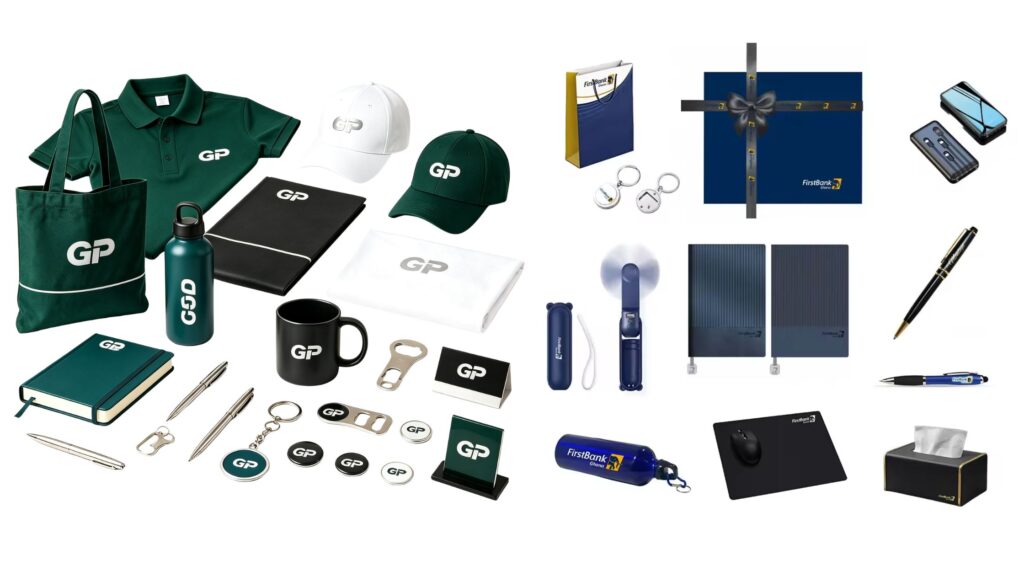
Fifteen types cover almost everything you can put a brand on. Here is the full map, with the average number of months people keep each one.
| # | Type of promotional item | What it covers | Months kept | Cost band |
|---|---|---|---|---|
| 1 | T-shirts | Cotton tees, promo tees, event tees | 14 | $ |
| 2 | Polos and workwear | Uniform polos, service shirts, aprons | 13 | $$ |
| 3 | Outerwear, fleece and jackets | Softshells, fleece, puffers, vests | 16 | $$$$ |
| 4 | Caps and headwear | Baseball caps, beanies, bucket hats | 10 | $$ |
| 5 | Drinkware | Mugs, tumblers, bottles, branded glassware | 12 | $–$$$ |
| 6 | Bags and totes | Tote bags, cooler bags, backpacks | 11 | $–$$ |
| 7 | Writing instruments | Pens, pencils, metal pens, pen sets | 9 | $ |
| 8 | Desk and office accessories | Mouse pads, organisers, pen cups | 13 | $–$$ |
| 9 | Notebooks, journals and calendars | Notebooks, planners, wall calendars | 8 | $–$$ |
| 10 | Tech accessories and power banks | USB drives, power banks, chargers, cables | 12–13 | $$–$$$$ |
| 11 | Umbrellas | Folding, golf, automatic | 14 | $$ |
| 12 | Home, kitchen and housewares | Blankets, towels, cookware, tools | Not measured | $$–$$$ |
| 13 | Health, safety and wellness | Hand sanitiser, face masks, first aid | Not measured | $ |
| 14 | Awards, trophies and recognition | Glass awards, medals, plaques | Not measured | $$$$ |
| 15 | Event gear and retail display | Tents, flags, signs, shelf displays | Not measured | $$–$$$ |
Cost bands are a rough guide, not a promise. They move with material, print method, packing and order size. Check them against a live quote before you set your budget.
The months kept set comes from ASI’s Global Ad Impressions Study, 2019 edition. The year matters, and we explain why further down.
Note what this table quietly admits. ASI measured twelve types, not fifteen. The last four were left out. Blankets and home goods now rank among the fastest-growing parts of the industry, but nobody has put a retention number on them. A blank here means nobody measured it. It does not mean zero.
Want to know what these are made of, and which material drives your after-sales problems? Read our take on what promo material means.
What Sells the Most vs What People Actually Want
Every other list of the types of promotional items stops at the catalogue. The catalogue answer and the human answer are not the same. Knowing the gap is free money.
ASI’s 2026 Ad Impressions Study gives us both sets, side by side.
Top five by share of US industry sales:
| Rank | Type | Share of industry sales |
|---|---|---|
| 1 | T-shirts | 16.1% ($4.3 billion) |
| 2 | Drinkware | 10.4% ($2.8 billion) |
| 3 | Polos | 9.5% ($2.5 billion) |
| 4 | Caps and headwear | 9.0% ($2.4 billion) |
| 5 | Bags | 7.2% ($1.9 billion) |
Top five that people say they are most keen to get: T-shirts, fleece and jackets, food gifts, blankets, and bags.
Now read those two lists against each other. Only two types show up on both: T-shirts and bags.
That leaves a strange gap. Polo shirts are the third best-selling type in the whole industry. People are not that keen to get one. Caps come fourth, and headwear is among the shortest-kept items at ten months. At the same time, food gifts and blankets sit near the top of what people want. Neither one is a big line on most orders.
One more thing about that lead group. Those five types alone make up most of the US market. Yet the market grew just 1.3% in 2025, per PPAI’s own sales estimate, which put the total at $27.1 billion — the first time past $27 billion.
PPAI’s own economist summed the year up in one line: *”Many distributors sold more but made less.”*
Growth that slow means hot categories are winning at someone else’s cost. They are not lifting the whole market.
How Long Do People Keep Each Type?
This is the part where most articles mislead you. So let us be exact.
Those “months kept” numbers making the rounds — outerwear 16, umbrellas 14, T-shirts 14, writing instruments 9, calendars 8 — come from ASI’s Global Ad Impressions Study, 2019 edition. Open ASI’s own PDF and you will see it stamped ©2019 on the page.
Promotional blogs have rewritten those numbers dozens of times since. Nearly every rewrite drops the year. Some are dated 2026, so old figures read as current.
ASI’s later editions ask a different question. Instead of counting months, they ask whether you keep something for at least a year. That is not the same measure. You cannot lift the 2019 months into a 2026 deck and call them new.
We use the 2019 set here because it is the one with a traceable source. And we print the year. That is the step everyone else skips.
What the 2019 data still tells you, and it holds up:
- Outerwear lasts longest at 16 months. Jackets get worn in public, again and again, for years.
- Calendars go first at 8 months. They also have the highest bin rate of the twelve — close to half of recipients just throw them out.
- T-shirts and umbrellas tie at 14 months. Very different price tags, the same staying power.
- Drinkware holds 12 months. And 87% of people say they keep it because it is useful.
Usefulness drives the whole chart. In ASI’s 2026 study, 78% of people said they keep an item because it is useful. Compare that with “enjoyable to have” at 43% and “attractive” at 42%. It is not close.
For the newer numbers and what moved this year, our promotional product trends in 2026 guide covers the same ground with current data.
Why Is a Short-Lived Item Sometimes the Best Buy?
Here is the twist that trips up every first-time buyer.
Promotional pens are kept for about nine months on average. That is second worst of the twelve types measured. Read the retention chart alone and pens look like a bad idea.
Yet that same pen pulls in roughly 3,000 brand impressions over its life. That is among the highest of any type.
Both things are true, and the reason is simple. Pens are cheap, so people hand out thousands of them, and they travel. They get borrowed from reception, left in hire cars, and passed to a co-worker. Retention tracks how long one unit lasts with one person. Impressions track how many people the whole batch touches.
Outerwear wins on retention at 16 months and pulls in around 6,100 impressions. It also costs many times what a pen does.
So read it honestly:
- Buy on impressions per dollar when you need reach. Cheap, useful, high-volume types win here.
- Buy on retention when you need presence. Costly, kept, used-in-public types win here.
Most budgets need some of both. Pick them on purpose rather than by habit.
The 2026 ASI study found one more thing worth knowing. A $6 tote bag pulls in close to 5,000 impressions over its life, at about one tenth of a cent each. A $13 cap lands near three tenths of a cent. Measured by cost per impression — the number that survives a budget review — the cheap bag beats the dear cap.
The Map Other Lists of Promotional Item Types Leave Out
Now for the part no list of promotional item types mentions. Those lists are written by people selling a catalogue, not by people running a factory order.
Every promotional item sits on a scale of custom depth, and that depth changes what the order really costs you.
| Depth | What you get | What it does to your order |
|---|---|---|
| 1. Stock plus print | An existing factory item, your logo added | Lowest minimum, fastest sample, no tooling cost |
| 2. Semi-custom | Stock item with your own colour, fabric, lining or packing | Needs dye or material matching, so minimum and lead time rise |
| 3. Full custom | New tooling or a new mould built for you | Tooling fee added, highest minimum, longest lead time |
Here is why this matters more than the category itself. A stock tumbler with a print may have no minimum at all. The same tumbler in your brand colour does. The same tumbler in a shape nobody else has is a tooling job — with a mould cost, a longer timeline, and usually a minimum in the thousands.
Same product. Same logo. Three very different purchase orders.
The trap new buyers fall into is asking “what is your MOQ on this item?” without saying which depth they mean. The answer changes completely, and so does the quote.
Each depth has its own rules, so we keep the detail on its own pages: minimum order quantities for custom promotional products, how lead times are actually built, and what to ask a supplier before you commit. Ready to shortlist factories? Start with how to find promotional product suppliers in China.
Does Your Print Method Change the Minimum Order?
Yes, and it is the least-known fact in this whole trade.
The method used to put your logo on the item carries its own minimum. Some methods need a setup step that only pays off over a big run. Others are digital and can start at one piece.
VistaPrint, one of the biggest decorators in the market, prints this split right on its technology page — and it matches what we see at factory level.
| Print method | Minimum order applies? | Best on | Watch out for |
|---|---|---|---|
| Screen printing | Yes | Fabric, bags, flat surfaces | Each colour adds cost; no photos or fades |
| Pad printing | Yes | Pens, caps, curved hard goods | One colour at a time |
| Embroidery | No | Polos, caps, outerwear, bags | No photos or fine fades |
| Direct-to-garment (DTG) | No | Cotton garments | Colour can fade after many washes |
| Heat transfer | No | Complex, multi-colour | Firmer, slightly plastic feel |
| Dye sublimation | No | Polyester or coated surfaces only | Will not work on cotton |
| Digital inkjet | No | Many hard surfaces | Poor on porous materials |
| Laser engraving | No | Metal, glass, wood, leather | One colour, set by the material |
Read that table as a buyer and one thing jumps out. If you need fifty units with a five-colour logo, screen printing is the wrong habit. It will drag in a minimum you did not plan for. Embroidery, heat transfer or dye sublimation will usually get you there.
There is a second reason to lock this down early. Changing the method after the run starts is normally billed as a new order, because the setup work is done. It is one of the fastest ways a promotional budget grows.
So before you sign anything off, write down three things together: the item, the print method, and the artwork version. One without the other two is not a spec, and cannot be compared supplier to supplier. Our questions to ask promotional product suppliers in China gives you the wording.
What Does Each Type of Promotional Item Cost?
We will not print unit prices here, and you should be wary of anyone who does without asking a thing about your brief. Unit cost moves with material weight, print method, order size, packing and freight — at times by a factor of five.
Here is what does hold true across the board:
| Situation | Usually cheapest | Usually dearest |
|---|---|---|
| Reach per dollar | Writing instruments, bags, stickers | Outerwear, awards, tech |
| Cost per impression kept | Bags and totes | Awards and recognition pieces |
| Longest useful life | Outerwear, umbrellas | Calendars, paper goods |
| Heaviest freight per unit of value | Umbrellas, event tents | Pens, notepads, stickers |
That last row catches people out every season. Bulky, light items cost a lot to ship and very little to make. A tent can cost more to move than it costs to build, and freight is billed on size, not just weight.
Three habits protect your budget:
1. Ask for landed cost, not unit price — freight, duty and packing included. 2. Ask how long the quote holds, and what stands behind it. In a year when tariffs and freight both moved hard, a quote that stays flat for two years usually means a material changed. 3. Agree payment terms up front. Most factories want a deposit to start, with the rest due before the goods leave. Get the split in writing before you approve the sample.
How Do You Choose Which Type of Promotional Item to Order?
Skip the catalogue. Start with who is holding it at the end. Then run four checks.
1. Who ends up owning it? A staff member, a customer, a venue, or a shopper walking past a shelf. That one answer removes most of the fifteen types right away. There is a channel note below if you sell drinks.
2. How long do you need it seen? One weekend — buy paper goods. Six months — buy something washable. A few years — pay for build quality now, because the cost per use of the cheap version is higher every single time.
3. Which depth do you really need? If a stock item with your logo does the job, take it. Do not open a mould to fix a problem that printing already fixes. Our guide to custom lead times shows how much calendar each level adds.
4. Will your artwork survive it? A detailed crest shrunk to two centimetres turns into a smudge. Fewer colours live through more methods, including the tough ones.
One last filter, borrowed from the retail side. Display items only work if the venue agrees to put them up. Measure the shelf depth and get the yes in writing before anything gets tooled. Stockrooms are full of great displays that never reached a shelf.
What Changes for Drinks and Beverage Brands?
Buying for a brewery, a drinks importer or a bar group? Then about a third of the fifteen types above hardly apply to you.
The difference is ownership. Hand someone a T-shirt and they own it. Put a branded bar mat on a counter and the venue owns it, while your logo rents that space for months. So your test flips from “will someone keep this” to “will the venue leave it out, and will it last six months of service”.
Three things follow:
- Spec for abuse, not for the photo. Commercial dishwashers, spilled drink, UV, sand, being stacked in a van. Tell the factory the use conditions before you approve the material — not after the first shipment comes back faded.
- Brand for the distance it is read from. A tap handle is read from two metres. A coaster from thirty centimetres. A festival tent from across a field. Logo size and colour count should follow viewing distance.
- Work back from the calendar. Beer promotion is seasonal. Miss a festival by two weeks and the whole order sits in a warehouse for eleven months.
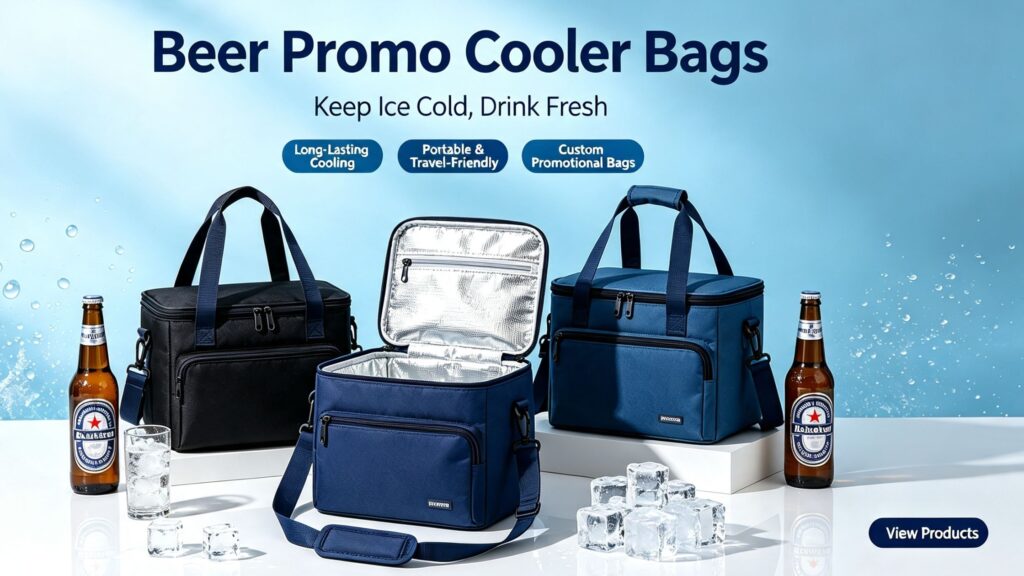
The types that matter most here map cleanly onto the general list above: drinkware such as custom beer mugs and branded glassware; serving pieces including personalized beer steins, growlers and pitchers; coasters in every material; bar mats; ice buckets; bottle openers; tap handles; serving trays and napkin holders; cooler bags and can coolers; event kit like canopy tents, patio umbrellas and promotional chairs; and retail-facing tin signs, table tents and full display stands.
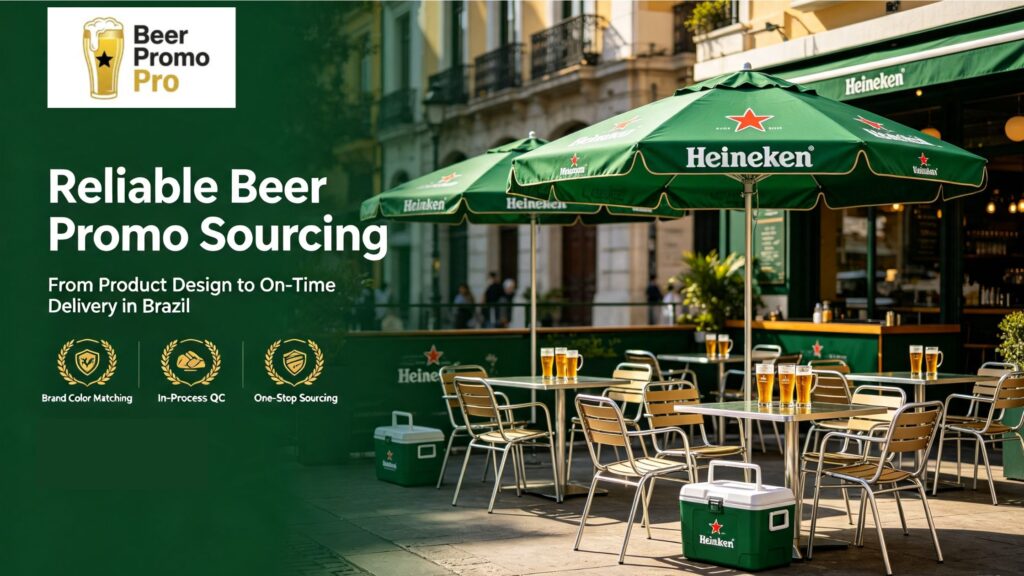
We keep the full channel map on its own page, because it needs more detail than this wide-angle guide can give: read our complete guide to branded promotional items. You can also see POSM options, how to choose the right POSM, examples of brewery merchandise, whether certain pieces work as gifts, and a real rescue job on a Heineken campaign in Brazil.
What Usually Goes Wrong?
Six mistakes account for most of the money wasted here.
1. Buying for the receiver instead of the job. Nobody needs another pen. Decide what you want people to do, then find the item that makes doing it easier. 2. Choosing the type before the depth. This is the costliest habit on the page. Level 3 custom work solves problems that Level 1 solves for a fraction of the price. 3. Ignoring the print method’s minimum. Wanting fifty units and specifying screen printing are two clashing instructions. Fix the method before you fix the supplier. 4. Letting unit price eat build quality. A cheap quote is cheap for a reason — thinner material, fewer print passes, weaker frame. On anything meant to last a year, cost per use favours the better build. 5. Forgetting freight on bulky items. Tents, umbrellas and glassware can cost more to ship than the unit price you saved. See how we handle importing bar supplies. 6. No buffer units. Order a small surplus. Things break, venues open a second site, and a re-order six months later rarely matches the first colour run.
Frequently Asked Questions
What are the different types of promotional items?
Fifteen types cover most orders: T-shirts, polos and workwear, outerwear, caps and headwear, drinkware, bags, writing instruments, desk accessories, notebooks and calendars, tech accessories and power banks, umbrellas, home and kitchen goods, health and safety items, awards and recognition pieces, and event gear plus retail display. Apparel and drinkware together make up well over a third of US industry sales.
Which types of promotional items do people keep longest?
Outerwear leads at about 16 months, then umbrellas and T-shirts at 14 months each, per ASI’s 2019 Global Ad Impressions Study. Calendars are kept shortest at around 8 months, with writing instruments just above at 9. Check the edition year whenever you see this list — many reprints leave it out.
Which types of promotional items get bought the most?
T-shirts lead US industry sales at 16.1%, then drinkware at 10.4%, polos at 9.5%, caps and headwear at 9.0%, and bags at 7.2%, per ASI’s 2026 study. That set does not match what people most want to get, where fleece, food gifts and blankets rank high.
What do people most want to receive?
T-shirts top the list, followed by fleece and jackets, food gifts, blankets, and bags. Only T-shirts and bags also make the top five by sales. So there is a real gap between what companies buy and what people would rather get.
Which types of promotional items work best at trade shows?
Choose for the walk home, not for the booth. Bulky or fragile pieces get left behind, so the safe picks are light, flat and useful — tote bags, notebooks, pens and drinkware. If you want people to stop at your stand, hand them something during the conversation rather than leaving it in a pile. The same logic applies in shops, which our guide to how to choose the right POSM covers in detail.
Does the print method change the minimum order?
Yes. Methods that need a setup step, like screen printing and pad printing, normally carry a minimum. Digital methods — embroidery, heat transfer, dye sublimation, digital inkjet and laser engraving — mostly do not. Lock the method before you ask for prices, because changing it mid-run is usually billed as a new order.
What is the difference between stock, semi-custom and full custom?
Stock plus print means a factory item with your logo on it. Semi-custom changes the colour, fabric, lining or packing of that item. Full custom means new tooling built for you. Minimums, tooling fees and lead times climb sharply at each step, even when the finished goods look alike.
Are pricier promotional items always better value?
No. A $6 tote bag pulls in about 5,000 impressions at roughly one tenth of a cent each, while a $13 cap lands near three tenths of a cent. Cost per impression often favours the cheaper, more useful item. Dearer long-life pieces win instead when you need years of presence rather than sheer reach.
Where does the minimum order come from?
Two places, and this trips people up. The custom depth sets it — new tooling needs a long run to pay off. The print method also sets it — setup-based methods like screen printing need volume. Ask which one applies to your order, because they are different answers.
Why do some promotional item stats look dated?
Many retention figures online come from ASI’s 2019 study, even on pages posted this year. Later ASI editions stopped counting months and started asking whether an item is kept at least a year. Always check which edition a number came from before you build a case on it.
How much do promotional items cost?
It hinges on material weight, print method, order size, packing and freight — which is why any price list written without knowing your brief is unreliable. Ask for landed cost rather than unit price, plus quote validity in writing. Bulky light goods such as tents and umbrellas often cost more to ship than they cost to make.
Do promotional items need safety or food-contact papers?
Anything that touches food or drink should carry papers for your market, and electrical goods need their own set. Ask for them before production rather than at import. Our guide to promo material and compliance covers which ones to request.
What is the biggest mistake buyers make?
Picking the item before picking the depth. Buyers open a mould to solve a problem that printing on a stock item already solves, for far less money — and minimums, tooling fees and lead times all climb as a result. Read our minimum quantity guide first.
Can different promotional item types ship together?
Yes, and joining them up usually helps the freight maths. The catch is timing: the shipment moves at the pace of the slowest item. Check that every production plan lines up before you book anything into one container.
Where to Start Your Order
Two calls, in this order.
First, pick the depth before the type. Decide whether you need stock plus print, semi-custom, or new tooling. That single call sets your minimum, your tooling cost and your calendar — and it clears most of the fifteen types off the table before you get attached to any of them.
Second, sort what is left by who holds it at the end. Staff, customers, venues and shoppers walking past a shelf all need different things. Usefulness decides whether an item survives at all, and 78% of people keep one because it does a job.
Then get it all in writing: item code, print method, artwork version, colour reference, quantity, payment split and landed cost. Comparing suppliers line by line only works when both sides wrote down the same things. And agree what gets inspected before the goods leave.
If you would rather have someone run the legwork, we source promotional products across Chinese factory clusters. We handle supplier checks, sample sign-off against your written spec, and merged shipping. Send your list of types, your quantity per item, your destination and your needed arrival date, and we will come back with options and a project quote. See how the process works, read more promotional case studies, or contact our team today.