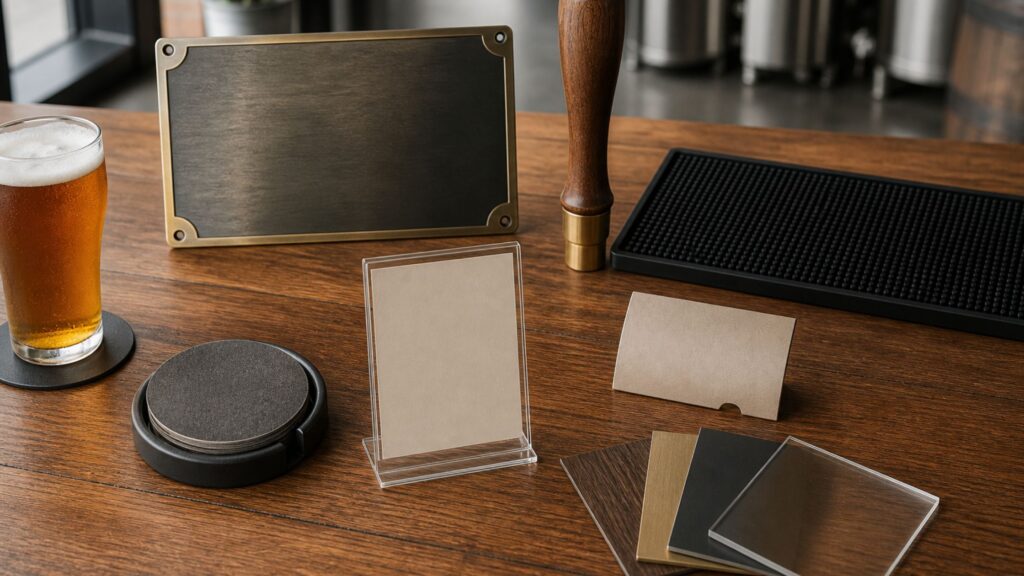
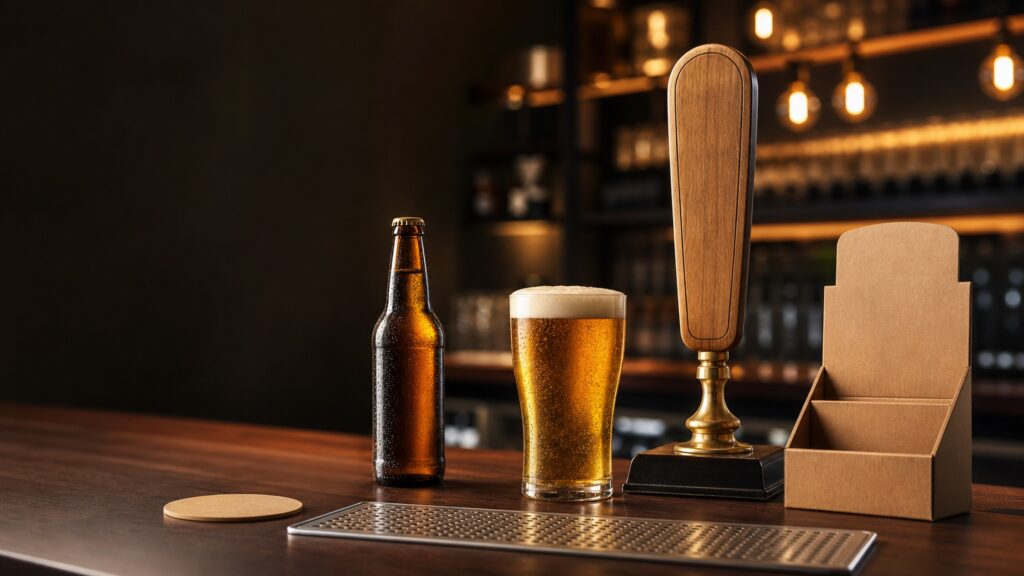
Custom beer POSM—short for point-of-sale materials—is the branded equipment and display material that helps a beer stand out where people order or buy it. It may be a tap handle behind the bar, a bar mat under a glass, a shelf talker in a store, or a full floor display for a seasonal launch.
For a drinker, these items may look like decoration. For a brewery, importer, distributor, or trade-marketing buyer, they are part of retail execution. The right custom beer POSM must fit the venue, carry the brand clearly, survive its expected use, and arrive in a form that staff can set up without friction. This guide explains the main types, the sourcing trade-offs, and the questions to settle before placing a wholesale order.
What Is Custom Beer POSM?
Beer POSM is a broad category of promotional materials placed close to the buying or serving moment. In on-premise locations such as pubs, restaurants, and taprooms, it improves visibility around the bar and the tap. In off-premise locations such as liquor stores and grocery stores, it helps a product claim attention on the shelf, endcap, or sales floor.
“Custom” can mean more than adding a logo. Depending on the item, it can include a custom shape, colors, finishes, product messaging, interchangeable artwork, structural design, packaging, and display configuration. The sensible level of customization depends on how long the campaign will run and how often the item will be reused.
Main Types of Custom Beer POSM
On-premise POSM for bars and taprooms
These products work at the serving point, where space is usually limited and staff use matters as much as appearance.
| POSM type | Typical role | Buying consideration |
|---|---|---|
| Custom tap handle | Identifies a draft beer and adds a visible brand cue | Confirm thread/fit, weight, grip, finish durability, and whether inserts need to change by SKU. |
| Bar mat or rail mat | Protects the bar while keeping the brand in constant view | Check non-slip performance, washability, edge finish, and color accuracy. |
| Coaster | A low-cost table touchpoint for launches or tap takeovers | Decide whether it is disposable pulpboard or a reusable material; test ink rub and moisture resistance. |
| Table tent, menu holder, or countertop sign | Explains a new beer, offer, or pairing | Keep the message easy to update and verify stability in a busy service area. |
| LED, neon-style, tin, or acrylic sign | Creates longer-range visibility behind the bar | Confirm electrical requirements, mounting method, brightness, local approval needs, and replacement parts. |
A functional object often earns a longer life in a venue. For example, a well-made bar mat or usable tap handle can remain in daily service, while a one-time leaflet may be removed after the campaign. That does not make permanent POSM automatically better: a short seasonal launch may be better served by a lightweight, easily replaced piece.
Off-premise POSM for beer retail
Retail POSM must work with shelf plans, store rules, product case sizes, replenishment routines, and aisle traffic.
| POSM type | Best use | Sourcing trade-off |
|---|---|---|
| Shelf talker, wobbler, or shelf strip | Calls out a product or promotion without taking floor space | Low freight cost, but exact fixture compatibility and adhesive performance matter. |
| Counter display | Supports small packs, gift items, or samples near checkout | Compact and easy to deploy, but capacity is limited. |
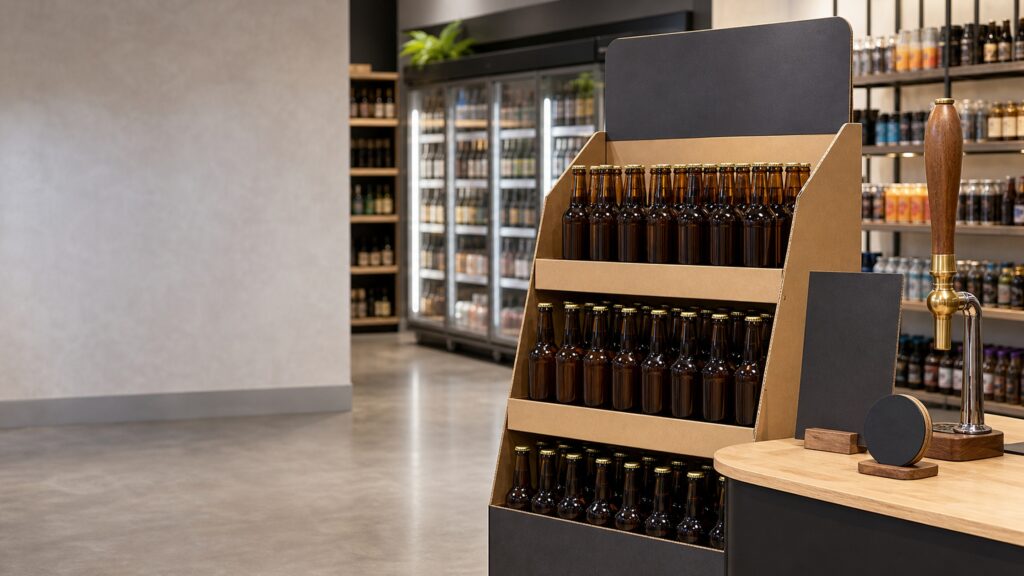
| Corrugated floor display / case stacker | Seasonal packs, new distribution, or high-visibility promotions | Efficient for campaign-scale shipping; needs structural testing and clear assembly instructions. |
| Pallet wrap or pallet display | Bulk retail promotions | Useful only when the retailer accepts the footprint and loading method. |
| Metal, wood, wire, or acrylic fixture | Semi-permanent or permanent placement | Higher initial and freight cost, but potentially longer service life and a more premium presentation. |
Choose Materials by Campaign Duration and Venue Conditions
Material should follow the deployment plan—not just the visual concept.
Corrugated cardboard is commonly used for temporary floor displays and case stackers. It is comparatively light and can ship flat, but it needs the right board grade, artwork protection, and structure for the load and humidity it will encounter. Ask for a packed and loaded sample if cases will sit on the display.
Paperboard and coated card suit coasters, shelf communication, and temporary countertop pieces. They are economical for artwork changes and seasonal campaigns. The buyer should confirm coating, die-cut accuracy, and how the material performs when handled with cold or wet drinks.
PVC, acrylic, and other plastics can support semi-permanent indoor signs and counter displays. They can provide a clean, premium look, but the quote should clearly distinguish material thickness, print method, protective film, and assembly hardware.
Metal and wood are appropriate when the display is intended to stay in place and contribute to the venue’s atmosphere. They also add weight, shipping volume, and finishing requirements. Check welds, sharp edges, powder coating or paint adhesion, and whether replacement headers or graphics can be supplied later.
Silicone, rubber, and resin are common for bar mats, molded promotional items, and some tap handles. For these items, confirm odor, surface finish, color consistency, and the actual branding process rather than approving only a digital rendering.
How to Select the Right Custom Beer POSM for Your Campaign
Start with the exact commercial job the item needs to do. A POSM project becomes expensive when one object is asked to work everywhere.
- Map the touchpoint. Is the goal to identify a tap, make a product visible from the aisle, communicate a limited release, or support an event? A bar counter, a beer fridge, and a grocery endcap have different viewing distances and installation limits.
- Choose temporary, semi-permanent, or permanent. This decision drives materials, printing, packaging, and acceptable freight cost.
- Design around the product pack. Give the supplier real bottle, can, carton, or case dimensions. A display that photographs well but does not fit a sellable unit creates rework at the last stage.
- Keep the callout simple. The shopper or bartender should quickly recognize the beer, variant, and action. Avoid treating every surface as a message board.
- Plan artwork versions early. If a distributor needs multiple languages, ABVs, flavors, or retailer-specific offers, ask whether a common structure can use changeable headers or inserts.
- Confirm retailer requirements before tooling. Large chains may specify footprint, height, fire performance, pallet handling, assembly, or approved display locations. A supplier cannot infer those requirements from a logo file.
Quality Checks Before You Approve Production
The best sample is not merely a beauty sample. It should answer the questions that lead to field failures.
- For a floor display, load it with the actual packed products; examine bowing, shelf sagging, and stability after assembly.
- For a tap handle, test the connection, hand feel, scratch resistance, and fit on the intended dispense equipment.
- For a bar mat or coaster, test moisture, rub resistance, odor, flatness, and cleanup after normal service use.
- For illuminated POSM, inspect brightness, cables, adapters, mounting points, and unit-to-unit consistency.
- For every printed item, approve a physical color standard or pre-production sample. Screen, digital, UV, and other print processes can produce different results on different substrates.
- Audit the packed carton: count per carton, spare parts, assembly instructions, inner protection, master-carton markings, and drop/handling risk.
For multi-SKU orders, set an inspection plan that checks not only the main display but also small parts, artwork versions, and packing lists. A display with a missing clip, header, or instruction sheet can be unusable even when its main structure is correct.
Custom Beer POSM Sourcing Questions to Ask a Supplier
Before requesting a final quote, provide a concise brief covering quantity, target delivery date, destination, venue type, branding files, and product dimensions. Then ask:
- Is the MOQ based on one design, one colorway, or the combined order quantity?
- Which parts require tooling, and who owns that tooling after the project?
- Can you supply a structural prototype and a printed pre-production sample?
- What material, thickness, finish, print process, and hardware are included in the price?
- Will the display ship flat, partially assembled, or ready to place? What is the assembly time?
- What are the carton dimensions, gross weight, and palletization plan?
- Can the supplier provide replacement graphics, headers, or spare parts for a permanent fixture?
- Which test reports or declarations are available for the target market, if the retailer or local rules require them?
MOQ and lead time are configuration-specific, so treat a marketplace listing as a starting point—not a universal commitment. A simple flat printed item and a molded, illuminated display may have completely different sampling, tooling, production, and shipping timelines.
Compliance and Responsible-Marketing Checks
Beer POSM is promotional material, so the legal and retailer requirements of the destination market matter. Requirements can affect wording, age-related messaging, placement, electrical components, fire performance, and product claims. In the United States, the Beer Institute’s advertising code addresses responsible marketing and audience targeting; it is an industry code, not a substitute for legal review or retailer policy. Review the current Beer Institute guidance.
Ask the brand, importer, retailer, and local advisor to approve the final copy and placement before production. This is especially important for claims, promotions, youth-facing imagery, and alcohol-related messaging. For electrical signs and fixtures, confirm the market-specific electrical and installation requirements with the importer or retailer.
FAQ
What does POSM mean in the beer industry?
POSM means point-of-sale materials. In beer, it covers branded items that help a product get noticed or understood at the bar, taproom, store shelf, checkout, or retail floor.
What is the difference between POSM and promotional merchandise?
POSM is generally placed at the selling or serving location to support a purchase decision. Promotional merchandise—such as apparel or gifts—may travel beyond that location. Some items overlap, but their deployment and sourcing requirements are different.
Which custom beer POSM is best for a new draft beer launch?
For a draft launch, begin with the operational touchpoints: a recognizable tap handle, a bar mat, and an easy-to-read menu or countertop sign. Add event or table materials only where the venue will genuinely use them.
Can a beer floor display be shipped flat?
Many corrugated displays are designed for flat shipment, but the answer depends on the structure, pre-packed product method, and retailer requirements. Request an assembly test and clear packing plan before confirming the order.
Final Thought
Effective custom beer POSM is not simply a branded object. It is a piece of retail or bar equipment with a defined job, a real operating environment, and a supply-chain cost. When you match the format and material to the campaign, approve practical samples, and confirm retailer and market requirements early, you can build POSM that is easier to deploy and more useful to the people selling the beer.
If you are preparing a custom beer POSM program from China, consolidate your design brief, product measurements, artwork versions, destination requirements, and target in-hands date before supplier outreach. That gives you a sound basis for sampling, quality inspection, and freight planning.
Research basis and editorial notes
- Business model: China-sourcing or manufacturing partner supporting breweries, importers, distributors, retail buyers, and beverage-brand marketers with custom promotional materials.
- Search intent: Informational definition plus commercial sourcing intent. Buyers want to understand POSM categories and prepare a viable customized order.
- SERP and platform observations: Current category pages consistently group on-premise items (tap handles, bar mats, signage, table materials) with retail items (corrugated displays, shelf talkers, floor fixtures). Supplier claims and listed MOQs are treated as configuration-specific rather than industry-wide facts.
- Open verification items: Final material specifications, food-contact boundaries, electrical certifications, fire/retail display requirements, alcohol-marketing rules, MOQ, lead time, and freight data must be confirmed for the exact SKU and destination market.
- Potential internal links: Custom beer tap handles; bar mats; custom LED signage; retail POS display sourcing; China quality-inspection service; consolidated shipping service.