There are 9,578 craft breweries left in the US. In 2025, 481 of them closed and only 300 opened. Beer volume fell again. Here is the part that should change how you plan: merchandise is the only revenue line at your brewery that does not depend on how much beer you brew. A taproom can sell a hoodie on a slow Tuesday.
This guide is not another list of 30 cute swag ideas. It tells you which items actually sell, what margin to expect, how much to order the first time, and which of them you should buy from China and which you should not.
1. What Does “Brewery Merchandise” Actually Cover?
Most people use one word for three different things. That confusion is why so many merch programs lose money. Split your budget three ways before you pick a single product.
1.1 Three Kinds of Branded Stuff, Three Different Budgets
| Who pays | What it is for | Typical items | |
|---|---|---|---|
| Retail merch | Your fan pays you | A profit line. Margin runs 40–60% | T-shirts, hoodies, hats, stickers, enamel pins, glassware sets |
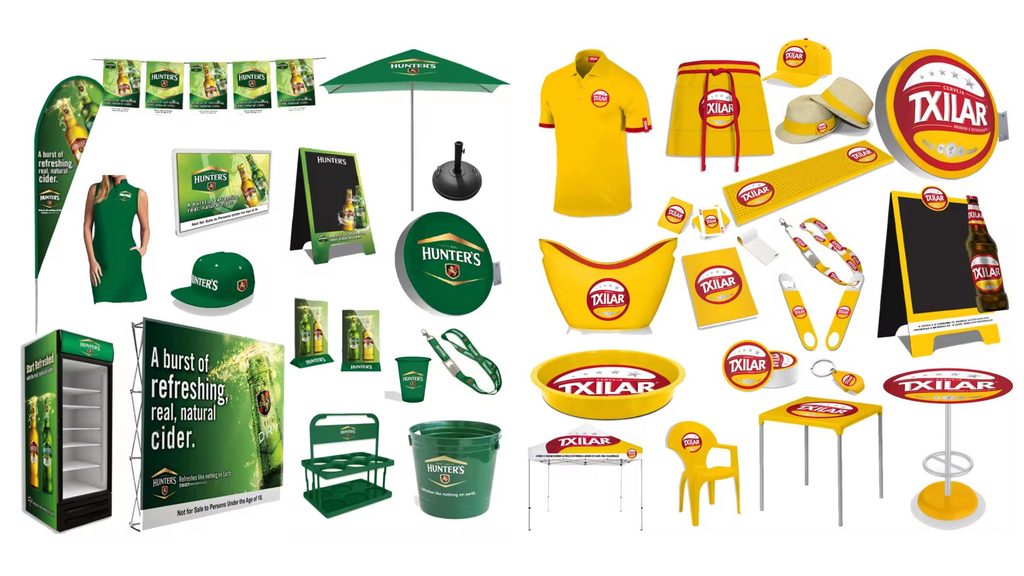
| Promotional items | You pay | A cost line. You buy visibility and bar space | Coasters, openers, can coolers, ice buckets, bar mats, tents, display racks |
| Taproom supplies | You pay | Operating cost. Not marketing at all | House glasses, bar mats, trays, outdoor furniture, staff shirts |
The same pint glass can be all three. Sell it on a shelf and it is merch. Give it away with a case and it is a promotional item. Pour in it behind the bar and it is a supply. The product does not change. The direction of the money does.
1.2 Why the Split Decides Who You Buy From
Here is what that means for your orders. Retail merch has sizes, and it changes design four to six times a year. So it belongs with a local printer or a print-on-demand shop that can turn 30 pieces fast. Promotional items and taproom supplies have no sizes and no expiry date. A bar mat works for three years. That is where a Chinese factory wins, because the runs are longer and the unit price matters more.
We wrote a full category guide to the give-away side already — see branded promotional items for beer brands. This article is about the money-making side, and about the line between the two.
1.3 The Mistake That Kills a Merch Line
Do not give away what you also sell. If a customer can get your $34 tee free at a festival next month, nobody pays $34 for it. And do not sell give-away quality at retail prices either. A shirt that cracks after five washes ends the line, not just the sale.
Keep two quality tiers on purpose. Your sell line gets the good blank. Your give-away line gets the cheap one. One Australian supplier put it plainly: a stubby holder that costs $5 to make is a $5 expense if you hand it out and $10 of margin if you sell it at $15. Same product. Different decision.
2. Why Merch Matters More When Beer Sales Are Flat
2.1 The Numbers Behind US Craft Right Now
The Brewers Association released its 2025 figures in 2026, and they are worth reading before you write a merch budget.
- 9,578 craft breweries were operating, down 2.9% in a year.
- 300 opened and 481 closed. Closures beat openings for the second year running.
- Craft production fell 4% to about 22 million barrels. Total beer fell 5.7%, so craft held up better than the category.
- Retail dollar value slipped 2.8% to $28.0 billion, or 24.8% of the US beer market.
- Taprooms and brewpubs are 73% of all craft businesses but only 15% of the volume.
2.2 What That Means for Your Program
Read that last line again. Most craft breweries are small rooms that serve their own neighbourhood, not factories that ship kegs. That is a hard year for a wholesale brewer and a much softer one for a room with regulars.
Merch is the lever that room can pull. Merch usually runs 5–15% of a brewery’s total revenue, and operators who take it seriously push it to 12% in peak season. Buyers of merch also come back more often — one operator measured a 17% higher repeat visit rate.
The commercial point: when beer volume is falling, the brands that survive are the ones with a room and a relationship. Merch turns that relationship into a second till.
3. Which Brewery Merch Ideas Actually Sell?
Forget the 30-item lists. Most brewery merch revenue comes from four things: a tee, a hoodie, a hat, and something under $10. Everything else is either seasonal or a test.
3.1 Apparel: The Volume, The Margin, The Headache
A logo tee is the volume seller. Industry guides put t-shirts at around 60% of a typical merch program’s revenue. A standard printed tee costs you $10–12 to make and sells for $25–28. Move up to a softer blank, such as Bella+Canvas or Comfort Colors, and it costs $14–18 and sells for $32–38.
Craft drinkers expect a good blank. They will pay for it, and they will not forgive a cheap one.
A hoodie makes the most money per sale. At $22–30 landed and $55–65 retail, it carries the biggest dollar margin on the rack.
A hat is the best impulse buy. Embroidered trucker and dad hats cost $8–24 depending on stitch count and volume, and sell for $25–38. They are one-size, they sit at eye level, and they attach to 30–40% of tee and hoodie orders. A hat is also the easiest thing to sell to someone who came in for a beer, not a shirt.
3.2 Glassware: The Only Merch Item That Repeats
Glassware is the quiet winner. A branded pint glass or tumbler costs $12–18 to produce and sells for $30–38. That puts gross margin near 70% — higher than apparel. Laser engraving lasts forever, so the logo never fades.
But the real reason to stock it: glass breaks. A bar loses somewhere between 10% and 40% of its glassware a year, depending on the venue and the glass type. Fully tempered glasses run as low as 2–4%. Untreated soda-lime in a busy bar can hit 40%.
So your glass program has two quantities: what you sell, and what you replace. Order both. We cover the buying side in custom drink glasses with a logo and custom beer mugs.
3.3 Small Items Under $10
These are the add-ons that turn a $30 sale into a $38 sale, and they are cheap to test.
- Stickers — $0.50–1 each, sell at $3–5, or give one away with every order.
- Can coolers and koozies — the cheapest useful thing you can brand. See can coolers in bulk.
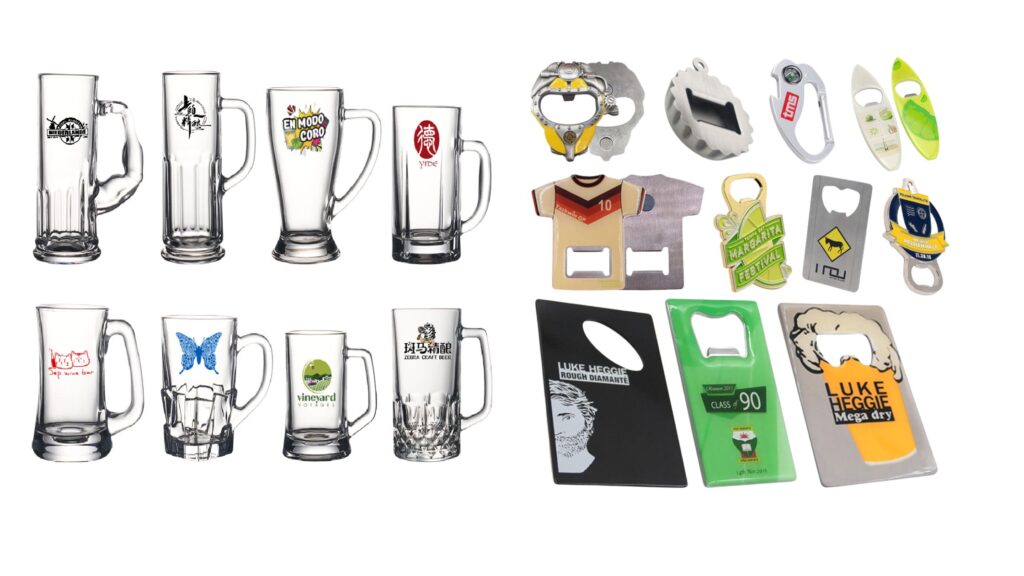
- Bottle openers — small, cheap, and actually kept. See types of bottle opener.
- Coasters — sell them in sets of four. A set is a gift; a single is a bar item. See custom coaster design ideas and coaster materials compared.
- Enamel pins — low cost, high collectibility, and they drive the “I need the whole series” behaviour.
3.4 The Bigger Pieces
A few items earn their shelf space once you have a real following:
- Growlers — see personalized beer growlers
- Beer steins — see personalized beer steins
- Mini tap handles — a collectible for the beer nerd. See custom beer tap handles
- Tin signs and wall pieces — see custom brewery signs and tin beer signs
3.5 What to Skip
Skip anything with a year on it unless you can sell through it. An “Oktoberfest 2026” shirt is dead stock on 1 October. Skip deep size runs on your first order (see section 5). And skip a 12-item line on day one — four or five SKUs done well outsells twelve done badly.
4. What Should You Charge?
4.1 The 2.5–3x Rule
The standard retail markup on brewery merch is 2.5 to 3 times your cost. A tee that costs you $12 to produce sells at $30–36. That lands you a gross margin around 55–60% on apparel, and up to 70% on glassware.
4.2 Margin by Category
| Item | Your cost | Retail | Gross margin |
|---|---|---|---|
| Standard tee | $10–12 | $25–28 | 55–60% |
| Premium tee | $14–18 | $32–38 | 53–58% |
| Embroidered trucker hat | $10–14 | $28–32 | 56–64% |
| Hoodie | $24–30 | $55–65 | 54–58% |
| Tank top | $8–12 | $24–30 | 60–67% |
| Beanie | $8–12 | $22–28 | 57–64% |
| Engraved pint glass or tumbler | $12–18 | $30–38 | 60–70% |
| Sticker | $0.50–1 | $3–5 | — |
*These are typical ranges from US and Canadian merch suppliers, not a quote. Your numbers move with blank quality, stitch count, print method and order size.*
4.3 Price It Like a Brand, Not Like a Cost Recovery Exercise
Three rules that work. Round to clean numbers — $34, not $29.99, because “$29.99 reads like retail clearance.” Put every tee at one price and every hoodie at one price, so the line moves faster. And charge what your beer customers already expect — if your four-pack is $18, a $34 tee feels right and a $24 tee makes people wonder what is wrong with it.
5. How Much Should You Order the First Time?
This is where new merch programs die. Not on design, on sizes.
5.1 Where the Dead Stock Sits
A typical size break in craft beverage retail looks like this:
| Size | Share of sales |
|---|---|
| XS | 2–3% |
| S | 10–12% |
| M | 25–28% |
| L | 28–30% |
| XL | 18–22% |
| 2XL | 8–10% |
| 3XL and up | 2–5% |
Buy to that curve, not to a flat spread. And do not stock the tails on your first run.
5.2 What the Best Operators Actually Do
Rhinegeist, one of the larger US craft brands, runs its apparel on a simple rule. Look at the first two weeks of sales. Take the size break that actually sold, and reorder in that ratio. Do not reuse last year’s curve. Do not guess.
They also cut the tails outright. Their team had size pars before, but never said “no more extra smalls and no more XXL” — and that inventory is exactly what they were stuck sitting on. Their rule of thumb: “I’d rather be left with 30 mediums than 30 3Xs.”
A second rule from the same team: go wide and shallow rather than narrow and deep. More designs, fewer units each, until one proves it can move thousands. Then go deep on that one.
5.3 A Sensible First Order
For a new taproom:
- T-shirts: 50–100 units, concentrated in M, L and XL
- Hats: 25–50 units, two or three styles
- Hoodies: 25–50 units, if you are heading into autumn
- One small item — stickers, coasters or openers — as an add-on
Budget $1,500–3,000 for that first buy. Reorder when stock drops to about 25% of the starting quantity, and reorder the sizes you actually sold.
6. Print on Demand or Bulk Production?
This decision picks your supplier, so make it before you ask for a quote.
6.1 Where the Break-Even Sits
For a one-colour design on a light tee:
| Quantity | Print on demand (DTG) | Screen print | Better option |
|---|---|---|---|
| 1–11 | $12–18 | $20–30 | Print on demand |
| 12–23 | $10–14 | $14–20 | Print on demand |
| 24–35 | $8–12 | $10–14 | The break-even zone |
| 36–71 | $7–10 | $7–10 | Roughly equal |
| 72–143 | $6–9 | $5–8 | Screen print |
| 500+ | $5–8 | $2–5 | Screen print |
Screen printing charges $20–50 in setup per colour, and that setup is why small runs are expensive. More colours push the break-even higher — a six-colour design can stay cheaper on DTG all the way to 100 pieces.
6.2 What Each Method Is Actually For
- Print on demand — no minimum, no inventory, no storage. Best for testing a design, limited drops, anniversary and collab pieces, and anything that might only sell 30–50 units. The trade-off is a higher unit cost, and DTG prints fade sooner — roughly 30–50 washes against 100+ for screen print.
- Bulk screen print — cheaper per unit and a better hand feel, but you pay for inventory up front. Traditional programs tie up $4,000–12,000 in screen minimums, storage and dead sizes.
6.3 The Rule Most Mature Programs Use
Keep a design on print on demand until it sells 50+ units a month, then move it to bulk. Leave limited releases there permanently. For a taproom doing under 5,000 units a year, avoiding dead stock usually beats the lower unit cost.
7. Which Merch Should You Make in China?
Now the part most “merch ideas” articles cannot tell you.
7.1 What Belongs With a Chinese Factory
Order from China when the item has no size, no expiry date and a long run. That means:
- Coasters — see custom drink coasters
- Bar mats — the best value-for-money item on any beer list. See custom bar mats
- Bottle openers, can coolers and ice buckets — see custom beer ice buckets and insulated ice buckets
- Glassware, mugs, steins and pitchers — see custom beer pitchers
- Bar serving gear — see custom bar serving supplies and the barware buying guide
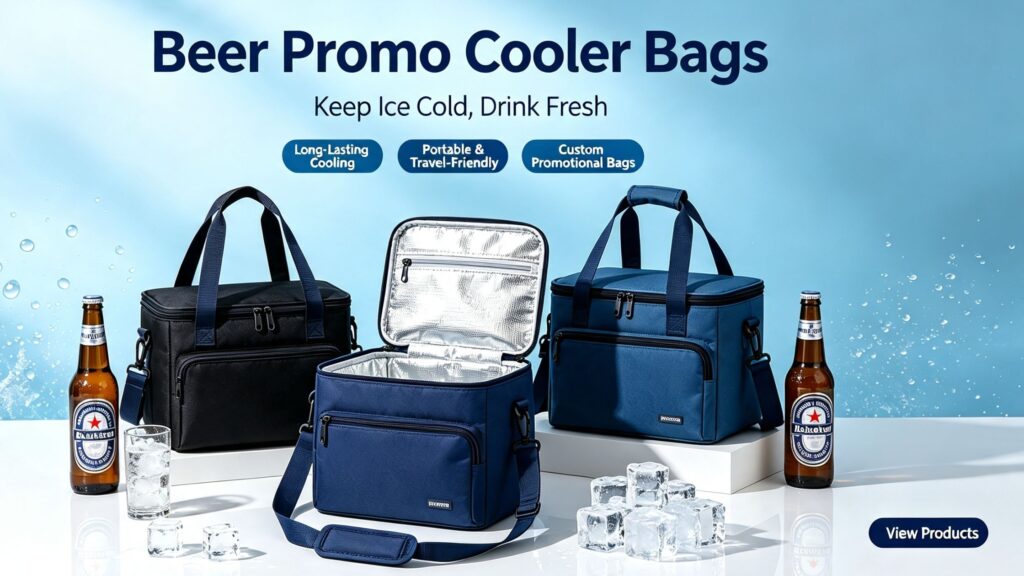
- Outdoor and event equipment — canopy tents, patio umbrellas, promotional chairs, beach mats, cooler bags
- Retail display and signage — see custom retail displays and POSM signage and beer display ideas
7.2 What to Keep Closer to Home
Keep apparel local or on print on demand. Three reasons, and none of them are about quality.
1. Sizes multiply your risk. A tee in seven sizes across three designs is 21 SKUs, and you cannot predict which ones die. 2. Your designs change four to six times a year. That kills the long-run economics that make overseas production pay. 3. US apparel tariffs are among the highest in the customs book. A cotton T-shirt under HTS 6109.10 currently carries an effective rate around 36.5% into the US. That is roughly 16.5% base duty, 7.5% Section 301, and 12.5% under the forced-labour measure added in July 2026. On top of that, cotton is a UFLPA high-priority sector, so CBP can hold a shipment until you trace the cotton back to farm, gin, spinner and mill.
The rule of thumb: if it has a size, keep it local. If it has a shape, China can make it.
That is not to say hard goods are tariff-free. Glassware and metal barware carry Section 301 layers too. But a bar mat has no size curve, no expiry date and no cotton traceability. For a full walkthrough of the buying process, see how to source beer promotional products from China.
7.3 What to Expect on MOQ and Lead Time
There is no single minimum. One order can carry four or five different minimums — one for the base product, one for the material or colour, one for the decoration, one for tooling, and one for the packaging. Ask which one is actually limiting you, and quote per version rather than per total. Our MOQ guide breaks this down by product.
On timing, plan on 7 days for a sample and 25–35 days for bulk, plus sea freight. See the lead time guide for the stage-by-stage schedule, and quality control for what to check before a shipment leaves.
One more thing people forget: the US $800 de minimis exemption was suspended for China and Hong Kong in May 2025 and removed globally in August 2025. Small sample shipments no longer clear duty-free, so build that into your sampling budget.
8. Which Certifications Does Brewery Merch Need?
Once you sell an item, you own its compliance. This is where a merch program gets expensive if nobody checked.
8.1 If You Sell in the US
- Prop 65, for anything with a printed glass or ceramic surface. The rule targets the coloured decoration on the outside of drinkware, not the beer. On a food or drink vessel with a rim, exterior decoration must stay at or under 0.06% lead and 0.48% cadmium. And any decoration reaching into the top 20 mm of the rim must be non-detectable — 0.02% lead, 0.08% cadmium. Children’s products are stricter. Penalties run to $2,500 per violation per day, and anyone can bring a claim.
- Plan for one change now: from January 2028, California’s short-form warning must name at least one chemical. If your packaging uses the short warning, it needs reprinting.
- FDA bans lead above 0.5 ppm in pottery meant for food use.
- CPSIA applies properly only when an item is made for children. A kids’ tee is a different file from an adult one.
- Adult apparel still needs fibre content, country of origin and care labels.
8.2 If You Sell Into Europe
- EU textile labelling (Regulation 1007/2011): any product that is at least 80% textile fibre by weight needs a sewn-in fibre composition label. Use the official fibre names, list them by weight in descending order, and write them in the language of the country where you sell. Multi-part garments label each part.
- GPSR (EU) 2023/988, in force since December 2024: risk assessment, traceability marking, and an EU-based responsible person.
- REACH for azo dyes, lead and phthalates.
- LFGB for anything that touches a drink. German buyers will ask for it by name, and it is stricter than the EU baseline.
- Coming: the Digital Product Passport for textiles. The registry went live in mid-2026 and the textile-specific rules are expected around 2027, with compliance likely around mid-2028. Nothing to do today, but build your product data so you can.
9. How Often Should You Release New Merch?
9.1 Four to Six Drops a Year
The breweries with strong merch programs run four to six releases a year, and they follow the same patterns:
- Anniversary — one, five, ten years
- Seasonal beer release — a shirt tied to the pumpkin, the stout, the summer pilsner
- Collab — with another brewery, or a local artist
- Holiday — Christmas and Father’s Day carry real gift volume
- Festival or tour — for breweries that travel
Each drop is a new design on the same shop. Winners keep selling. Losers get archived quietly. That is the whole point of print on demand — you are not committing to inventory to find out which is which.
9.2 Work Backwards From the Date
The production calendar is not the festival calendar. Cooling and outdoor items peak in Q2 and Q3. Display and lighting peak in Q4. With 25–35 days of bulk production plus freight, an order placed in July for a September festival is already tight, and August means air freight on top.
Our rule: sign off the sample by spring for an autumn event. See how to choose beer POSM for planning a kit by channel, and custom beer POSM for what is worth tooling.
10. Frequently Asked Questions
What brewery merchandise sells best?
A logo tee is the volume seller — around 60% of a typical merch program’s revenue. A hoodie makes the most money per sale, and an embroidered hat is the best impulse add-on, attaching to 30–40% of tee and hoodie orders. Glassware carries the highest margin of the four.
What is a good markup on brewery merch?
2.5 to 3 times your cost. A $12 tee sells at $30–36, which is roughly a 55–60% gross margin. Glassware runs higher, nearer 60–70%. Price in round numbers — $34, not $29.99.
How much merch should a new taproom order?
Start with 50–100 tees concentrated in M, L and XL, 25–50 hats, and 25–50 hoodies if you are heading into autumn. Budget $1,500–3,000. Reorder when stock falls to about 25% of the starting level, and reorder the sizes you actually sold.
What sizes should I stock?
Follow the sold curve, not a flat spread. Typical craft beverage retail runs XS 2–3%, S 10–12%, M 25–28%, L 28–30%, XL 18–22%, 2XL 8–10%, 3XL+ 2–5%. Cut XS and XXL from your first run — the tails are where dead stock lives.
Should I use print on demand or bulk screen printing?
Print on demand below about 24–35 units of one design, screen printing above that. Keep a design on demand until it sells 50+ units a month, then move it to bulk. Leave limited drops, collabs and anniversary pieces on demand permanently, because a design with a year on it is dead stock after the season.
What is the difference between merchandise and promotional products?
Merchandise is sold, promotional products are given away. Merch is a profit line at 40–60% margin. Promotional items are a cost line, bought for visibility and bar placement. The same item can be both — and giving away what you also sell is the fastest way to destroy your retail price.
Which brewery merch should I buy from China?
Order from China anything without a size and without an expiry date. That means coasters, bar mats, bottle openers, can coolers, ice buckets, glassware, bar trays, tents, umbrellas, flags and display racks.
Keep apparel local or on demand. Three reasons: sizes multiply risk, designs change four to six times a year, and US tariffs on Chinese cotton tees run around 36.5%. UFLPA cotton traceability sits on top of that.
What is the MOQ for custom brewery merchandise?
There is no single number. One order can carry a base-product minimum, a material or colour minimum, a decoration minimum, a tooling minimum and a packaging minimum. Ask which one is actually limiting you, and quote per version, not per total. See our MOQ guide.
How long does custom brewery merch take to produce?
About 7 days for a sample and 25–35 days for bulk, plus freight. Work backwards from your event date — sign off samples by spring for an autumn festival. See the lead time guide.
Do branded pint glasses need safety testing?
Yes, if you sell them. In the US, expect FDA food-contact rules plus California Prop 65 limits on the printed exterior decoration. Decoration reaching the top 20 mm of the rim must be non-detectable for lead and cadmium. In the EU, expect LFGB on top of the EU food-contact framework, plus GPSR traceability.
Does apparel need compliance paperwork too?
In the EU, yes — and it is the one people miss. Any product that is at least 80% textile fibre needs a sewn-in fibre composition label. Use the official fibre names, listed by weight, in the language of the selling country. You also need a GPSR responsible person. In the US, adult apparel needs fibre content, country of origin and care labels.
How often should I release new merch designs?
Four to six times a year. Anniversary, seasonal beer release, collab, holiday and festival drops. Keep each drop on print on demand until it proves it can move volume.
Can I put my brewery logo on anything I like?
On your own brand, yes. On someone else’s, no. And check what is protected near you — several beer style names carry geographical protection in the EU. We covered the German examples in German beer brands: who owns what.
Can I mix different merch items in one shipment?
Yes, and consolidating is usually what makes freight work. The constraint is timing: a consolidated shipment moves at the speed of the slowest item. Confirm every production schedule lines up before you book one container.
How much can a taproom actually make from merch?
A small neighbourhood brewery with 2,000 monthly visitors converts around 3% of them, at about $15 margin per item — roughly $900 a month. A destination brand with 15,000 monthly visitors can reach $10,000 a month. Add 20–40% on top for online orders from out-of-town fans.
Wrapping Up
Four things are worth taking away.
First, split the budget three ways — merch you sell, items you give away, and supplies you use. Mixing them is how a retail line loses its price.
Second, the money is concentrated. A tee, a hoodie, a hat and something under $10 will carry most of your program. Glassware carries the best margin of all, because it breaks and gets replaced.
Third, buy sizes locally and shapes from China. Apparel tariffs and cotton traceability make Chinese tees a bad bet. Bar mats, coasters, openers and glassware are exactly what a Chinese factory is good at.
Fourth, let print on demand tell you what to bulk-order, rather than guessing with a $4,000 screen-print minimum.
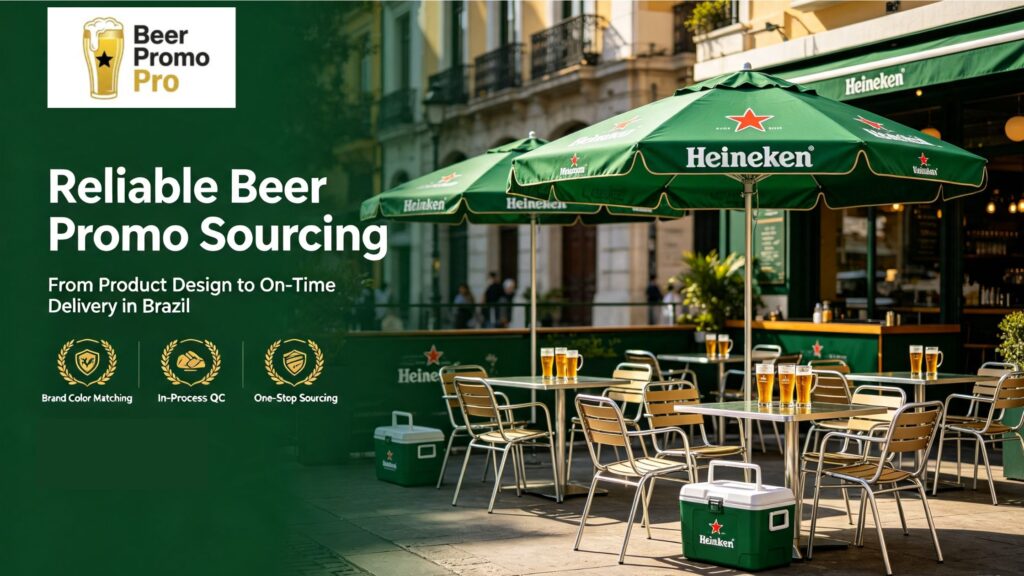
Where we fit is the second half of that list. We have supplied beer promotional products and POSM for 14 years. Our range covers bar mats, coasters, bottle openers, can coolers, ice buckets, branded glassware, growlers and steins, tap handles, signs, tents, umbrellas and display racks. Sampling takes 7 days and bulk production 25–35 days. For how this runs at scale, see our Heineken campaign in Brazil and the rest of our case studies.
Tell us which items you want to sell, and which you want to give away. Send your quantities and your event dates. We will come back with materials, a sample plan and a production slot that lands before your season does. Send us your brief or leave a comment below.