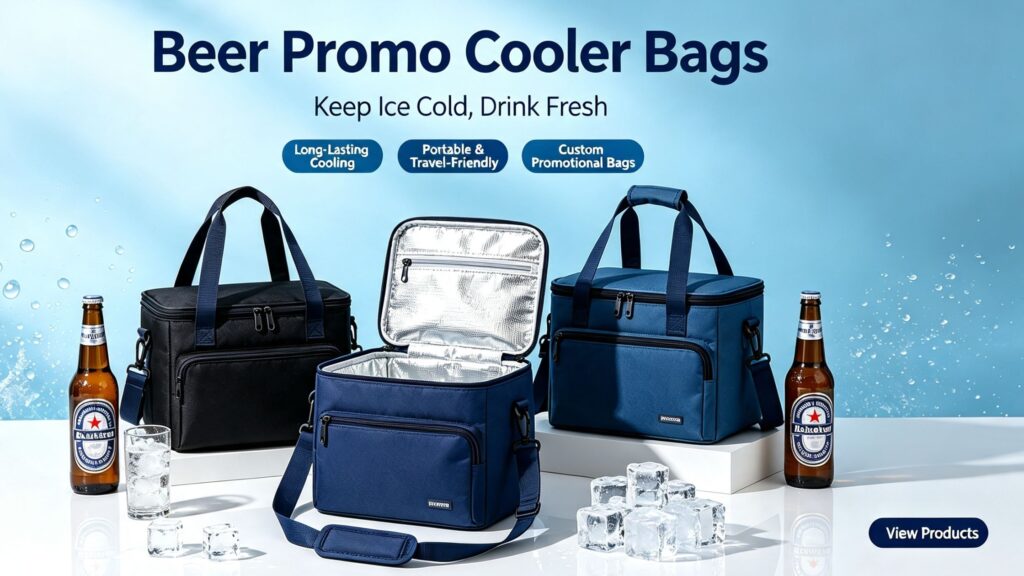
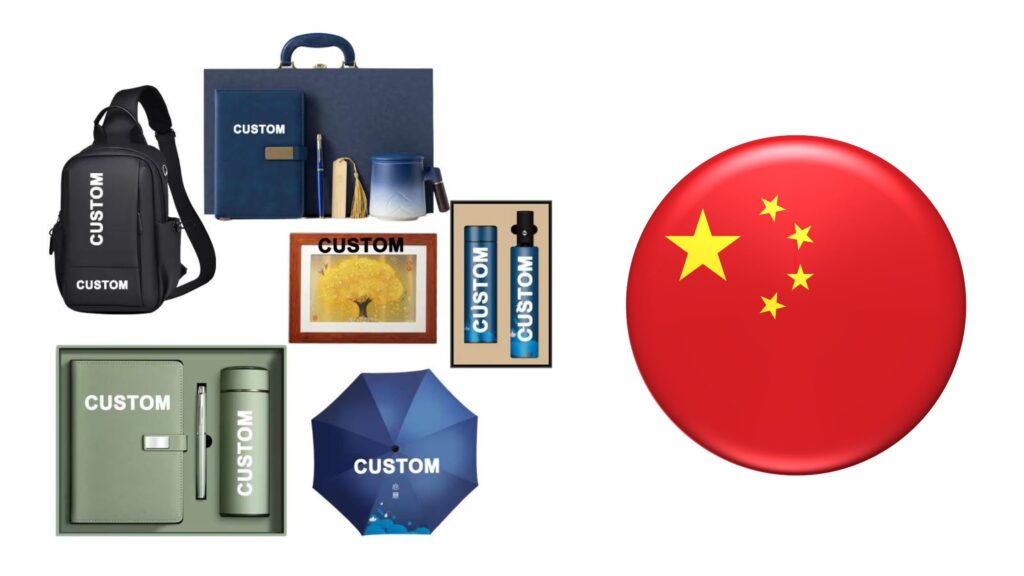
Promotional products China is shorthand for one thing. You want branded items made in China and shipped to your country. The phrase covers a long list of goods. Mugs, drink glasses, cooler bags, bottle openers, ice buckets, coasters, bar mats.
One thing to clear up first. In retail, “promotional product” can also mean an item that is on sale this week. That is not what this page is about. Here it means the branded object itself.
Here is the mistake almost every first buyer makes. You get a quote that says $0.90 per piece. You multiply by 500 and put $450 in the budget. The real number is meaningfully higher, and the gap is not a surprise fee. It is seven costs stacked on top of each other.
This page takes those seven apart.
What “Promotional Products China” Usually Refers To
Three kinds of buyer type this phrase, and they are all chasing a different number.
| Buyer | What they are comparing | What they miss |
|---|---|---|
| First-timer | Two or three unit prices | Every cost below the unit price |
| Comparing quotes | The FOB number on each email | The quotes are not on the same basis |
| Reordering | This year against last year | Which layer moved, and why |
All three are comparing the wrong number. One quote is EXW, one is FOB, one is DDP. One includes tooling, one does not. One says “freight TBD.”
If you want the full sourcing route instead, our guide to sourcing promotional products from China walks all ten steps. This page covers the money.
Why the Quote Price Is Not the Landed Cost
Landed cost is what the goods cost you at your door. It is seven layers. The unit price is only the first one.
| # | Layer | What it covers | What makes it grow |
|---|---|---|---|
| 1 | Unit price | The decorated item, at the factory | Falls as quantity rises |
| 2 | Tooling and setup | Moulds, screens, plates, digitising | One-off; new shapes cost most |
| 3 | Samples | Pre-production sample plus its air freight | Every re-sample round |
| 4 | Packaging | Retail box, polybag, cartons | Retail packing vs bulk packing |
| 5 | Freight | Origin handling to your port | Volume, not just weight |
| 6 | Duty and tax | Border charges | HS code, origin, declared value |
| 7 | Broker, port and last mile | Entry filing, port fees, delivery | Less-than-container loads |
Read it as a stack, not a list. Layer 1 is the only one most buyers actually compare.
The Two Layers That Break the Budget
Layer 5, freight, is billed on volume. Carriers charge on volumetric weight. A crate of empty mugs or ice buckets weighs little and still fills a pallet. Two products with the same weight can carry very different freight bills because one packs tighter. Get carton dimensions and carton count before you believe any freight number.
Layer 2, tooling, does not scale down. A mould costs what it costs. On a short run that mould may be the largest single line in the whole job, and it will not be in the unit price. This is why MOQ for custom promotional products is a cost question before it is a quantity question.
What One Order Looks Like Stacked
Set the factory unit price at 100 as a reference point. Everything else is added on top.
| Layer | Added, with unit price at 100 |
|---|---|
| 1. Unit price at the factory | 100 |
| 2. Tooling, spread over the run | 5–20 |
| 3. Samples, spread over the run | 2–5 |
| 4. Export packing and cartons | 3–10 |
| 5. Freight to your port | 15–60 |
| 6. Duty, on the declared value | Set by code and origin |
| 7. Entry, port and last mile | 5–15 |
These are a rough guide, not a promise. The point is the shape, not the numbers. Freight alone can add half again as much as the goods cost. And duty sits on top of that.
What Duties Add to Promotional Products China in 2026
Layer 6 changed recently, and almost nothing written about this category has caught up.
On 23 July 2026, the U.S. Trade Representative took final action under Section 301 of the Trade Act of 1974. It imposed tariffs of 10% or 12.5% on 60 trading partners, covering 99.4% of U.S. imports.
Mainland China and Hong Kong are in the 12.5% group. The rate took effect on 24 July 2026.
Per the Hong Kong Trade and Industry Department, these new tariffs stack on top of existing Section 301 tariffs. They do not stack with Section 232 tariffs, and antidumping or countervailing duties still apply. Certain goods are excluded, including informational materials, donations, and accompanied baggage.
So the duty line is not one number. It is a stack.
| Layer of duty | Applies to China? | Note |
|---|---|---|
| Base (MFN) rate | Yes | Set by the HS code |
| Existing Section 301 | Yes, on listed goods | Still in force |
| New Section 301 (2026) | Yes, 12.5% | Since 24 July 2026 |
| Section 232 | Only where it applies | Does not stack with 301 |
| Antidumping / countervailing | Only on covered goods | Stacks with 301 |
⚠️ Tariff rules move fast. Confirm the current stack with a licensed customs broker before you commit, and ask which party carries the risk if the rate changes between order and arrival.
Are Free Promotional Gifts Duty-Free?
This is the question that matters most for this category, and the answer is no. There are two reasons, and both sit in the rules themselves.
Reason 1: The $800 Duty-Free Channel Is Closed
The de minimis exemption once let shipments valued at $800 or less enter the U.S. duty-free. That is gone.
Following the executive order “Suspending Duty-Free De Minimis Treatment for All Countries,” which took effect 29 August 2025, CBP indefinitely suspended duty-free treatment for shipments of $800 or less. This covers all modes of entry, including international mail.
Two exceptions survived: bona fide gifts and personal articles accompanying travellers.
Reason 2: A Giveaway Is Not a Bona Fide Gift
That gift exception sounds like it should cover promotional products. It does not, and the regulation says so in plain words.
Here is 19 CFR § 10.153(a):
> A “bona fide gift” … is an article formerly owned by a donor (may be a commercial firm) who gave it outright in its entirety to a donee without compensation or promise of compensation. It does not include articles acquired by purchase, barter, promissory exchange, or similar transaction, nor does it include articles said to be “given” in conjunction with a purchase … such as a so-called bonus article.
A bonus article — an item handed over alongside a purchase — is named in the regulation as *not* a bona fide gift. That is the standard shape of a promotional giveaway.
Put the two together. The $800 channel is closed, and the gift exemption does not reach promotional items anyway. Branded goods imported from China are dutiable at any unit price.
And this category is exactly where the temptation sits. Unit prices are low, orders run in the hundreds, and declaring a low customs value feels harmless. It is the pattern that gets shipments held. A free gift still has a value, and that value has to be declared.
Our import guide for bar supplies covers the paperwork side step by step.
Why Promotional Products Have No Single HS Code
This is the reason two similar giveaways land at different total costs.
Promotional products do not have one HS code. They are classified by material and function. A stainless steel tumbler and a ceramic mug sit in different headings. A silicone wristband and a PVC one can too. A tin sign and a brewery sign may not fall together either.
The code sets three things at once:
| What the code decides | Why it matters to your budget |
|---|---|
| The duty rate | Two similar items can carry different rates |
| The certificates you need | Some headings trigger testing |
| Whether the shipment gets held | Wrong codes are a common hold reason |
So the only real lever on layer 6 is classifying the goods correctly. There is no negotiating the rate itself.
Ask your supplier for the exact code they plan to declare, in writing, before production starts. Then check it against your own broker.
Which Cost Layer Bites Hardest for Each Product
The seven layers do not weigh the same for every product. Each product type has a layer that dominates, and that is the layer worth managing.
| Product type | Heaviest layer | Why | What you can do |
|---|---|---|---|
| Bulky hollow items (ice buckets) | Freight | Big volume, low weight | Nest them; flat-pack where the design allows |
| Glass and ceramic (glasses, mugs, steins) | Freight plus breakage | Heavy and fragile | Ask for drop-test packing; check carton count |
| Textiles (cooler bags, beach mats) | Duty plus compliance | Often higher duty; chemical rules | Confirm the HS code up front |
| Metal items (bottle openers, tin signs) | Tooling | New shapes need new moulds | Reuse a stock shape |
| Large printed items (brewery signs, table tents) | Freight, from the flat panel size | Rigid panels do not fold | Check the panel size, not the weight |
| Electronics | Certification plus shipping | Battery rules; testing fees | Ask what the test report costs before quoting |
| Flat small items (coasters, bar mats, napkin holders) | None dominates | Packs flat, light | Usually the cheapest to land |
The pattern: air is the most expensive thing you can ship. A hollow product ships mostly air, so it pays freight on its empty space.
Our page on branded promotional items covers the cost bands by category.
What Speed and Payment Add
Two more costs sit outside the seven layers, and both are easy to miss.
Speed Has a Price
Promotional orders are tied to dates. A festival, a launch, a trade show. When the calendar tightens, someone pays.
| The shortcut | What it costs you |
|---|---|
| Rush production | A rush fee, or your order jumps the queue ahead of others |
| Air instead of sea | Much faster, and a large multiple of the sea cost |
| Peak-season booking | Space gets scarce before the autumn peak and Chinese New Year |
The cheapest way to buy speed is to plan for it. If you know the date now, say so in the first email. Our lead time guide covers planning backwards from an event date.
Payment Has a Price Too
How you pay, and when, also lands in the total.
| Payment factor | The cost it carries |
|---|---|
| Bank transfer fees | Charged at both ends. On a small order, the fee is a bigger slice |
| Deposit timing | A deposit ties up cash weeks before anything ships |
| Currency and rate moves | A quote in one currency, settled later at another rate |
| Payment method | Cards and platforms cost more than a transfer, and someone pays for it |
None of these appear in a unit price. They are real all the same, and they are worth asking about on a first order.
The Incoterm Is Why Two Quotes Never Match
This is the single most common reason two Chinese suppliers look far apart when they are not.
Incoterms say which of the seven layers is inside the quoted price. Three letters change everything.
| Term | What is inside the price | What you still pay |
|---|---|---|
| EXW | Layer 1 only. The goods, at the factory door | Layers 2–7, including getting it out of China |
| FOB | Layers 1–4, plus loading onto the vessel | Layers 5, 6, 7 |
| CIF | Layers 1–5, delivered to your port | Layers 6, 7 |
| DDP | All seven, delivered to your door | Nothing extra — but the margin is hidden in there |
Read that table and the comparison problem solves itself. A $1.10 DDP quote can be cheaper than a $0.85 EXW quote, because the EXW one still has six layers to add.
EXW is not a bad price. It is an incomplete one. And it is the default on a lot of first enquiries, which is why first-time budgets break.
If you want one term for comparing, ask every supplier for FOB on the same named port. Then add layers 5, 6 and 7 yourself, in your own currency.
Where Quantity Actually Helps
Ordering more does lower the unit price. It just does not lower everything, and knowing which is which changes the decision.
| Layer | Does a bigger order help? | Why |
|---|---|---|
| Unit price | Yes | Suppliers price in steps |
| Tooling and setup | Yes | The same one-off cost spreads over more pieces |
| Samples | Yes, slightly | The fee is a smaller slice of the total |
| Packaging | Barely | Cartons scale with the count |
| Freight | No, per unit | More cartons, more volume. Better rates only past a container |
| Duty | No | Charged on declared value, whatever the quantity |
| Broker and port | Yes, per unit | Entry costs do not double when the count doubles |
So a bigger order helps most with the layers that were one-off. It does not help with the layers that scale with volume or value.
There is a point where more stops being cheaper. A pallet that is short of a full container pays nearly the same freight as a fuller one. Filling it up is often the cheapest single move available, and it is why consolidating several items into one shipment tends to beat shipping them separately.
What You Can Move and What You Cannot
Not every layer negotiates. Splitting them saves you from asking for the impossible.
| Layer | Can you move it? | How |
|---|---|---|
| Unit price | Yes | Quantity, or a simpler decoration method |
| Tooling | Partly | Use a stock shape instead of a new mould |
| Samples | Partly | One clear brief cuts re-sample rounds |
| Packaging | Yes | Bulk packing instead of retail packing |
| Freight | Yes | Consolidate, or improve the pack density |
| Duty | No | Set by HS code and origin. Correct classification is the only lever |
| Broker and port | Partly | Consolidate into one shipment instead of several |
| Speed | Yes, if early | Rush fees disappear when the date is known up front |
Duty is the one to stop arguing about. There is no discount on it. The only real lever is classifying the goods correctly, which can move the rate between two headings that look similar on a sample table.
Why This Hits the Whole Industry
This is not only your problem. PPAI puts US distributor sales at $27.13 billion in 2025, a record in dollars. But growth was only 1.3%, behind inflation.
Looking ahead to 2026, 60% of distributors expect higher sales. Only 53% expect profit.
PPAI’s economist put it plainly: *many distributors sold more but made less.* The gap is tariffs, freight and compliance cost — the same three layers sitting at the bottom of your stack.
How to Compare Two Chinese Quotes on the Same Basis
Do this before you pick a supplier. It takes one email.
1. Ask for all seven layers. Not the unit price. All seven. 2. Ask for the same Incoterm. EXW, FOB and DDP are not comparable. 3. Ask for carton dimensions and carton count. Freight is billed on volume. 4. Ask for the HS code they will declare. In writing. 5. Ask how long the quote holds. Prices and rates both move. 6. Add the lines up yourself. If they will not break out the quote, the comparison is not real.
A supplier who will not split the quote is telling you something.
There is a short first-inquiry email you can copy, and how to find suppliers in China covers the search side. For quality, see the QC checklist.
Frequently Asked Questions
Why is my landed cost so much higher than the unit price?
Because the unit price is one of seven layers. Tooling, samples, packing, freight, duty and entry fees sit on top. Bulky items are hit hardest, since freight is charged on volume.
Can I use the $800 duty-free rule for a small order?
No. That exemption was indefinitely suspended from 29 August 2025, and it covers all modes of entry including mail.
Are promotional gifts exempt as gifts?
No. US regulation 19 CFR § 10.153(a) excludes a “bonus article” — an item given alongside a purchase — from the definition of a bona fide gift. That is the shape of most promotional items.
What is the duty rate on promotional products from China?
There is no single rate. It is a stack: the base rate for the HS code, plus existing Section 301, plus the new 12.5% Section 301 rate that took effect on 24 July 2026. Promotional products have no single HS code, so it depends on material and function.
Which layer should I attack first?
The one that is biggest for your product. For bulky items, that is freight — improve pack density or consolidate. For new shapes, it is tooling — use a stock shape.
How do I cut freight cost on a bulky item?
Improve pack density first. Nesting, knock-down designs and consolidation into one container all help. Then check whether the carton size wastes pallet space.
Can I declare giveaways at zero value?
No. Goods handed out for free still have a customs value that must be declared. Free to the recipient does not mean zero at the border.
Does paying a deposit early lower the total?
It usually does not lower the price. It locks the production slot. The saving is in avoiding a rush fee later, not in the deposit itself.
Work Out Your Real Cost Before You Order
Send us the product, the quantity and the port. We will break the quote into the seven layers, tell you which one dominates for your item, and give you a landed figure you can budget against.
Get a landed-cost quote from BeerPromoPro · Browse promotional products · Read the sourcing guide