Search for plastic cup brands and you get two kinds of answer. The first is a list of retail water-bottle names: Supor, Tupperware, Contigo, CamelBak. None of them make beer service cups. The second is a wall of Amazon links judging cups on picnic fit.
Neither list helps a brewery or an event buyer. The useful question is not which brand is famous. It is which material and which factory can legally put your logo on cups for the market you sell into.
Here is what really decides a plastic cup order.
What Are the Plastic Cups Beer Sellers Actually Buy?
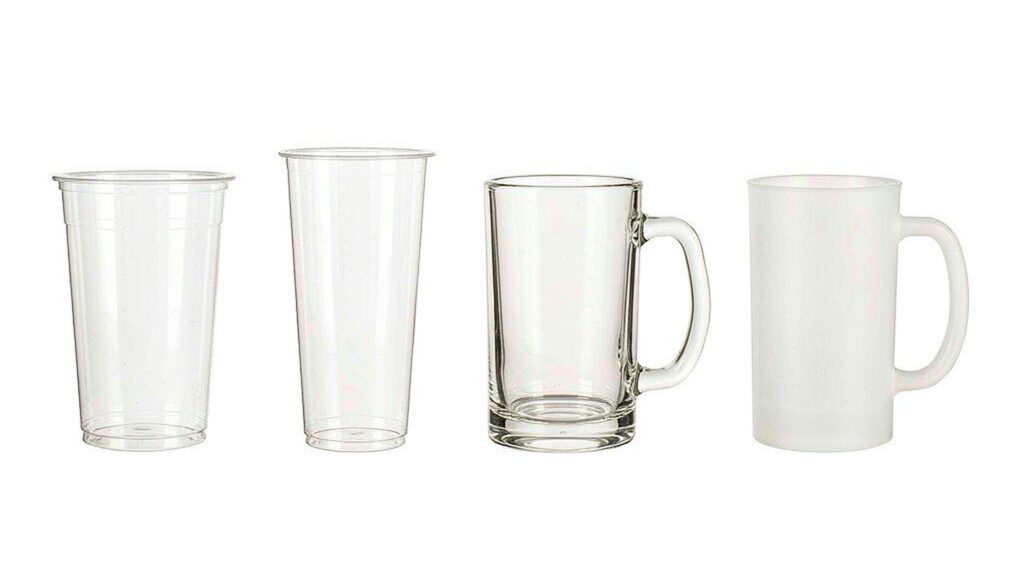
Four materials cover almost all beer service. They differ less in taste than in what they will survive.
| Material | Look and feel | Heat | Reuse | Main risk |
|---|---|---|---|---|
| PET | Crystal clear, light, thin wall | Cold drinks only | Single use | Warps above about 70°C |
| PP | Milky or frosted, flexible, tougher | Better than PET | Often single use | Not fully clear |
| Acrylic (PMMA) | Glass-like, heavy, hard | Good | Hundreds of washes | Brittle when dropped |
| Tritan copolyester | Glass-like, lighter, very tough | Good | Hundreds of washes | Expensive, needs real resin proof |
PET is the default for single-use pint cups and costs least. PP is the festival workhorse because it takes rough handling. Acrylic and Tritan are the reusable range, sold as merchandise or used at higher-volume venues.
Two things buyers get wrong. First, clarity is not a quality sign — a thicker wall often looks clearer and costs more. Second, plastic does not mean cheap: a mug for reuse often costs several times a single-use PET cup.
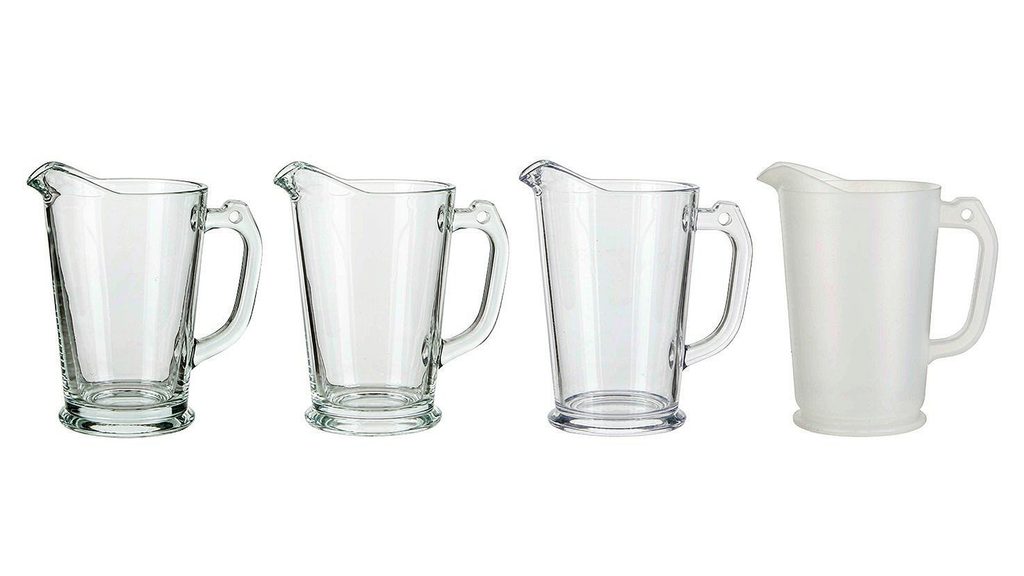
!Four plastic cups in polypropylene PET acrylic and Tritan side by side
!Four clear plastic beer cups in four different shapes
Is Polycarbonate Still a Legal Choice for a Beer Cup?
Not for anything you sell into the EU. This is the single change most likely to wreck an order placed on old habits.
Regulation (EU) 2024/3190 applies from 20 January 2025 and bans BPA and its salts in plastic food-contact materials in principle. No permanent exemption was kept for adult polycarbonate drinkware. EFSA’s 2023 opinion cut the tolerable daily intake for BPA to 0.2 ng/kg bodyweight per day, down from the 4 µg/kg figure set in 2015.
The United States takes a different line. FDA still considers BPA safe at levels in currently approved food containers and packaging. It has withdrawn clearance for polycarbonate baby bottles and sippy cups, on grounds of market abandonment rather than safety.
So one product, two legal answers. Ask which market the cups ship to, and if the EU, drop polycarbonate.
What About Expanded Polystyrene Cups?
EPS foam drink cups have been banned in the EU for years, under Article 5 of Directive (EU) 2019/904. The Packaging and Packaging Waste Regulation 2025/40 does not start that ban — it adds XPS, from 1 January 2030.
Solid polystyrene cups are a separate matter and still legal, though they crack when dropped. They suit indoor service, not outdoor events.
Does “BPA-Free” Tell You What a Cup Is Made Of?
No, and this is where most buyers get sold the wrong thing. “BPA-free” is a claim about one substance. It says nothing about which polymer you have.
Tritan is a trademark owned by Eastman Chemical, not a category name. It describes a copolyester, which is a different polymer family from polycarbonate. Another supplier’s BPA-free copolyester or SAN gives you the same BPA-free result without Tritan.
The recycling triangle makes this worse. Resin code 7 (OTHER) covers polycarbonate and Tritan alike, so neither the number nor a look tells you which one you hold. Only the resin grade records and the maker’s batch chain settle it. If a supplier asserts Tritan, ask for the resin documentation, not a slogan.
What Does the EU Require That a US Order Does Not?
The paperwork gap is wider than the material gap, and it starts with one document.
A Declaration of Compliance is what Regulation (EC) 10/2011 requires for plastic food-contact articles, and it must travel down the supply chain with test data behind it. So “food-grade” printed on a bag is worth less than it looks. It is an adjective, while a Declaration of Compliance is a file you can check.
Beyond that, the Packaging and Packaging Waste Regulation 2025/40 has applied since 12 August 2026, and two rules bite immediately. Food-contact packaging cannot enter the EU market above 25 ppb for any single PFAS, 250 ppb total PFAS, or 50 ppm including polymeric PFAS, and there is no sell-through period for stock. Total lead, cadmium, mercury and hexavalent chromium in packaging is capped at 100 mg/kg from the same date.
One of those rules surprises almost everyone. Under Recital 11 of the same regulation, cups designed to be sold empty and filled at the point of sale are not treated as packaging at all. Only cups meant to be filled at the point of sale, or sold already filled, count as service packaging. Selling empty branded cups to a distributor is a much lighter compliance job than selling filled ones.
If no SML is set for a substance, Regulation 10/2011 applies a general limit of 60 mg/kg. Ask what the number is rather than accepting “meets standard”. Among plastic cup brands, the paperwork is where the real gap sits.
How Do You Lock a Plastic Cup Order Down?
Turn the brand name into seven written items. Most bad plastic cup orders trace back to a vague first message.
1. Resin, by name and grade. PP, PET, PMMA or Tritan, plus the resin grade code. Never “plastic cup” or “BPA-free” as the whole spec. 2. Capacity in millilitres, plus the fill line. Say whether that number is to the line or the brim. Our beer mug size guide covers the unit traps. 3. Single use or reusable, and the reuse target. These are different products with different unit costs. 4. The Declaration of Compliance, dated and matched to your order, with the market it covers stated. 5. Decoration route and print area. Screen print, pad print or a printed sleeve each behave differently on a curved or frosted wall. 6. Empty weight, full weight and carton quantity. These three drive your freight quote more than the unit price does. 7. Market. EU, US or UK, because that decides whether polycarbonate and EPS are even on the table.
Then confirm one real filled sample against the written spec. A 3D proof shows shape. Only a filled sample shows how it pours.
What Is a Realistic MOQ for Custom Plastic Cups?
Rough guide, not a promise. Unprinted single-use plastic cups often start at 500 to 2,000 pieces. Printed plastic cups usually start at 500 to 1,000. Mugs for reuse more often start at 300 to 1,000. The print method moves that number more than anything else, so settle the printing before you ask for a quote.
How Long Does a Plastic Cup Order Take?
Budget three stages, and remember the first is not production. Artwork and proofs take 3 to 7 days. A physical sample takes another 5 to 10 days to approve. Production runs 10 to 20 days for single-use cups and 20 to 30 days for acrylic or Tritan mugs, plus longer runs if tooling changes.
Add shipping. Sea freight from China to a US or European port runs roughly 25 to 40 days door to door. Air freight is 5 to 10 days and can cost three to five times as much per unit. Work back from your event date and lock the spec in week one. Our lead time planning guide covers the scheduling maths.
How Do Plastic Cup Suppliers Handle Payment?
Most plastic cup factories quote 30% deposit against the order and 70% against a passed inspection, before shipping. That is the standard payment terms most buyers first meet. Better terms usually come after three or four settled orders.
A deposit you already paid buys nothing if the cups are wrong, so the inspection-before-balance clause is what protects you. Never pay the balance against a photo. Ask for check photos of the real production run with your carton marks visible. Confirm who pays the bank fee on each side. See quality control for promotional products in China for what a real pre-shipment check covers.
Frequently Asked Questions
Which Plastic Cup Material Is Best for Beer?
PET for single-use outdoor service, acrylic or Tritan for reuse. PET is clear and cheap but cannot take heat. PP is tougher and cheap, but not fully clear. Acrylic and Tritan survive repeated washes and suit venues buying mugs for reuse.
Can Plastic Beer Cups Go in the Dishwasher?
Only the reusable range, and only if the supplier confirms it. Most disposable PET and PP cups are not built for machine washing and will crease or distort. Acrylic and Tritan usually are, but confirm the heat limit, because dishwasher cycles run well above hand-wash heat.
Are All Clear Plastic Cups Made of the Same Plastic?
No, and they can look identical. Resin code 7 covers polycarbonate, Tritan and other copolyesters alike. The number will not sort them. You need the resin grade record.
Is Polycarbonate Safer Than Tritan for a Reusable Mug?
Neither is “safer” once BPA rules are met, and the EU now bars BPA polycarbonate anyway. Choose on toughness and heat tolerance, not fear. Tritan is lighter and less prone to shattering; acrylic is heavier and more scratch resistant.
How Many Plastic Cups Should I Order for a Festival?
Work from servings, not guest numbers. One 500 ml cup per serving per person for a long session, plus 10 to 15% for breakage and second pours. Our beer display ideas covers how cups fit the wider service setup.
Turn “Plastic Cup Brands” Into a Specification You Can Order
A brand name tells you who made the last batch. It tells you nothing about what you will get.
Write down the resin and grade, the capacity and fill line, the Declaration of Compliance and its market, and the empty and full weights. Then the unit price means something, and your quote is comparable to another supplier’s.
We source custom beer mugs, printed drink glasses and plastic beer buckets from the same factories, so a mixed programme can ship in one container. If cups are part of a wider bar setup, the barware buying guide covers the rest of it, and how to import bar supplies from China covers the logistics side. For minimums across a wider range of items, see MOQ on custom promotional products in China.