Most people ordering a mug of beer get the product they want. The words they use to ask for it are another story. A buyer who says “I need 2,000 steins” in June and 2,000 of the same cups arrive in January has a vocabulary problem, not a factory problem.
This guide sorts the four words that cause the most confusion, then shows you which material and which shape actually fit the beer and the budget.
What Is a Beer Mug? Knowledge of Beer Mugs Starts With the Handle
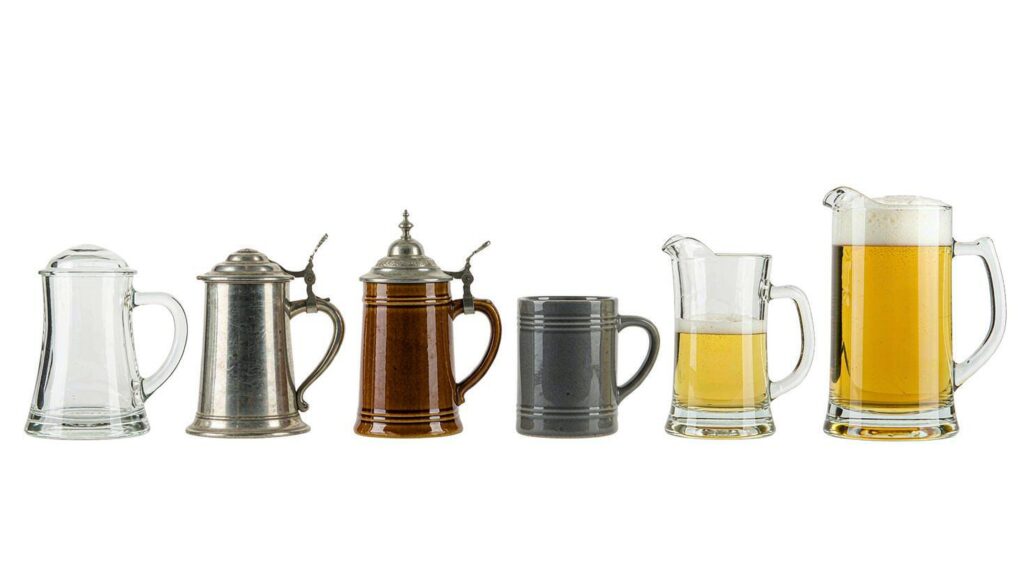
Knowledge of beer mugs is mostly a naming problem, and the naming problem starts with one fact. A beer mug is a handled, thick-walled drinking vessel built to keep your hand off the beer. That is the whole definition. The handle gives you a grip without your palm warming the liquid, and the thick wall slows the same heat transfer from the outside.
Beer glasses are built on the opposite logic. A pilsner glass, a weizen glass and a snifter have no handle and thin walls on purpose. Their shape is doing the work. The bowl traps aroma, the flare holds the foam, the narrow base keeps the beer cold longer.
So the first cut in any beer mug order is simple: handle or no handle. Everything after that is a variation. A vessel with a handle belongs to the mug family. A vessel without one belongs to the glass family, and it is designed to show the beer rather than hide it.
| The vessel | Handle | Wall | What it is built for |
|---|---|---|---|
| Beer mug | Yes | Thick | Holding without warming the beer |
| Tankard | Yes | Thick, often metal | Holding, often with a lid |
| Stein | Yes | Thick, often stoneware | Holding, traditionally with a hinged lid |
| Pilsner glass | No | Thin | Showing colour, carbonation, aroma |
| Weizen glass | No | Thin | A very large, stable foam head |
| Snifter | No, has a stem | Thin | Swirling a strong beer to release aroma |
If your customer asks for “beer mug glasses”, they usually mean the second row, not the first. Ask which one they mean before you quote.
For capacity, all the numbers live in our beer mug sizes guide. This article is about names and materials.
Mug vs Tankard vs Stein: Where Knowledge of Beer Mugs Usually Goes Wrong
Here is the strict version. Most people never need it, but factories do.
| Word | Strict meaning | Handle | Lid | Usual material |
|---|---|---|---|---|
| Mug | Any handled cup, no lid | Yes | No | Glass, ceramic |
| Tankard | A metal handled cup, or a lidded cup | Yes | Often | Pewter, silver, steel |
| Stein | A lidded stoneware jug | Yes | Yes, hinged | Stoneware, porcelain |
| Seidel | A regional Bavarian word for a 0.3 to 0.5 L handled mug | Yes | No | Glass |
| Maßkrug | The one-litre handled mug | Yes | No | Glass, stoneware |
| Krug | The plain German word for a jug | Sometimes | No | Any |
Two of these are worth extra attention.
Tankard is the oldest English term and the most misused one. Historically it meant a single-walled metal cup, often pewter, sometimes silver. It also carried a hinged flat lid. Today most people use it as a synonym for mug, which is fine at a bar and useless in a purchase order.
Seidel and Maßkrug are volume words, not style words. A Seidel is whatever the local brewery pours, usually half a litre. A Maßkrug holds a full litre. If a supplier quotes “a set of Seidel and Maß,” you are getting two sizes, not two styles.
The practical move is to stop using any of these words alone. Write the material and the capacity into the same sentence. “500 ml glass beer mug with handle, no lid” cannot be misread. A supplier reading “mug beer glassware” without units has to guess, and a guess on a 2,000-unit order is expensive.
If your customer’s brief just says “beer in a mug”, ask two questions before you quote. Is the mug the product, or is the beer in the mug the product? The first answer means drinkware. The second means glassware for a brewery, and the shapes change completely.
Why Does a German Stein Have a Lid?
Because of flies, and the fear that came with them.
Between roughly 1340 and 1380 the bubonic plague killed about a third of Europe. When it passed, sanitation rules across German-speaking regions tightened hard. One early target was open food and drink containers. Flies carried disease, and an uncovered mug was an open invitation.
By the early 1500s, several German principalities had passed laws requiring all food and beverage containers to be covered. The answer was a hinged lid in tin or pewter with a thumb lever, so you could open it and drink with one hand. That single feature is why the English word stein ended up meaning a lidded mug.
The other change came at the same time. Potters pushed the firing temperature from around 500 °C up to roughly 1,200 °C. The clay vitrified into stoneware, or Steinzeug in German, which is where the word stein actually comes from. Stoneware does not absorb liquid, it resists chipping, and it holds cold better than glass. That is the whole material case in one sentence.
The lid is now mostly a styling choice. Modern beer gardens serve plain glass. If your order needs a real stein with a working hinge, that is a decorative and heritage product, not a bar staple. Our personalized beer steins page covers that route specifically.
Why Is “Stein” the Word That Causes the Most Trouble?
Because in Germany it is not really a cup name, and English speakers use it for the wrong size.
Two separate problems sit under the same word.
First, Germans do not use it. The plain German word for a beer jug is Krug, and you will see Steinkrug, Bierkrug and Maßkrug on real menus. Sources that study German-language beer service all note that Stein is an English usage, not a German one. Put “Stein” on German-market packaging and you have chosen a word that locals do not recognise, and that a competitor could argue about.
Second, English speakers point at the wrong size. If you ask an English speaker for “a stein,” many picture the one-litre festival measure. A German speaker hearing “Stein” pictures a half-litre stoneware mug with a lid. Same word, two different objects.
There is a third, quieter problem. Because stein points at a specific material and heritage, using it loosely on a printed product invites the same challenge a food brand would get for calling sparkling wine “Champagne.” We are not making a legal claim here. We are telling you that the word carries a promise about material and origin, and you should be able to keep it.
The fix costs nothing. Say “beer mug” or “glass beer mug” and specify the size in millilitres. If the design really is a lidded stoneware piece, say so in full words. Our custom beer mugs catalogue uses the plain terms for exactly this reason.
Which Material Should You Choose: Glass, Stoneware or Ceramic?
Pick for three things at once: what the beer looks like, how far it has to travel, and what the logo has to sit on.
| Material | Shows the beer | Breaks | Feels | Logo routes | Typical MOQ |
|---|---|---|---|---|---|
| Glass | Yes, fully | Yes | Light | Laser, screen print, etch | 500 to 1,000 |
| Stoneware | No | Rarely | Heavy, warm | Transfer print, hand paint, relief | 1,000 and up |
| Porcelain | No | Rarely | Fine, thin | Full-colour transfer, hand paint | 1,000 and up |
| Stainless steel | No | No | Cold, heavy | Laser, etch, wrap print | 1,000 and up |
| Plastic | Yes, partly | No | Cheap | Screen print, pad print | 500 to 1,000 |
Glass is the default for most programmes. It shows the colour and the head, which is the point of pouring beer in front of anyone. It is also the cheapest to ship, because a glass mug weighs less than the same shape in stoneware.
Stoneware is the choice when the mug is the gift. It survives being dropped in a gift box and handed around. It feels expensive without costing more than a good bottle of whisky. What you give up is the beer itself, which nobody sees.
Stainless steel is for outdoor and event use. Nothing breaks it, and it holds cold far longer than glass. It is also the one material that reliably keeps beer cold without ice, which matters at a long outdoor event. If your programme is cooler bags and tent furniture, our cooler bag range sits in the same order.
Plastic is a decision, not a default. It will not break and it is the cheapest unit cost, but it reads as cheap in a gift bag. Use it where the mug gets thrown away after one event.
One material question settles most returns. Ask whether the beer goes in the mug or the mug goes next to the beer. A beer garden service puts beer in it dozens of times a day and needs a dishwasher-safe, chip-resistant body. A branded gift keeps one mug of beer in it and needs to look good in a photograph. Ask for a filled sample in both cases and weigh it.
One more material note. If your customer wants a vessel with no handle, that is a different order. Those go through the same factories but a different tool. Our drink glasses with a logo page covers that.
Which Glass Goes with Which Beer?
Once the material is settled, the shape decides how the beer tastes. This matters most when you are supplying a brewery rather than a gift buyer.
| Glass | Pairs with | Why the shape works |
|---|---|---|
| Pilsner | Pilsner, Helles, pale lager | Tall and slim, shows clarity and a tight head |
| Weizen | Hefeweizen, Dunkelweizen | Tall and curved, leaves room for a huge foamy head |
| Tulip | IPA, Belgian ale, saison | Round belly traps aroma, flared lip supports the foam |
| Snifter | Imperial stout, barley wine | Wide bowl, narrow mouth, built for swirling |
| Nonic pint | English bitter, ale, porter | Bulge near the rim, legal imperial measure, stacks safely |
| Stange | Kölsch, Altbier | Narrow straight cylinder, keeps delicate beer cold |
| Shaker pint | American light lager | Straight walls, cheap, stackable |
| Dimple mug | English ale, traditional bitter | Dimpled surface bends light through the beer, hard to break |
Two of these deserve a note because they sound similar and are not.
A nonic pint and a beer mug pint are different products. The nonic pint is a handled glass in Britain that carries a bulge about an inch below the rim. The name comes from “no nick” — if the glass tips over, the bulge hits the counter instead of the rim. The design was patented in the United States in the early 1910s and spread through British pubs after the war. A UK pint glass must hold a legal imperial measure, and its bulge is what lets glasses stack without fusing together. That makes it a bar glass, not a mug.
A dimple mug is a bar glass too. It has no handle and no lid, and the dimples are there to refract light through the beer so you can see how clear it is.
For a brewer buying taproom glassware, these distinctions are the whole order. For a gift buyer, they are noise. Ask which one you are dealing with before you pick a catalogue page.
Do People Still Buy Vintage Beer Mugs?
Yes, and the reason has nothing to do with drinking out of them.
Vintage beer mugs are bought as objects, not vessels. Three formats sell in volume: commemorative steins with relief scenes, brewery-logo mugs from a specific festival year, and character steins shaped like a barrel, helmet or animal. People buy them to put on a shelf or give as a milestone gift.
That changes the order completely. Nobody orders a “vintage” product from a factory. You order a modern product that looks vintage, or you order a reproduction of a historical piece. Useful ways to specify it:
- Commemorative stein: stoneware, relief or transfer-printed scene, hinged lid, gift box. Usually a low-volume run with a date on it.
- Festival mug: the year and the artwork are the product. Repeat this every year and it becomes a collector’s series.
- Character stein: a moulded shape. Needs tooling, so the minimum is high and the unit price is higher.
If a brewery wants this, the practical question is whether the mugs are merchandise or giveaways. Merchandise sells at a margin and wants a nice box. Giveaways want a lower cost and a sturdy body. The beer promotion case studies cover how those two budgets play out.
Related: if your programme is about the beer itself rather than the vessel, our brewery merchandise ideas and China beer brands pages cover that side.
How Do You Order Beer Mugs Once the Terms Are Settled?
The vocabulary fixes the product. Five numbers turn it into something a factory can quote.
1. Capacity in millilitres. Not ounces. The beer mug sizes guide covers why 20 oz means two different things, and why a fill line is not the same as a rim.
2. Full weight, not empty weight. A 1 L stoneware stein can weigh well over a kilogram empty, and a full one can pass 2 kg. That number changes your freight bill more than the unit price does.
3. Carton quantity and dimensions. Freight is charged on volume. A 0.5 L mug nested properly ships very differently from the same mug in a thick box.
4. Decoration route, in writing. Screen print charges setup per colour and per position. Laser engraving has no ink and suits short runs. Say which route you want, and get the setup fee quoted separately.
5. Full-material weight for a filled sample. Ask for one filled sample and weigh it. It is the fastest way to catch a capacity mistake before production.
Those five numbers sit alongside the usual commercial terms, which do not change with the style of cup. Treat them as 2026 rough guides rather than promises:
- Glass mugs, plain: about $1.20 to $3.50 per unit at volume
- Glass mugs, printed one colour: about $1.80 to $4.50 per unit
- Ceramic or stoneware mugs: about $2.00 to $5.50 per unit
- Screen print setup: about $30 to $100 per colour per position
- Most factories quote 30% deposit, 70% against a passed inspection
A small large beer mug order changes those numbers more than people expect. If your venue wants the 1 L or 1.5 L size, ask about a nested carton and a two-piece box before you accept the freight quote.
Budget three stages for timing. Artwork and proofs take 3 to 7 days. A physical sample takes 5 to 10 days. Production runs 10 to 20 days for glass and 20 to 25 days for ceramic. Sea freight to a US or European port adds roughly 25 to 40 days door to door. Our lead time planning guide covers the scheduling maths.
Two things protect the deposit. Inspect before you pay the balance, not after. And confirm who clears the cargo, so a broken carton in transit is not your problem by default. The quality control page sets out what to ask for.
Frequently Asked Questions
Is a beer mug the same as a beer stein?
In everyday English, often yes. Strictly, no. A stein has a hinged lid and is traditionally stoneware. A mug has a handle and no lid. If your order needs one specific thing, describe it in full words rather than relying on either term.
What is a German beer mug called?
A Krug. You will also see Steinkrug, Bierkrug and Maßkrug on menus. Maßkrug specifically means the one-litre measure, and Seidel is a regional word for a half-litre handled mug. German speakers do not normally use “Stein” for a drinking cup.
Is a glass beer mug better than a ceramic one?
Glass shows the beer and ships lighter. Ceramic or stoneware survives being dropped and feels more like a gift. Most bar and brewery orders go glass. Most corporate gift and heritage orders go ceramic.
What does “beer mug glassware” usually mean?
Usually it means all the vessels, both handled mugs and handleless glasses, rather than one product. Ask whether the order needs a handle. If it does not, you are buying from the glass range, not the mug range.
How many oz is a large beer mug?
“Large” has no fixed meaning in the trade. Common large formats run from 1 L to 1.5 L, with 2 L as a novelty or event size. Always confirm the millilitre figure rather than the word “large”, because suppliers use it loosely.
Can I get vintage beer mugs made new?
Yes, as reproductions. You would order stoneware with a transfer-printed or hand-painted period design, often with a hinged lid and a gift box. You cannot order an actual antique at volume. Moulded character steins need tooling, so the minimum is higher than for a printed mug.
Are ceramic beer mugs dishwasher safe?
Most glazed ceramic is, but a decorated mug with a transfer print or a metallic band often is not. Decals can dull in a dishwasher over time. If your customer is washing in a machine, ask the factory for a dishwasher-safe test on the exact finish you ordered.
What about glass mug breakage in transit?
Well-packed orders are commonly quoted under 0.3% breakage. Thin packing pushes it much higher. On a 2,000-unit order, 1% is twenty mugs you cannot sell. Ask for the packing method in writing, and consider a two-piece box for large glass mugs.
Turn a Name Into Something You Can Order
The whole job of this guide is one sentence: say the material, the capacity in millilitres, and whether it has a lid. Everything else is detail. Once you have those three, the rest is a standard purchase order and this guide to ordering custom beer mugs takes you through it.
If you want a supplier to sanity-check your specification, send us your use case and we will tell you which sizes, materials and decoration routes actually fit it, plus what the realistic MOQ and lead time look like in 2026.
We source beer pitchers, growlers, printed drink glasses, tap handles and bar mats from the same factories, so a mixed programme can ship in one container. The barware buying guide covers the alternatives if glass is wrong, and how to import bar supplies from China covers the logistics end to end. For minimums across a wider range of promotional items, see MOQ on custom promotional products in China, and for supplier questions worth asking before you commit, see questions to ask promotional product suppliers in China.