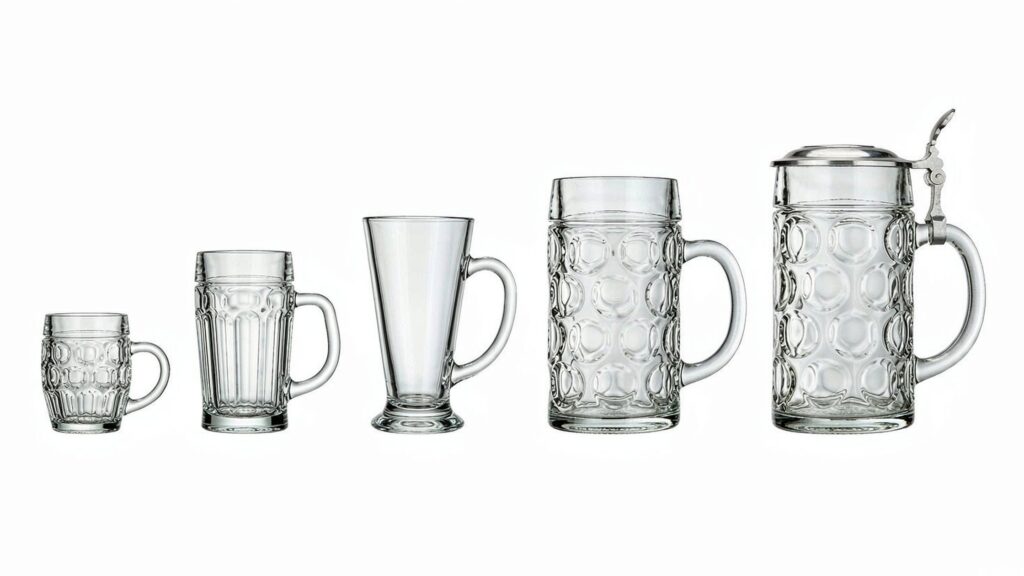
A beer mug’s capacity is the number everyone looks at and the number buyers most often get wrong. “20 oz” can mean 568 mL in the UK and 591 mL in the US. A 1 L German stein is measured to a fill line, not to the rim. And a full 1 L stein weighs about 2.25 kg, which changes your freight bill more than your unit price does.
This beer mug sizes guide gives you the capacity numbers, then shows you the three details that decide whether the order is right.
What Are the Most Common Beer Mug Sizes?
Most beer mug sizes charts stop at the ounce column. Here is the full version. Two columns matter: the US fluid ounces people order in, and the millilitres that appear on factory spec sheets.
| Cup type | Capacity | US fl oz (about) | Millilitres |
| Third pint, UK | 1/3 pint | 6.4 | 189 |
| Half pint, UK | 1/2 pint | 9.6 | 284 |
| Small stein | 0.3 L | 10.1 | 300 |
| US liquid pint | — | 16.0 | 473 |
| Seidel, Halbe | 0.5 L | 16.9 | 500 |
| Schooner, UK two-thirds | 2/3 pint | 13.3 | 379 |
| Imperial pint, nonic | 568 mL | 19.2 | 568 |
| Maßkrug, Mass | 1.0 L | 33.8 | 1,000 |
| Large stein | 1.5 L | 50.7 | 1,500 |
| Oversize stein | 2.0 L | 67.6 | 2,000 |
Three facts in that table surprise people:
- A 0.5 L seidel is bigger than a US pint. 500 mL beats 473 mL by 27 mL. Many US buyers assume the round number matches.
- A UK pint is 19.2 US ounces, not 20. The 20 figure is imperial fluid ounces. In metric, 20 imperial ounces equals 568.26 mL.
- A schooner is 379 mL, not 13.5 oz exactly. That comes from two-thirds of an imperial pint.
The US liquid pint is fixed by law at 473.176 mL. The UK imperial pint is fixed at 568.261 mL by Schedule 1 of the Weights and Measures Act 1985. Between them sits the 500 mL glass common across most of continental Europe.
Why Does a “20 oz” Beer Mug Sometimes Hold a Fifth More Than You Expected?
Because 20 ounces means two different things, and the gap between them is 95 mL.
One US fluid ounce is 29.57 mL. One imperial fluid ounce is 28.41 mL. So twenty of each gives:
| The supplier wrote | They most likely mean | That equals |
| 20 oz imperial | UK pint | 568 mL |
| 20 oz US | A slightly oversized US pint | 591 mL |
| 19.2 oz US | The same UK pint | 568 mL |
Write the unit system into the order. A spec that reads “20 oz” without a system is not a spec, and getting it wrong is the most common beer mug sizes error we see. Ask for millilitres, then check the millilitres against the row you want in the chart above.
The same problem shows up in catalogue numbers. A European 0.5 L glass gets marketed in the US as 16.9 oz. Round that to 17 and you have lost track of it. The millilitre figure is the one that survives the trip.
If a factory quotes you “one pint” without units, assume it means 500 mL until proven otherwise. Many European factories use “pint” loosely for the half-litre.
Does a UK Bar Have to Serve a Full Pint in a 568 mL Glass?
Yes, and this is the one place where the capacity question becomes a legal question.
UK law allows draught beer and cider to be sold by the glass in only four quantities: a third of a pint, half a pint, two-thirds of a pint, or multiples of half a pint. The first three came from the Weights and Measures (Intoxicating Liquor) Order 1988. The two-thirds measure was added by a 2011 amendment, effective 1 October 2011.
The order also states that beer sold for consumption on the seller’s premises must be sold in a capacity measure of the quantity being sold. There is one exception: when the drink comes through stamped measuring equipment the customer can watch.
For you, that means the cup is the measure at a tap. A UK bar cannot pour a pint into a 500 mL cup and call it a pint. The quantity is fixed by law, so the vessel has to match it.
| Measure | Millilitres | Imperial fl oz | Common name |
| Third pint | 189 | 6.67 | — |
| Half pint | 284 | 10 | Sampling, tasting |
| Two-thirds pint | 379 | 13.33 | Schooner |
| Pint | 568 | 20 | Standard |
| Two pints | 1,137 | 40 | — |
If you supply a UK venue, ask whether they pour from tap or from bottled beer. Tap service means the cup must be a legal measure. Bottled beer has no specified quantity.
Two details are worth knowing here. The British Beer and Pub Association guidance says a pint should be at least 95% liquid, which is about 540 mL of beer and no more than 28 mL of foam. And Trading Standards officers can test a glass against its crown stamp, so a mislabelled measure is a real problem, not a rounding argument.
Why Does a German Stein Have Two Marks on It?
Because German beer is measured to a line, not to the rim.
A Maßkrug carries a calibrated fill line below the top edge. The space above it holds the head, which German brewing treats as part of the pour rather than as empty glass. Buy a certified 1 L Maßkrug and the line marks exactly one litre. Fill to the rim and you have served more than a litre.
Most American glassware works the other way. Capacity usually means the brim, and a full pint glass is full to the top edge.
So the same product description — “1 litre mug” — can mean two different liquid volumes depending on the market it was written for. Ask which line the measurement refers to. If a supplier cannot answer that, they have not tested the glass.
There is a second reason German glassware is often larger than its rating: the foam allowance. That extra capacity above the line is not a defect, and it should not be trimmed off to save material.
How Much Head Space Should You Leave?
Industry guidance treats the head as roughly 5% of a 568 mL pint. On smaller pours the same 25 to 30 mL of foam is a much bigger share of the volume.
That matters for two reasons. A thicker head traps aroma compounds, so the beer tastes different. And a glass with almost no head pushes a bartender to overpour, because there is nowhere for the foam to go.
If you are buying for a venue, ask what head height their pour targets. A brewery taproom pouring 30 mL of foam is a different programme from a corporate gift where the recipient pours for themselves.
Why Is the Weight of the Beer Part of a Capacity Decision?
Because a 1 L stein filled with beer weighs about 2.25 kg, and only about 1.3 kg of that is the glass.
Full weight drives three separate costs that most quotes hide:
- Freight weight. Couriers charge on the heaviest of actual weight and volumetric weight. A box of 1 L steins hits the volumetric limit long before it hits the actual-weight limit.
- Pallet and carton count. Large steins nest badly, so each carton holds fewer pieces. More cartons means more outer packaging and more handling.
- Breakage rate. A heavy glass dropped on a warehouse floor breaks. Breakage is not a one-off cost; it shows up as insurance claims, replacement stock and unhappy venue staff.
| Size | Empty weight, about | Full weight, about | Relative freight cost |
| 0.3 L stein | 0.25 kg | 0.55 kg | Baseline |
| 0.5 L seidel | 0.45 kg | 0.95 kg | Moderate |
| 1 L Maßkrug | 1.3 kg | 2.25 kg | High |
| 1.5 L stein | 1.9 kg | 3.4 kg | Very high |
These are typical figures for thick-walled glass, not guarantees. Weight varies with wall thickness and design, and borosilicate mugs sit at the lower end.
Choose the smallest mug that serves the beer properly. A 1 L stein is a strong photo at Oktoberfest and a weak choice for an airline gift programme.
Why Does Weight Decide Between Two Mugs of the Same Capacity?
Because at the same capacity, the lighter mug wins on every cost that is not the unit price.
A 500 mL borosilicate mug and a 500 mL soda-lime glass mug hold the same beer. The borosilicate one survives drops and thermal shock, weighs less for its strength, and costs more up front. If your venue has staff washing mugs all night, the borosilicate option usually wins over a year.
The same logic applies to shape. A straight-sided mug stacks and nests in a carton. A dimpled or handled festival stein does not, so you pay for more cartons to move the same number of mugs.
Weight and shape are logistics decisions disguised as product choices. Ask for both numbers before you commit.
Which Beer Mug Size Should You Order?
Start from the beer, not from the number. The right size follows the style and the occasion.
| Your use case | Size to look at | Why |
| Corporate gift set | 0.3 L to 0.5 L | Light to ship, fits one hand, survives parcel delivery |
| Brewery taproom retail | 0.5 L seidel | Standard in most markets, shows the beer colour |
| Oktoberfest event | 1 L Maßkrug | The expected vessel, and it is what guests photograph |
| UK venue, draught | 568 mL nonic | Legal measure for pint service |
| UK venue, bottled | Any | No specified quantity applies to packaged beer |
| Bar with fast table turns | 0.3 L to 0.5 L | Lower total weight means faster service and less breakage |
| Retail merchandise programme | 0.5 L glass or ceramic | Best balance of presence, weight and packing density |
A general rule helps: the smaller the pour, the faster the beer warms up. A 0.3 L mug is finished before the lager loses its chill. A 1 L stein is still warm near the end, because it takes so long to drink.
For high-alcohol styles this matters more. Barleywine and Belgian tripel are meant to be sipped warm, so a big stein is not a problem. For a pilsner or a cold lager at an outdoor event, the large mug works against the beer.
How Do You Know the Difference Between a Stein and a Seidel?
The names get mixed up constantly, including in factory listings. The practical differences:
- A stein is traditionally a lidded vessel. The word comes from German Stein meaning stone, and the fuller form Steinzeugkrug means stoneware jug.
- A seidel is the open-topped glass version. It is the everyday glass in German beer halls today.
- In modern German nobody says stein for a drinking glass. Germans say Krug, Humpen, or Seidel in Bavaria and Austria.
So the lidded stein in a gift box and the heavy dimpled glass in a beer garden are different products that share an English word. When you order, describe what you need instead of trusting the name: material, lid or no lid, capacity, and whether it is for drinking or for collection.
Lidded pieces with pewter hinges or metal clasps need more fit and finish checks. They also carry more weight and more breakage risk. Reserve them for commemorative and collector programmes, not high-volume giveaways.
What About the Dimples?
Dimples on a German-style glass are not decoration only. They give grip when condensation forms, add wall thickness, and catch light so the beer colour shows.
They also shrink your usable print area. A dimpled surface is not flat, so screen printing needs a pad printing route and a single-colour design. Confirm the print position on a physical sample before artwork approval.
Flat-walled clear glass gives you a wider decoration area and simpler artwork rules. That is why most brewery merchandise runs on flat glass even when the taproom pours dimpled steins.
How Do You Order Beer Mugs by the Right Size?
Here is the order of operations that avoids most sizing mistakes.
1. Write capacity in millilitres. Not ounces. Millilitres survive the trip between factories, freight forwarders and importers, and they leave no room for the imperial-versus-US argument.
2. Confirm whether the measurement is to the line or to the rim. This matters for anything above 0.5 L, and for anything sold in Germany or the UK.
3. Ask for the empty and full weight. Two numbers, no charge to get. They tell you whether your freight quote is realistic.
4. Ask how many units fit in a master carton and on a pallet. Carton quantity is what turns a unit price into a landed cost.
5. Order a physical sample before artwork approval. Fill it with water and put it on a scale to confirm the volume yourself.
That last step takes five minutes and catches the two most common mismatches: a glass that is smaller than its own spec sheet, and a print position that does not survive the handle.
Why Does the Sample Matter More Than the Spec Sheet?
A factory spec sheet describes what the mould makes. A sample tells you what you will receive.
Capacity drifts. Wall thickness varies between moulds. Handle joints shift. A glass rated at 500 mL can land anywhere from 470 to 520 mL depending on the run, and nobody in the supply chain treats that as a defect.
Here is how to check a sample yourself:
- Put the empty mug on a kitchen scale and zero it.
- Fill it to the fill line, or to the level the brand pours to.
- Read the weight in grams. For water, grams and millilitres are nearly the same number.
- A 500 mL glass should read close to 500 g. Divide by 29.57 for US fluid ounces.
Use room-temperature water and leave the same head space your customers will leave. If you pour to the rim for the test but the brand pours to the line, your number is wrong by roughly 30 mL.
You can also fill a suspect glass and pour it into a marked measuring jug. That catches a badly shaped glass, but it will not tell you the difference between a deliberate fill line and a manufacturing error.
How Do You Check a Fill Line You Cannot See?
Ask the factory to point at it. A calibrated line is normally moulded into the glass near the base of the foam zone, and it is often faint on cheap products.
If nobody can find it, treat the glass as a brim-measure product. That is fine for most markets. It is a problem only if you are supplying UK or German venues that expect a certified measure.
How Many Beer Mugs Should You Order?
MOQ depends on the route, and the difference between routes is larger than most buyers expect.
| Route | Typical MOQ | What it suits |
| Stock glass, printed | 500 to 1,000 units | Repeat promotional orders |
| Custom mould and tooling | Several thousand units | A new shape or a new handle |
| Laser engraving on stock | As low as 12 to 24 units | Samples, small gifts, name lists |
| Ceramic, decorated | 1,000 units and up | Heritage and merchandise programmes |
Most Chinese glassware factories quote a 1,000-unit minimum and will mix styles or finishes inside that number to hit it. Some will mix capacities too, which is useful when you want a 0.3 L and a 0.5 L in one carton.
Screen printing and laser engraving quote very differently. Screen printing charges setup per colour and per position, so it gets cheap fast at volume. Laser engraving has no ink cost and needs no plate, so it suits short runs and single-name gift lists. Suppliers quote engraved MOQs in the dozens where printed MOQs sit in the thousands.
Before you compare two quotes, check four things: is tooling included, is the setup fee charged per colour, is artwork revision charged, and what happens to the unit price at double your order quantity.
How Do Beer Mug Suppliers Handle Payment Terms?
Most factories quote 30% deposit against the order and 70% against a passed inspection, before shipping. A few accept an open account after three or four settled orders, and that is where the better terms live.
The practical rules when you compare payment terms across beer mug sizes:
- A deposit you have already paid buys you nothing if the mugs are wrong. Inspection before the balance is the clause that protects you.- Never pay the balance on a photo. Ask for inspection photos of the actual production run, with your carton marks visible.
- Bank charges are not the supplier’s fault, but they are your cost. Confirm who pays the fee on each side, and add it to your landed cost.
- Air freight with a supplier-arranged agent often means less control. If you need speed, ask who clears the cargo and what happens if a carton breaks in transit.
Most buyers settle 30/70 with a small supplier, then move to a confirmed order or a credit arrangement once they have worked together twice. Ask for that at your second order, not your first.
What Does a Custom Beer Mug Cost?
Treat every number here as a rough guide from 2026 supplier quotes, not a promise. Freight, artwork and packaging move these figures more than the factory margin does.
- Glass mugs, plain: about $1.20 to $3.50 per unit at volume
- Glass mugs, printed one colour: about $1.80 to $4.50 per unit
- Frosted or etched finish: about $2.50 to $6.00 per unit
- Ceramic mugs: about $2.00 to $5.50 per unit
- Insulated steel mugs: about $6.00 to $14.00 per unit
Setup fees run $30 to $100 per colour per position. They are one-time, so they matter at 500 units and barely register at 5,000.
The cost that surprises buyers is not the unit price. It is breakage. Glass breakage in transit is commonly quoted under 0.3% for well-packed orders, and it is much higher when packing is thin. On a 1 L stein, a 1% breakage rate on a 2,000-unit order is twenty glasses that no longer sell.
How Long Does a Custom Beer Mug Order Take?
Budget three stages, and remember the first one is not production:
- Artwork and proofs: 3 to 7 days, longer if the supplier has to rework vector files
- Sample and approval: 5 to 10 days for a physical sample
- Production: 10 to 20 days for glass, 20 to 25 days for ceramic
Add shipping. Sea freight from China to a US or European port runs roughly 25 to 40 days door to door including clearance. Air freight is 5 to 10 days and can cost three to five times as much per unit on a heavy item like a filled stein.
Work backwards from your event date. If you need 3,000 mugs for a festival in eight weeks, you cannot approve artwork in week three. Lock the spec in week one.
Our guide to planning lead time on custom promotional products covers the scheduling maths in more detail.
Frequently Asked Questions
Is a 16 oz Beer Mug the Same as a 500 ml Mug?
No, and the difference is small enough to miss. A 16 US fl oz pint is 473 mL. A 500 mL seidel is 16.9 US fl oz. If you want a true US pint, order by millilitres and check the sample. If you want the European standard, order the 0.5 L.
What Size Is a German Stein?
Most are 0.5 L, which is 16.9 US fl oz. The 1 L Maßkrug is the Oktoberfest standard at 33.8 US fl oz. Sizes from 0.3 L to 2 L are all in production. Our personalized beer steins guide walks through how the material changes the buying decision.
How Much Does a Full 1 L Maßkrug Weigh?
About 2.25 kg, of which roughly 1.3 kg is the glass. That is the figure to send to your freight forwarder, not the empty weight.
Can I Get Beer Mugs With My Logo in Small Batches?
Yes. Laser engraving has no ink or plate cost, and some suppliers quote from 12 to 24 units. Screen printing needs setup per colour and usually starts at 500 to 1,000 units. The right route depends on how many colours you need and how many names vary. More on this in custom beer mugs with logo.
Does the Mug Size Affect How Much Beer Lands in a Serving?
Only if you change the fill line. Keep the same fill line and the same beer, and a bigger mug just means a bigger pour. If the venue pours to the rim on one size and to a line on another, the poured volume changes with the vessel. Decide the fill line before you compare quotes.
Which Mug Size Travels Best?
The 0.3 L to 0.5 L range. They pack densely, stay under courier weight limits, and break at a much lower rate than a 1 L stein. If you need a large mug for a photo moment, our festival and large-capacity mug options are worth a look.
Turn a Size Into a Specification You Can Order
A mug order goes wrong in three places: the unit system, the fill line, and the weight. Settle all three and the rest is arithmetic.
Write capacities in millilitres. Confirm the line or the rim. Get the empty and full weight plus the carton quantity. Then the unit price means something.
If you want help putting a specification together, send us your use case and we will tell you which sizes, materials and decoration routes actually fit it. We also source beer pitchers, growlers and printed drink glasses from the same factories, so a mixed programme can ship together.
For minimums across a wider range of promotional items, see MOQ on custom promotional products in China. If glass is the wrong material for your event or shipping route, the barware buying guide covers the alternatives, and how to import bar supplies from China covers the logistics.