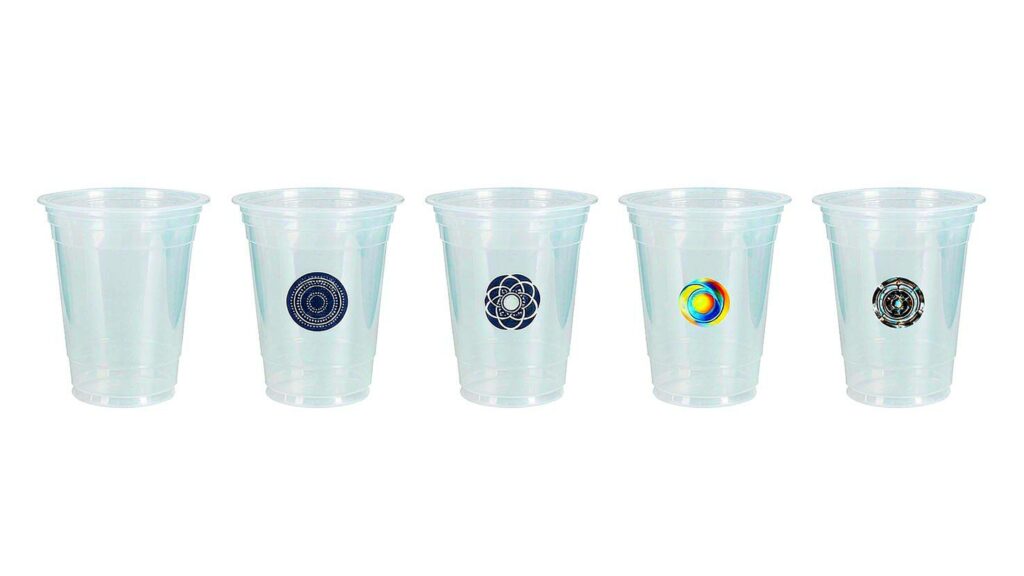
Most people searching plastic cup printing want one thing: their logo on a cup that does not look like a sticker peeled off a bottle. The printing method matters, but it is only half the job.
The other half is what happens after the ink is on. A plastic cup that gets filled with beer and sold across a bar is not merchandise. In the UK it is a capacity serving measure under the Measuring Instruments Regulations 2016, and it must carry markings that a logo cannot cover up.
This matters because plastic cup printing is not a one-step job. You pick a process, then a material, then artwork, then markings. Get one of them wrong and the whole run is affected. This guide covers all four.
This guide covers both halves. Which printing method fits which design, which plastic holds ink, and the marking rules that decide whether your printed cup can legally pour beer.
What Are the Main Plastic Cup Printing Methods?
Five methods cover almost all production. Each one buys you something and costs you something.
Our plastic cup designs guide works the other way round, starting from the cup shape and asking what it can take. This section starts from the method itself. Use it when you already know the cup and want to know what the artwork can do.
| Method | Colours | Typical minimum | Durability | Best for |
|---|---|---|---|---|
| Screen printing | 1 to 4 spot colours | 500 to 1,000 cups | Very high | Simple logos, bold text, one-colour brand systems |
| Pad printing | 1 to 6 spot colours | Medium | Medium | Small logos, curved or irregular areas, cup bases |
| Digital / UV printing | Full colour CMYK | 100 to 500 cups | Medium, improving | Photos, gradients, short runs, personalised cups |
| Heat transfer printing | Full colour, full wrap | 1,000 cups and up | Medium to high | Large all-over designs, 360 degree artwork |
| In-mould labelling (IML) | Full colour, full wrap | 3,000 cups and up | Highest | Premium brands, cups washed hundreds of times |
Screen printing is the workhorse and the cheapest per unit at volume. Ink is pushed through a mesh screen, one screen per colour. The thick laydown gives strong colour on a clear cup, and the print shrugs off handling. What it cannot do is gradients or anything finer than a hairline. Fine details below about 1pt fill in with ink and turn to mud. Offset printing is a sixth route worth knowing, and it sits between screen and digital on volume.
Pad printing solves the problems screen printing creates on shapes. A soft silicone pad picks the image off a plate and presses it onto the surface. It can print near a curve, or in a small area a screen cannot reach. Its weakness is the shape that made it useful. The pad presses unevenly at edges, so heavy ink lifts sooner.
Digital printing removes the setup cost. No screens, no plates, so a run of 100 cups costs almost what a run of 500 does. It is the only realistic route to photographs or gradients at low volume. The trade-off is a higher cost per cup, and ink can look flatter on a curved clear wall than it does on a flat proof.
Heat transfer wraps full colour around the wall in one pass. It is the go-to for full-wrap festival artwork, because it covers large areas with no seam and no per-colour setup. Quality depends on holding temperature and pressure steady. That is why a sample from the middle of a run matters.
In-mould labelling is the premium option and the least flexible. A pre-printed label sits inside the mould, and the cup is formed around it. The graphic ends up inside the wall, so it cannot scratch off or peel. You pay for that in tooling and in minimums.
Why Does Ink Peel Off Some Plastic Cups?
Because most common packaging plastics have almost no surface energy. Water beading on a waxy surface is the same physics.
Polypropylene and polyethylene need surface treatment before anything will stick. UV ink makers state the rule plainly: surface tension on PP and PE must reach 40 dyne/cm² or higher after flame or corona treatment. Untreated PP will pass a casual tape test and then fail on a summer festival.
PET is easier but not free. Its structure takes ink better than PP, though corona treatment still improves results, and glossy clear surfaces need UV-cured inks rather than solvent ones.
The treatment has to be on the cup, not described in an email. Ask what the line actually does. Flame treatment burns the surface in a controlled burst, and needs care so it does not damage the wall. Corona treatment uses an electrical discharge and needs its own equipment. A chemical primer wipe is the cheap route, and the one most likely to be skipped when a run gets tight.
A cross-cut tape test is the fair check. You press tape onto the printed area, pull it off hard, and look at how much ink lifts. Ask for the result on your material. A photo of somebody else’s PET cup proves nothing.
Which Plastic Should You Print On If You Are Serving Beer?
For repeated use and washing, the answer is polypropylene, and this is the trade-off that catches people out.
| Plastic | Takes ink | Holds cold beer | Survives a wash | Reuse |
|---|---|---|---|---|
| PP polypropylene | Needs treatment | Yes | Yes | Best |
| PET | Good with corona | Yes | No, deforms at heat | Single use |
| PS polystyrene | OK | Yes | No, brittle | Single use |
| rPET | Same as PET | Yes | No | Single use |
PP is the only practical choice for a reusable beer cup. PET and rPET are cold-beverage plastics. They soften and distort in heat, and commercial dishwashers are hot. PS is printable but brittle and sensitive to solvents. If you want printed pints that come back from a wash sharp, PP is what you order.
This matters because PP is also the hardest plastic to print on. You are picking the material that most depends on treatment. Lock the treatment into the order, not just the colour.
If the cup is a single-use give-away rather than a reusable one, PET becomes reasonable and cheaper. Our printed drink glasses guide covers the glass routes, and custom beer mugs covers ceramic and steel.
What Is a Line Mark and Why Does It Change the Spec?
A line measure is a cup marked with a line where the measure sits. A brim measure holds the full measure when filled to the top. Both are legal shapes for beer.
The difference matters because of how the law defines capacity. Under Annex X of Directive 2014/32/EU, “capacity” is the volume to the filling mark for line measures. For brim measures it is the volume of the whole cup. Same word, two different physical measurements.
A line cup is slightly oversized, with room for a head. A brim cup uses less material for the same measure. Bar staff pour faster into a line cup at volume. Neither choice is free, so state it in the order instead of letting the factory pick.
Permitted error depends on size. For serving measures of 200 ml and above, the negative error is zero, so a cup may never under-fill. The positive tolerance runs to 10 ml plus 5%, with an added two-way term of 5 ml plus 2.5%. Reference conditions are 20 °C, standing free on a level surface.
For the oz and ml equivalents of common beer sizes, our beer mug sizes guide has the full table.
What Marks Does a Printed Beer Cup Have to Carry?
This is where a plastic cup printing quote and a plastic beer cup order part company. If the cup measures and sells the drink, it is a regulated measuring instrument.
In Great Britain, capacity serving measures must carry the UKCA marking and the M marking. The M marking must come straight after the UKCA mark, and both must be fixed visibly, legibly and indelibly, on the instrument or its data plate. If a notified body checks production control, its body number follows the marks. Regulation 52 of the 2016 Regulations accepted CE as an alternative in GB until 1 January 2025. In Northern Ireland the CE mark applies, or CE plus UKNI where a UK approved body ran the check, alongside the M marking.
The nominal capacity must be clearly and indelibly marked on the cup. Any filling marks must be clear and durable enough that the permitted errors are not exceeded in use. A cup may show up to three capacities, provided none can be confused with another.
Three practical points for your artwork:
- Keep the logo clear of the capacity number, the fill line, the M marking and the body number. Covering any of them breaks the “legibly and indelibly” requirement.
- Ask whether the printing is part of the moulding or applied afterwards. IML artwork becomes part of the wall, which leaves room for the markings to sit cleanly beside it. A screen-printed cup needs reserved space on the layout.
- Ask for the marking set in writing with the quote. A supplier who answers “CE certified” and stops has told you nothing about whether the M marking is there.
The old crown symbol is decoration now. GOV.UK is explicit that it “does not indicate compliance with any legal requirements” and that no measurement accuracy should be read into it. You can put it anywhere, at any size. It must not cover any required marking, and no numbers should sit straight under it.
If the cup is merchandise, and the beer is measured in a separate legal measure, the duty sits on that measure, not on the cup. Check your set-up with your local trading standards service before you rely on that reading.
What Artwork Do You Need to Send?
Send vector files, and send Pantone references. AI, EPS and print-ready PDF are the normal formats, with fonts converted to outlines and the file in CMYK. Pantone references remove most colour arguments, because a screen colour is not a Pantone colour.
Plan for the shape of the cup. Flat square artwork distorts when wrapped around a tapered wall. The design has to be built as a fan shape, worked out from the top and bottom widths of the cup. Ask the factory for that template rather than guessing.
Extend artwork past the trim line. Two to three millimetres of bleed stops white edges appearing after trimming.
Do not plan fine detail for spot colour. A gradient, a photograph or a hairline means screen printing is the wrong method. Find that out before the quote, not after the sample.
What Food Contact Papers Should You Ask For?
Two separate things are being regulated here, and buyers often ask for only one of them.
The plastic itself must be cleared for food contact in its market. In the US, PET polymers sit under 21 CFR 177.1630. PP and PE sit under 21 CFR 177.1520. In the EU and UK, plastic food contact materials fall under Regulation (EU) No 10/2011. The overall migration limit there is 10 mg/dm² or 60 mg/kg of food simulant.
The ink is a second, separate question. Printing inks in their supply form sit outside the EU positive list. Their main framework is Council of Europe Resolution AP(2005)2 plus national rules. The European Printing Inks Association set an industry target of 10 parts per billion for ink on the non-food-contact side. Switzerland’s Ordinance SR 817.023.21 runs a positive list and is the sharpest written rule in Europe.
Watch the set-off problem. EU guidance defines set-off as the transfer of substances from the outer layer straight onto the inner food contact layer. It happens by direct contact, not through the wall, and it happens during storage, transport and stacking. Stacked printed cups nest inside each other, so set-off is exactly what you would expect. Ink components on the 10/2011 positive list must still meet their own limits.
What to request:
- An ink composition note from the ink maker. EuPIA publishes a model form covering the maker, the date, the product, a note that the ink was mixed for food packaging use, and a list of substances restricted under 10/2011.
- A Declaration of Compliance for the finished cup, not for the resin or the ink. Only the factory that makes the final plastic article can issue it.
- If either is missing for your market, run a migration test on the printed cup. Paper about raw resin does not cover the finished product.
One phrase to retire: “FDA approved resin” tells you about one ingredient, not the finished cup. Under 21 CFR 170.100 a food contact notification covers only the maker and the customers named in it. A different factory that adds colour and additives needs its own basis.
How Much Does Plastic Cup Printing Cost?
Here is a rough guide, not a promise. Real quotes move with cup size, colour count, print area and order size.
- Setup per colour per position: about $30 to $100, one time
- Screen printing, per colour per cup: about $0.01 to $0.03 at volume
- Digital printing, per cup: about $0.03 to $0.08
- IML: the highest per-unit cost of the five, plus tooling
- Samples: usually $50 to $150, shipping extra
The cost that surprises buyers is not the print. It is reprinting a run whose ink did not last. Agree the test method before you pay for production, not after.
Freight is charged on volume, not weight. Cups are light and bulky, so they ship as dimensional weight. Before you commit, ask for cartons per cubic metre and how many cartons fill a 20GP container. That one number moves the landed cost more than the print price does. Our guide to importing bar supplies from China covers the freight side, and MOQ on custom promotional products in China covers minimums across categories.
Payment terms are usually a deposit and a balance. Most factories ask for 30% deposit on order and the balance against the pre-shipment photo, sometimes through a bank guarantee on first orders. Ask in writing who the contract is with. If the seller is a trading company rather than the factory, the payment terms are theirs, not the maker’s, and you lose the ability to walk away at the sample stage.
Ask who takes the risk when something is wrong. A contract that only covers unit price and delivery time is not enough. Get the sample approval step written into it, with the cross-cut tape result as the standard.
How Long Does a Printed Plastic Cup Order Take?
Budget three stages, and remember the first is not production.
- Artwork and proof: 3 to 7 days
- Sample and approval: 5 to 10 days
- Production: 20 to 25 days for screen printing, 25 to 35 days for heat transfer and IML
Add shipping. Sea freight from China to a US or European port runs roughly 25 to 40 days door to door including clearance. Air freight is 5 to 10 days and costs several times more per unit on a bulky item.
Order seasonal programmes early. Summer beer events are the busiest production window for printed cups, so a September festival order placed in August is gambling. Our lead time planning guide has the scheduling method.
Frequently Asked Questions
Can You Print on Any Plastic Cup?
No. PP and PE need surface treatment first, and they will not hold ink reliably without it. PET and PS take ink more readily. Ask what treatment the line runs before you order.
Can You Print a Photo on a Plastic Cup?
Yes, with digital printing or heat transfer. Screen printing cannot do it. Expect a higher per-unit cost and a longer minimum than a one-colour logo.
What File Format Should I Send for Cup Artwork?
Vector, in AI, EPS or PDF, in CMYK, fonts converted to outlines. Add Pantone references so the factory mixes ink against a standard rather than a guess.
What Is the Minimum Order for Printed Plastic Cups?
Screen printing usually starts at 500 to 1,000 cups, because of the setup cost. Digital printing can start at 100. IML on a new mould starts around 3,000 cups. UK moulders working from existing tools quote far lower. Whatever the number, ask what happens if you need 200 extra later, because plastic cup printing rarely lines up with a fixed event budget.
Why Did My Printed Cups Smudge in Cold Drinks?
Condensation is the usual cause. Cold liquid on a warm cup puts water on the ink film all evening. Ask for UV-cured ink rather than solvent-based, and ask for a cross-cut tape result on your material before you approve the run.
Can I Print on the Bottom of a Plastic Cup?
You can print on the base, and suppliers offer it. It is a poor choice for branding. The base carries mould marks and the resin code, and it is the part that sits in a holder or on a table. Put the design on the sidewall.
Do Printed Plastic Cups Need a Legal Marking to Sell Beer?
In Great Britain, if the cup measures and sells the drink, yes. It is a capacity serving measure under the Measuring Instruments Regulations 2016 and needs the UKCA marking with the M marking, plus a clear and indelible capacity marking. Ask for this in the quote, in writing.
Turn a Printing Method Into a Specification You Can Order
A printed plastic cup order goes wrong in four places: the plastic, the process, the artwork and the marking. Settle all four and the rest is arithmetic.
Write the specification as a list. Name the material and the surface treatment. Name the process and the colour count, with Pantone references. Keep the print area clear of the markings. State capacity as line or brim. List the food contact papers you require. Then get a sample and run a cross-cut tape test on it.
Send us the use case and we will tell you which material and which process fit it. Sometimes the honest answer is glass or steel instead. Use our contact page.
We also source beer pitchers, growlers, coasters and ice buckets from the same factories, so a full bar programme can ship in one container. For how to vet the factory before you commit, see how to source beer promotional products from China and questions to ask suppliers.