Type plastic cup suppliers into a search box. You will get pages full of factories telling you they are factories. What you rarely get is a way to tell which of them can really make your cup.
That gap matters more than it sounds. When we pulled listings from a major sourcing platform on 15 October 2026, the category had 41,696 “plastic cup” products from 471 suppliers. Prices on that same page ran from $0.01 to $2.75 per unit. Order minimums ran from 20 pieces to 250,000. The search term was identical. The products almost had nothing in common.
So comparing quotes before you define your cup is not just hard. It is meaningless. Define the cup first. Then judge the supplier.
That is the order this guide uses. Most plastic cup suppliers are honest and capable. The trouble is that those two things cannot be checked until you know what you asked them for.
This guide walks through that order of operations for bars, breweries, events and brand teams buying plastic cups with a logo on them.
1. What Kind of Cup Are You Actually Buying?
Before you email anyone, answer four things. This takes ten minutes and saves you three rounds of useless quotes.
- Single-use or reusable? This one answer changes the factory, the mold, the price and the compliance path.
- Hot or cold? A cup for frozen margaritas and a cup for hot mulled wine are not the same object.
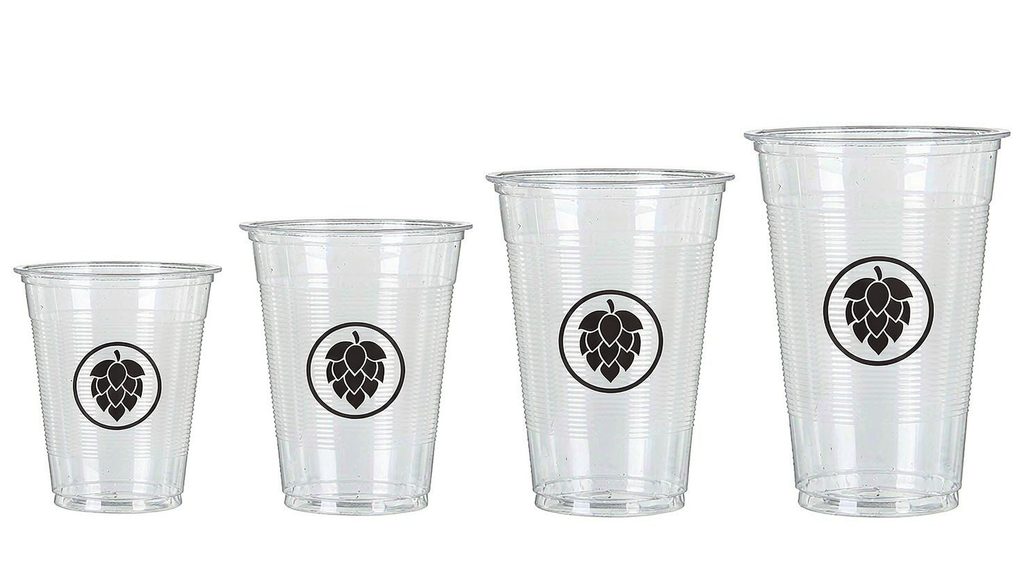
- What size? Common bar sizes run 9 oz to 22 oz. Say ounces and millilitres both, since your factory may work in metric.
- Printed or plain? A printed cup needs artwork, plates and a proof cycle. A plain cup does not.
Write those four answers into your first message. A supplier who quotes without asking any of them back is guessing. Guessing is fine on day one. It is expensive by week three.
Then add the two items most buyers forget: your destination country and your needed date. These drive the compliance answer and the freight answer. Neither can be worked out later.
A note on emails. Most plastic cup suppliers reply within a day. If yours takes a week to answer four small questions, that is your sample of their production updates. Believe it.
Finally, say whether you need one item or a matched set. A cup order often grows into buckets, trays and mats. Tell them now. It changes who you should be talking to, and it changes how they quote freight.
2. Which Plastic Should Your Cups Be Made Of?
This is the decision everything else hangs off. The table below covers the materials you will actually be offered.
| Material | What it does well | Where it struggles | Best for |
|---|---|---|---|
| PET | Very clear, stiff, good barrier | Not heat-friendly | Clear cold-drink cups |
| PP | Handles heat, cheap, can be thick-walled | Less brilliant clarity | Hot or cold, reusable cups |
| PS | Lowest cost, rigid | Brittle, cracks under stress | Portion cups, one-shot events |
| PC | Clear and very tough | Made with BPA, losing ground | Being replaced by Tritan |
| Tritan | Glass-clear, dishwasher safe, no bisphenols | Costs much more | Premium reusable cups |
| PLA | Plant-based, compostable in industry | Softens with heat | Eco lines, cold use only |
A few notes worth reading twice.
PS has a legal problem in Europe. Expanded polystyrene cups, including their lids, cannot be placed on the EU market under the Single-Use Plastics Directive. We cover that in Section 7.
Tritan is genuinely different from most “BPA-free” claims. It is a copolyester built from three monomers — DMT for rigidity, CHDM for clarity, and TMCD for impact. Its glass transition temperature sits around 120°C, where many ordinary copolyesters sit nearer 80°C. Two common grades are TX1001 at 99°C heat deflection and TX2001 at 109°C. It cleared the US FDA through Food Contact Notification No. 729.
That last line is useful in a negotiation. Any factory can type the words “BPA-free.” Far fewer can name the grade and produce the notification. Ask for both.
PLA needs honesty in your own marketing. “Compostable” mostly means an industrial facility, not a backyard pile. If you print that on a cup, make sure your market has the plants to back it up.
3. How Much Do Plastic Cups Cost?
Rough guide, not a promise. These are real posted prices and minimums from a large sourcing platform, checked on 15 October 2026.
| Product | Unit price | Minimum |
|---|---|---|
| PS portion cups | $0.01 – $0.03 | 20 |
| Clear PET cups | $0.01 – $0.04 | 1,000 |
| Promotional 12 oz / 16 oz cup | $0.08 – $0.09 | 2,000 |
| Double-wall reusable, straw and glitter | $0.29 – $0.49 | 2,000 |
| Gold-rimmed 9 oz party cup | $0.05 – $0.08 | 5,000 |
| 700 ml dual-use water cup | $1.25 – $1.55 | 1,000 |
| Custom printed clear 14 oz cup | $1.50 – $2.00 | 1,000 |
| PP and silicone coffee cup, 400 ml | $0.58 – $2.75 | 100 |
Notice what that table really shows. The two lowest prices are also the two largest minimums. Cheap per-unit pricing is usually rent paid upfront in volume and storage.
Three other costs hide in most cup quotes:
- Mold or tooling. If you need a new shape or IML work, this may be billed once, up front. Ask whether you own the mold. If you do not, you cannot move production later.
- Plate or setup fees for printing. Usually per colour, sometimes per design. These reappear on reorders with some factories and not others.
- Packing and export handling. Nested cups are light and bulky. Freight is usually quoted on volume, not weight. A pallet of air is still a pallet of money.
The spread above comes from real postings, not from a single factory asking what you want to spend. Different plastic cup suppliers punch out different rungs of this ladder. A thermoforming shop chasing 100,000 units cannot quote you 2,000 printed pieces sensibly, even if the listing says they can.
Always ask for one landed number — unit price, print, mold, packing and freight to your port. Compare that, never the headline unit price alone. If you want the deeper logic on minimums, see our guide on MOQ for custom promotional products.
4. Where Do Buyers Find Plastic Cup Suppliers?
There are four real channels. Each does a different job, and most buyers use two.
B2B marketplaces. Best for discovery and product format. You see what a category looks like, who claims what, and how people describe their specs. Verified badges bring a third-party audit sheet, which is useful but not a substitute for a sample or a compliance pack.
Search engines and factory websites. Best for finding makers with a documented process. Look for real shop-floor photos, named material grades, and a registered company name. Be careful of a catalogue that runs from cups to tents to speakers. Wide ranges usually mean reselling.
Trade fairs and their directories. Best for meeting people and touching product. Ask the person at the stand whether they represent the maker or the agency. Both are legitimate. They just carry very different accountability.
China domestic platforms. Best for seeing what things truly cost in-country, but the listed price is not your export price. Someone has to handle export papers, inspection and payment. Clarify who does that before you compare the number.
Pick two channels and work them until they overlap. The strongest shortlists come from names that show up more than once. A maker you found on a marketplace and also met at a fair is a very different bet from one either source alone handed you.
We went deeper on verifying the company behind the contact in our guide to finding promotional product suppliers in China.
5. How Do You Tell a Real Factory from a Reseller?
Both are fine to buy from. What is not fine is not knowing which one you have.
Ask these five:
1. What is your registered Chinese company name? Ask for it in Chinese characters. That name should match your contract and your payment beneficiary. 2. Which steps do you do in-house, and which do you buy in? A cup factory that prints in-house is different from one that trucks blanks across town. Neither is wrong. You need to know. 3. How do you make this exact cup? Make them explain this specific item, not their business in general. 4. What can you send before I pay? Test reports, declaration of compliance, past export documents with redactions. 5. Who signs if something goes wrong? Watch for the answer that never lands.
The word to watch for is a claim with no evidence behind it. “We have FDA” is a claim. A named notification number with your SKU on it is evidence.
Resellers can be excellent, especially when your order touches five different factories and you do not want five sets of freight. Just ask what you are paying for the coordination, and decide if it is worth it.
The split that matters is not factory against agent. It is people who answer the hard question against people who dodge it. A factory that says “I do not know, I will check the resin spec and come back” is ahead of one that says yes to everything in ten seconds. Most plastic cup suppliers you meet will pass this test. The good ones will also tell you when your design will not print well.
6. What Compliance Papers Should You Ask For?
This is where most cup orders quietly go wrong. Your supplier cannot know your import rules. Your customer cannot fix them after arrival. It lands on you.
Here is the set to request, by market.
| Market | What to ask for | The point |
|---|---|---|
| EU | Declaration of compliance under Regulation (EU) No 10/2011 | Names the material, confirms migration limits |
| EU | Overall migration test report | Limit is 10 mg per dm² of contact surface |
| EU | Confirmation of SUP marking on cups | Legal requirement, see Section 7 |
| USA | FDA food contact basis for the exact resin | For Tritan: FCN No. 729 |
| China outbound | Test report against GB 4806.7-2023 | The current national standard |
The EU migration rule deserves one clear sentence. The overall migration limit under Regulation (EU) No 10/2011 is 10 mg per dm². Products aimed at infants and young children are held tighter, at 60 mg per kg of food. Your declaration of compliance should confirm both specific and overall limits, and identify the material by trade name and type.
Now the red flag almost nobody checks.
If a supplier hands you a certificate against GB 4806.6-2016 or GB 4806.7-2016, that document points to a replaced standard. Those two were merged into GB 4806.7-2023, published 6 September 2023 and enforced from 6 September 2024. The newer standard also added a limit for total primary aromatic amine migration, and requires the maximum use temperature to be clearly marked on the product.
A lot of factory documentation online still cites the old numbers. That is the tell. It usually means nobody has refreshed their compliance file in two years, which tells you how they will handle your order too.
7. The EU Rule Most Cup Suppliers Skip Over
Here is the part that catches buyers out, and almost no selling page mentions it.
Under the EU Single-Use Plastics Directive, Directive (EU) 2019/904, cups for beverages must carry a visible, clearly legible and indelible marking. It goes on the packaging or the cup itself. Implementing Regulation (EU) 2020/2151 sets the specs. The marking has to tell the user how to dispose of the cup, that the product contains plastic, and what happens when people litter it.
That is not optional decoration. It is a condition of placing drinking cups on the EU market.
Two more parts of the same directive touch plastic cups directly:
- EPS cups are banned outright. Beverage cups made of expanded polystyrene, including their covers and lids, cannot be placed on the EU market. So do not plan a foam-cup programme for Europe. There is no waiver to ask for.
- Member states must cut drinking cup consumption. The law requires an ambitious and sustained reduction by 2026, measured against a 2022 baseline. That is a policy wind against your single-use volume, and it is why buyers move toward reusable.
That last point is your business case, not just your compliance burden. A reusable printed cup turns a regulation problem into a keepsake. And the new EU packaging rules, Regulation (EU) 2025/40, push further along the same road from 2026.
One honest caveat: do not let anyone quote you a single “EU plastic cup ban” date. There is no one date. There is a material ban on EPS, a marking duty on all beverage cups, and a member-state consumption reduction target. Three different instruments, three different mechanics.
8. Which Print Method Should Carry Your Logo?
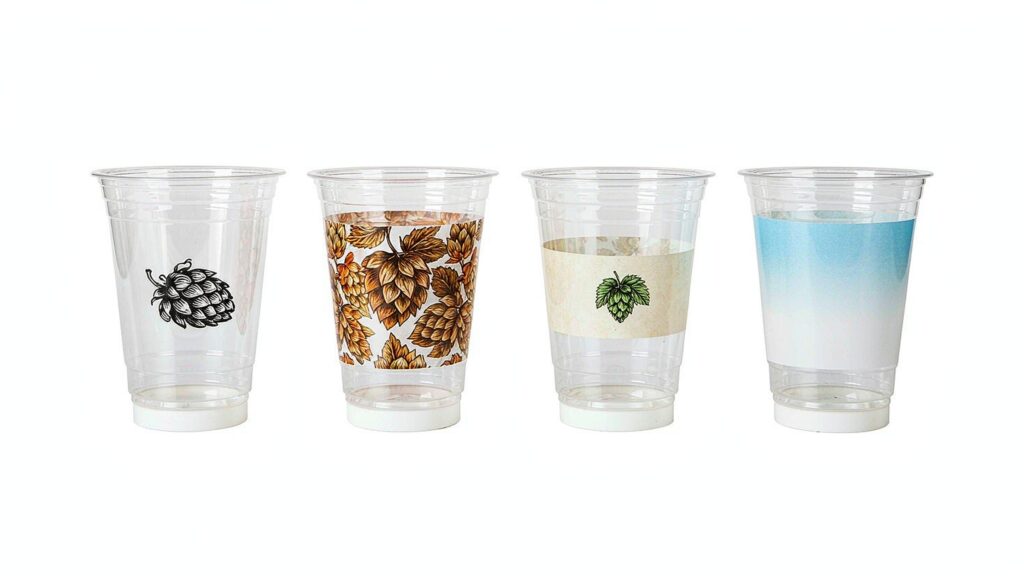
Your print method sets your minimum, your unit cost, and how the logo survives a night in a busy bar.
| Method | How it works | Good for | Watch out for |
|---|---|---|---|
| Screen print | Ink pushed through a mesh | Simple logos, big runs | Cost climbs per colour |
| Heat transfer | Image transferred with heat | Photographic detail, gradients | Softer hand-feel |
| IML | Label fused into the cup wall during moulding | Wrap-around art, very durable | Needs its own label tooling, high minimum |
| Digital print | Direct to surface | Sampling, short runs | Higher unit cost |
The trap here: nobody tells you the print failed until cups reach the venue. So test the print as it will actually be used. Fill it with ice. Let it sit twenty minutes. Hand it to someone with wet hands. Rub it with a bar towel. Then dishwasher it if it is reusable.
Ask two questions before you approve art:
- Will this ink hold up to the drink you are serving? Acidic and alcoholic drinks are not water.
- Is your factory the one printing, or is it outsourced? If it is outsourced, ask who owns the quality call when it goes wrong.
If you are deciding between materials for the same print, comparing against custom drink glasses with a logo helps clarify which look you are paying for.
9. What About MOQ, Lead Time and Payment?
These are the four questions that actually decide whether your order lands. Get them in writing.
What is the minimum, and is the print minimum the same as the cup minimum? Usually they differ. A factory may take 1,000 plain cups but need 5,000 before it will set up your print.
What is the production lead time, measured from sample approval? Not from today. Not from deposit. From the day you sign off the sample. Everything before that is guesswork.
What do samples cost, and are they refunded? Paid samples are normal and often faster. Free samples are rarely truly free, since the delay costs you too. Ask whether the fee comes off the order.
What are the payment terms? Standard practice in China manufacturing is a deposit, then the balance before shipment, often against your inspection result. Be cautious of any request for full payment up front from a name you have not verified.
Then add freight. Cups are bulky and cheap per unit, so the shipping line can carry more of the cost than the factory does. Compare landed cost, not unit cost. Our guide to importing bar supplies from China covers that arithmetic, and custom lead times explains where the calendar really goes.
10. How Do You Compare Samples Fairly?
Send identical briefs to two or three shortlisted suppliers. If the briefs differ, the samples are not comparable — the cheaper one may simply be lighter, thinner or smaller.
Set the same test conditions for every sample:
1. Weigh it empty. Weight tracks resin use, and resin is usually the biggest hidden variable. 2. Fill it with ice water, hold it twenty minutes. Look for cracking, clouding or sharp edges. 3. Rub the print with a wet cloth. Then with alcohol if your venue cleans that way. 4. Check the rim. Roll it against your lip. A rough seam reads as cheap, because it is. 5. Stack twenty. They will jam or they will nest — and that determines your freight cost.
Score each result while it is fresh. Photos age faster than notes. And write down what you did *not* test, since that is the list you need to close before a big run.
One more tell. Ask your shortlisted plastic cup suppliers what they would change about your design. The factory that spots the weak wall or the fine print line now will not discover it on your 5,000-unit run. Silence usually means they plan to take the drawing exactly as given, problems included.
Our questions to ask promotional product suppliers carries the wider version of this checklist, and quality control for China orders explains what to inspect before release.
11. Frequently Asked Questions
What is the lowest MOQ I can expect for printed plastic cups? Posted minimums for printed work generally sit between 1,000 and 5,000 units, though some suppliers list plain-cup minimums as low as 20. Lower minimums nearly always mean a higher unit price.
Are Chinese plastic cup suppliers safe to buy from? Plenty are, and plenty are not. The difference is documentation, not geography. Ask for the resin name, the food contact basis for your market, and a named test report — then check that the numbers match your SKU.
Do I need FDA approval for my cups? You need a lawful food contact basis for the exact resin and use conditions in the USA. Some materials carry a specific clearance, such as Tritan’s FDA Food Contact Notification No. 729. Ask which route your material used, and get the number.
Is it cheaper to buy from a factory or a trading company? Compare landed costs for the identical spec, including sampling, packing, freight coordination and export handling. Then price your own team’s time. The cheapest quote often just moves work onto you.
Can I still buy single-use plastic cups for the EU? Yes, if they are not made of EPS, and if they carry the required marking. Plan around the 2026 consumption-reduction policy too, since that is the direction your buyers and regulators are moving.
How many plastic cup suppliers should I shortlist? Start with three or four whose product range already fits, then narrow after replies come in. Ten quoted spread thin beats none of them carefully checked. You are collecting comparable evidence, not racing for a percentage quote count. For beers festivals, golf days and staff use, reusable often wins on both optics and total cost. A printed reusable cup survives the event and keeps working afterwards. Compare against single-use by washing cycles, not by unit price.
Ready to Move?
Good plastic cup suppliers are easy to find and harder to prove. The ones worth keeping will name their material grade, produce the paperwork for your market without being chased, and tell you what they cannot do.
If your project covers printed cups alongside plastic beer buckets, pitchers or a full barware set, coordinating them matters more than optimising one item. One mould schedule, one freight booking, one colour standard across the whole run.
Send us your cup size, material preference, quantity and date, and we will tell you honestly whether a custom option or a stock option serves you better. Share your scope here, or read our notes on the China bar wholesale markets if you plan to visit suppliers yourself.