A plastic cup labelled “16 oz” and one labelled “473 ml” can hold different amounts of liquid. The label is a legal number, not a measurement of what you get.
Three questions decide your order: what the number on the label actually measures, whether it holds up to a 5% tolerance, and what a full cup weighs before it ships.
This guide covers all three, plus a size chart, the UK fill-line rules for beer, and what to ask a supplier before you pay.
If you already know your drink and just need the numbers, the chart below is the whole answer. If you are still choosing, read on — most wrong plastic cup sizes orders come down to one missing word in the spec.
What Are the Most Common Plastic Cup Sizes?
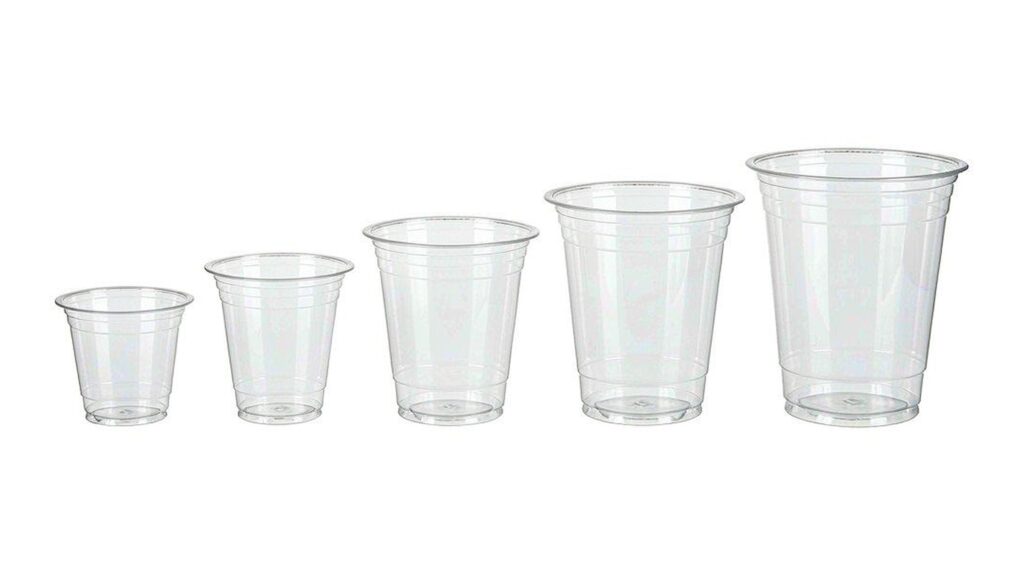
Here is the chart. The ounce column is US fluid ounces. The ml column is the rounded metric equivalent.
| US fl oz | Approx ml | Common name | Typical beer use |
|---|---|---|---|
| 1.5–2 oz | 44–60 ml | Shot or tasting cup | Tasting samples |
| 5 oz | 148 ml | Sampler | Small tastings |
| 7 oz | 200 ml | Water or sample cup | Water stations |
| 9 oz | 266 ml | Small soft drink | — |
| 10 oz | 296 ml | — | — |
| 12 oz | 355 ml | Regular | The everyday standard |
| 14 oz | 414 ml | — | — |
| 16 oz | 473 ml | Large | Craft beer, stadium cup |
| 20 oz | 591 ml | Jumbo | US “pint” size |
| 24 oz | 710 ml | — | Large soft drinks |
| 32 oz | 946 ml | — | Cinema and fountain |
Watch out for the ounce gap. The UK and the US both name cup sizes in ounces, but the numbers do not match. A UK “16 oz” is 454 ml. A US “16 oz” is 473 ml. A UK “20 oz” is 568 ml, which is an imperial pint. A US “20 oz” is 591 ml.
When a supplier quotes ounces without naming the country, the number is worth nothing until you fix the unit system. Ask for millilitres, or ask which standard they use.
Why Does a “16 oz” Plastic Cup Sometimes Hold Less Than 16 oz?
Because three different numbers get called “the capacity.” Getting them confused is the most common way buyers overpay.
| Term | What it means | Who cares about it |
|---|---|---|
| Nominal capacity | The number declared on the label | Law, your PO, the buyer’s expectation |
| Brimful capacity | Water filled to the rim and one drop from spilling | Engineers, mold makers, spec sheets |
| Practical fill | What actually gets poured, after lid room | Bar staff, menu pricing |
Brimful capacity is always bigger than nominal capacity. A cup needs headspace for the lid and for foam, or it spills the moment a customer picks it up.
Practical fill usually lands at 80% to 90% of brimful. A 16 oz cup with a lid serves closer to 14 to 14.5 oz in practice.
Hong Kong’s Consumer Council tested 18 travel cups in January 2025 using the European method, filling to 10 mm below the lid insert. Fourteen of 18 fell below their labelled capacity, by 3.33% to 20.24%. The worst sample was marketed as 420 ml and measured 335 ml at the nominal point. One brand explained that its label was measured without the lid on.
The takeaway is small but useful. “Nominal capacity” is not a fixed idea. Whether the lid counts changes the answer. Write your measurement point into the purchase order.
What Is the 5% Tolerance You Can Actually Check?
If you buy into China, you have a number you can verify at receiving. It comes from the national standard for plastic disposable tableware.
GB/T 18006.1-2025 took effect on 1 March 2026. It replaced the 2009 version. Clause 5.3.1 sets the rule: the volume deviation of disposable cups and other containers must not exceed 5%.
The test method matters as much as the number. Clause 6.3 says to fill the cup with distilled water at 23 ± 1°C until the water level is level with the cup opening, then pour into a graduated cylinder and read the value.
That fill point is the part most people get wrong. It is the cup opening, not a printed line.
Two related checks sit in the same clause set. Load-bearing capacity allows a height change of no more than 5% under load. Drop performance requires no cracks at all.
One honest caveat. GB/T 18006.1 is a recommended standard, marked GB/T, not a mandatory one. Mandatory food-contact rules live in GB 4806.7-2023, which handles migration limits and labelling for food-contact plastics. Buyers into Europe need EU 10/2011 instead, and buyers into the US need FDA compliance. These are three separate systems, and they do not substitute for each other.
Why Does a Supplier Offer Two Capacities for the Same Cup?
Because one cup shape can be moulded for two jobs, and the difference is where the line sits.
British law treats a cup as a legal measure when it carries the UKCA mark. Then the cup itself becomes the measuring device, and the fill line has to be moulded in to a verified tolerance. A line printed on afterwards does not count.
This produces two standard products from one mould:
- Pint to line. 568 ml to a moulded line below the rim, leaving room for a head. This is the correct cup for draught beer and cider.
- Pint to brim. 568 ml or 625 ml measured right to the rim. This suits soft drinks and pre-mixed cocktails, where no head is wanted.
Serving draught beer in a brim cup and calling it “a pint” is exactly where venues get into trouble. The measure is fixed. The vessel has to match it.
For planning, one current UK specification is worth reading. A polypropylene festival pint cup runs 158 mm tall, 85.5 mm across the top, 63.2 mm across the base. It holds 625 ml to the brim and 568 ml to the line. A single cup weighs 49 g. A box holds 288 cups, a UK pallet holds 5,760.
Same legal framework as the beer mug sizes guides cover for glass, but a different answer. Glass must be matched to the serving. Plastic becomes the measure itself.
Half-pint cups at 280 ml also carry moulded lines, and nucleated bases are now common in this format. That base design keeps a drink fizzy and full-flavoured.
What Does a Full Plastic Cup Weigh, and Why Does It Change Your Bill?
This is where plastic beats glass, and most buyers miss it.
A full 1 L glass Maßkrug weighs about 2.25 kg. A full 568 ml plastic pint cup comes to roughly 0.62 kg — around 49 g of cup and 0.57 kg of drink.
That is a 3.5 times difference. It shows up in three places: courier weight, sea freight volumetric weight, and how many cups fit in a container.
The number that makes it concrete is the pallet. 5,760 plastic cups on a 300 kg UK pallet. A comparable shipment of glass mugs would break that total many times over.
So plastic cups are not the cheap option in total cost. They are the option that ships in volume. You buy a lot of them, and freight decides whether that is a win or a loss. Ask for carton counts and pallet weights before you compare two quotes.
Which Plastic Cup Size Should You Order for Beer?
Start from the drink, not the cup. Then check three things.
Decide the fill point first. If you serve draught beer in the UK, pint-to-line at 568 ml is your only compliant choice. Soft drinks and cocktails do not need a head, so pint-to-brim works.
Pick a size that standard lids fit. Rim diameter is the spec to check, not just volume. Common standards are 80 mm, 90 mm, 95 mm and 98 mm. A 90 mm rim usually covers 12 to 16 oz cups, and 98 mm covers 20 to 24 oz. Many suppliers run 12, 16 and 20 oz cups on the same 90 mm rim so one lid covers all three.
Watch wall thickness on larger sizes. A 32 oz cup needs reinforced walls to stay rigid when full. This is where material choice shows up.
| Material | Code | Strength | Use it for |
|---|---|---|---|
| PET | 1 | Clear and light, cold drinks only | Cold beer, tastings |
| PP | 5 | Dishwasher safe, heat tolerant | Fill-line beer cups, reusable schemes |
| PS | 6 | Cheap and stiff, poor with heat | One-off cold drinks |
| Tritan | 7 | Clear, survives dishwashers | Premium reusable cups |
| RPET | 1 | Recycled PET, GRS certified | Sustainable buying rules |
Material does not change the stated capacity. It changes whether the cup keeps its shape, and a warped cup gives you a wrong volume reading.
If your buyer must show sustainability numbers, note that PLA and bamboo fibre cups are compostable but cannot be dishwashed. They do not belong in a reusable cup scheme.
What Is the Biggest Trick in Plastic Cup Sizing?
Wall thickness. Reducing it is the cheapest way to cut cost per cup, and it hits capacity at the same time.
Shanghai market regulators inspected disposable cups in 2016 and found the pattern directly. Their rule for matching a cup to its label is to fill it to 5 mm below the rim. Inspectors found many makers counted the volume at the rim itself to save raw material. In technical terms that cup cannot reach its declared capacity, which makes it non-conforming. The same inspection covered 130,000 cups across four models.
Wall thinning also caused a second failure in that same batch. Cups advertised as “thickened for a firm grip” collapsed under a 3 kg weight. Inspectors blamed reduced gram weight and thinner walls.
Here is the part that matters for buying. Gram weight is the spec to put in your contract, not ounces. Two suppliers both quote a 16 oz PET cold cup. One lists 10.5 g per cup, the other 8.3 g. That is a 26% material difference in cups that may hold the same volume.
Asking for gram weight gives you two things at once. You can compare quotes on real cost, and you can spot a supplier who is buying down on material before volume fails.
How Do You Order Plastic Cups by the Right Size?
Get these seven points settled before you ask for a quote. Most supplier problems come from leaving one of them vague.
1. Volume, unit system, and fill point. Write it as one sentence: “16 US fl oz, 473 ml nominal, measured level with the rim at 23°C.” Without that, two quotes are not comparable.
2. Rim diameter in millimetres. This decides your lids. Ask for the top diameter, not just “fits a standard lid.”
3. Gram weight per cup. Your real cost driver and your cheapest quality check at the same time.
4. Material, and whether it is virgin or recycled. Say which resin. If you need recycled content, ask for GRS certification for RPET.
5. Print method and where the artwork sits. IML wraps the print into the wall, so it survives condensation and dishwashers. Silk screen is cheaper and suits one or two Pantone-matched colours. Flexo and offset cost least at high volume.
6. Box and carton counts. Ask for pieces per carton, carton dimensions and gross weight. That is what decides your freight bill.
7. How the capacity will be checked. Say which standard applies to you — GB/T 18006.1-2025, EU 10/2011 or FDA — and name the fill point. One rule on print placement matters for food contact. Keep artwork away from the cup rim. The band right below the opening touches lips on every drink, so that is where ink should not go. A current pint-to-line cup offers 209 mm of wrap width and 143 mm of print height — that is the area you actually have.
Seven points is not fussy. It is the difference between a quote you can compare and one you cannot.
How Many Plastic Cup Sizes Should You Order?
Chinese supplier minimums vary more than you would expect. These are 2026 figures, a rough guide rather than a promise.
| Cup type | Typical MOQ | Custom lead time |
|---|---|---|
| Stadium or printed PP/PS cup | 1,000–2,000 pcs | About 7–31 days |
| Custom PET cold drink cup | 30,000 pcs | About 25 working days |
| UK-made fill-line pint cup | 50 pcs printed | 10 working days standard |
| Plain stock cup | Ask about inventory | Fast |
The gap between 50 and 30,000 is the real story. Always ask whether stock is available in your size. Many factories hold unprinted cups ready and can put your logo on existing inventory at a much smaller quantity.
Volume pricing moves hard. One current UK full-colour IML price list, excluding VAT, runs £1.85 per cup at 50 units, £1.15 at 100, £0.98 at 250, £0.87 at 500, £0.80 at 1,000 and £0.70 at 2,000. That is a 2.6 times spread between the smallest and largest run. Your MOQ decision is worth more money than any discount you negotiate later.
How Do You Compare Plastic Cup Sizes on Price?
Price comparisons go wrong in a predictable way. Two quotes look similar, and the cups are not the same product.
Start with the three numbers that decide the real cost. Volume with its fill point, rim diameter and gram weight. Plastic cup sizes are cheap enough that volume matters more than unit price. A £0.10 difference on 30,000 cups is real money, but so is a wall that thinned from 10.5 g to 8.3 g per cup.
Then divide by what a container holds. A pallet that ships 5,760 cups delivers a lower cost per cup than a smaller shipment, even at a higher unit price. Ask for pieces per 20GP and 40HQ, and weight those two answers against each other.
The cheapest quote is often the one that arrived with the least information attached.
How Do You Pay, and What Do Samples Cost?
Standard terms are T/T with 30% deposit against the proforma invoice and 70% balance before shipment. L/C at sight is also common. Both are normal for export, and both are negotiable.
Samples usually cost a fee plus courier freight, with the sample fee refundable once you order. Keep this in your budget from the start.
Existing stock samples can ship in 2 to 3 days. Custom artwork samples take 5 to 7 days, because a new screen has to be made. Order a sample of your actual print, not a blank cup. Cup wall and artwork position interact, and the sample is the only place you will see it.
What Should a Quote Include?
Ask for these nine lines in writing. A quote that leaves one out is not a quote yet.
1. Volume in both oz and ml, with the fill point stated 2. Rim diameter in mm 3. Gram weight per cup 4. Material name, plus virgin or recycled 5. Print method, number of colours, and Pantone references 6. Pieces per carton, carton size, carton gross weight 7. Total pieces per 20GP or 40HQ container 8. Unit price at your quantity, and the price at the next quantity up 9. Sample fee, refundable or not
Ask for the price at the next tier up every time. It tells you whether pushing your quantity is worth the extra cartons.
How Do Plastic Cups Compare With Glass Ones?
For a permanent bar, glass still wins on taste and on how customers read a venue. For volume service, plastic wins clearly.
| Need | Better choice |
|---|---|
| A bar that keeps its glasses | Glass |
| A festival with no glass allowed | Fill-line PP plastic |
| Cold beer on tap in volume | PET or PP plastic |
| A printed giveaway under a budget | PS or PET plastic |
Pair the cup with the rest of the kit. A drink served in a printed cup lands on a custom drink coaster, not a bare table. At a festival or a stadium you are also buying custom bar mats and, if the venue pours its own beer, custom tap handles. For volumes larger than a cup, our custom beer pitchers page covers the same spec points at 1 L and up.
How plastic cup sizes sit inside a wider order. If you are buying cupware alongside glass, our custom beer mugs guide covers the glass fill lines and weights. If you need printed glass instead, see custom drink glasses with logo. For bulk ice and chilling, plastic beer buckets are the larger-format option.
How to order the whole bar. Our custom barware buying guide covers cup choices beyond volume alone, including materials and decoration. For the commercial side, how MOQ works for custom products from China explains why the minimum shifts with decoration, and how to import bar supplies from China covers freight, customs and payment steps. If your buyers are choosing the beer before the glassware, China beer brands covers what the market is actually drinking.
For how a serving size turns into a head count, see how many beers fit in a bucket.
Frequently Asked Questions
How Many Millilitres Are in a 20 oz Plastic Cup?
A US 20 oz cup is about 591 ml. If the supplier means a UK 20 oz, that is an imperial pint at 568 ml. The 23 ml gap matters on a fill-line order, so name the country.
Is a 16 oz Plastic Cup the Same as a 473 ml Cup?
Only if you mean US fluid ounces. 16 US fl oz is 473 ml. A UK 16 oz cup is 454 ml. Most US and export quotes use the US measure, but confirm it — this single question resolves most plastic cup sizes disputes.
Does Nominal Capacity Mean the Cup Is Filled to the Rim?
No. Nominal capacity is the declared amount of product. Brimful capacity is the volume to the rim. Nominal is always lower, because a cup needs headspace for its lid and for foam. You can measure either one, but you must say which.
Do I Need the UKCA Mark on a Plastic Cup?
Only if you are serving measured quantities of beer or cider in the UK. The UKCA mark certifies the cup as a legal measure, and it depends on the fill line being moulded to a verified tolerance. A printed-on line does not satisfy it. For soft drinks anywhere, the mark is optional.
Can I Get Custom Printed Plastic Cups in Small Batches?
Often yes, depending on whether you use stocked cups. Printed UK-made fill-line cups start at 50 units. Chinese stadium cup suppliers commonly start at 1,000 to 2,000, and custom PET cold cups can ask for 30,000. Ask about printed stock first — it is the cheapest route to a small batch.
Is a Reusable Plastic Cup Worth It for a Festival?
The deposit-return schemes at major UK music festivals now make it routine. A polypropylene cup rated for 200-plus commercial washes can replace several hundred single-use cups, and a UK pallet holds 5,760 of them. The saving is in waste volume and washing logistics, not in the unit price.
Which Plastic Cup Holds a Cold Craft Beer Best?
PET, for clarity. It shows the beer clearly and is the standard choice for cold single-use service. If you need a cup that survives a dishwasher for repeated service, choose PP instead.
Turn a Size Into a Specification You Can Order
Every size question in this guide ends in the same three numbers: volume with its fill point, rim diameter, and gram weight.
Send those three with your artwork, and any supplier can quote you a comparable price. Leave any one of them out, and you are comparing different products.
If you tell us your drink, your volume and your market, we can send a sample set and a full specification for your sizes.