A plastic cup has two looks. One is the shape and colour you choose. The other is the print that lands on it. Buyers often pick the first, send artwork to a factory, and find out the design will not work on that cup. The artwork was too detailed for screen print. The colour count was too high. Or the cup was a thin thermoformed shell where offset ink cracks under a cold drink.
So here is the useful version. This guide lists the eight plastic cup designs you will actually be able to buy, then shows which printing method each one can take and what it costs you to get that plastic cup design made.
Which Plastic Cup Designs Can You Actually Buy?
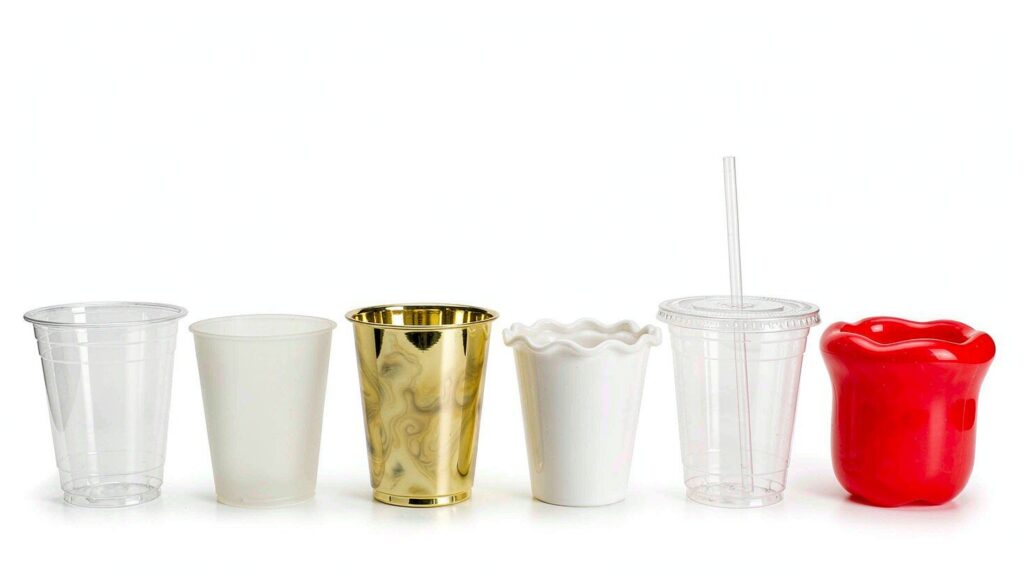
Every plastic cup design below is a real, production-ready shape. None of them are decorative concepts. For each one, the table gives you the look, the material it is usually made in, and the printing methods that work on it.
| Cup design | What it looks like | Usual material | Prints well with |
| Clear straight-sided | Crystal clear, plain taper | PET or PP | All methods, including full wrap |
| Frosted matte | Semi-opaque, soft finish | PET or PP | Screen, offset, IML |
| Solid colour | One colour through the whole body | PP or PS | Screen, offset |
| Metallic | Glossy gold or silver look | PET with film | Offset, IML |
| Scalloped rim | Wavy or fluted lip | PET or PS | Screen, offset |
| Printed pattern | Full graphic across the body | PET or PP | Offset, IML, digital |
| Textured grip | Ribs or waves you can feel | PP | Screen only, low area |
| Stadium cup | Rigid, straight, reusable | PP | Screen, IML |
Two things in that table decide most orders. Material decides the temperature and the clarity. Surface shape decides the printing. A frosted cup and a clear cup look identical on a screen and print nothing alike.
Why Do Plastic Cup Designs Limit What You Can Print?
Because printing sits on the outside of the cup, and the outside of the cup is not flat. It is a cone, usually slightly curved, and often slippery.
That geometry sets hard limits. Three things follow from it:
- A flat rectangle of artwork will distort. Artwork must be prepared as a fan shape, calculated from the cup’s top and bottom circumference. Send a flat file and the print will stretch at the top and squeeze at the bottom.
- The more curved the cup, the fewer colours hold up. Offset ink sits on the surface. On a sharp curve it can crack when the cup goes cold and the plastic shrinks.
- Surface texture eats detail. A ribbed or textured cup has no flat area, so a small print will never sit straight across it.
This is why design and production have to be decided together. A beautiful artwork that cannot be produced at your volume is not a design. It is a picture of a cup.
Keep that in mind while you read the plastic cup designs below. Each one comes with a printing ceiling, and the ceiling is set by the shape.
Which Printing Method Should You Use?
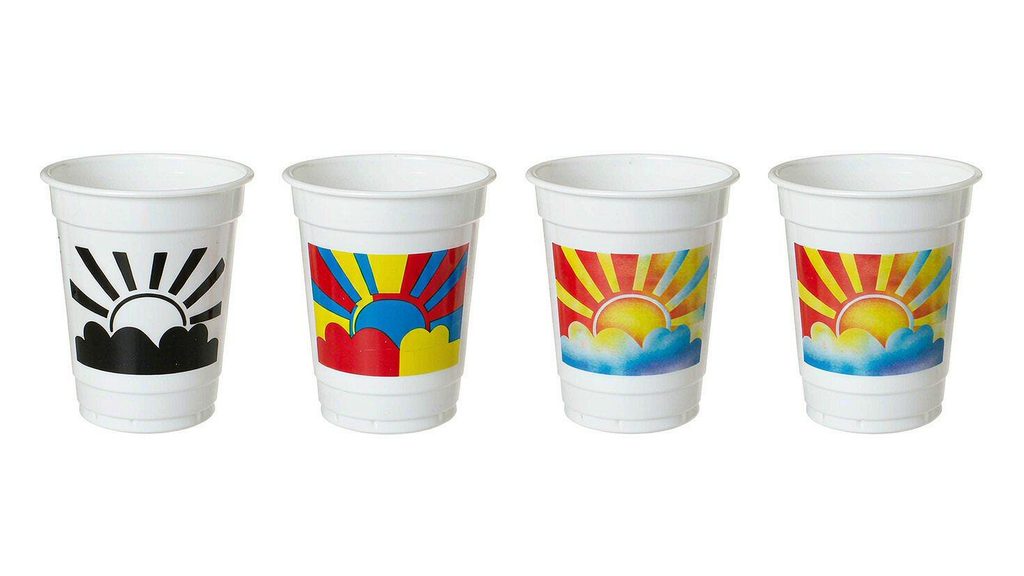
The printing method decides what a plastic cup design is allowed to look like. Pick the shape first, then pick from the methods below.
This section answers from the cup side. If you already know the cup and want to know what the artwork can do instead, our plastic cup printing guide works from the method side, and it also covers the UKCA and M markings a cup needs before it can legally pour beer.
| Print method | Colours | Minimum order | Cost per cup | What it cannot do |
| Screen printing | 1–3 spot colours | 250–1,000 | Low | Gradients or photos |
| Digital printing | Full colour CMYK | From 100 | Medium | Perfect match on clear plastic |
| Heat transfer | Full colour, wraps 360° | 1,000–5,000 | Medium-high | Cheap at small volumes |
| Offset printing | 2–6 colours | About 10,000 | Medium | Sharp curves |
| In-mold labelling (IML) | Unlimited full colour | 10,000–50,000 | High | Small runs are not economical |
If you only need a logo, use screen printing
One colour, one logo, a few thousand cups. Screen print is the cheapest way to get your mark on a cup. Each colour needs its own screen, and setup is about $30 to $80 per colour. Running cost is about $0.01 to $0.03 per colour, per cup.
The limit is the artwork. Screen print lays down flat ink. Gradients, photographs and fine shading will not reproduce. If your logo is a wordmark or a flat mark, you are fine. If it is a photograph of a beer, you are not.
If you need full-colour artwork, you have three options
Digital printing takes any CMYK file from about 100 cups. Nothing is screens or plates, so colours and gradients come through. Watch one thing: ink can look less saturated on curved clear plastic than it does on your monitor proof. Get a physical sample before you approve a full run.
Heat transfer wraps full colour right around a curved body in one pass. It is the usual choice for full-wrap designs at a thousand cups and up. The trade-off is upfront cost: the equipment and screens are not cheap.
Offset printing applies ink after moulding, usually 2 to 6 colours in CMYK or matched Pantone. It gives a cleaner, more professional result than screen print and a much lower MOQ than IML. It suits a brand with real artwork and mid-sized volume.
If the cup gets handled, washed and stacked, use IML
In-mold labelling puts the printed film inside the mould before the plastic is injected. The label and the cup wall fuse into one piece. There is no ink sitting on the surface, so the artwork cannot scratch, peel or fade in a crate or come off in a dishwasher.
The cost is volume. Most factories set IML MOQ at 10,000 to 50,000 pieces per size, and per-cup price is the highest of any method. One European maker quotes 1,000 pieces for reusable event cups, so the real floor depends on whether the cup is a consumable or a kept item.
Rule of thumb: if the cup is thrown away after one event, do not pay for IML. If it is a stadium cup a customer keeps and reuses, IML pays for itself over several seasons.
Which Plastic Cup Material Should You Choose?
Material is not a design decision. It is a temperature and clarity decision, and it is harder to change later.
| Material | Resin code | Temperature range | Clarity | Best for |
| PET | #1 | Cold drinks, to about 70°C | Excellent | Showing off beer colour and head |
| PP | #5 | -10°C to 120°C | Semi-clear | Hot drinks, smoothies, heat-seal service |
| PS | #6 | Cold drinks, to about 70°C | Clear but brittle | Cheapest option, low volume |
| rPET | #1 | Same as PET | Very clear | Events with recycled-content rules |
| PLA | Compostable | Cold only, about 55°C | Clear | Compostable programmes |
PET gives you the best clarity, which is why it wins for beer. A pale lager, an amber IPA and a stout all look different in a clear cup, and that colour is part of what the customer is buying. PET is cold only. It will deform with hot liquid.
PP takes heat up to 120°C and takes a beating, which is why it is the standard for coffee, bubble tea and anything sealed with a film. The trade-off is clarity: PP is semi-opaque. If your design depends on seeing the drink, use PET.
PS is the cheapest and the worst for your brand image. It is brittle and poorly recycled. Several regions now restrict it. Use it only where the cup is a giveaway and cost is the only thing that matters.
rPET is made from post-consumer bottle plastic and is fully recyclable. More and more event and festival organisers now require recycled content, so a recycled cup can be the difference between winning the pitch and losing it.
One detail worth getting right: the 90 mm mouth is the heat-seal industry standard. A 90 mm PP cup works with standard lids, sealing film and sealing machines. A 95 mm cup needs its own lids and its own machine. If your buyer plans to seal the cups, confirm the diameter before you order.
What Food-Safe Paper Do You Need From the Factory?
Ask for documents before you pay, not after the cups arrive. The words “food grade” on a supplier’s website mean nothing on their own.
Two regulations cover most exports:
- FDA 21 CFR 177.1520 in the US covers olefin plastics such as PP and PE. It sets purity standards and extraction limits.
- EU 10/2011 in Europe sets an overall migration limit of 10 mg/dm² of food contact surface, plus specific limits for restricted substances.
China’s national standard is GB 4806.7, which also uses 10 mg/dm² as the total migration limit. If you sell into more than one market, the most restrictive rule usually sets the standard for the whole order.
Since February 2025, the EU packaging regulation PPWR (2025/40) adds rules on top of food contact law. It bans PFAS in food contact packaging and sets minimum recycled content targets from 2030.
Three resin codes cause most of the trouble. PVC (#3) leaches plasticisers into fatty food. PS (#6) breaks down under heat. Polycarbonate (#7) uses BPA in its production and should only be bought when it is explicitly labelled BPA-free.
Ask for a certificate of analysis from the factory, not from the trading company. And confirm the colourants and additives are on the authorised list, not just the base resin.
How Do You Prepare Artwork So It Prints Right?
Get this part right and most of your problems disappear before production starts.
- Send vector files. AI, EPS or PDF, in CMYK, with fonts converted to outlines. A 300 dpi raster image will look soft on a curved surface.
- Send it fan-shaped. The artwork must be laid out for the cup’s taper, not as a flat rectangle.
- Give Pantone references. They cut colour arguments, which are the most common reason a run gets held up.
- Keep type big. Small type disappears on a curve and on a ribbed surface. Test it at actual size.
- Ask for a pre-production sample. Check it in real light, with condensation on the cup. A colour that looks perfect on a backlit screen looks different on a translucent wall at 80% humidity.
That last point is the one most buyers skip and most regret.
How Do You Order Plastic Cup Designs From China?
Once the plastic cup designs are fixed, the rest is a normal wholesale order. Here is what to expect.
| Item | Typical range |
| MOQ, stock unprinted cups | 1,000 pieces per size |
| MOQ, screen printed | 250–1,000 pieces |
| MOQ, offset printed | 10,000 pieces per size |
| MOQ, IML | 10,000–50,000 pieces per size |
| Sample lead time | 3–7 days for stock, 7–10 days for printed |
| Production lead time | 15–25 days after artwork approval |
| Tooling for a new shape | 30–45 days, plus the fee |
Prices are a rough guide, not a promise. They move with resin prices, order size and how much printing you add. Ask for a written quote that lists the cup, the print method, the plate or screen fee, and freight separately. If a quote does not break down the printing fee, you cannot compare it against another factory. The same logic applies to your MOQ — factories quote a stock number and a printed number, and the gap between them can be ten times. Our guide to MOQ for custom promotional products covers how that threshold is set.
Shipping is by carton. A standard packing is 25 cups per sleeve and 500 per carton. Lids usually ship separately at 1,000 per carton. Plan your freight by volume, not weight, because empty cups nest and take up far less room than glass.
Payment terms are normally 30% deposit with the balance against the copy of the bill of lading. Sample fees are usually refundable once the main order goes through, but confirm that in writing before you pay.
Because a printed cup is a one-off moulded item, we cannot hold stock for you. Send your artwork, get a sample approved, and expect the 15 to 25 day clock to start after that approval.
Which Plastic Cup Design Fits Your Event?
Match the plastic cup design to how the cup gets used, not to how it photographs.
Beer festival or tasting flight — go small and clear. A 4 oz to 9 oz cup lets people sample several beers without overdoing it. Pick a clear PET or rPET cup so the colour reads. Put the beer name on the cup rather than a big logo.
Taproom or patio — 16 oz is the workhorse pour. Clear PET, screen printed with one logo. This is the volume order and it should be your cheapest.
High-volume bar or stadium event — a rigid reusable PP stadium cup. It survives stacking and washing, so it works as merch instead of a consumable. Here IML is worth paying for.
Smoothie or bubble tea shop — 90 mm PP injection cup with a heat-seal film. Design for the lid, not the cup. The dome height is what limits your topping size.
Merch or gift with purchase — rPET or IML. The cup is the product here, so print and finish carry the value.
One last thing. Plastic is also a design tool. If you need something bigger, our guide to plastic beer buckets covers the outdoor bulk sizes. For the glass alternative, see custom drink glasses with logo. And if you are working out glassware and plastic together, how to choose beer POSM covers the wider decision.
What Should You Ask Before You Order?
Send these seven questions to the factory. The answers tell you more than the product page does.
- What is the MOQ for my exact print method? Not the stock MOQ. The printed one.
- Can you print on a sample before the full run? If the answer is no, walk away.
- What resin is the cup, and what is the resin code on the base? If they cannot tell you, the cup is not food grade.
- Which food contact certificates can you supply? Ask for FDA 21 CFR 177.1520 or EU 10/2011 paperwork.
- What is the mouth diameter, and do I need matching lids? Ask whether 90 mm works with the sealing machine you own.
- Is the plate or screen fee refundable? On repeat orders it should be.
- What is the lead time counted from? Artwork approval, not order date. These are different by two weeks.