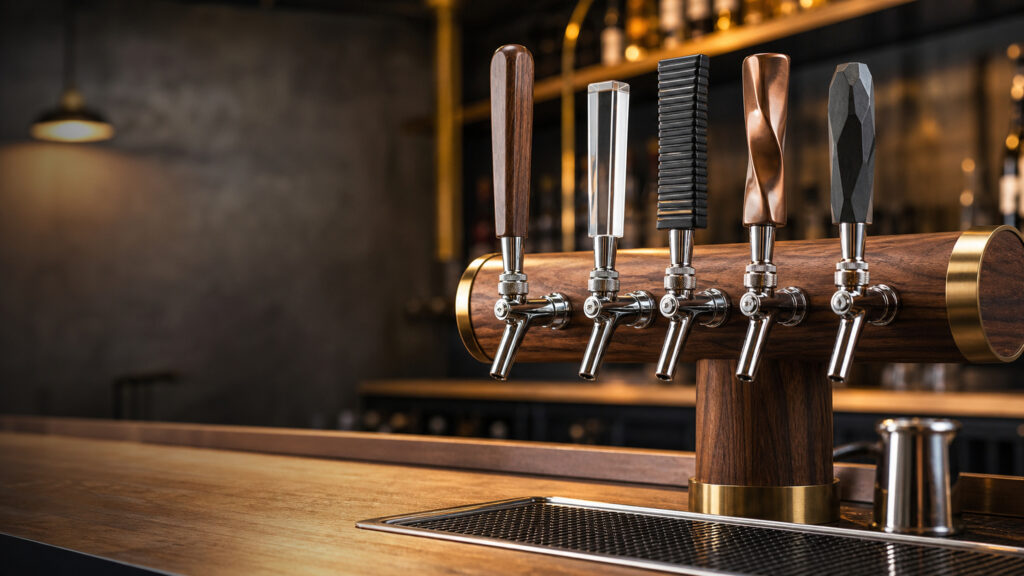
Custom beer taps can make a draft line easier to recognize, easier to manage, and more consistent with a brewery’s brand. For a drinker, the visible part is simply the handle they pull. For a buyer, however, a custom beer tap project involves two connected but different products: the dispensing faucet that contacts the beverage and the branded tap handle or marker that customers see.
This guide helps breweries, bar groups, distributors, and promotional-product buyers choose the right configuration before placing a wholesale order. It covers materials, branding options, sample approval, packaging, and the questions worth resolving with a supplier.
What are custom beer taps?
The phrase custom beer taps is commonly used for several products: a complete draft-beer faucet with a custom finish, a branded tap handle fitted to a standard faucet, or a full tower-and-faucet installation. Confirm which product your quotation covers. A decorative handle is not a beverage-dispensing faucet, and it should not be treated as one.
For most branding projects, the practical route is a standard-compatible faucet plus a custom handle. This reduces tooling complexity while letting the brewery customize the visible shape, color, logo, medallion, or changeable beer-name insert.
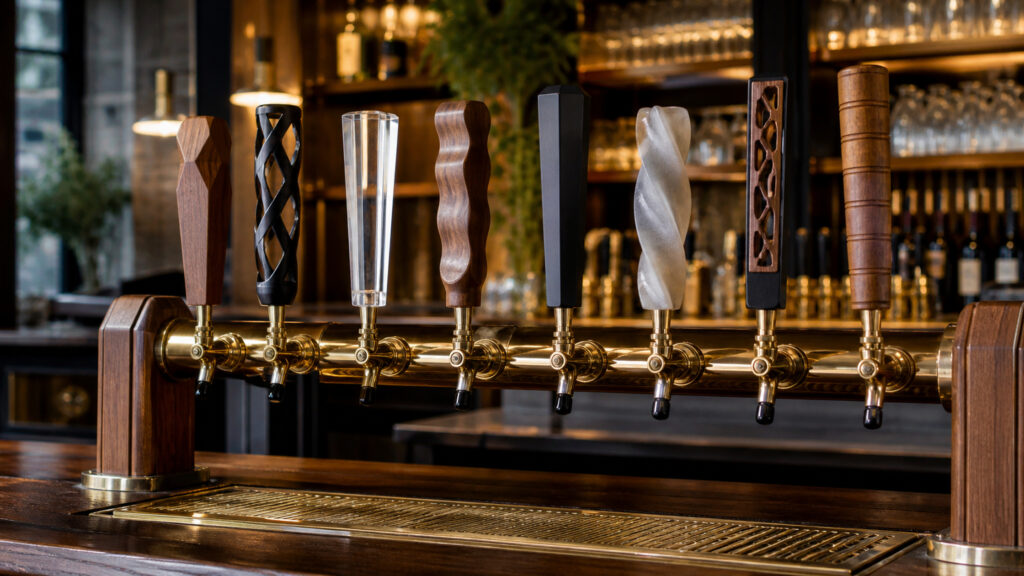
Main types of custom beer taps
Custom tap handles
These are the most common choice for craft breweries and beverage brands. They screw onto the faucet lever through a threaded insert or ferrule. Buyers can customize the outline, artwork, finish, and hardware while retaining a familiar draft setup.
Rotating-label and replaceable-insert designs suit breweries that change beer styles frequently. They can reduce the need to replace the whole handle, but the insert retention and legibility need testing before production.
Custom beer faucets
A custom faucet may use a selected finish, branded badge, special lever, or flow-control configuration. Because it forms part of the beverage-dispensing path, compatibility, cleaning, and destination-market requirements matter far more than they do for a decorative handle.
Towers, tap markers, and complete displays
Multi-tap towers and tap markers work well for taprooms, restaurant groups, and event installations. They create a coordinated display but add installation, carton-size, and replacement-part considerations. Ask whether faucets, shanks, fittings, and handles are included separately or assembled.
Choosing the right material for a custom tap handle
The material should reflect the desired brand position, the artwork, and the expected handling conditions—not just the lowest unit price.
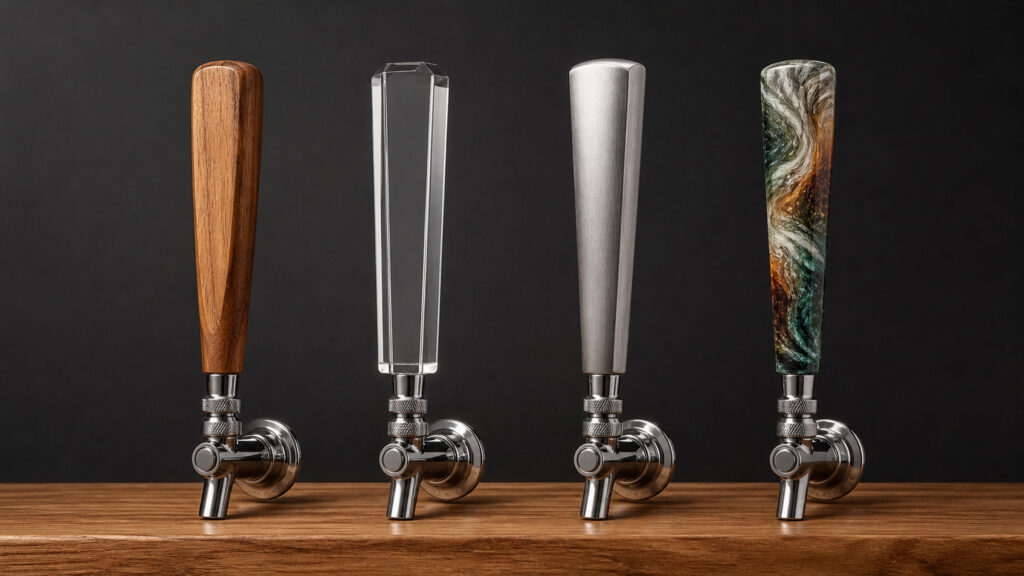
Wood
Wood gives a natural, craft-oriented feel and is suitable for stained, painted, engraved, turned, or laser-cut designs. It is a strong choice for heritage, farm, and small-batch brand stories. Specify the species or engineered wood, grain direction, coating, and moisture-resistance expectations. Fine detail and very thin projections may be more vulnerable during shipping or bar use.
Polyresin or resin
Resin supports sculpted, figurative, and high-detail shapes that are difficult to make economically in wood or metal. It can create a memorable tap-line silhouette, but buyers should inspect seam lines, paint coverage, balance, and the strength of the internal insert. A complex shape may also need more protective packaging.
Metal
Stainless steel, aluminum, brass, or zinc-alloy details can produce a premium, durable appearance. Metal can suit minimalist branding, engraved logos, and high-traffic hospitality settings. Its trade-off is weight: this can affect shipping cost, handling comfort, and the stress placed on the faucet lever.
Acrylic and changeable inserts
Acrylic creates a clean, modern look and can support printed or interchangeable graphics. It is useful for seasonal lineups and beverage programs beyond beer, such as cold brew or kombucha. Request scratch-resistance and print-adhesion tests for the exact finish rather than relying on a sample photo.
What to specify before requesting a quote
A clear brief makes supplier comparisons much more useful. Include:
- Product scope: handle only, faucet only, or a complete set.
- Artwork: logo files, color references, the desired front/back/side treatment, and whether the beer name changes.
- Dimensions and target weight: especially important on crowded tap lines.
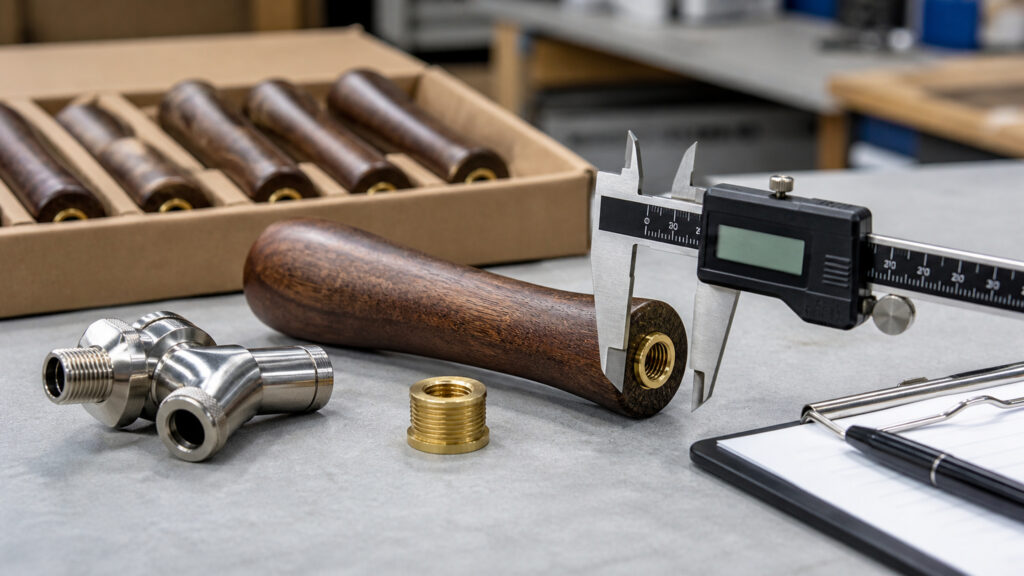
- Material, finish, and hardware: including the threaded insert or ferrule specification.
- Quantity by design: separate MOQs may apply to each shape or artwork version.
- Packaging: individual box, protective sleeve, master-carton quantity, and drop-protection needs.
- Delivery destination and required date: prototype approval and production time are separate stages.
Avoid assuming a marketplace listing’s MOQ, price, or lead time applies to your artwork. Those details are configuration-specific; confirm them in a written quotation.
Quality checks that prevent avoidable problems
Approve a physical sample before mass production whenever the project has custom shape, paint, or hardware. Check the following:
- Fit and thread compatibility. Test the handle on the intended faucet or a confirmed reference fitting. Do not infer compatibility from photos.
- Balance and clearance. Open and close the faucet; confirm that the handle does not hit adjacent taps, tower surfaces, or signage.
- Artwork accuracy. Compare colors, placement, registration, and finish against the approved artwork file under normal bar lighting.
- Surface quality. Inspect resin seams, paint edges, wood coating, acrylic scratches, and sharp edges.
- Hardware retention. Check that inserts, medallions, labels, and glued elements remain secure after reasonable handling.
- Carton protection. Review the packed sample, not only the loose product. Small projections and glossy finishes are common damage points.
For faucet or tower components, ask for the exact material declaration, drawings, fitting information, and any applicable test or certification documents for your destination market. NSF/ANSI 18 addresses manual food and beverage dispensing equipment; it is relevant to dispensing equipment, but a buyer should verify which finished component, model, and production facility is actually covered by any claimed listing.
Custom beer taps for different sales channels
Breweries and taprooms usually benefit from distinctive handles that tell the brand story from a distance. Prioritize visual recognition, cleaning-friendly shapes, and spares for replacement.
Bar and restaurant groups may prefer a controlled family of handles or changeable inserts. Standardization helps staff identify products quickly and maintains a consistent back-bar look across locations.
Distributors and wholesalers should consider cartons, replacement units, and mixed-SKU planning. A design that looks impressive but breaks easily in a distributor warehouse can create avoidable claims.
Promotional and gift channels can use mini handles, display sets, or non-functional branded replicas. Be explicit that these are promotional items rather than dispensing components.
How to source custom beer taps from China
Start with a sourcing brief and several supplier options that match your intended material and process. A factory experienced with resin figures may not be the best choice for precision metal faucets; it is often sensible to source the decorative handle and the beverage-contact hardware through specialized supply chains, then coordinate packaging and consolidation.
Ask suppliers about their design-to-sample workflow, tooling requirements, material options, sample charge, MOQ per design, production capacity for your timeline, and inspection procedure. If sourcing multiple components, align the thread/ferrule specification and approve a fully assembled pre-production sample.
During production, an inspection can verify workmanship, branding, quantity, and packed-carton condition against the approved sample. For export orders, request carton dimensions, gross weight, packing list details, and appropriate labeling before booking freight. Oversized sculptural handles may raise dimensional-weight costs even when the material itself is light.
FAQ
Can a custom tap handle fit any beer faucet?
No. Many handles use common threaded systems, but compatibility must be confirmed against the actual faucet and insert. Test a sample before committing to production.
What is the best material for custom beer taps?
There is no universal best choice. Wood suits a craft aesthetic; resin supports sculptural designs; metal feels premium and durable; acrylic is effective for modern or changeable graphics. Choose based on design, handling, budget, and packaging needs.
Do custom beer taps require a special certification?
Decorative tap handles and beverage-contact dispensing equipment have different requirements. For faucets and related beverage-contact components, confirm destination-market rules and request SKU-specific documentation. Do not assume that a handle’s material claim proves compliance for a complete dispensing system.
How many custom tap handles should I order?
Order quantity depends on the number of locations, tap positions, replacement needs, and whether one design is used across several beer styles. Ask for MOQ by design and consider a small spare allocation for breakage, new accounts, or seasonal rotations.
Final thought
The best custom beer taps combine a clear brand look with dependable fit, durable finishing, and packaging designed for the actual distribution route. Start with a precise brief, approve the assembled sample, and make compatibility and carton protection part of the buying decision—not an afterthought.
If you need help comparing specialist suppliers, reviewing samples, arranging inspection, or consolidating handles with related barware, a sourcing partner can help keep the project coordinated from artwork approval to export packing.