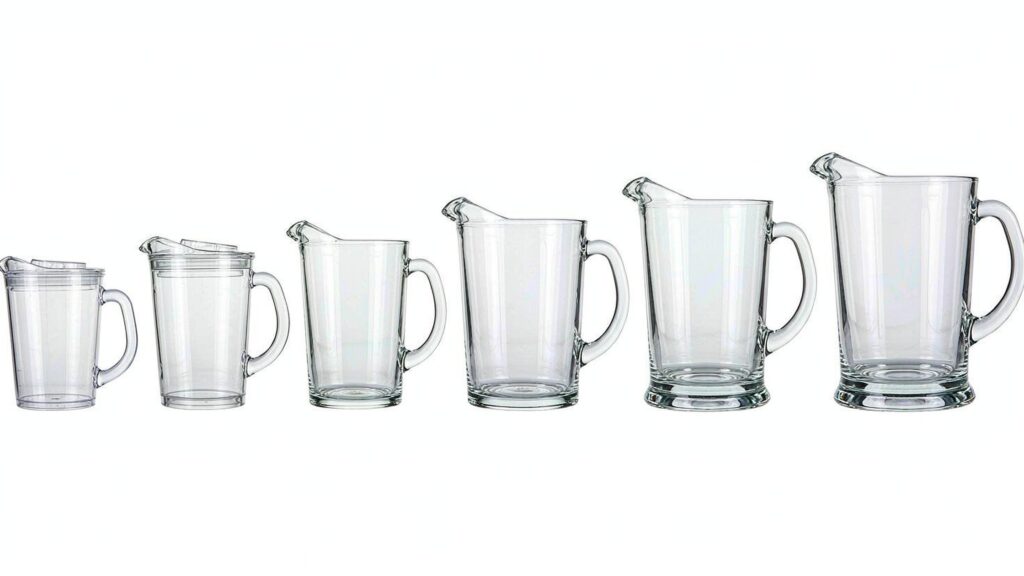
A beer pitcher’s capacity is the one number buyers get wrong most often. You ask for “60 oz”, the factory builds to 1.8 litres, and 25 millilitres arrives on your dock. US bars default to 60 oz glass, but there is no federal pitcher size anywhere in America. China plants build to round metric numbers: 1 L, 1.5 L, 1.8 L, 2 L, 3 L. Those two systems only meet at the edges.
This guide gives you the numbers a buyer actually needs. That means the capacity table, the pour math, the weight difference between materials, and the four documents that decide whether you can legally sell what you ordered.
What Are the Most Common Beer Pitcher Sizes?
Two columns matter here. The US fluid ounces people order in, and the litres that appear on factory spec sheets. One US fluid ounce is 29.5735 millilitres.
| Pitcher size | US fl oz | Millilitres | Serves (12 oz glasses) |
|---|---|---|---|
| Small pitcher | 32 | 946 | 2.6 |
| Bistro pitcher | 48 | 1,419 | 4 |
| Standard US pitcher | 60 | 1,775 | 5 |
| Half gallon pitcher | 64 | 1,893 | 5.3 |
| Metric 1 L | 33.8 | 1,000 | 2.8 |
| Metric 1.5 L | 50.7 | 1,500 | 4.2 |
| Metric 1.8 L | 60.9 | 1,800 | 5 |
| Metric 2 L | 67.6 | 2,000 | 5.6 |
| Metric 3 L | 101.4 | 3,000 | 8.3 |
Three facts in that table catch people out:
- The US “60 oz” size is really 1,775 mL, not 1,800. When Cambro lists a 60 oz pitcher, the metric spec reads 1.8 L. Those are the same object, rounded two different ways.
- “Half gallon” is 64 oz, not 60. If your menu says “half gallon pitcher” and your invoice says “60 oz”, you have a 4 oz dispute.
- 1.8 L is 60.9 oz, not 60. It is the closest metric size to US 60 oz. This is why almost every Chinese factory builds 1.8 L.
American foodservice brands all publish their own spec sheets, and they agree with each other. Cambro’s Camwear line runs 32 oz, 48 oz, 60 oz, and 64 oz. Arc Cardinal’s best-selling 60 oz glass pitcher, the C0678, measures 9 inches tall with a 5.75 inch top diameter. Libbey’s 5260 is the same 60 oz capacity at 9.25 inches.
Why Does a 60 oz Beer Pitcher Not Hold Four Pints?
Because 60 divided by 16 is 3.75, not 4. This is the most common math error on pitcher listings.
A 60 oz pitcher gives you:
- 3.75 US pints at 16 oz each
- 5 twelve-ounce glasses with nothing left over
- 4 people get 15 oz each, about an inch short in a standard pint glass
A 64 oz pitcher gives you exactly 4 pints. That is the whole reason half-gallon pitchers exist. Some pubs call the 60 oz “a standard pitcher” and pour 15 oz per person, which feels short but is arithmetically correct.
Now add foam. A sloppy head can swallow 2 to 4 oz of what you poured. A 60 oz pitcher may deliver closer to 3.25 real pints.
The glass matters too. A 16 oz pint glass, a 500 ml seidel and a 568 ml nonic all take a different bite out of the same pitcher. Our beer mug sizes guide works through those numbers and through the fill lines that decide how full the glass really is.
Why Do Factories Build 1.8 L Pitchers When Bars Order 60 oz?
Because factories quote in round numbers and bars quote in ounces. Neither side is wrong, but the gap between them is where wrong goods come from.
Chinese suppliers list beer pitchers at 1 L, 1.5 L, 1.8 L, 2 L and 3 L. Those are mould sizes, not serving sizes. A plant running an injection mould cannot afford a new tool for 1,775 mL when 1.8 L uses the same tooling.
What to do: order in metric and let the supplier convert. Ask for the pitcher’s brim capacity in millilitres, not the volume to the fill line. Then check your menu against it.
- 1.8 L = 60.9 oz → this is your “60 oz” pitcher
- 2 L = 67.6 oz → this is your “70 oz” pitcher
- 3 L = 101.4 oz → this is your “100 oz” pitcher
If a supplier quotes you a “60 oz” pitcher and the drawing says 1.8 L, that is correct. If the drawing says 1.775 L, expect to pay for a custom tool.
Which Material Should You Choose for a Beer Pitcher?
Material decides three things at once: how much the full pitcher weighs, how many survive shipping, and whether you need a food contact certificate before you can sell it.
| Material | Empty weight (2 L) | Breakage | Max usable | Food contact paperwork |
|---|---|---|---|---|
| Heavy glass | about 1.9 kg | High | Hot or cold, one at a time | Lead-free declaration, dishwasher safe |
| Polycarbonate (PC) | about 0.5 kg | Very low | Hot or cold | Declaration of Compliance under EU 10/2011 |
| Polypropylene (PP) | about 0.3 kg | None | Boiling water if kept off the flame | Declaration of Compliance under EU 10/2011 |
| SAN / AS | about 0.4 kg | Low | Cold drinks only | Declaration of Compliance under EU 10/2011 |
The weight difference is bigger than buyers expect. Arc Cardinal’s 60 oz heavy glass pitcher ships at 25 lb per case of 6. That works out to about 1.9 kg per empty pitcher. The 2 L polycarbonate pitcher from Cal-Mil ships at 1.12 lb. A full glass 60 oz pitcher weighs around 3.8 kg. A full polycarbonate one weighs around 2.5 kg. That 1.3 kg gap is what your servers feel at the end of a shift. It is also what decides whether a plastic bucket beats a glass pitcher in a beer garden.
Polycarbonate is the safest all-round choice for outdoor and high-volume service. Glass wins on presentation and on the fact that it does not scratch or cloud. If you need a hot-fill pitcher, ask for PP rather than PC.
What Does a Beer Pitcher Need to Carry a Logo?
Less space than you would hope. On the standard 60 oz glass pitcher, the usable print area is about 3 inches by 3.5 inches, sitting front centre.
That single number decides your decoration method:
| Method | Best surface | Watch out for |
|---|---|---|
| Silkscreen (screen print) | Flat glass panels, flat-sided plastic | Needs the surface to be flat, not curved |
| Pad printing | Curved handles, round bodies | Small artwork only, distortion near edges |
| Laser engraving | Metal and some glass | No colour, slow, higher unit cost |
| Heat/water transfer | Injection-moulded plastic, full wrap | Colour on clear plastic reads milky |
| In-mould label | Very high volumes only | Tooling cost, long lead time |
Libbey and Acopa both sell 60 oz glass pitchers with a printable panel as a standard feature. Acopa’s 999GPB60 has a smooth round body at 8.25 inches tall. If your artwork has fine detail, ask for a flat-sided design rather than a tapered one.
For plastic pitchers, ask for Pantone matching. Shenzhen suppliers will do any Pantone code, usually from 500 pieces per colour. Our custom beer pitchers page covers the decoration options in more detail.
Do I Need Paperwork Before I Can Sell a Beer Pitcher in the EU?
Yes, and it is more than one document. Plastic food contact rules in Europe are written into law, not left to the supplier’s discretion.
Regulation (EU) No 10/2011 covers plastic materials that touch food. Article 15 requires a written Declaration of Compliance (DoC) at every marketing stage before retail. The declaration must name the operator, identify the material and article, and cite the regulation. It must also state that the product complies under its intended use conditions. It must be renewed when the recipe or the process changes in a way that alters migration.
Article 16 lets national authorities demand supporting documents: test conditions, results, calculations, modelling and analysis. Article 12 sets the overall migration limit at 10 mg per square decimetre of contact material, or 60 mg per kilogram of food.
Regulation (EC) No 1935/2004 is the framework law above it. It covers glass, metal, paper and plastic alike, and requires good manufacturing practice.
For the US, look for three things: NSF listing for foodservice use, an FDA-compliant material statement, and a lead-free claim. Arc Cardinal states its glass is lead-free and dishwasher safe, and Cambro lists its Camware pitchers as NSF Listed.
Ask the supplier for all of it in writing before you pay the balance. Our quality control for promotional products page covers how to check that paperwork is real.
How Does Pitcher Size Change What You Ship?
It changes your freight bill more than your unit price, because pitchers are hollow and light.
The 32 oz Camwear pitcher ships 6 per case at 3.7 lb. The 64 oz model with a lid ships 6 per case at 7.4 lb. A single size step nearly doubles the case weight, and roughly doubles the cube you pay to move.
Two decisions cut that cost:
- Stackable or nesting plastic. Shenzhen factories list stackable beer jugs as a standard mould, and most of that product goes to Europe and North America. A stackable 2 L jug nests inside the one below it, so a 40-foot container carries far more units than a rigid one.
- Ask for units per carton, not just per container. One Shenzhen supplier quotes 40 pieces per carton for its 2 L model with a printed box. Another quotes 6 per case for Cambro-style foodservice packing. That is a sevenfold difference in carton count, and it decides your pallet layout.
Glass changes the calculation again. Glass is dense, so it hits the payload limit before it hits the volume limit. The rule of thumb for any container order is simple: plan against 85 to 90 percent of usable volume, never 100 percent. Cartons do not tile the space evenly, and the last layer rarely fits.
Which Beer Pitcher Size Should You Order?
Match the size to what the pitcher does at the table, not to what looks generous on a menu.
- Sports bar, table service, US menu in ounces → 60 oz heavy glass. It is the default, it stacks on a dishwasher shelf, and staff already know it.
- Beer garden or patio, breakage is the risk → 1.8 L or 2 L clear polycarbonate with a lid. Nothing shatters, staff carry less weight.
- Brewery taproom pouring flights → 32 oz polycarbonate. Small pours, frequent refills, and a pitcher you can move one-handed.
- Branded merchandise, gift-with-purchase → 1.5 L or 1.8 L plastic. Wide flat panel, Pantone colours, low MOQ, and it survives being carried home.
- Catering and banquets, high ABV beer → 48 oz. Strong beer needs smaller serves, and a full 60 oz of an IPA is a lot to put in front of anyone.
Not for: 3 L pitchers for beer. At 101 oz you are pouring eight-plus glasses, and nobody finishes a jug that size. That size belongs on water and iced tea.
If you need a vessel that leaves the bar with the customer, look at personalized beer growlers. A 64 oz US growler holds 1.89 litres, the same volume as a 64 oz table pitcher, but it is sealed and portable.
How Many Beer Pitchers Should You Order?
Work it out from tables, not from headcount.
A 60 oz pitcher serves a table of four in two rounds, or a table of five in one round. So:
| Venue | Tables in service | 60 oz pitchers to hold |
|---|---|---|
| 40-seat bar, 2 turns | 20 tables | 20 |
| Same bar, 3 turns | 20 tables | 30 |
| 100-seat sports bar | 25 tables | 40 to 50 |
| Single event, 8 hours | 15 tables | 20 |
The pattern: order one pitcher per table, plus 20 percent for breakage and staff swapping it for a chipped one. Glass pitchers in a busy venue tend to hit a 10 to 15 percent loss rate in the first year, higher if you have no dishwasher.
For plastic, plan on half that loss rate. For a printed promotional run, add one spare per 20 pieces. If a venue tells you their dishwasher is the bottleneck, buy the stackable polycarbonate line instead of glass.
What Should You Expect on MOQ, Samples and Payment?
The numbers above are realistic China supplier numbers, not aspirational ones. Here is what the rest of the order looks like.
MOQ. Stock-colour plastic pitchers often start at 200 to 500 pieces. Custom-colour plastic runs 500 pieces per colour. A printed carton or a custom logo pushes it higher, and a new mould is quoted separately.
Samples. Stock samples take 1 to 5 working days to send. A custom-colour sample takes 5 to 10 working days. Treat the sample as a paid step, not a free one, and ask for it in the exact colour you plan to order.
Lead time. Small stock orders ship in 7 to 10 days after payment. Production runs take 10 to 20 working days. A full container takes 20 to 40 days after the deposit lands. Add sea freight on top.
Payment terms. T/T is the norm. A deposit with the balance against a copy of the bill of lading is the standard structure. L/C, PayPal and Western Union are common alternatives. On a first order, ask to hold the balance until the goods pass your own pre-shipment check. Our questions to ask promotional product suppliers in China page has the full checklist.
Shipping. One Shenzhen supplier loads 40 pieces per carton for its 2 L model, another quotes 6 per case for foodservice packing. Ports are usually Ningbo or Shanghai. Incoterms to expect: EXW, FOB, CIF, DDP.
Unit price. Very roughly, plastic beer pitchers land in the low single digits of US dollars each at container volume, and branded glass pitchers sit several times higher. Treat any figure as a rough guide, not a promise, until you have a quote against a real spec sheet.
Frequently Asked Questions
Is a 60 oz beer pitcher the same as a 1.8 L pitcher?
Effectively yes. 60 US oz is 1,775 mL, and 1.8 L is 60.9 oz. The two numbers describe the same jug within rounding. This is the single most common match between a US menu spec and a factory mould.
How many pints are in a 60 oz beer pitcher?
3.75 US pints at 16 oz. Four people get 15 oz each. Allow 2 to 4 oz for foam and the real yield drops to about 3.25 pints. A 64 oz pitcher gives exactly 4 pints, which is why half-gallon size exists.
Is a 2 L beer pitcher bigger than 60 oz?
Yes. 2 L is 67.6 US oz, about 13 percent larger than a 60 oz pitcher. Shops often call this a “70 oz” pitcher, which is the other reason the two get confused.
What is the best material for a beer pitcher?
Polycarbonate for outdoor or high-volume service, because it will not break and it is 60 percent lighter empty than heavy glass. Use heavy glass for table service where presentation matters and staff are not carrying it far. Use PP only if you need to pour boiling water into it.
Can I put my logo on a beer pitcher?
Yes, on a limited area. The standard 60 oz glass pitcher has about 3 by 3.5 inches of printable panel. Silkscreen works on flat panels, pad printing on curved bodies, and heat or water transfer on injection-moulded plastic. Plastic suppliers can match any Pantone code, usually from 500 pieces per colour.
Do I need a Declaration of Compliance for plastic beer pitchers sold in the EU?
Yes. Regulation (EU) No 10/2011 Article 15 requires a written Declaration of Compliance for plastic food contact articles at every stage before retail, backed by test documentation under Article 16. Regulation (EC) No 1935/2004 applies on top of it. Ask for the DoC before you pay the balance.
Are plastic beer pitchers safe for boiling water?
Only PP versions. Most suppliers offer a PP build that handles boiling water as long as it stays off the flame, and a clear PC build for cold drinks only. Tell the supplier which one you need before sampling.
Does pitcher size change how much beer reaches each glass?
Yes, and this is the pour math buyers skip. A 60 oz pitcher split four ways gives 15 oz per person. A 64 oz pitcher split four ways gives 16 oz. Pick the pitcher size so the division lands on a clean number for your table size.
Turn a Pitcher Size Into an Order You Can Send
Size is the easy part. The order depends on the details around it. Think about whether you order in ounces or millilitres. Think about which material changes your freight and your breakage rate. Then think about how much print area your logo needs, and whether the food contact paperwork is in your hands before the balance payment.
Send us the four numbers below and we will come back with a spec sheet, a sample and a quote.
1. Capacity in millilitres, not ounces. Say 1.8 L rather than 60 oz. 2. Material and colour. PP, PC or glass; stock colour or Pantone. 3. Quantity per colour, so we can check MOQ and stackable moulds against it. 4. Print method and artwork file, if you need it branded.
Our custom bar serving supplies page lists the full range of table service ware we handle. For the shipping and duty side once the spec is locked, see how to import bar supplies from China.