A pitcher of beer is one large, pourable container of draft beer, filled at the tap and shared by a group at the table. The bar pours it, brings it over, and your group fills its own glasses from there. One order, many serves, no repeat trips to the bar.
The phrase carries two meanings, and buyers need both. A “pitcher of beer” is the drink — a serving size, usually 60 US oz or 1.8 litres. A “beer pitcher” is the vessel — the handled, spouted jug that holds it. If you source barware, the vessel is your product. If you write menus or bar programs, the serving is your unit. This guide covers the vessel first, then the order behind it.
What Does a Pitcher of Beer Actually Look Like?
Picture the jug on the table at a sports bar. That is the vessel. It has five visual features you can spot from across the room:
- A wide body that holds one to two litres of beer
- A spout or pouring lip built into the rim, opposite the handle
- A sturdy handle big enough for a full, wet grip
- A broad base that keeps a full pitcher stable on a crowded table
- Clear walls, in most versions, that show the beer colour and level
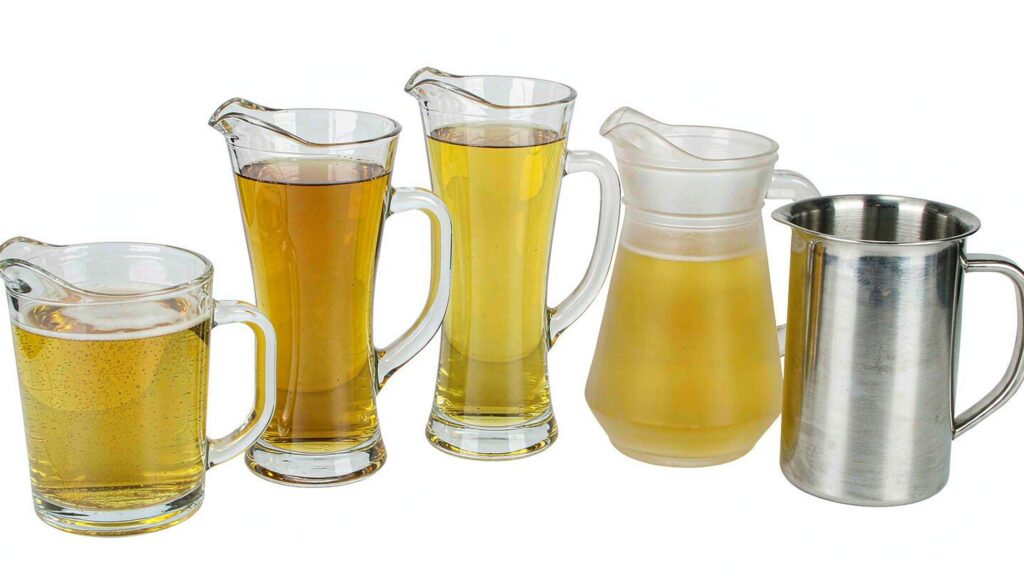
Here is what that looks like across the main materials:
!Five beer pitchers in glass, plastic and stainless steel in a row on a white background
The three glass and plastic pitchers at the left hold the same beer and show it. The frosted one hides the beer but hides scratches too. The steel one at the right shows nothing but lasts the longest. Same job, five material answers — which is exactly the choice a buyer has to make.
Where Does the Word “Pitcher” Come From?
The word is old. Pitcher entered Middle English in the 13th century as picher, from Old French pichier, meaning a small jug. The French word came from Medieval Latin picarium, which likely traces back to the Greek bikos, an earthen vessel. Its closest English cousin is beaker — the two words share the same root.
The geography of the word matters more than the history. In North America, a pitcher is the standard bar vessel. In most other English-speaking countries, people call the same object a jug. Modern British English kept one exception: when a pub sells beer by the pitcher, it borrows the American word. So if your market is the UK, Ireland or Australia, your menu may say jug while your factory still says pitcher. Decide which word your market uses, then lock it into your spec sheet — otherwise the same order can arrive labelled two different ways.
What Are the Parts of a Beer Pitcher?
Most articles stop at “it’s a big jug”. A buyer cannot order a big jug. Seven parts decide how the pitcher pours, survives and carries your logo, and each one is a line on a spec sheet.
| Part | What it does | What goes wrong if you ignore it |
|---|---|---|
| Body | Holds the beer and carries the logo area | Wall too thin on plastic = clouding after weeks of wash cycles |
| Rim and spout | Shapes the pour and the foam | A crude lip dribbles down the side with every pour |
| Handle | Carries a full pitcher safely | Undersized handle = dropped pitchers on a busy floor |
| Base | Keeps a full pitcher stable | Narrow base tips over when a glass knocks it |
| Fill line | Marks the serving volume | No line = staff overpour and your stated size is wrong |
| Lid and ice guard | Blocks flies and ice in outdoor service | Open top at a beer garden is a wasp magnet |
| Nucleated base | Feeds bubbles up so beer keeps its head | Plain base = beer looks flat halfway through the round |
Three of these deserve a closer look.
The spout is a foam machine if it is wrong. Beer is carbonated, so the pour has to stay smooth. A tapered, well-shaped lip keeps turbulence low and the head under control. On plastic pitchers the spout is moulded in one piece with the body, so the tooling decides your pour quality for the life of the mould.
The fill line is a legal question, not just a marking. In the EU and UK, a pitcher used to serve a stated volume is a capacity serving measure. That is the same rule family as the M marking on pint glasses — see the compliance section below.
The nucleated base is the quiet quality upgrade. A laser-etched pattern on the inside bottom releases bubbles through the session, so the last glass poured still shows a head. It is cut with a laser, like a fill line, and it is invisible in photos — which is why nobody specs it until they taste the difference.
Pitcher, Jug, Growler or Carafe: Which Word Gets the Right Product?
These words overlap, and factories ship what the words literally mean. Here is the map.
| Word | What it means | Buyer’s note |
|---|---|---|
| Pitcher | Open-top jug with a handle and spout, for table service | The default word in the US; safe with any barware factory |
| Jug | The same object in most of the English-speaking world | To a Chinese factory, “jug” alone can mean a water or milk jug — always add “beer” |
| Growler | A lidded glass jug, usually 64 oz, filled to go and resealed | For takeaway and refill programs, not table service |
| Crowler | A one-use 32 oz aluminium can, sealed at the bar | Canned takeaway; a canning line, not a glassware order |
| Howler | A 32 oz growler, half the size | Same tooling and caps as the 64 oz growler |
| Carafe | A handleless glass flask for wine or water | No handle, no spout — wrong product for beer service |
| Stein | A lidded or handled drinking mug for one person | A single-serve vessel, see our beer mug terms guide |
Two mix-ups cause real damage.
“Jug” sent without “beer” is the classic error. The buyer emails about jugs, the factory quotes water jugs with narrow necks, and the sample photos only surprise you at unboxing. Write “beer pitcher (beer jug)” the first time, then abbreviate.
A growler is not a table pitcher. It seals, it travels, and it belongs to the takeaway program. If that is your product, our personalized beer growlers page covers the lid, gasket and filling valve options. Table service wants the open pitcher, and the two never substitute for each other on a spec sheet.
What Are Beer Pitchers Made Of?
Five materials cover almost every order. The short version:
| Material | What it is | Typical role |
|---|---|---|
| Soda-lime glass | The classic machine-made bar glass | Best clarity and print surface; breaks |
| Tempered glass | Heat-treated to resist impact and thermal shock | Safer break pattern; costs more |
| SAN plastic | Rigid, glass-clear, BPA-free | Longest wash life of the clear plastics |
| Polycarbonate | Near-unbreakable clear plastic | Glass-free venues; needs BPA-free grade |
| Stainless steel | Brushed or polished metal, often double-wall | Outdoor and premium service; no visibility |
Material is a service-life decision, and it interacts with your dishwasher count, your print method and your budget. We break the full trade-off down in the materials section of our custom beer pitchers page, so here it stays short.
Why Do Bars Sell Beer by the Pitcher?
Because the pitcher earns more per table than the glass does. Three reasons repeat in every bar program:
- Fewer trips. One pour fills up to five glasses. Staff time goes to new tables, not refills.
- Higher spend. A group that orders a pitcher keeps drinking after the first round instead of re-deciding.
- Table time. A branded pitcher sits in the middle of the table for the whole visit.
That last point is the one beer brands care about. A glass is drained and cleared; a pitcher stays on the table, logo facing the room, for 40 minutes. It is the longest-dwell brand carrier in on-premise beer service, which is why brewery campaigns order pitchers alongside the glasses rather than instead of them.
How Many Beers Are in a Pitcher of Beer?
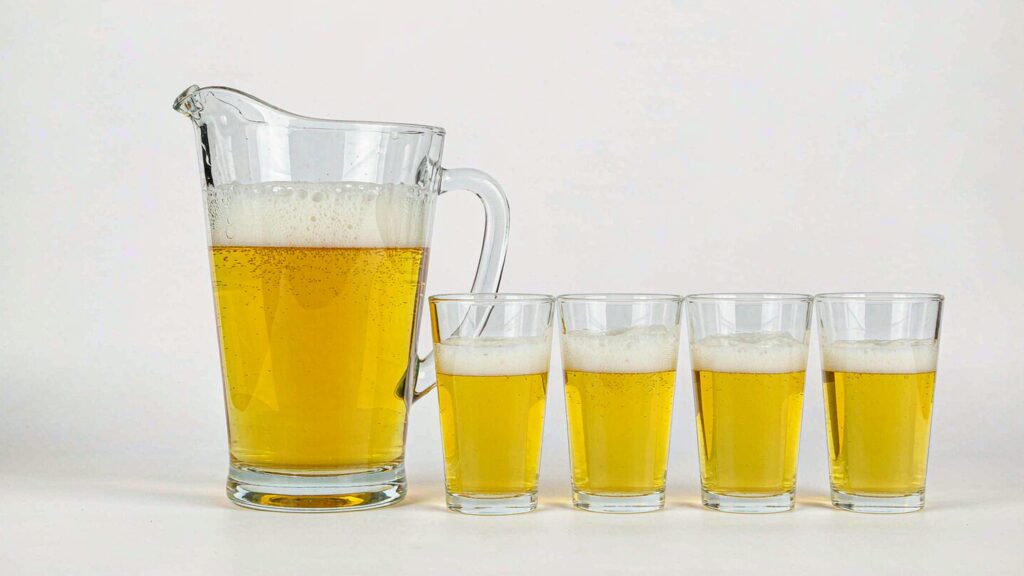
The short answer for the US standard: a 60 oz pitcher pours five 12 oz glasses, or just under four 16 oz pints. Foam eats some of that, so real service lands closer to four full glasses per pitcher.
The full oz-to-ml conversion table — including why US “60 oz” and factory “1.8 L” are not the same number — lives in our beer pitcher sizes guide. This article stays on the vessel.
!A glass pitcher of beer standing next to four filled beer glasses
What Should You Confirm Before You Order Custom Pitchers?
The definition is the easy half. These eight checks are what separates a smooth reorder from a stuck container, and every one of them costs nothing to ask up front.
1. Lock the capacity both ways. State the size in oz and in ml, and say which one governs. If your menu promises 60 oz and the tooling builds 1.8 L, you have a 25 ml dispute on every unit. Our sizes guide gives you the exact numbers to quote.
2. Say rim fill or line fill. Rim capacity means full to the brim; line capacity means filled to a marked line. The difference is a full head of foam. Factories need the words, not the intention.
3. Check the metrology rule for your market. In the EU and UK, a pitcher that serves a stated volume is a capacity serving measure under Directive 2014/32/EU. It needs a CE marking plus the M marking, a notified body number, and an indelibly marked nominal capacity. The allowed error for a transfer measure over 100 ml runs from zero to plus 6 percent — never under. In the US there is no federal pitcher size, so the stated capacity is whatever your spec sheet says it is.
4. Match the material to the wash cycle. Ask how many commercial dishwasher cycles a day the pitcher must survive. Most pitchers retire for cloudiness or faded print, not for breakage, and the material decides which of the two gets there first.
5. Match the print method to the same wash cycle. A high-fired ceramic decal fuses into glass and survives the machine. A low-temperature screen print is a hand-wash finish. Laser etching never fades but prints in one tone. Getting this wrong is the number-one cause of “the logo came off” claims.
6. Confirm MOQ and price by material. Stock plastic shapes with a logo start around 200 pieces; custom colour or machine-made glass starts around 500; new tooling starts around 1,000. Unit prices run roughly USD 2–15 across materials. Ask what sits behind the number: print method, packing and freight all move it.
7. Ask about sampling, lead time and payment terms. A physical sample in about 7 days lets you run the pitcher through your own machine before you commit. Bulk production typically runs 25–35 days after sample approval. Payment terms are usually a deposit with the balance before shipment — agree it in the first quote, not the last email.
8. Spec the packing before the container books. Glass needs dividers in the master carton. Stackable bodies cut freight volume, but only if the tooling was designed for it. A pallet plan that ignores packing turns a good unit price into a bad landed cost.
Frequently Asked Questions About Pitchers of Beer
Is a pitcher of beer a gallon? No. The common US pitcher is 60 oz, and a US gallon is 128 oz. A 64 oz “half gallon” pitcher exists, but a full gallon is two of those, and no standard bar service pours it.
Why is it called a pitcher of beer? The word is the vessel, borrowed from 13th-century French and Latin roots. The beer took the container’s name the way “a glass of wine” did — you order the container and receive the drink.
What is the difference between a pitcher and a jug of beer? The object is the same; the dialect is different. North America says pitcher; most other English-speaking markets say jug. For factories, “pitcher” is the safer word because it always means the bar vessel.
Does a pitcher of beer need a fill line in Europe? If the menu sells a stated volume — “1.8 L pitcher” — then yes, in practice. The EU treats it as a capacity serving measure and expects the capacity marking and the metrology marking. If the pitcher is a shareable extra with no stated volume, marking rules ease off, but your distributor will still want the capacity marked.
A pitcher of beer looks simple from the bar stool: one jug, five glasses, one round. From the buying side it is a short spec sheet — capacity in both units, fill type, material, print method, marking and packing. Get those seven lines right and the pitcher does what it has always done: sit in the middle of the table, pour after pour, with your logo facing the room.
Need custom beer pitchers for your bar, brewery or campaign? Tell us your market and your wash cycle, and we will spec the pitcher to match.