Germany makes more than 7,500 different beer brands, and you will never stock more than a handful of them. That is the real problem behind this search. You are not looking for a tasting note. You are trying to work out which German brands deserve a place in your portfolio, who actually owns them, which regions drink what, and what you can print their name on. This guide maps the brands the way a buyer needs them — by group, by region, by style and by season — and finishes with the four checks that decide whether your German beer promotion survives a brand review.
1. The Numbers Behind the Brand List
Germany ended 2025 with 1,415 breweries, according to the federal statistics office. That is 53 fewer than the year before, the third year of decline in a row, and the lowest figure since 2016 — the country has lost 137 breweries since the 2019 peak of 1,552. Those breweries produce more than 7,500 beer brands between them.
The market they sell into is shrinking fast. German breweries and distributors moved about 7.8 billion litres of beer in 2025, down 6% in a year and down 15.7% against 2019. Two facts sit behind that number, and both of them matter to you.
1.1 A Few Giants, Thousands of Small Brewers
More than half of Germany’s breweries — 821 of them — produce no more than 100,000 litres a year, while only eight breweries produce over 200 million litres each. So a “German beer brand” can be a 400-year-old family brewery serving one valley, or a national brand poured in every airport bar. The two need completely different promotional programs, and the price you can charge for a bar mat has nothing to do with the price you can charge for a national glassware rollout.
1.2 Shrinking Volume, Louder Brands
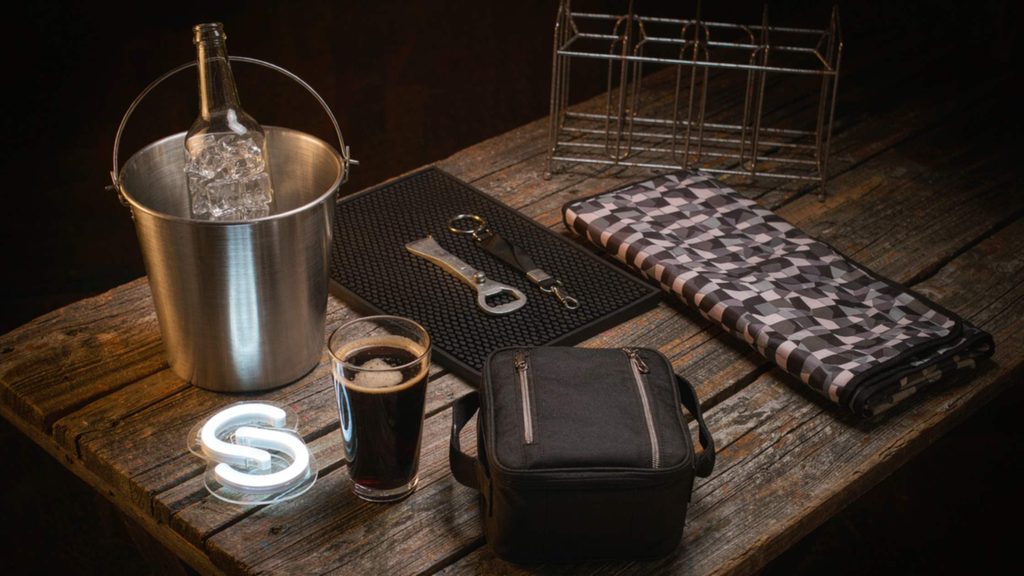
Consumption keeps falling, but the brands fight harder for the on-trade every year, and they pay for that fight with visibility — glassware, ice buckets, bar mats, neon, display racks. When a market stops growing, brands spend more per account to hold the accounts they have. For a promotional buyer, that is the most useful fact in this section.
1.3 The Growth Sits in Alcohol-Free
One part of the category still grows, and it deserves its own plan: non-alcoholic beer. Germany brewed roughly 750 million litres of alcohol-free beer in 2025, up 7.6%, and alcohol-free beer and mixes now make up about 11% of all beer consumption in the country. Germany leads Europe in non-alcoholic beer production. If you plan a German beer program and your artwork only covers the alcoholic SKUs, you are designing for the shrinking half of the shelf.
2. The Groups Behind the Brands: Who Actually Signs Off
This is the part most “German beer brands” articles leave out, and it decides how your order moves. A brand name is what the drinker sees; a group is who you negotiate with. Ownership changes the approval chain, the speed of decisions, and who pays the invoice.
2.1 The Big Groups at a Glance
| Group | Home | Brands you will meet | What it means for you |
|---|---|---|---|
| Radeberger Gruppe (Dr. August Oetker KG) | Frankfurt | Radeberger, Jever, Schöfferhofer, Clausthaler, Tucher, Berliner Kindl, DAB, Dortmunder Kronen, Stuttgarter Hofbräu, Ur-Krostitzer, plus the Cologne Kölsch brands Sion, Gilden and Sester | Germany’s largest privately owned brewery group — over 80 brands across 16 sites. Many of its brands are local heroes that compete with each other in different regions. Ask which brand company you are dealing with, not just which group |
| Paulaner Brauerei Gruppe | Munich | Paulaner, Hacker-Pschorr, Chiemseer, Mönchshof, plus a majority stake in the Kulmbacher group | 70% Schörghuber family, 30% Heineken. The most export-minded of the big German houses — exports make up 36% of its beer sales and its Weißbier reaches 85 countries |
| AB InBev Germany | Bremen | Beck’s, Löwenbräu, Spaten, Franziskaner, Hasseröder, Diebels, Haake-Beck | Three of Munich’s six Oktoberfest names sit with a global group. Global brand guidelines and global procurement: expect strict artwork rules and a longer approval chain |
| TCB Beteiligungsgesellschaft | Hanover | Frankfurter Brauhaus, Feldschlösschen (Dresden), Gilde | Germany’s third-largest brewing group by output and the one English-language guides almost always miss. If you work in eastern Germany or around Frankfurt, this is the group you will actually meet |
| Oettinger Gruppe | Oettingen, Bavaria | Oettinger | The value segment, and a large private-label brewer. High volume, thin margin — promotional budgets here go to price communication, not premium glassware |
| Krombacher | Kreuztal, NRW | Krombacher | Germany’s best-selling single beer brand. Oettinger, which also brews private label at scale, leads on some volume measures; Krombacher is the name most rankings cite |
| Bitburger Braugruppe | Bitburg, Rhineland-Palatinate | Bitburger, König Pilsener, Köstritzer (Schwarzbier), Licher | A family group with its heart in Pilsner and regional strongholds. Köstritzer gives it the Schwarzbier niche almost single-handedly |
| Carlsberg Deutschland | Hamburg | Holsten | Danish-owned, Hamburg-based, strong in the north and in export |
2.2 The Independents
The names that often move fastest, because one person can say yes:
- Augustiner-Bräu, Munich — founded 1328, Munich’s oldest brewery, and the last big Munich brewery that still runs on its own.
- Hofbräu München — the Bavarian state’s own brewery, founded 1589.
- Erdinger Weißbräu — the world’s largest wheat beer brewery, based in Erding, Bavaria.
- Weihenstephan — dates to 1040 and most references call it the world’s oldest working brewery; another Bavarian state-owned house.
- Rothaus — owned by the state of Baden-Württemberg, in the Black Forest.
- Früh, Gaffel, Reissdorf, Päffgen, Sünner — the Cologne Kölsch houses, mostly family-run and fiercely local.
2.3 What Ownership Means for Your Order
Two practical rules follow from this table. If the brand sits inside a global group, budget time for artwork approval — the brand book wins every argument. And if the brand belongs to a family, decisions come faster, but the owner’s personal taste becomes the brand book, so send a physical sample rather than a PDF.
3. The Style Map: What Each Region Actually Orders
Germany is not one beer market. It is a set of regional markets that happen to share a purity law, and a brand that is strong in Hamburg can be almost unsellable in Munich. The Reinheitsgebot — the 1516 purity rule, now 510 years old, which limits beer to water, malt, hops and yeast — sets the floor. Geography sets the taste.
3.1 The Styles, the Regions and the Glasses
| Style | Where it belongs | Share and trend | The glass that goes with it | Brands to know |
|---|---|---|---|---|
| Pilsner | North and west, NRW above all; the national default | Just under 50% of the market | Pilstulpe — the Pilsner tulip, usually around 300 ml, up to 500 ml | Krombacher, Bitburger, Veltins, Warsteiner, Jever, Beck’s, Radeberger |
| Helles | Bavaria, and now spreading | About 12%, the fastest-growing mainstream style | Maßkrug, or the half-litre “Halbe” | Paulaner Münchner Hell, Augustiner, Hacker-Pschorr, Löwenbräu, Spaten, Chiemseer |
| Weizen / Weißbier | Bavaria | Paulaner Weißbier holds 21.2% of the German wheat beer market | Weizenglas — tall, narrow at the base, wide at the rim, about 500 ml | Paulaner, Erdinger, Franziskaner, Weihenstephan, Schneider Weisse |
| Kölsch | Cologne only | Protected, small, very high turnover per account | Stange — a 0.2 L straight-sided glass; the Konvention requires it | Früh, Gaffel, Reissdorf, Sion, Päffgen |
| Altbier | Düsseldorf and the Lower Rhine | Regional, about ten brewers | Becher — shorter and thicker than a Stange | Schlüssel, Bolten, Uerige, Diebels |
| Bock / Doppelbock | Nationwide, sold in Lent and autumn | Seasonal, high ABV | Bock glass or smaller tulip; often a stoneware mug in Bavaria | Paulaner Salvator, Einbecker, Ayinger Celebrator |
| Dunkel / Schwarzbier | Franconia, Thuringia | Small but loyal | Standard mug or tumbler | Köstritzer, Weltenburger, Ayinger |
| Kellerbier / Zwickelbier | Franconia | Unfiltered, cask-conditioned, local | Stoneware mug or straight glass | Mahr’s, local Franconian brewers |
| Rauchbier | Bamberg | Smoke-dried malt, an acquired taste | Mug | Schlenkerla |
| Berliner Weisse / Gose | Berlin and Leipzig | Sour, niche, growing through craft bars | Bowl or small glass | Berliner Kindl, Bayerischer Bahnhof |
| Märzen / Festbier | Munich, in autumn | Munich’s festival-season style | Maßkrug — one litre | The six Munich breweries |
| Alkoholfrei | Nationwide | ~750 million litres, +7.6%, about 11% of consumption | Same shape as the parent style, with its own colour coding | Clausthaler, Bitburger 0.0%, Paulaner, Erdinger, Krombacher |
3.2 Plan by Region, Not by Country
The commercial point is simple. A Pilsner brand has no natural pull in Bavaria, where Helles and Weizen own the tap; a Weizen brand will struggle in Hamburg. If you buy POSM for a portfolio that covers both, you are running two campaigns with two different glass shapes — and one generic “German beer” kit is the fastest way to end up with stock nobody wants to put on a bar.
3.3 Where the Exports Go
One export note for importers. The most recent trade figures put Italy far ahead as the biggest destination for German beer exports at roughly 372,000 tonnes, with China second at about 112,000 tonnes and the Netherlands third at roughly 73,000 tonnes. If you build a German beer range outside the EU, you enter a market that other importers are already testing — not one you have to create.
4. The Six Oktoberfest Brands, and the Rule Nobody Can Bend
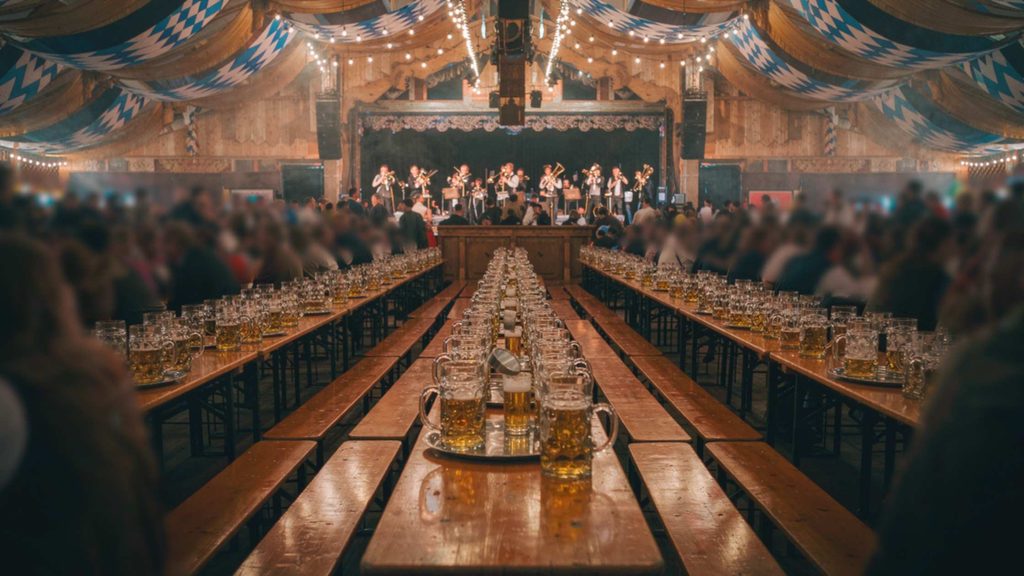
Every large tent at the Munich Oktoberfest pours beer from one of six breweries, and the right to pour there belongs only to breweries inside Munich’s city limits. No outside brand, however famous, ever gets a tap. That exclusive right is the oldest rule at the festival, and it explains why these six names carry so much weight with buyers.
4.1 The Six Breweries and Their Tents
| Brewery | Founded | Its main tent | Who owns it |
|---|---|---|---|
| Augustiner-Bräu | 1328 | Augustiner-Festhalle, Fischer-Vroni | Independent — the last big Munich brewery that still runs on its own |
| Löwenbräu | 1383 | Löwenbräu-Festhalle, Schützen-Festzelt | AB InBev |
| Spaten (Spaten-Franziskaner-Bräu) | 1397 | Schottenhamel, Ochsenbraterei, Marstall | AB InBev |
| Hacker-Pschorr | 1417 | Hacker-Festzelt, Pschorr-Bräurosl | Paulaner Brauerei Gruppe |
| Hofbräu München | 1589 | Hofbräu-Festzelt | The state of Bavaria |
| Paulaner | 1634 | Paulaner Festzelt (Winzerer Fähndl), Armbrustschützen, Käfer | Paulaner Brauerei Gruppe (70% Schörghuber / 30% Heineken) |
The festival runs 14 large tents and around 20 small ones, and one brewery runs each large tent. The beer is not the breweries’ everyday Helles either: the six brew their Wiesnbier stronger, around 6% against roughly 5% for a normal Munich lager, which is why a one-litre Maß lands harder than its colour suggests. A Maß cost €15.70 to €16.50 in 2026 depending on the tent, and the big tents pour nothing smaller.
4.2 The Marks You Cannot Use
The brewery names and logos belong to their owners, the Club of Munich Brewers owns the trademark “Münchner Bier”, and both Bavarian beer and Munich beer also hold EU protected geographical indication status. If you run an Oktoberfest-themed event outside Germany, you can build the *look* — blue and white check, pretzel, brass band, Maß-shaped glassware — but you cannot put a Munich brewery’s mark on a glass or a banner without that brewery’s permission. Get that permission in writing before you go to tooling.
4.3 The Calendar Does Not Move
Crews build the tents from June and take them down within weeks of the closing day. That means the promotional goods for an autumn festival sit in production in early summer. With a 25–35 day bulk lead time, an order placed in July for a September event is already tight, and an order placed in August is a rush job with air freight on top. If you want festival stock, sign off the sample by spring.
5. Glassware: The Part of the Brand You Cannot Freelance
In Germany, the glass is part of the brand, and in one case the law makes it part of the style. Get it wrong and this is not a style choice — it is a brand-compliance failure that a brewery rep will spot across a bar in two seconds.
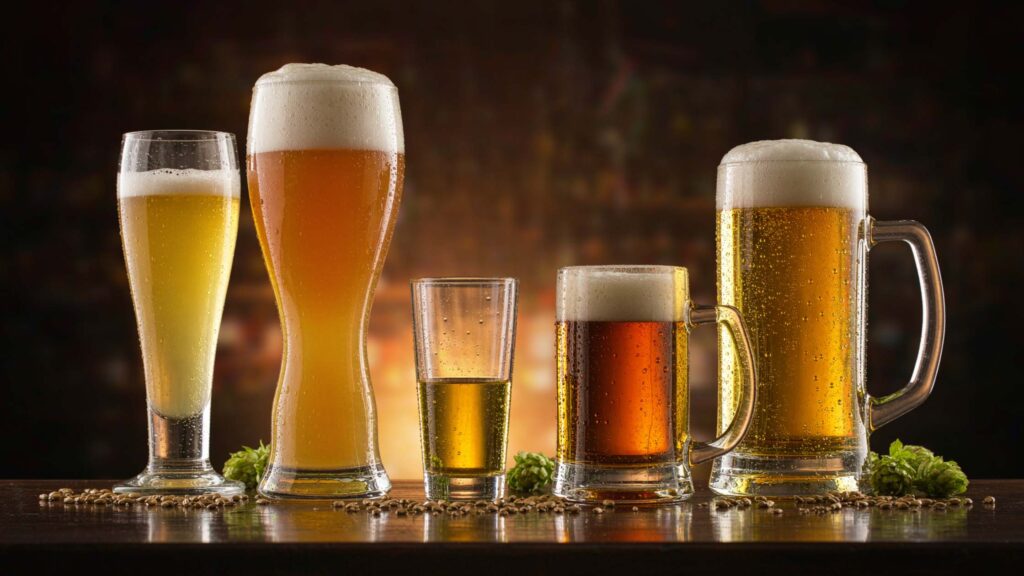
5.1 Every Style Has Its Glass
- Pilstulpe — the Pilsner tulip, tall and slightly flared, typically around 300 ml. Every Pilsner brand has its own.
- Weizenglas — tall, pinched at the waist, wide at the rim, about 500 ml; the shape holds the thick head a wheat beer throws.
- Stange — the Cologne glass, 0.2 litres, straight-sided, no handle, no curve. The 1986 Kölsch Konvention specifies it, and the style has held EU protected geographical indication status since 1997 — both the name and the vessel carry legal protection. Only around 20 breweries within roughly 50 km of Cologne may call their beer Kölsch.
- Becher — the Düsseldorf Altbier glass, shorter and thicker than a Stange.
- Maßkrug — exactly one litre, because a Maß is a unit of measure, not a shape. A bar that fills a Maß short creates a legal problem, not a service problem.
- Bierstiefel — the beer boot, 2 to 4 litres, passed around the table. A novelty item, and a good one for events.
5.2 The Glass Is a Placement, Not a Purchase
Here is what that means for a promotional program. Breweries and their distributors usually place branded glassware into an account and keep control of it — they do not sell it. So the questions that decide your quote are not unit price. They are fill accuracy, how many dishwasher cycles the print survives, whether the glass takes a nucleated base, and what breakage allowance you agree. A cheap printed glass that fades after fifty washes costs a brewery more than a good one, because it has to replace the whole placement.
Two more checks catch people out. Ask the brand for its glass specification before you quote — “a 0.5 L mug” does not transfer between brands, and a Weizen glass from one brewery is not a Weizen glass for another. And confirm the food-contact paperwork at the same time as the design, not after sample approval (see section 7).
6. The Calendar: When German Beer Brands Spend Money
German beer is seasonal in a way most buyers outside Germany underestimate. Four spending windows repeat every year, and each one asks for a different product.
| Season | What is poured | What brands order | Sample sign-off by |
|---|---|---|---|
| Starkbierzeit — Lent, about mid-March to early April | Strong beer, Doppelbock above 7%. The Paulaner Salvator tapping at the Nockherberg opens it; the Löwenbräukeller and Augustiner-Keller run their own | Indoor POSM: stoneware and heavy glass, bar mats, chalkboards, table stands | December–January |
| Maibock and spring — April to May | Pale strong lager | Glassware, garden furniture, parasols, opening-season signage | February |
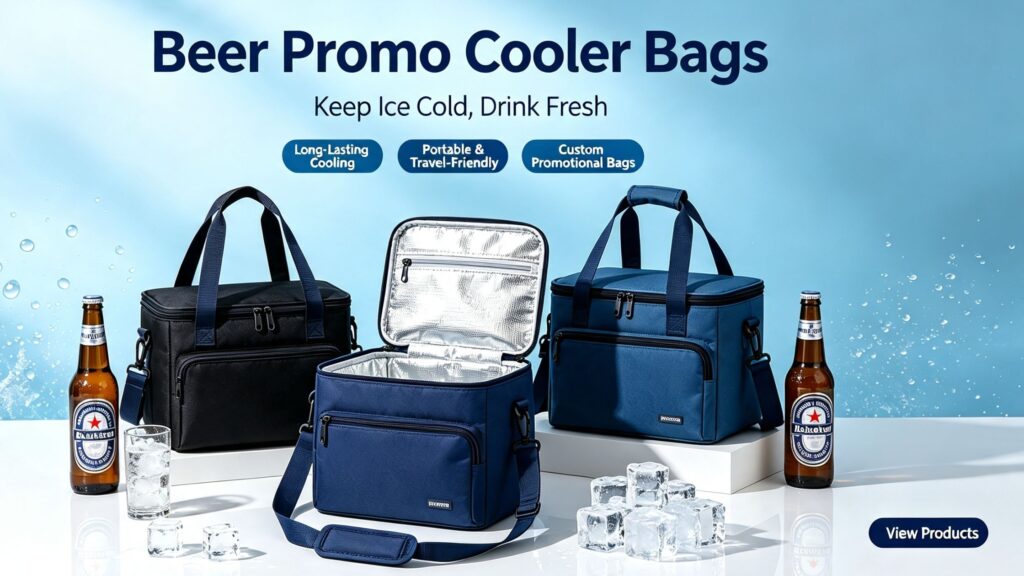
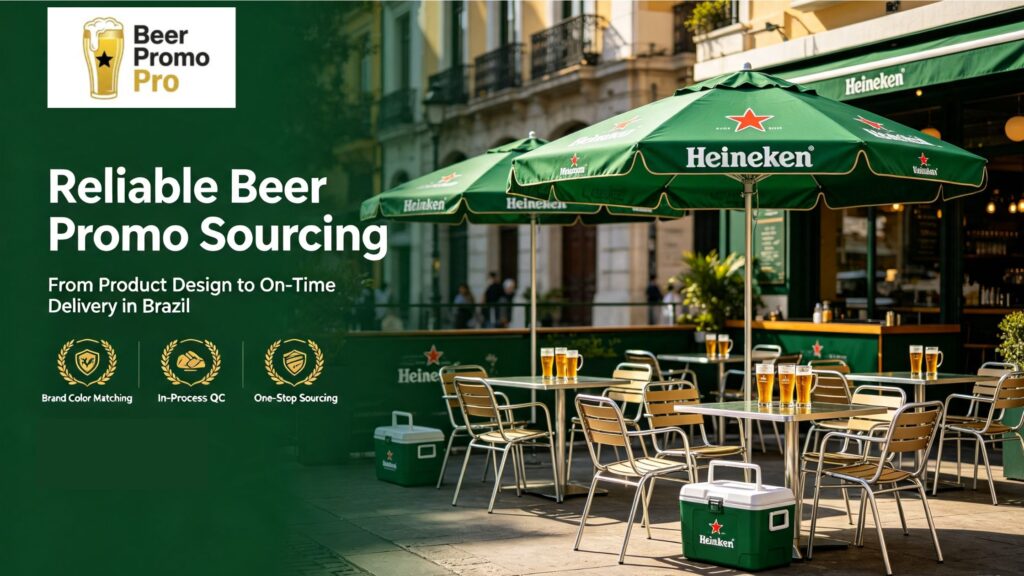
| Beer garden and summer — May to September | Helles, Weizen, Radler, and a fast-growing alcohol-free range | Ice buckets, cooler bags, bar mats, bottle openers, outdoor furniture, beach mats, flags | March–April |
| Festival season — September to October | Märzen and Festbier at around 6%; the Cannstatter Volksfest in Stuttgart runs alongside Munich | Maßkrugs, tent and hall dressing, neon signs, staff wear, crowd giveaways | May–June |
| Year-round | Alcohol-free, Radler, core Pilsner | Retail display: shelf talkers, display racks, neon signs, infographic boards | Rolling |
The pattern to plan against: the outdoor and cooling categories peak in Q2 and Q3, and the display and lighting categories peak in Q4. If you only talk to a German brand once a year, do it in the first quarter — that is when the summer budget is still open, and by the time the season starts, it is spent.
7. Four Checks Before You Put a Brand’s Name on Anything
7.1 Who Owns the Mark, and Who Signs
Find the group behind the brand first. A global group will route you to global procurement and a brand-guidelines review; a family brewery will decide in a week. Get the permission in writing before you cut tooling, and ask whether the local distributor or the brand owner pays the invoice.
7.2 Protected Names Are a Hard Line
The Kölsch Konvention and EU geographical indication status protect the name Kölsch, Bayerisches Bier and Münchner Bier carry protection too, and the Club of Munich Brewers owns the “Münchner Bier” registration. You can describe a beer as Kölsch-style. You cannot label a promotional item with a protected name you have no right to use.
7.3 Do Not Print a Purity Claim You Cannot Back
The Reinheitsgebot restricts beer to water, malt, hops and yeast, and it is a genuine selling point — but it does not cover beer mixes. Radler, Cola-Weizen and cola-mix drinks are different products, and printing “brewed to the 1516 purity law” on a mixer is the kind of mistake that makes a brand owner reject the whole shipment.
7.4 Treat Compliance as Part of the Quote
For drinkware going into the EU, expect the EU food-contact framework plus Germany’s own LFGB testing, which is stricter than the EU baseline. Since the end of 2024 the General Product Safety Regulation has also applied, which means traceability labelling and an EU-based responsible person. Electrical items such as neon signs need CE marking and the usual electrical safety file; textiles such as beach mats and flags fall under REACH, and most buyers will also ask for OEKO-TEX. For the US, that becomes FDA food-contact clearance and CPSIA where relevant. Ask which reports the brand already holds — and which ones you must supply.
Two more practical notes. Send a vector file and a brand colour reference, never a screenshot — German brand owners reject a raster file on sight. And agree the quantity in writing before the artwork starts, because a festival program of 20,000 pieces and a 500-piece bar program are two different factories inside the same supplier.
8. Frequently Asked Questions
What are the most popular German beer brands?
Most rankings name Krombacher as Germany’s best-selling beer brand, followed by the big Pilsner houses — Bitburger, Veltins, Warsteiner, Beck’s — with Paulaner as the largest Bavarian brand and the fastest riser among the big groups. Oettinger leads on some volume measures because it also brews private label at scale.
How many beer brands are there in Germany?
More than 7,500 brands, produced by roughly 1,400 breweries. The federal statistics office counted 1,415 breweries in 2025, down from 1,552 in 2019.
Which German beer brands are sold at Oktoberfest?
Only six: Augustiner, Löwenbräu, Spaten, Hacker-Pschorr, Hofbräu München and Paulaner. The rule allows only beer brewed inside Munich’s city limits, and one of those six runs each of the 14 large tents.
Is Kölsch a brand or a style?
Both, and that is the point. Kölsch is a pale, top-fermented, cold-conditioned beer, and the 1986 Kölsch Konvention legally restricts the name to roughly 20 breweries within about 50 km of Cologne; the style has held EU protected geographical indication status since 1997. Früh, Gaffel, Reissdorf, Sion and Päffgen are the names you will meet.
What is the oldest German beer brand?
Weihenstephan dates to 1040, and most references call it the world’s oldest working brewery. Among Munich’s festival breweries, Augustiner is the oldest, founded in 1328 — and still the only independent among the six.
Who owns Beck’s?
AB InBev. The brewery has made Beck’s in Bremen since 1873 and sells it in more than 90 countries, which makes it the most widely distributed German beer brand outside Germany.
Are German beer brands family-owned?
More than most markets. Radeberger sits inside the Oetker family group, Bitburger, Warsteiner, Veltins and Augustiner answer to their families, and Paulaner is 70% Schörghuber family with 30% Heineken. But several famous names — Beck’s, Löwenbräu, Spaten, Franziskaner, Hasseröder — belong to AB InBev, so check ownership before you assume a local decision-maker.
What is the difference between Pilsner and Helles?
Pilsner is dry, hoppy and crisp, and it owns the north and west with just under half the market. Helles is maltier and softer, belongs to Bavaria, and is the fastest-growing mainstream style at about 12%. If you stock one style for a southern German account, make it Helles.
Which glass goes with which German beer?
Pilstulpe for Pilsner, Weizenglas for wheat beer, a 0.2 L Stange for Kölsch (the Konvention requires it), a Becher for Altbier, and a one-litre Maßkrug for festivals and beer gardens. Ask each brand for its own glass specification — the shapes do not transfer.
Can I use a German beer brand’s logo on promotional products?
Only with the brand owner’s written permission. The logos are trademarks, and several of the names carry their own legal protection — Kölsch, Bayerisches Bier and Münchner Bier all hold EU protection, and the Club of Munich Brewers owns the “Münchner Bier” registration. For an Oktoberfest-themed event, use Bavarian motifs rather than a brewery’s mark.
Is non-alcoholic German beer worth a separate product line?
Yes. Germany brewed about 750 million litres of alcohol-free beer in 2025, up 7.6%, and it now accounts for roughly 11% of all beer consumption — Germany leads Europe in this category. Give the alcohol-free SKUs their own colour coding on shelf talkers and bar signage; customers look for it and get annoyed when they cannot find it.
What certifications do beer promotional products need for Germany?
Anything that touches a drink needs EU food-contact compliance plus LFGB testing — LFGB is stricter than the EU baseline, and German buyers will ask for it by name. Add General Product Safety Regulation traceability labelling, CE and electrical safety files for neon signs, and REACH (usually with OEKO-TEX) for textiles. For the US, that becomes FDA food-contact clearance and CPSIA.
What is the minimum order and lead time for custom beer POSM?
For a single item, programs usually start in the low hundreds of pieces — a 500-piece ice bucket run is a normal starting point, while a full festival kit runs into the tens of thousands. Standard timing is 7 days for a sample and 25–35 days for bulk, with consolidated shipping into EU ports and Euro pricing for European buyers.
Wrapping Up
Three things are worth taking away. First, the brand list is a group list — a handful of groups controls 7,500 brands, and knowing whether you deal with a global brewer or a family house changes how fast the owner approves your artwork. Second, Germany is regional, not national — Pilsner in the north and west, Helles and Weizen in Bavaria, Kölsch inside a 50 km circle around Cologne — so a single German-wide promotional kit is the wrong shape for the market. Third, the calendar runs the budget — strong beer in Lent, cooling and outdoor gear through summer, festivals in the autumn, and alcohol-free growing all year round — so you must sign off the sample for a September festival in spring.
Where we fit is the part that usually goes wrong: making the physical goods to a brand’s own specification, at festival volumes, inside a calendar that does not move. We have worked only in beer for 14 years, supplying ice buckets, cooler bags, bar mats, bottle openers, branded glassware, neon signs, display racks and outdoor furniture, with 7-day sampling and 25–35 day bulk production, consolidated shipping into EU ports and support in English and Spanish.
If you are planning a German beer campaign, send us the brand, the season and the quantity — and tell us which glass the brand requires — and we will come back with a sample plan and a production slot that lands before your event does. Leave a comment or send us your brief.