
Knowing how to measure a patio umbrella prevents more than a poor-looking fit. It helps buyers avoid incompatible canopies, blocked crank handles, undersized shade zones, and unclear supplier quotations. This guide explains what to measure for a new umbrella, an existing frame, a replacement canopy, or a commercial order.
The Quick Answer
Open and lock the umbrella before measuring it. Then use the method that matches its shape:
- Round or octagonal: record one rib from the center hub to its outer tip. Double that measurement and, when the manufacturer’s method requires it, add the hub width.
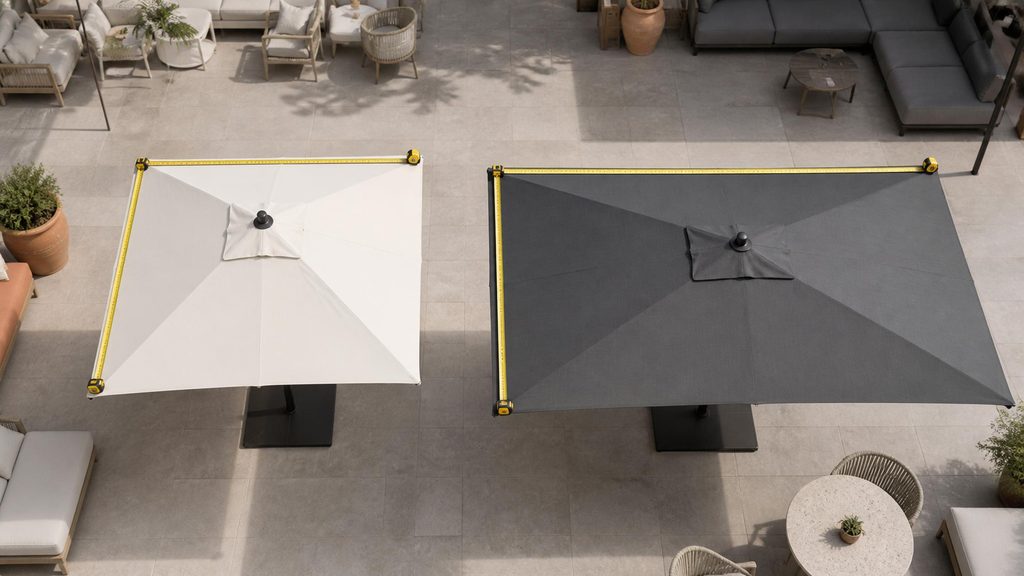
- Square: measure the length of one side, not the diagonal.
- Rectangular: record the long side × short side.
- Cantilever or offset: measure the canopy by its shape, then record arm reach, mast position, base footprint, and operating clearance separately.
For a replacement canopy, size alone is not enough. Also record the exact rib length, rib count, frame type, vent design, top opening, attachment method, and brand or model.
What Does Patio Umbrella Size Mean?
Patio umbrella size normally describes the canopy, not the overall height or base. A round or octagonal umbrella may be sold as a 9 ft model. A rectangular model may be listed as 8 × 11 ft.
The complication is that brands do not always obtain that stated size in the same way. A straight line across an open umbrella is its span. A measurement following the sloped ribs or curved canopy can be longer. How far the frame is opened can also change the straight span.
One published measurement diagram illustrates a 9 ft octagonal umbrella as:
53 1/8 in rib arm × 2 + 2 in hub width = about 108 1/4 in
The same diagram shows an open span of only 101–103 3/4 in and warns that span varies with the opening position .
This is why a nominal “9 ft” label is useful for product categories but not sufficient for replacement-canopy compatibility. When exact fit matters, use the original brand’s diagram or compare actual frame measurements with a supplier drawing.
What You Need Before Measuring
Prepare a tape measure, a phone or notepad, and the original product label if it is available. A caliper is useful for pole diameter. For a large umbrella, ask another person to stabilize the frame and hold the tape.
Work on a level, wind-free surface. Open the umbrella fully and engage its locking mechanism. Do not climb on unstable furniture or try to hold a large open canopy alone in windy conditions.
Create a simple record with both inches and millimeters if you are comparing international suppliers. Photograph the full umbrella, the hub, a rib tip, the top opening, and any label. Photos often resolve details that a single number cannot.
How to Measure a Round or Octagonal Patio Umbrella
Method 1: Measure the Rib
This is the most useful method for identifying a frame or matching a replacement canopy.
- Open and lock the umbrella.
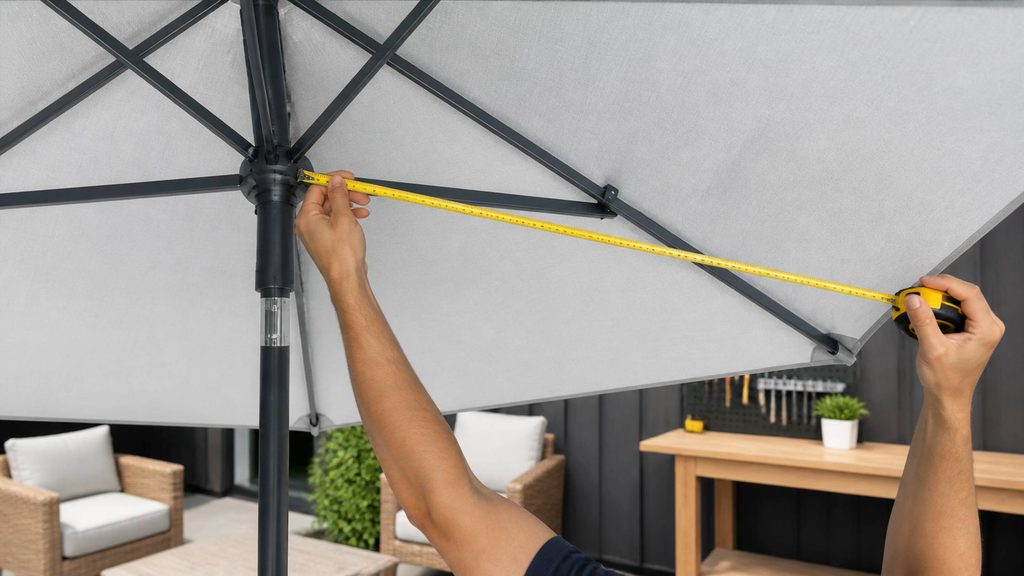
- Find a full-length main rib running from the center hub to the canopy edge.
- Measure from the rib’s connection at the hub to the outer metal tip.
- Repeat on two or three ribs to detect a bent part or measuring error.
- Record the exact result rather than immediately rounding it to a standard size.
Doubling the rib length gives a practical size estimate. Some manufacturers include the center hub width as well, so confirm the supplier’s formula before treating the result as the nominal diameter.
Method 2: Measure Over the Canopy
Place the tape at one rib tip, follow the surface over the top and finial, and finish at the opposite rib tip. FiberBuilt demonstrates this method with the umbrella fully open and safely positioned on its side.
This method can help identify the marketed size, but record that it is an over-canopy measurement. Do not mix it with a straight horizontal span in a supplier comparison.
Method 3: Measure the Straight Span
Measure between opposite rib tips through the center in a straight line. This tells you the approximate open footprint, which is useful for checking nearby walls, railings, or other umbrellas.
Do not assume this span is the same as the nominal size. The canopy’s slope and opening position can make it smaller than the rib-based or over-canopy measurement.
How to Measure Square and Rectangular Umbrellas
For a square umbrella, measure one outside side from corner rib tip to corner rib tip. Check a second side to confirm that the frame is square. Do not use the corner-to-corner diagonal as the product size.
For a rectangular umbrella, record both dimensions:
- Measure the longer outside side from one corner rib tip to the next.
- Measure the shorter side in the same way.
- Write the result as length × width, keeping one unit throughout.
If you are ordering replacement fabric, also measure the relevant ribs from hub to tip. A rectangular frame may use corner ribs and side ribs of different lengths. Record each rib type and its quantity instead of submitting one average.
How to Measure a Cantilever or Offset Umbrella
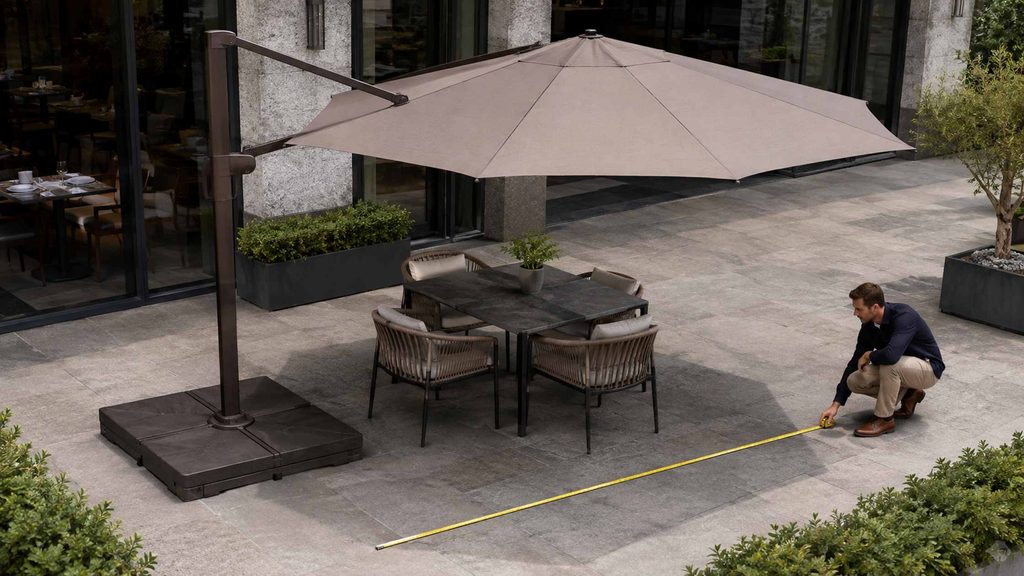
Measure a cantilever canopy according to its shape: rib-based diameter for an octagonal canopy or length × width for a rectangular one. Then capture the offset frame separately:
- Mast height and cross-section
- Horizontal reach from the mast to the canopy center
- Base or mounting-plate footprint
- Rotation range and swept area
- Clearance needed to open, close, tilt, and rotate
- Rib count and individual rib lengths
- Position and shape of the support-arm opening
- Hub, vent, and canopy attachment details
An offset umbrella can fit the measured shade zone while its mast, arm, or base conflicts with furniture and walkways. Commercial patio planning must therefore use the complete operating envelope, not canopy dimensions alone. Shade position also changes with sun angle, so a stated canopy size is not a promise of constant usable shade .
How to Measure for a Replacement Canopy
A replacement cover must match the frame geometry, not just the number in the old product name. Before contacting a supplier, record:
| Item | How to record it | Why it matters |
|---|---|---|
| Nominal and actual size | Label plus exact measurements | Separates product naming from physical fit |
| Shape | Octagonal, square, rectangular, or custom | Determines the panel pattern |
| Rib length | Hub connection to metal tip | Controls panel reach and tension |
| Rib count | Count every main rib | Determines pocket and seam positions |
| Multiple rib types | Length and quantity of each | Essential for rectangular and unusual frames |
| Vent | No vent, single tier, or double tier | Affects top construction and attachment |
| Finial/top opening | Diameter, shape, and fastening method | Prevents an incompatible center opening |
| Rib-tip attachment | Pocket, screw, hook, grommet, or other | Determines how the cover is secured |
| Frame type | Center pole or cantilever | Changes cutouts and geometry |
| Brand/model | Label, manual, or order record | May reveal a proprietary pattern |
| Photos | Full frame, hub, tips, vent, and label | Lets the supplier check details visually |
Do not rely on “universal 9 ft canopy” without comparing its stated rib-length range, rib count, and attachment design. Community replacement questions regularly involve six-rib frames, unusual cantilever openings, and sizes between common labels—exactly the details a nominal diameter hides .
If the old fabric is stretched, torn, or badly distorted, measure the frame rather than copying the cloth. Ask for a technical drawing and mark every dimension you have verified. For a custom order, an inexpensive sample is safer than assuming a drawing proves final tension and assembly.
How to Measure the Table, Base, and Patio Space
Table and Shade Zone
Measure the tabletop at its widest relevant dimension: diameter for a round table, one side for a square table, and length × width for a rectangular table. Then include occupied chair positions, not only the tabletop.
A commonly published starting rule is to let the canopy extend about 2 ft beyond the table edge on each side. Treat that as an initial sizing estimate, not a guarantee. Low sun, wind exposure, furniture layout, and the umbrella’s height can change the useful shade.
For restaurants and hotels, mark the intended shade zones on a scaled plan at more than one time of day. Several medium umbrellas may fit changing table layouts better than one very large unit.
Pole, Table Hole, and Crank
Use a caliper or measure straight across the widest part of the pole. That is the pole diameter. Do not confuse diameter with circumference. Measure the clear inside diameter of the table hole and the opening of the base tube separately.
The pole must physically pass through the table opening and fit the base’s clamping system. A small size mismatch can make a table unusable with the chosen frame, as real buyer discussions illustrate (table-hole example). Never enlarge a table opening or modify a structural pole without approval from the responsible manufacturer or qualified professional.
Also measure from the bottom of the umbrella pole to the bottom of the crank handle. The tabletop must sit below this crank height for the handle to turn. The published umbrella diagram explicitly treats crank height as a separate compatibility check.
Clearance and Base Footprint
Record the available ground area and overhead height. Check eaves, branches, lights, walls, railings, doors, and walking routes. For a tilting or rotating model, measure the largest area it occupies while moving, not only its parked position.
Sizing the canopy does not size the base. Base selection depends on the specific frame, installation method, exposure, and manufacturer requirements. Do not apply a generic weight formula as if it were a wind rating.
A Better Measurement Sheet for Commercial Buyers
For a retail listing, purchase order, or RFQ, avoid one unlabeled “umbrella size” field. Use a structured specification:
- Product type and canopy shape
- Nominal size and the method used to define it
- Actual rib length, hub width, span, and length × width as applicable
- Rib count, rib types, and frame material
- Pole or mast diameter and total height
- Crank height and open-canopy clearance
- Cantilever reach, rotation, tilt, and base footprint
- Canopy vent, valance, finial, and attachment details
- Required shade/layout zone
- Measurement units and acceptable dimensional tolerances
- Manufacturer model, drawing revision, photos, and approved sample
- Packing dimensions and order quantity
Ask the supplier to return a dimensioned drawing rather than simply confirming “9 ft.” For repeat orders, attach the approved drawing and sample reference to the purchase order. This reduces the chance that a familiar product name hides a changed hub, rib, or fabric pattern.
Common Patio Umbrella Measuring Mistakes
Measuring the Umbrella While Closed
Folded length does not reliably indicate open canopy size. Open and lock the frame or use the original technical drawing.
Measuring Only the Fabric Edge
Fabric can stretch, shrink, sag, or tear. Measure the frame ribs for replacement work.
Using the Diagonal of a Square Canopy
The listed square size is normally its side length. A diagonal exaggerates the usable width and will not match common product descriptions.
Rounding Too Early
A 53 1/8 in rib should remain 53 1/8 in, or its accurate millimeter equivalent, in the measurement record. Round only when assigning a product category—not when checking fit.
Ignoring the Hub and Measurement Convention
Two suppliers can both describe a 9 ft umbrella while using slightly different geometry. State whether the figure is a straight span, over-canopy distance, or rib-based calculation.
Treating Diameter as the Whole Specification
Rib count, top opening, vent, attachment points, pole diameter, and frame style can all make a same-size component incompatible.
Frequently Asked Questions
Do you measure a patio umbrella open or closed?
Measure it fully open and locked. A closed umbrella does not provide a reliable canopy dimension.
Is a patio umbrella measured by diameter?
Round and octagonal umbrellas are generally described by a diameter-like canopy size. Square models use side length, and rectangular models use length × width. Confirm how the manufacturer defines the stated size.
Can I measure straight across a patio umbrella?
Yes, if you need its approximate open span. However, that straight span may be smaller than the nominal size because the canopy slopes and its opening position can vary. Record the method with the number.
How do I calculate umbrella size from rib length?
Double the length of one main rib for a practical estimate. Some designs and measurement conventions also include the center hub width, so use the manufacturer’s diagram when exact size or replacement fit matters.
What measurements do I need for a replacement patio umbrella canopy?
Record exact rib length, rib count, shape, frame type, vent, top opening, rib-tip attachment, brand/model, and photos. Add the lengths of every distinct rib type for rectangular or custom frames.
How do I measure a patio umbrella pole?
Measure straight across the widest section with a caliper or tape. Record that outside diameter and compare it with the table hole and base tube’s clear inside diameters.
Should I order a replacement canopy by nominal size alone?
No. Compare exact frame dimensions, rib count, and attachment details with the replacement supplier’s drawing or fit range. “Universal” does not mean every same-size frame is identical.
What should a retailer show on a patio umbrella product page?
Show the nominal canopy size, measurement method, shape, actual span or side dimensions, pole diameter, overall and crank heights, base compatibility, and a dimensioned diagram. Clear data helps customers self-check fit and can reduce avoidable returns.
Measure the Job, Not Just the Canopy
The correct method depends on what you are trying to accomplish. Use rib and frame details for a replacement canopy, side dimensions for square and rectangular models, and the full operating footprint for a cantilever umbrella. Add pole, table-hole, crank, base, and clearance measurements when planning an installation.
For a commercial order, send suppliers one dimensioned specification with photos and request a returned drawing plus a sample approval step. That process turns “about 9 ft” into a product both sides can identify, quote, inspect, and reorder consistently.