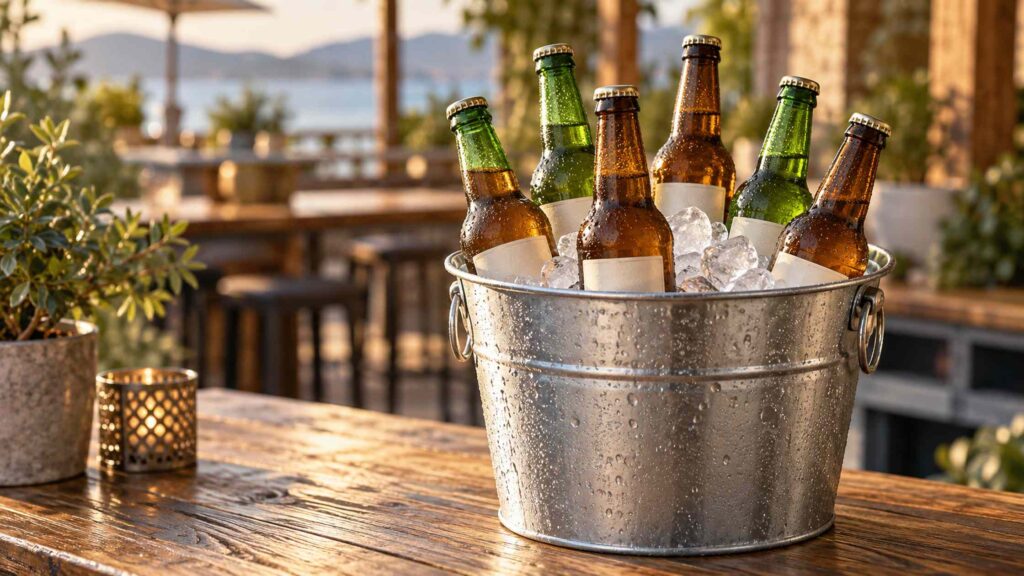
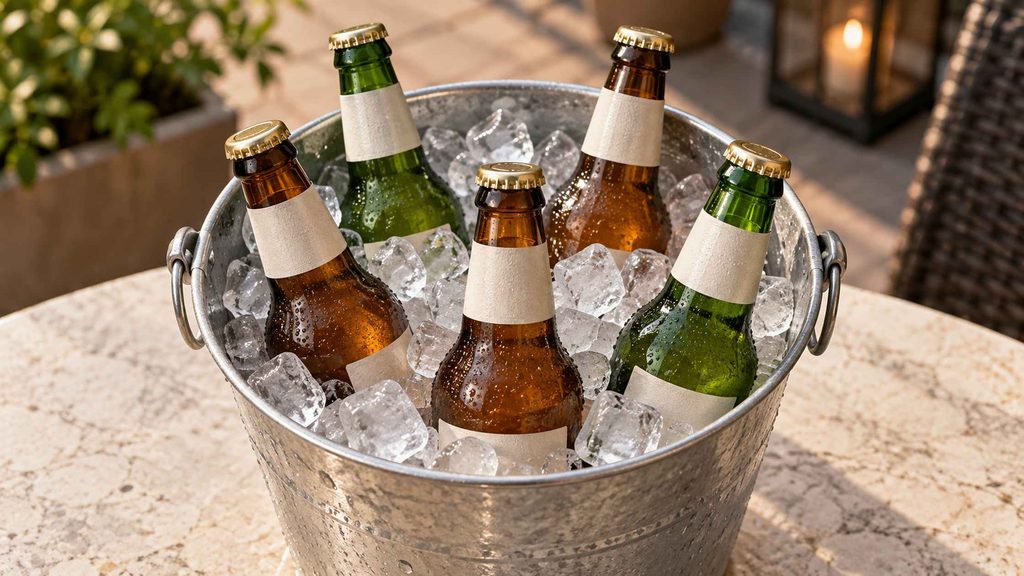
How many beers in a bucket? Five or six bottles is a common bar serving.** A bucket of beer does not have a fixed capacity, though. Some serving buckets hold about five bottles with ice; larger designs can hold six to eight. The bucket’s shape, drink size and ice space determine the fit.
How Many Beers Come in a Bucket at a Bar?
A beer bucket is a container used to hold bottled or canned drinks with ice. You will see them on bar tables, at outdoor events and beside drinks stations at parties.
On a menu, a “bucket of beers” means a set number of bottled or canned drinks served together. The venue decides the quantity. That serving count does not necessarily tell you the bucket’s maximum capacity.
For example, Shuffles lists five-bottle buckets, while STATS Brewpub offers six-bottle and larger packages. Always check the menu if you want to know how many drinks are included.
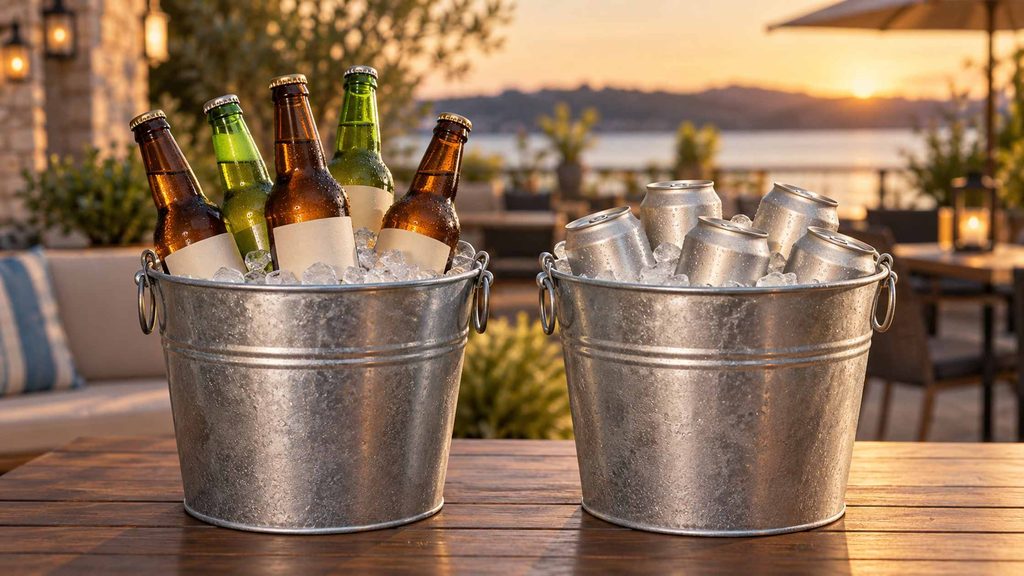
Beer Bucket Sizes: How Much Can They Hold?
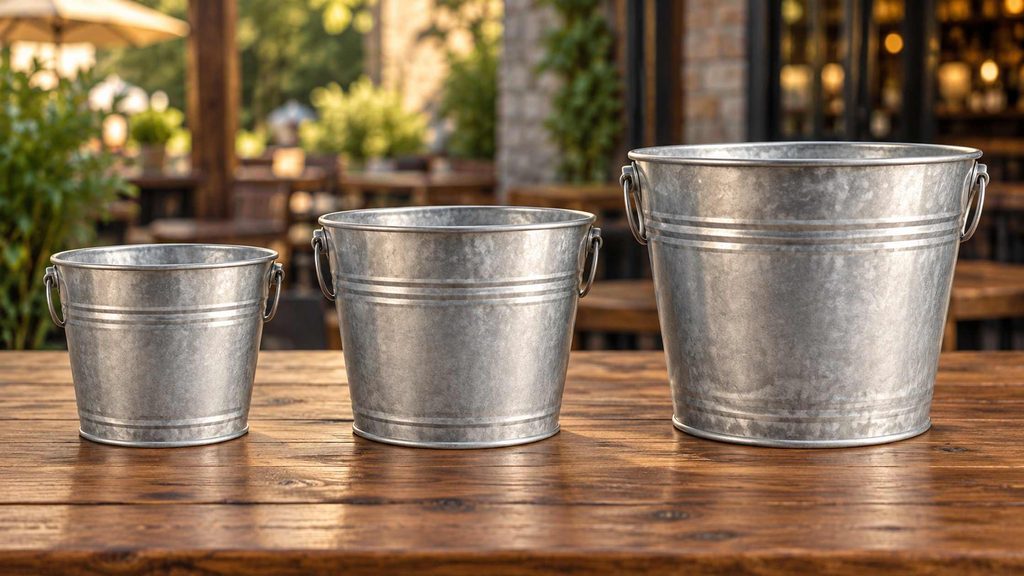
Beer buckets come in different shapes and sizes, from compact table buckets to wide beverage tubs. Their size may be listed in litres, quarts or the number of drinks they hold.
These measurements tell you different things. Litres and quarts describe liquid volume. A bottle count describes a particular way of loading the bucket—and may or may not include ice.
Small Tabletop Buckets
A small bucket is useful for a few drinks on a table without taking up too much room beside glasses and food.
As one example, manufacturer Behrens describes a 5-quart metal bucket holding about five standard 12 oz beers with ice. Five US liquid quarts is approximately 4.73 litres. This is a useful reference for a compact serving bucket, rather than a promise for every bucket of that size. Behrens beer bucket guide.
Larger Serving Buckets
A wider bucket can give you room for more bottles and ice, making it useful for a shared table or a larger drinks offer.
Whirley-DrinkWorks lists its 200 oz B-200 bucket as holding six to eight regular beer bottles with ice. Brooklyn Brewery describes its 12 × 8 × 7-inch metal bucket as holding up to eight bottles with ice. These are product-specific examples; the exact bottle dimensions and ice amount still matter. Whirley B-200, Brooklyn Brewery beer bucket.
Large Beverage Tubs
For a drinks station, a beverage tub gives people access to a larger selection in one place. Behrens lists metal beverage tubs ranging from 5 to 17 gallons, much larger than a small tabletop bucket. Behrens tub sizes.
There is no single bottle count for this category. A wide, shallow tub and a tall, narrow container can hold drinks differently even when their stated volumes are similar. Look for a capacity figure that names the drink size and includes ice.
Here is a quick comparison:
| Size or product example | Beer capacity with ice | Typical use |
|---|---|---|
| 5-quart metal bucket, as described by Behrens | About five 12 oz beers | Small table service |
| Whirley B-200, listed at 200 oz | Six to eight regular beer bottles | Shared-table service |
| Brooklyn Brewery bucket, 12 × 8 × 7 inches | Up to eight bottles | A larger tabletop serving |
| Large beverage tub | Depends on the model and loading arrangement | Parties and drinks stations |
The figures above are published descriptions, not our own test results. They show the range of available designs rather than a standard size chart that applies to every brand.
How Does Ice Change Beer Bucket Capacity?
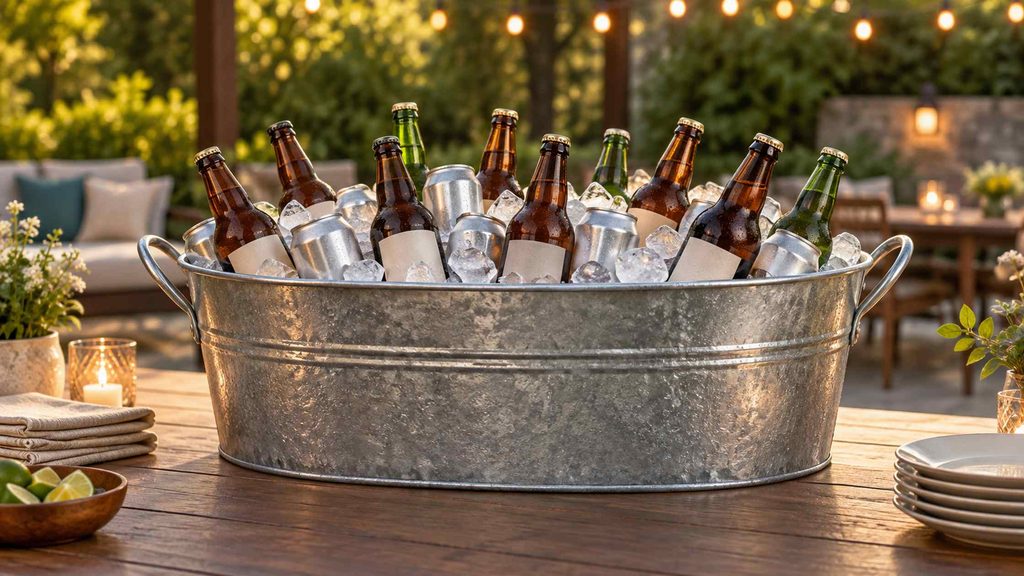
Ice takes up space that could otherwise hold drinks. That is why a bucket’s maximum bottle count can be higher than its useful serving capacity.
Imagine arranging six bottles in an empty bucket. They may fit tightly together, but there may be little room for ice around them. A slightly larger bucket could hold the same six bottles in a more practical serving arrangement.
For example, a hypothetical bucket that fits eight bottles without ice might work better as a six-bottle serving once ice is added. This illustrates the difference between maximum fit and serving capacity; it is not a capacity claim for a particular model.
Check the wording in the product description. For example, YETI’s beverage bucket FAQ states a capacity of six cans without ice. That does not mean six cans plus a full load of ice.
There is no fixed number of bottles to subtract when adding ice. The result depends on the gaps between drinks, the bucket’s shape and the amount of ice used. For a useful comparison, load each bucket with the same drink format and ice quantity.
How to Arrange Beer in an Ice Bucket
Start with chilled, unopened drinks. Arrange them securely, then add ice into the gaps around the bottles or cans. Leave the tops easy to reach and check that the handle can move without hitting them.
If you have to remove nearly all the ice to fit the last bottle, use a larger bucket or reduce the serving count. If you are using several buckets, repeat the same arrangement so each table gets a consistent serving.
Bottles vs. Cans: Will the Same Number Fit?
Not always. The amount of beer inside a container does not tell you its outside dimensions.
| Drink format | What affects the fit? |
|---|---|
| 330 ml or 355 ml glass bottles | Bottle width, shoulders and neck height |
| Short, wide bottles | More space may be needed across the bucket’s base |
| Standard cans | Their compact shape allows a different arrangement from long-neck bottles |
| 500 ml or other tall cans | Extra height matters, particularly if the bucket has a lid |
| Mixed bottles and cans | Different shapes leave different gaps for ice |
Cans can sometimes pack more neatly, but you should not assume a bucket always holds more cans than bottles. The actual dimensions and arrangement decide the result.
If you serve several brands, check their containers together. Two beers labelled “330 ml” do not necessarily use the same bottle shape.
Why Bucket Shape Matters as Much as Size
A bucket can look large from above and still have a narrow bottom. When bottles stand upright, their bases need enough room to sit securely.
Three dimensions are especially useful:
- Top width: the opening available for arranging and reaching drinks.
- Bottom width: the space for bottles or cans to stand.
- Inside height: how much of each drink fits below the rim, and whether a lid can close.
Insulated walls and internal features can also affect usable space. Compare inside measurements where available, rather than judging capacity from outside dimensions alone.
Avoid dividing the bucket’s volume by the volume of beer in each bottle. A five-litre bucket divided by 330 ml does not give a realistic bottle count: that calculation leaves out the glass, the spaces between bottles and the ice.
What Size Beer Bucket Do You Need?
Choose according to how you will use it.
For a small table: a compact bucket that comfortably holds your intended five- or six-bottle serving with ice is a sensible starting point. Check that it leaves room for glasses and food.
For a larger shared table: consider a wider serving bucket. Extra capacity is useful only if people can reach the drinks and the loaded bucket remains manageable to carry.
For a party or event: a beverage tub can hold a wider selection at a central drinks station. Several smaller buckets may be more convenient if drinks need to be spread across different tables.
For a bar promotion: match the bucket to the offer. If the menu promises six bottles, confirm that six of those exact bottles fit with ice before choosing the design.
The easiest check is to load one sample as you intend to use it. Add the drinks and ice, lift it carefully, and take out a bottle. You will quickly see whether the advertised capacity works for your setup.
How Many Beers in a Case—and How Many Buckets Will It Fill?
In US retail, a beer case often means 24 bottles or cans, although pack sizes vary. For example, Total Wine lists a 24-bottle case of Budweiser. Check the quantity printed on the carton rather than relying on the word “case.”
A case is the pack you buy; a bucket is the serving you prepare. Using a 24-beer case, the calculation is:
| Beers in each serving | Full bucket servings from 24 beers | Beers left over |
|---|---|---|
| 5 | 4 | 4 |
| 6 | 4 | 0 |
| 8 | 3 | 0 |
These are stock calculations, not claims that one bucket size holds all three amounts. Each serving still needs a suitable bucket with room for ice.
For example, preparing ten six-beer buckets at the same time requires 60 beers. If you buy 24-beer cases, three cases provide 72 beers, leaving 12 in reserve. You also need ten suitable buckets for simultaneous service; refilling four buckets over time is a different setup.
Common Questions About Beer Bucket Sizes
How Many Beers Are in a Corona Bucket?
Check whether you mean a bar’s Corona offer or the capacity of a Corona-branded bucket. The venue sets the serving count, while the physical bucket can vary in size. A logo alone does not tell you how many bottles fit with ice.
Is a 5-Litre Bucket the Same as a 5-Gallon Bucket?
No. Five US gallons is approximately 18.9 litres—almost four times the liquid volume of five litres. A five-gallon container is much larger than a typical small table bucket. Also check whether a supplier uses US or imperial units.
Does a Bigger Bucket Keep Beer Cold for Longer?
Size alone cannot tell you. Ice quantity, insulation, starting drink temperature and surrounding conditions all matter. Look for information about the specific product rather than assuming a larger capacity means better cooling.
Find a Bucket That Fits Your Drinks
Five or six beers is a common bar serving, but the right bucket capacity depends on the bottles or cans and the ice around them. Use the published capacity as a starting point, then check the actual serving arrangement.
For branded bar service or events, BeerPromoPro offers ice buckets in multiple sizes with custom logo options. Share your drink size and the number you want to serve, and contact our team to discuss a suitable bucket.