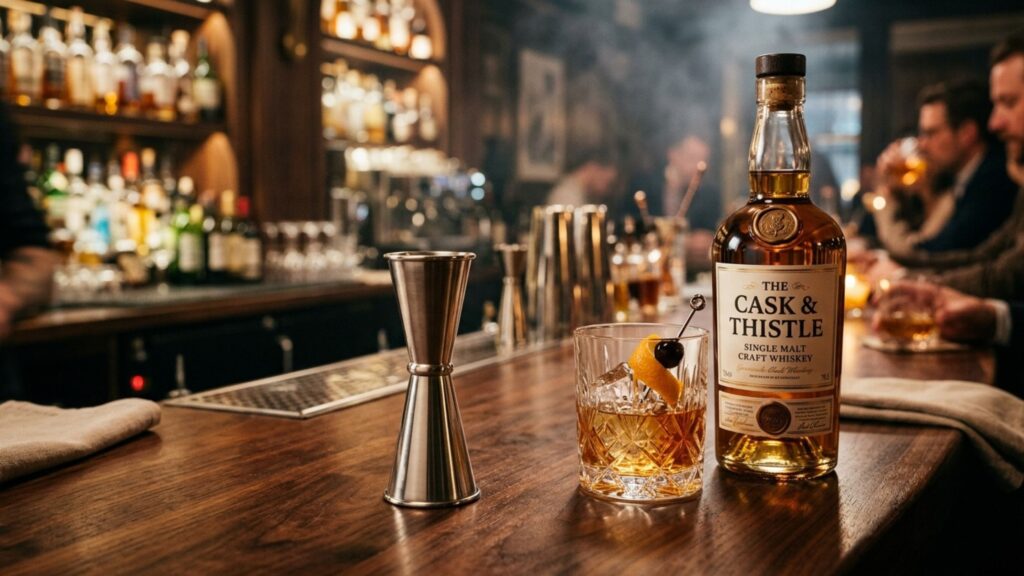
A standard U.S. jigger measure is 1.5 fluid ounces, or about 44 mL. The measuring tool, however, comes in several sizes. Its larger side might hold 1.5 or 2 ounces. Check both ends and the internal markings before using it for your recipe. Oxford’s jigger definition describes the traditional amount.
What Is a Jigger?
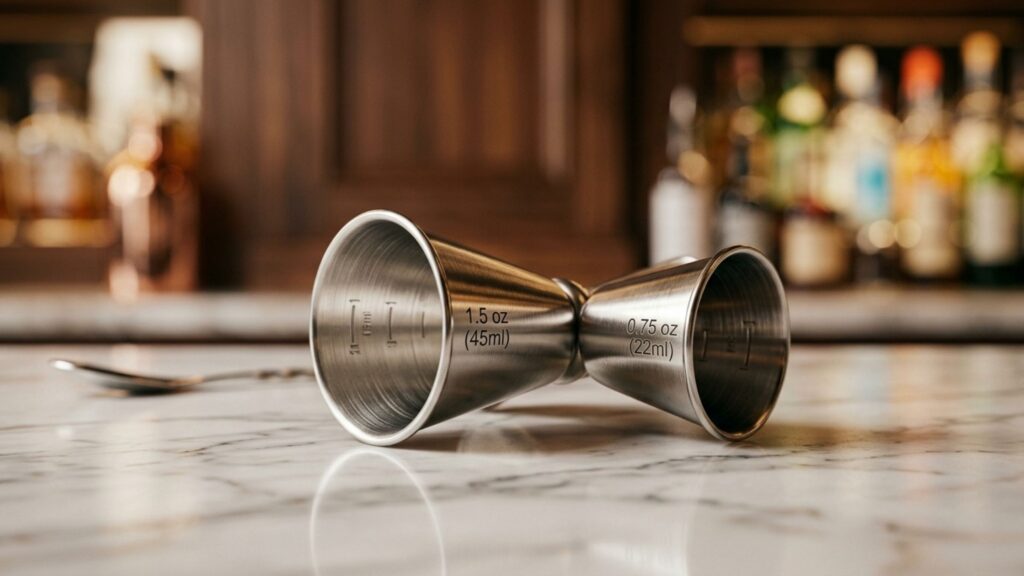
A jigger is a small measuring cup for cocktail ingredients. The familiar hourglass design joins two cups at their bases, letting you switch between different quantities by turning the tool over.
The word has two uses: it names the tool and can describe a measure in a recipe. That explains why a product sold as a “2 oz jigger” does not contradict the traditional 1.5-ounce answer. The tool’s actual capacity depends on its design.
Jigger Size Chart: How Many Ounces Are on Each Side?
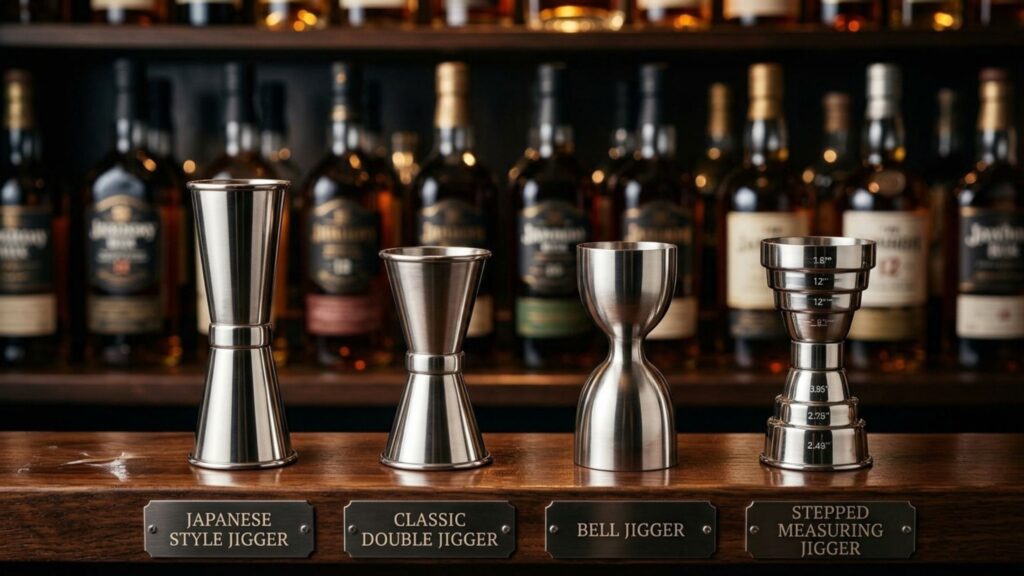
There is no universal pair of measurements. These three configurations are available in actual products:
| Double-sided jigger | Smaller side | Larger side | Product example |
|---|---|---|---|
| ¾ oz / 1½ oz | 0.75 fl oz | 1.5 fl oz | Acopa Classic Jigger |
| 1 oz / 1½ oz | 1 fl oz | 1.5 fl oz | OXO Double Jigger |
| 1 oz / 2 oz | 1 fl oz | 2 fl oz | Cocktail Kingdom Japanese Style Jigger |
These are examples of different capacities, not a ranking of the products. Other sizes exist, including metric versions. Campari Academy discusses 30/45 mL and 30/60 mL jiggers in its measuring guide.
Notice that the smaller end is not always half the larger end. On a 1 oz / 1½ oz model, the small cup holds two-thirds as much as the large cup.
Also, “double jigger” usually refers to the two-ended tool. It does not tell you that either end holds a double shot.
Jigger Conversion Chart: Ounces, Milliliters and Tablespoons
This chart uses U.S. fluid ounces and U.S. tablespoons. Milliliter values are rounded to two decimal places.
| U.S. fluid ounces | Milliliters, approximately | U.S. tablespoons |
|---|---|---|
| ¼ oz | 7.39 mL | ½ tbsp |
| ½ oz | 14.79 mL | 1 tbsp |
| ¾ oz | 22.18 mL | 1½ tbsp |
| 1 oz | 29.57 mL | 2 tbsp |
| 1½ oz | 44.36 mL | 3 tbsp |
| 2 oz | 59.15 mL | 4 tbsp |
The calculations use NIST’s volume conversion factors.
You will also see rounded bar equivalents such as 30 mL for 1 oz and 45 mL for 1½ oz. They are convenient approximations. A 50 mL cup holds about 1.69 U.S. fluid ounces, not 1½ ounces. If your recipe uses ounces and your tool uses milliliters, convert the amount before choosing a fill line.
Here, ounces describe liquid volume, not weight. Imperial fluid ounces also differ from U.S. fluid ounces; this chart is for U.S. recipes.
Is a Jigger the Same as a Shot?
A jigger and a shot can contain the same amount, but the words describe different things.
A jigger measures an ingredient. A shot is a serving, and a shot glass is the container used to serve it. Shot glasses come in different capacities, so filling an unmarked glass does not automatically give you the amount your recipe requires. WebstaurantStore’s shot glass guide explains those size differences.
If your bar uses a 1.5-ounce shot, that matches the traditional jigger measure. If the recipe specifies 2 ounces, measure 2 ounces regardless of what the venue calls a shot.
How to Measure with a Jigger
Choose the Cup or Line That Matches the Recipe
Read the amount first, then locate the corresponding cup or marking. Interior lines represent smaller quantities within a cup.
For example, Cocktail Kingdom’s 1 oz / 2 oz model lists internal marks for ½, ¾ and 1½ ounces. A 1½-ounce pour therefore stops at its marked line inside the larger cup, rather than at that cup’s rim. Other models may have different markings. Check the model’s specifications.
Hold It Level and Fill Carefully
Keep the jigger level while pouring. Stop at the required line, or at the rim when measuring a cup designed to hold its stated capacity to the top. Slow down as the liquid approaches that point.
Campari Academy emphasizes keeping the tool horizontal and avoiding both overfilling and underfilling in its pouring instructions.
Do not estimate half a measure by filling halfway up a tapered cup. Its width changes with height, so half the height is not half the volume.
Pour into Your Mixing Container
Tip the measured ingredient into the shaker or mixing glass. If you need more than one cupful, use quantities you can measure directly: two full 1-ounce measures give you 2 ounces.
For a bar team, write exact amounts on recipe cards. “One large jigger” is ambiguous when staff use different tools. Pouring 2 ounces instead of the intended 1.5 adds an extra half-ounce—one-third more of that ingredient—and changes the recipe’s proportions.
How to Measure Without a Jigger
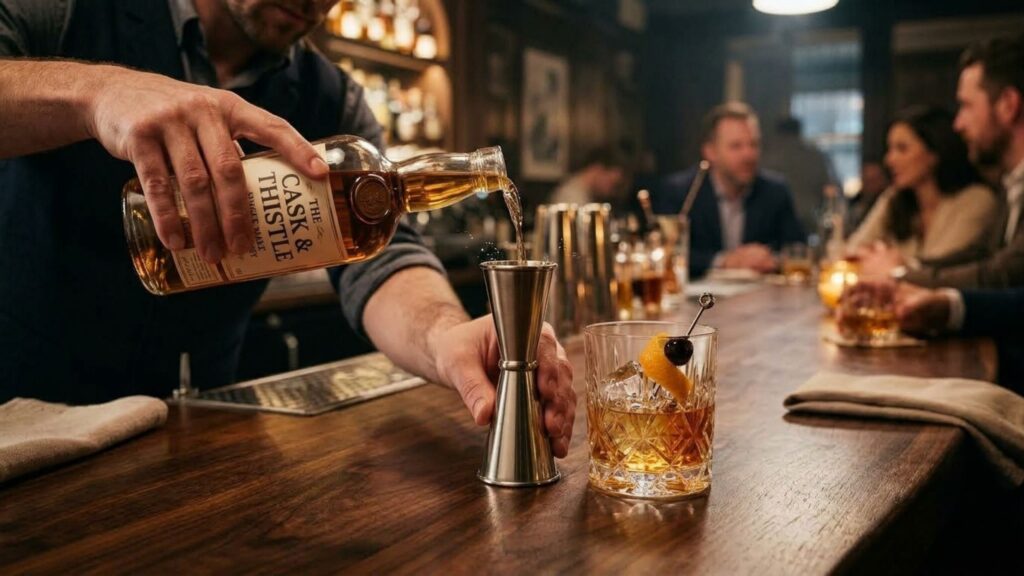
Three U.S. measuring tablespoons equal a traditional 1.5-ounce jigger measure. Use proper measuring spoons rather than ordinary cutlery.
Check the spoon’s units: three 15 mL tablespoons give 45 mL, a close approximation. A small graduated measuring cup also works if its markings are fine enough for your recipe.
Which Jigger Size Fits Your Recipes?
Check every quantity in your regular recipes, including the smaller pours. For example, a recipe using 2 oz of spirit, ¾ oz of juice and ½ oz of syrup needs three measurable amounts. A jigger advertised simply as “2 oz” does not tell you whether the smaller amounts are marked.
| What you need to measure | What to look for |
|---|---|
| Frequent 2 oz pours | A 2 oz cup avoids measuring 1 oz twice. |
| Both 1½ oz and 2 oz pours | A 2 oz cup with a clearly marked 1½ oz line lets you measure either quantity. |
| ¼, ½ or ¾ oz additions | Check the listed interior markings; do not assume every model includes them. |
| Recipes written in mL | A matching metric scale reduces repeated conversions during preparation. |
These are choices based on your recipes, not a rule that one jigger size suits every bar. For example, the OXO model above includes a ¼ oz mark, while the listed interior marks on Cocktail Kingdom’s model start at ½ oz. Compare the actual marks as well as the maximum capacity.
Readability matters, too. You should be able to identify the units and marks under your bar’s lighting. A double-ended model is not your only option: OXO’s angled jigger is designed so you can read its measuring scale from above.
Before introducing a new model to a shared bar, have staff measure the amounts on your recipe cards with it. This simple check can reveal a missing mark or a confusing unit before it affects service.
Frequently Asked Questions
How Can I Check a Jigger with No Markings?
First, look for the model’s original specifications. If you cannot identify it, fill one end with water and transfer the water into a reliable small graduated measuring cup. Repeat for the other end. This is a practical capacity check, not professional calibration; a large kitchen jug may have markings too coarse to help.
Can Every Stainless Steel Jigger Go in the Dishwasher?
No. Follow the instructions for the specific model and finish. OXO lists its Double Jigger as dishwasher safe, while Cocktail Kingdom says its gold-plated model is not. Stainless steel construction alone does not settle the question.
Make Your Measurements Consistent
Choose a jigger that matches your recipes, identify its fill points, and use clear quantities on your recipe cards. Once everyone follows the same measurements, changing tools becomes much less likely to change the drink.
Planning a broader bar or beer promotion? BeerPromoPro offers custom ice buckets, bar mats, bottle openers and glassware. Contact our team to discuss the serving and promotional items your event needs.