Custom brewery signs help a beer brand show up consistently at the taproom, behind the bar, on a retailer’s wall, and at an event. They can be a permanent brand marker, a campaign display, or a piece of merchandise customers want to take home.
For a wholesale buyer, the real question is not simply how a sign looks in a render. You need to match its format, material, finish, mounting, packaging, and any electrical requirements to its actual selling environment. This guide helps breweries, promotional agencies, distributors, and retail buyers make that decision before requesting quotations.
What Are Custom Brewery Signs?
Custom brewery signs are branded visual displays made for a brewery, beer launch, taproom, bar account, or promotional program. The term covers more than wall décor. A program can include a logo sign behind the bar, a chalkboard for rotating taps, a metal sign for a retail account, and a portable display for a festival.
Common uses include:
- Taprooms, brewpubs, bars, restaurants, and hotel venues
- Retail point-of-sale and distributor account displays
- Festivals, tastings, trade shows, and temporary activations
- Wayfinding, menus, daily specials, and entrance signage
- Brewery merchandise, gifts, and collector-style items
The right choice depends on viewing distance, how often the message changes, expected handling, and whether the sign is for one location or a multi-account rollout.
Main Types of Custom Brewery Signs
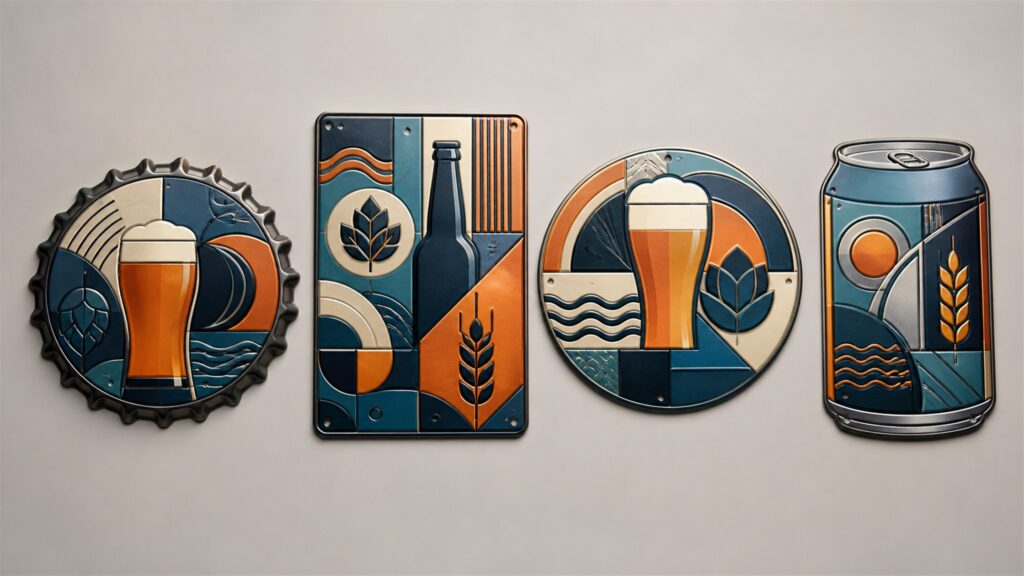
Metal tin tackers and embossed signs
Tin tackers are lightweight branded metal signs commonly used in bars and taprooms. They may be flat or embossed, with raised logos, borders, or graphics. Standard shapes include rectangles, circles, bottle caps, cans, and custom die-cuts.
They work well for permanent-looking bar décor, retail placement programs, and branded merchandise. Embossing can add depth and a collectible feel, but it also adds artwork, tooling, sampling, and print-registration considerations. Keep very small type and critical fine lines away from deeply formed areas.
Wood brewery signs
Wood signs suit craft, rustic, heritage, and premium taproom concepts. They can be printed, engraved, routed, layered, stained, or built in a barrel-head style. A-frame chalkboards are a practical related format for foot traffic and frequently changing specials.
Wood’s character is a commercial advantage when the sign is part of the venue experience. It is less convenient when every unit must look identical across a very large rollout, when conditions are damp, or when shipping weight is highly constrained. Confirm the wood species or board type, finish, hardware, and moisture-resistance expectations rather than relying on a product photo.
Acrylic, PVC, and rigid plastic signs
Acrylic can provide a clean, modern look and supports dimensional or layered logo treatments. PVC and other rigid plastic boards can be useful for cost-conscious indoor signage, temporary campaigns, or larger-format printed panels.
Ask about thickness, edge finishing, print protection, and mounting method. A material that looks polished on a wall may flex, scratch, or crack differently during freight and installation. For a multi-location program, request a packed sample as well as a display sample.
LED, neon-style, and illuminated signs
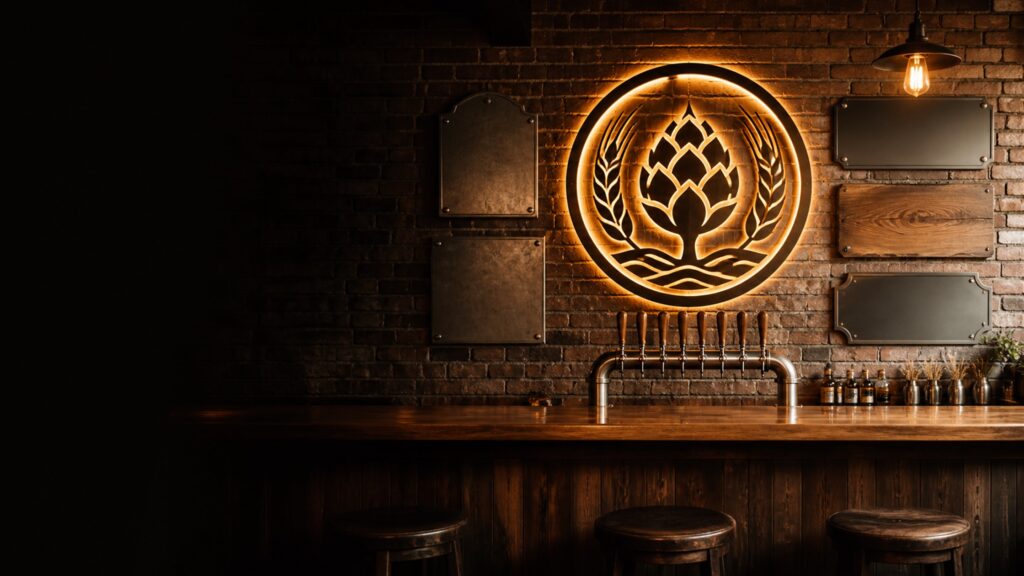
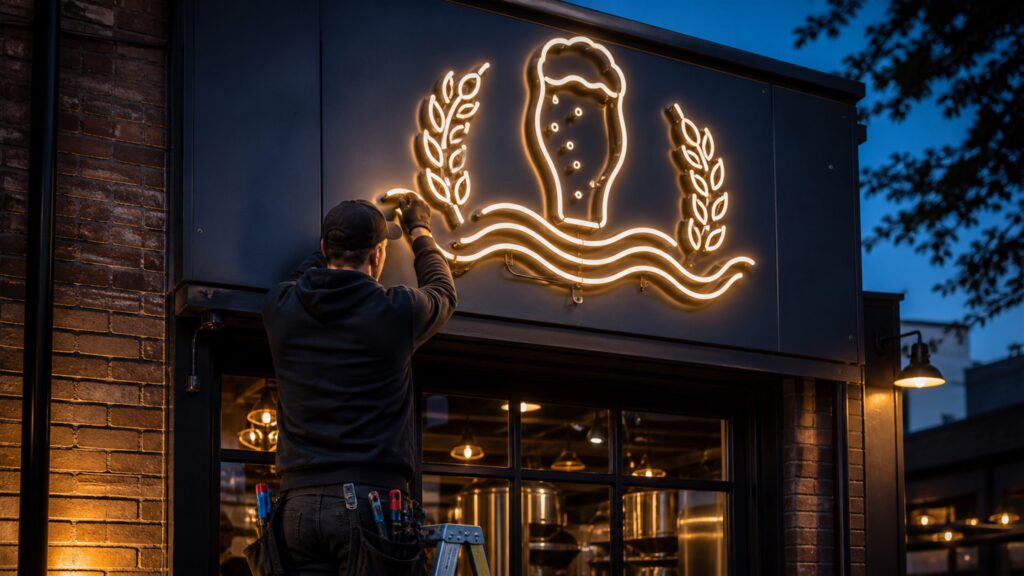
Illuminated custom brewery signs can create a strong focal point for a taproom, bar, or evening event. Options include LED channel letters, edge-lit acrylic, LED neon-flex styles, light boxes, and digital displays. They usually support a more premium visual position, but add power, wiring, installation, repair, and destination-market review to the brief.
For the United States, UL Solutions identifies UL 48 as the standard for electric signs and notes related requirements for sign components, LED sign kits, and National Electrical Code installation considerations. Do not assume that a generic “UL” statement covers your finished custom configuration; confirm the relevant documentation, voltage, plug, power supply, installation location, and local approval needs for the exact SKU. UL Solutions’ electric-sign overview is a useful starting point.
Banners, sidewalk signs, and event displays
Fabric banners, corrugated displays, yard signs, A-frames, and portable boards are designed for flexibility. They are useful when the message changes with a seasonal beer, a tasting, a festival, or a new account opening.
The buyer priority here is often speed, portability, setup time, and replacement cost—not permanence. Specify whether the sign will be single- or double-sided, wind-exposed, repeatedly folded, or carried by event staff.
Choose Materials by Use, Not by Appearance Alone
A strong brewery-sign brief describes the operating environment. “Outdoor,” for example, is not enough: direct sun, rain, coastal air, cleaning chemicals, and wall hardware create different risks.
| Material / format | Best fit | Main buyer checks |
|---|---|---|
| Printed or embossed metal | Bar walls, retail displays, merch | Sheet type, thickness, coating, edges, dents, protective packing |
| Wood | Taprooms, premium décor, A-frames | Construction, finish, weight, moisture behavior, hanging hardware |
| Acrylic / rigid plastic | Modern interior logos, campaign panels | Thickness, scratch resistance, edge quality, mounting, freight protection |
| LED / illuminated sign | High-visibility focal points | Electrical documentation, voltage, power supply, installation, spare parts |
| Banner / temporary display | Events and short campaigns | Base or frame stability, print visibility, wind and transport plan |
There is no universal “best” material. A thin metal tacker might be ideal for shipping many retail units, while a layered wood or acrylic sign could be the better investment for a flagship taproom.
Design Features That Affect Cost and Performance
Shape and viewing distance
Custom shapes such as bottles, cans, arrows, and bottle caps can make a brand memorable. They can also increase cutting complexity, protective packing needs, and bend risk at narrow projections. Approve the silhouette at the expected viewing distance, not only on a screen.
Print, finish, and color control
Full-color digital or UV printing can suit detailed art and gradients. Screen printing may suit simpler, bold-color designs. Matte, gloss, distressed, and textured finishes each change the perceived brand position and how marks show in use.
Provide vector artwork where possible, identify critical brand colors, and request a production-representative sample. A digital proof confirms layout; it does not fully confirm print density, surface reflection, embossing alignment, or scratch resistance.
Mounting and installation
Decide how the sign will be mounted before finalizing artwork. Confirm hole count, diameter, location, hanging hardware, weight, and whether the design must be visible from one or both sides. Keep logos and required text away from corners, holes, and narrow die-cut sections.
Changeable information
For beer menus, rotating taps, and daily specials, a reusable chalkboard, whiteboard, insert system, or digital display may be more useful than a fixed printed sign. This can reduce replacement demand, but creates cleaning, marker, legibility, and maintenance requirements.
How to Evaluate a Supplier Sample
Approve a finished sample that uses the intended materials, decoration, and packing method. A good review combines visual inspection with simple real-use checks.
- Verify size, material, thickness, shape, and mounting-hole locations.
- Check print color, logo placement, small text, finish, and surface cleanliness.
- Inspect edges, corners, folds, and holes for burrs, sharpness, or inconsistent treatment.
- For embossed items, check definition, cracking, distortion, and print alignment over raised areas.
- Trial-mount the sign using the planned hardware and check flatness and stability.
- Review an individually packed unit after normal handling for scratching, rubbing, bending, or broken accessories.
- For illuminated signs, test the power supply, plug, controls, brightness, heat, cables, and labeling against the agreed specification.
Turn the approved sample into a written inspection reference. This is especially helpful where a promotional agency, brewery team, factory, and third-party inspector all need to judge the same order consistently.
Packaging and Freight Planning for Brewery Sign Programs
Signs can be thin and still be difficult to ship. Metal edges can rub, acrylic can scratch, wood corners can chip, and irregular shapes may bend unless the inner pack controls movement.
Ask the supplier for individual protection, inner-pack quantity, carton dimensions, gross weight, carton photos, and pallet/loading guidance. Depending on the format, the solution may include protective film, paper sleeves, shrink wrap, dividers, corner guards, foam, or retail-ready boxes.
For campaigns distributed to multiple accounts, confirm carton marks, SKU labels, destination splits, and consolidation needs before mass production. A large taproom sign and small retail tin tackers should rarely share the same packaging assumption.
Custom Brewery Signs: Sourcing Questions to Ask Before Quoting
Send a complete brief rather than just a logo and quantity. Include:
- Intended location, viewing distance, and indoor/outdoor exposure
- Sign type, dimensions, shape, and single- or double-sided requirement
- Base material, thickness, finish, print method, and embossing or layered details
- Artwork files, color references, and required proof process
- Mounting holes, hardware, and installation plan
- Quantity by design or SKU, including any mixed-SKU order needs
- Sample expectation, target delivery date, and destination
- Individual packaging, retail packing, labels, and carton requirements
- Any destination-market electrical or product-safety documentation to be confirmed
MOQ, price, sample time, and production lead time are configuration-specific. Treat marketplace figures as an indication of available formats, not as a factory-wide promise. For example, specialist tin-tacker suppliers advertise a mix of standard shapes, embossing, full-color print, and custom die-cut options, while the final minimum and lead time vary by order. Custom Tin Tackers’ product overview illustrates this product vocabulary.
Customization Ideas for a Cohesive Beer POS Program
A sign is more effective when it supports the same visual system as the rest of the activation. Depending on the channel, you can pair custom brewery signs with tap handles, bar mats, trays, drinkware, coasters, coolers, or retail displays.
Use one clear hierarchy: the brewery logo or hero beer should remain recognizable first; secondary campaign messages should not crowd out the core identity. A strong program can use a durable permanent sign for brand recognition and lower-cost changeable pieces for seasonal offers.
BeerPromoPro can help you compare sign formats, coordinate custom artwork and samples, define inspection points, consolidate related beer-promotion products, and prepare packaging for international delivery. Explore our beer promotion products, view beer promotion case studies, or send your project brief.
FAQ
What is the best material for custom brewery signs?
It depends on the location and campaign. Metal can suit durable branded wall signs and retail programs; wood can support a handcrafted taproom look; acrylic suits a modern interior display; and illuminated formats suit high-visibility focal points. Compare the finished construction, not just the material name.
Can custom brewery signs be used outdoors?
Some can, but suitability depends on the material, coating, print system, hardware, and exposure conditions. State the expected weather and installation environment, then request evidence for the actual construction.
Are LED brewery signs more difficult to source?
They require a more detailed brief because power, voltage, components, wiring, installation, safety documentation, and after-sales support all matter. Confirm the destination-market requirements for the final configuration before production.
What files should I send for a custom brewery sign?
Send vector artwork when available, plus color references, sign dimensions, shape, material and finish requirements, mounting layout, quantity, packaging request, destination, and deadline. Mark any text or logo areas that must remain especially sharp.
Should I order a sample first?
Yes. A finished sample lets you check color, material feel, edge quality, mounting, embossing, lighting where applicable, and transit protection before you commit to a larger program.
Build the Sign Around the Selling Environment
The best custom brewery sign is not automatically the brightest, largest, or most elaborate. It is the one that presents the brand clearly where customers encounter it, installs safely, survives handling and freight, and meets the needs of the campaign. Start with the use environment and a complete specification, then use sampling to turn the design into a dependable branded asset.