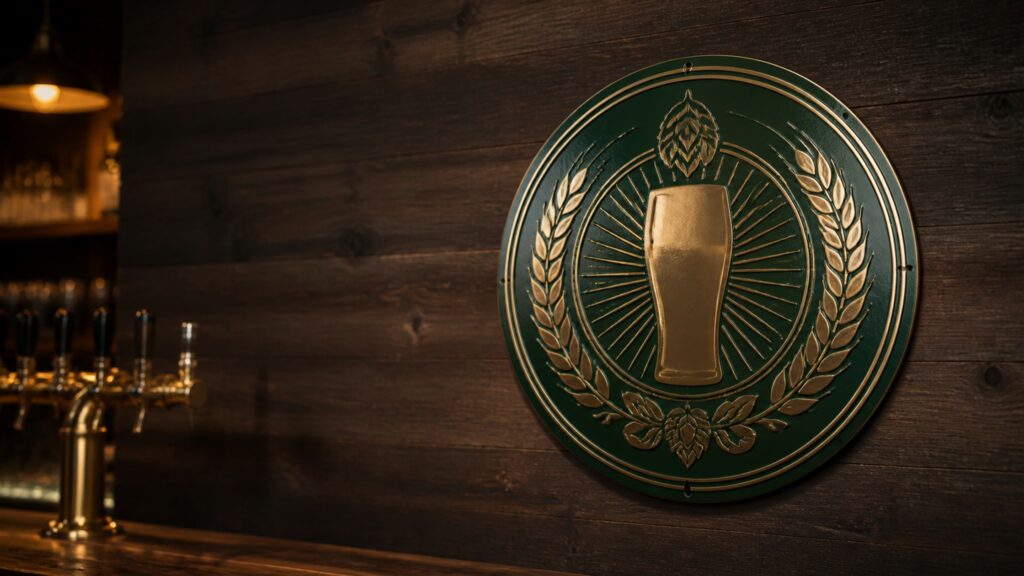
Tin beer signs give a brewery or beverage brand a durable presence where people order, gather, and notice the details: behind a bar, in a taproom, at a festival booth, or on a retail display. A good sign can remain visible long after a short campaign has ended.
For a buyer, though, a metal sign is more than artwork on a sheet. The choice of material, thickness, edge treatment, print process, embossing, mounting holes, and packaging affects how the sign looks in use and how reliably it arrives. This guide explains how to choose custom tin beer signs for wholesale programs, brand activations, and beer merchandise.
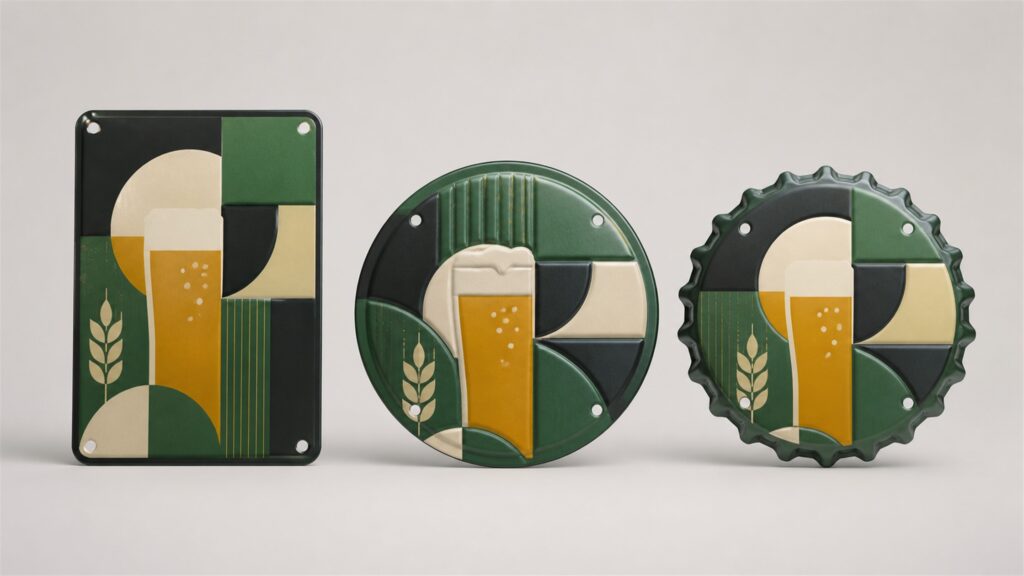
What Are Tin Beer Signs?
Tin beer signs are non-illuminated metal signs used to display a brewery, beer brand, product campaign, or bar message. You may also see them called metal beer signs, tin tackers, beer wall signs, or metal bar signs.
The word tin is a common category label, not a complete material specification. A sign sold as a tin sign may be made from tinplate, aluminum, or another metal sheet. Tinplate itself is thin steel coated with tin, rather than solid tin. That distinction matters when you compare weight, stiffness, corrosion protection, embossing, and outdoor suitability.
For beer promotions, these signs are commonly used in:
- Bars, restaurants, clubs, and hotel venues
- Brewery taprooms and tasting rooms
- Beer festivals and sampling activations
- Retail point-of-sale displays
- Distributor, sales-representative, and account gifts
- Brewery merchandise and collector-style retail programs
Tin Beer Signs vs. Tin Tackers vs. Aluminum Signs
These terms overlap in the market, so ask the supplier to describe the finished construction rather than relying on the name alone.
Standard printed metal signs
A standard sign is a flat metal panel with printed artwork and mounting holes. It can be a practical route for rectangular artwork, retro-style campaign graphics, price-sensitive rollouts, or retail merchandise where a flat finish suits the design.
Tin tackers and embossed signs
A tin tacker generally refers to a lightweight branded metal sign, often designed for wall mounting in bars and taprooms. It may have embossed logos, lettering, or graphic elements that rise above the surface. Embossing gives a sign more depth and a more permanent, collectible feel, but it also adds design, tooling, and sampling questions.
Keep fine text, tight registration, and critical artwork away from deep embossed areas. The final result should be checked on a physical sample, because lighting can make raised details look very different from a flat digital proof.
Aluminum signs
Aluminum can be a useful option when low weight and corrosion resistance are priorities. It is often used for embossed promotional signs. The correct choice still depends on the thickness, finish, rigidity, printing method, installation environment, and target cost. Do not assume that every aluminum sign is suitable for long-term outdoor use without confirming the actual coating and testing approach.
Choose the Shape for the Viewing Location
The best shape is the one that remains recognizable at the point of use, not necessarily the most unusual outline on a quotation.
Rectangles and squares
These are efficient for beer artwork, illustrated campaigns, menu-adjacent POS, and retail walls. They are also simpler to pack than an irregular silhouette. Check the intended orientation, the visible wall area, and whether the design still reads from across a bar.
Circles and bottle-cap styles
Round signs and bottle-cap profiles work well when a logo, badge, or heritage-style brand mark is central to the artwork. They can create a stronger beer-identity cue than a conventional rectangle, especially in taprooms and branded display areas.
Bottle, can, arrow, and custom die-cut shapes
Custom shapes can make a campaign more memorable. A can or bottle silhouette can support a new-pack launch, while an arrow can direct attention to a tap, cooler, or event zone. Balance the visual gain against the additional work: custom cutting, possible tooling, more complex protective packing, and higher risk of bent protruding sections.
Before approving any shape, define where it will hang, the typical viewing distance, and how it will be fixed. A large display sign and a small merch item should not be specified in the same way.
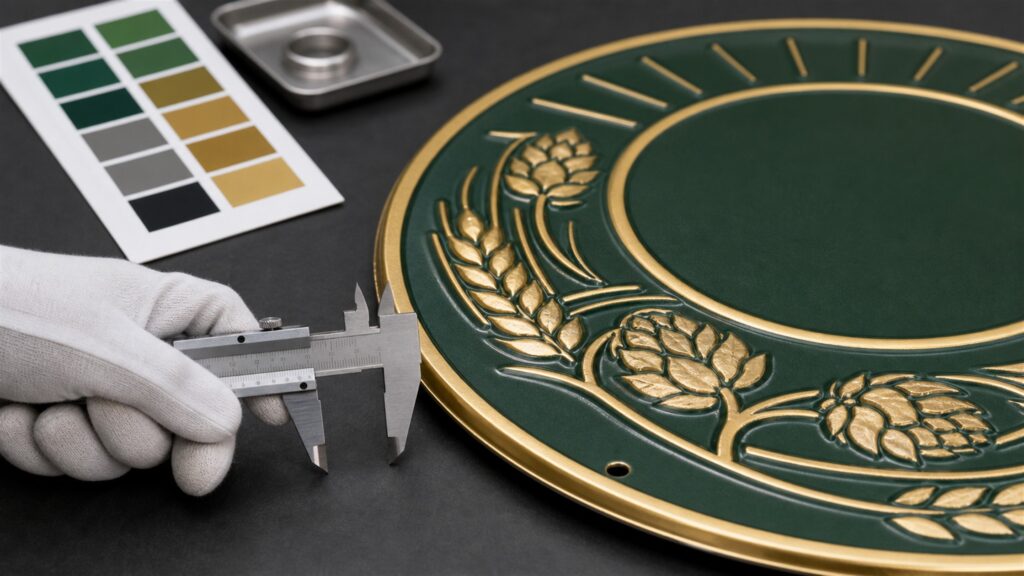
Material, Thickness, Edges, and Mounting Details
The material specification should be written in the product brief. Avoid a generic request for “metal” when the campaign has specific handling or environmental conditions.
Ask the supplier to confirm:
- Base material and surface coating
- Material thickness and finished rigidity
- Flat or embossed construction
- Rounded corners, folded edges, or rolled edges
- Mounting-hole count, diameter, and exact positions
- Sign size, weight, and permitted dimensional tolerance
- Intended indoor or outdoor application
Edges deserve special attention. A sign may look acceptable in a product photo but still have sharp cut edges, uneven folds, or rough holes. For signs handled by bar staff, consumers, or event teams, include edge finish and hole quality in the inspection standard.
If the sign is intended for outdoor placement, specify the exposure conditions rather than simply asking for “waterproof” material. Direct sun, rain, salt air, cleaning chemicals, and mounting hardware can affect the finished item differently. Request evidence relevant to the proposed construction and environment.
Custom Printing and Embossing Options
Your artwork and expected order quantity should guide the decoration method. Common options include full-color digital or CMYK printing, spot-color screen printing, UV printing, and embossed details. Availability depends on the factory, material, artwork, and order specification.
Full-color artwork
Full-color printing can suit illustrated campaign art, gradients, product photography, and detailed packaging-inspired designs. Request a color proof, then approve a production-representative sample to check tone, density, small text, and surface scratches.
Spot-color logo designs
For a simple brewery logo or strong brand block, spot colors may be appropriate. Supply vector artwork and agreed color references. If a brand color is critical, compare the sample under neutral light rather than approving only from a screen.
Embossed logos and graphics
Embossing can add tactile value to a logo, bottle cap, border, or hero graphic. It is not a substitute for good artwork. The raised area should be large enough to form cleanly, and the designer should account for how the shape changes ink coverage and line sharpness.
Artwork checklist
Provide editable vector files where possible, state the front orientation, mark any critical logo area, and identify approved colors. Keep essential text clear of holes, corners, narrow custom-cut sections, and deep formed areas. If the sign needs to be recognizable from both directions in a venue, specify whether it is single-sided wall décor or a two-sided hanging display.
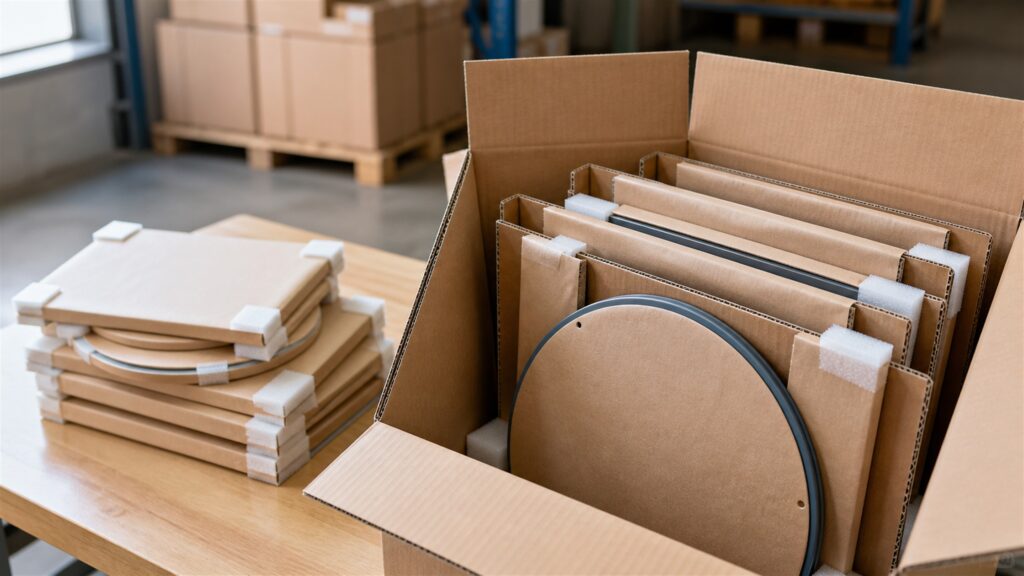
Quality Checks Before You Place a Wholesale Order
Approve a finished, decorated sample—not only an artwork rendering. A useful sample review covers both appearance and real handling.
- Confirm size, shape, thickness, flatness, and mounting-hole positions.
- Check edges, corners, holes, and folds for sharpness or exposed burrs.
- Inspect print color, registration, logo placement, gloss or matte finish, and fine text.
- For embossed signs, check definition, cracking, distortion, and artwork alignment around raised areas.
- Check for dents, scratches, coating defects, rust risk, and visible fingerprints or residue.
- Trial-mount the sign with the planned fixing method and confirm that it sits flat and remains stable.
- Review a packed sample after normal transport handling, especially for large, thin, or irregular shapes.
Turn the agreed sample into a written inspection reference. This helps separate acceptable production variation from defects that would affect brand presentation or safe use.
Packaging and Freight Planning
Metal signs are relatively thin, but they are not automatically easy to ship. A sign can arrive scratched, bent, or rubbed even when the outer carton appears intact.
Ask for the individual protective method, inner-pack quantity, carton dimensions, gross weight, carton strength, and pallet or container-loading plan. Decide early whether signs need sleeves, shrink wrap, protective film, corner protection, dividers, or a more robust retail-ready pack.
For a multi-country activation, also confirm carton marks, SKU labels, distribution quantities, and consolidation requirements before mass production. A custom shape with narrow projections may need a different pack from a simple rectangle, so do not use one packaging assumption for every sign in the program.
Safety, Compliance, and Brand Rights
Tin beer signs are normally decorative or promotional items, not food-contact articles. Do not describe them as food-safe, FDA-compliant, or certified unless the actual product, intended use, and supporting documentation justify that claim.
For products placed on the EU consumer market, Regulation (EU) 2023/988 establishes general product-safety obligations. Depending on the product and sales route, this can include safe design, product identification, relevant technical documentation, and a responsible economic operator in the EU. Review the requirements for the finished sign and destination market rather than treating a generic factory statement as sufficient. Read the EU regulation.
Special features can change the compliance picture. A sign with lighting, electrical parts, magnets, sharp functional hardware, or a child-directed design may need additional review. Confirm applicable obligations with a qualified destination-market adviser.
Finally, obtain permission before reproducing a beer brand’s logo, historical advertising, licensed character, or third-party artwork. A vintage look does not by itself give permission to reproduce brand assets.
How to Source Custom Tin Beer Signs from China
Start with a clear brief instead of asking only for a price. Include the intended use, size, shape, material preference, artwork files, print colors, embossing requirement, hole layout, target quantity, packaging preference, destination, and required delivery date.
If the campaign needs a straightforward sign, an existing size or shape may reduce development work. If the sign itself is a central part of the brand story, evaluate custom tooling only after the artwork, placement, sample, and packing plan are aligned.
BeerPromoPro can help beer brands and promotional agencies compare suitable sign formats, coordinate custom artwork and samples, define quality checks, and prepare packaging for international delivery. Explore our beer promotion products, see beer promotion case studies, or send us your project brief.
FAQ
Are tin beer signs made from real tin?
Not necessarily. “Tin sign” is often a market term. The finished item may use tinplate, aluminum, or another metal sheet. Ask for the exact base material, coating, and thickness.
What is a beer tin tacker?
A beer tin tacker is a lightweight branded metal sign used in bars, breweries, retail displays, and promotional programs. It may be flat or embossed and is commonly mounted using pre-punched holes.
Can I add an embossed logo to a metal beer sign?
Often, yes. The suitability depends on the artwork, size, material, embossing depth, and production method. Approve a physical sample to assess the formed logo and print alignment before production.
Are metal beer signs suitable for outdoor use?
Some constructions can be suitable, but the answer depends on the material, coating, print system, installation method, and exposure conditions. Confirm the finished specification for the intended environment.
What should I send a supplier for a quotation?
Send the sign size and shape, artwork, material preference, print and embossing requirements, hole layout, quantity, packaging request, destination, and deadline. Ask separately for sample timing, production timing, carton data, and any tooling requirements.
Build the Sign Around the Real Promotion
The best tin beer sign is not simply the one with the most elaborate shape or finish. It is the one that presents the brand clearly, installs safely, survives its intended handling, and arrives in a condition that supports the campaign. Set the product specification and sample standard first; then turn the sign into lasting brewery visibility.