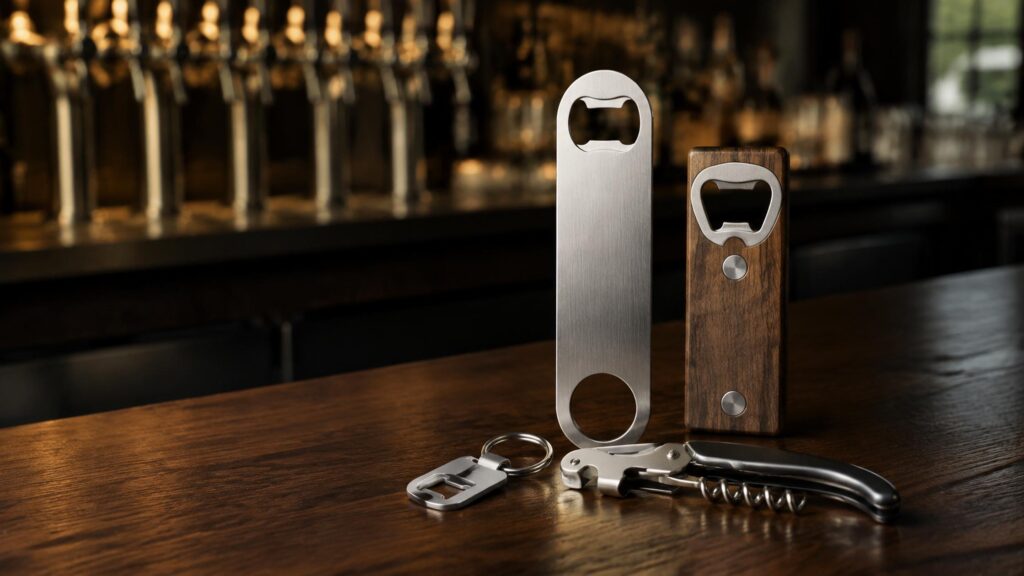
A custom opener can be a giveaway, a working bar tool, or a retail product. Each use calls for a different design, material, and level of durability. This guide will help you choose a bottle opener or corkscrew that fits your brand, performs reliably, and is practical to produce in bulk.
Start With the Bottle, User, and Sales Scenario
Before you design a bottle opener, define what it must open and where it will be used. “Bottle opener” can describe several products, but a tool for crown caps is not the same as a corkscrew for wine bottles.
Ask three questions first:
- Which closure will the tool open? Beer and soft-drink bottles commonly use crown caps. Still wine bottles often use corks or synthetic closures.
- Who will use it? A bartender values speed and grip. An event guest may value portability. A retail customer may care more about finish, packaging, and gift appeal.
- What should the product achieve? Decide whether it is a low-cost campaign item, durable branded equipment, a gift-with-purchase, or merchandise sold for profit.
These answers narrow the field before you compare decorative details.
Choose the Right Bottle Opener Format
The best format combines useful leverage with enough space for your branding.
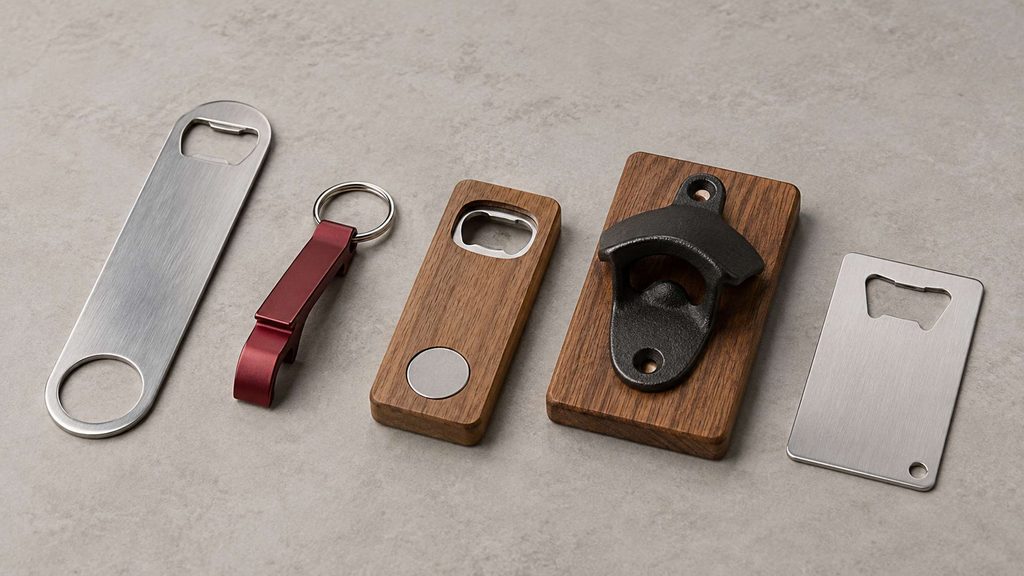
Bar Blade or Speed Opener
A bar blade is a flat metal opener designed for repeated, quick use. Its large surface can carry an engraved logo, printed graphic, or shaped handle treatment.
Choose it for breweries, bars, taprooms, festivals, and hospitality teams. When evaluating samples, check that the opening edge engages the cap cleanly and that the tool feels comfortable during repeated use.
Keychain Bottle Opener
Keychain models are compact and easy to distribute. Common constructions include stamped aluminum, stainless steel, zinc-alloy shapes, and mixed-material designs.
They work well for trade shows, tasting events, subscription boxes, and mass promotions. The tradeoff is branding area: a small product can make a detailed logo unreadable. A simplified mark or one-color design often works better than shrinking a complex graphic.
Magnetic Bottle Opener
A magnetic model can stay on a refrigerator, cooler, or metal display instead of disappearing into a drawer. Some designs also use a second magnet to catch the removed cap.
This format suits at-home beverage campaigns, brewery merchandise, and gift sets. Test both functions separately: the mounting magnet should hold the opener securely, while a cap-catching feature must retain the cap without making the product awkward to lift.
Wall-Mounted Bottle Opener
Wall-mounted openers provide permanent visibility in bars, tasting rooms, patios, and home-entertainment spaces. Wood backboards offer a large print or engraving area, while cast-metal components provide the opening function.
Check the mounting method, screw positions, opener alignment, and any cap catcher. Packaging should protect projecting hardware in transit.
Card-Style Bottle Opener
A stainless-steel card opener provides a broad decoration area in a slim format. It can be used as an event item, membership gift, or retail accessory.
The outer edges and cutout must be smooth. A supplier sample should also confirm that the thin profile still provides enough stiffness and leverage for normal use.
Custom-Shaped Cast Opener
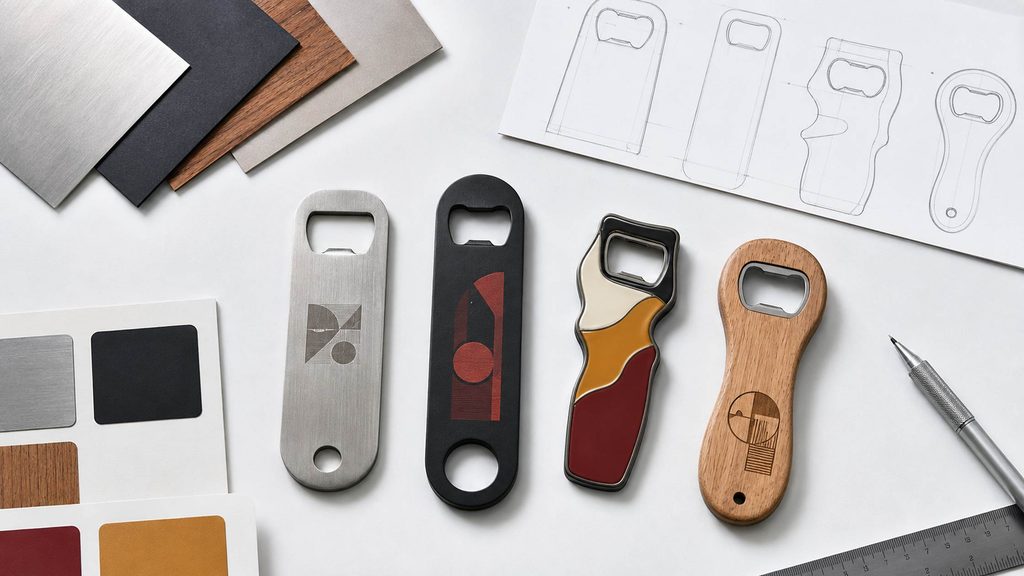
Die-cast zinc-alloy designs can turn a logo, mascot, bottle silhouette, or campaign icon into the product itself. Recessed enamel, relief details, and different plated finishes can create a collectible look.
This option makes sense when brand distinction matters more than the lowest unit cost. Confirm that the decorative silhouette does not interfere with grip or the opening edge. Tooling, artwork complexity, finish changes, and packaging can all affect the quotation.
Select a Wine Bottle Opener Design
A wine bottle opener design has more mechanical parts than a simple cap opener. Buyers should assess the complete opening action, not only the handle decoration.
Waiter’s Corkscrew or Wine Key
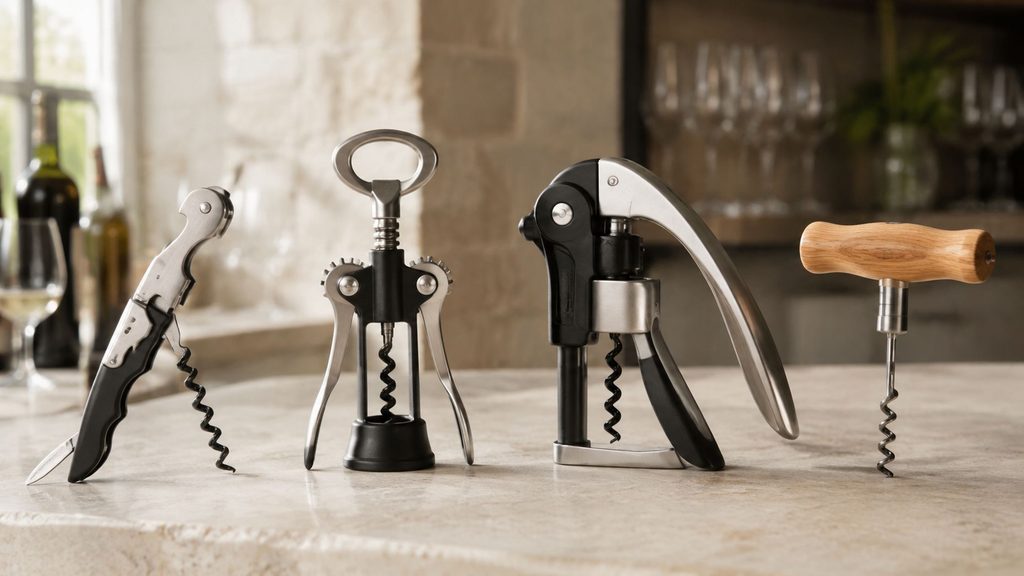
The waiter’s corkscrew combines a spiral, lever, and foil-cutting blade in a folding body. It is portable and familiar to restaurant, winery, and hospitality users.
For frequent use, compare single- and double-hinge models. A double-hinge design lifts the cork in two stages, which can make extraction more controlled. Inspect the hinge fit, spiral alignment, point, blade, handle grip, and bottle-rest contact area. A decorative proof cannot reveal weaknesses in these parts, so request a physical sample.
Wing Corkscrew
A wing corkscrew is recognizable and straightforward for occasional users. Its larger body also offers more visible branding than many folding wine keys.
It can suit gift sets, household promotions, and broad consumer campaigns. Check whether the gears and arms move evenly and whether the body sits securely on the bottle neck.
Lever Corkscrew
Lever models create a more substantial gift presentation and can support premium positioning. They are often paired with a foil cutter, stopper, pourer, or presentation box.
This format is better suited to wine clubs, corporate gifting, and higher-value retail sets than high-volume giveaways. Evaluate the mechanism over repeated opening cycles and account for the added packaging weight and shipping volume.
T-Handle Corkscrew
A T-handle corkscrew has a simple form and can showcase wood, metal, or molded handles. It can fit rustic, craft, or heritage-led branding.
Because it lacks a lever, it depends more on the user’s pulling force. Treat it as a design-led or occasional-use choice rather than assuming it is suitable for professional service.
Compare Materials by Use, Appearance, and Cost Structure
Material affects strength, weight, finish, decoration, and perceived value.
| Material | Main advantages | Watch points | Suitable applications |
|---|---|---|---|
| Stainless steel | Strong, clean appearance, suitable for thin profiles | Grade, edge finishing, surface scratches, print adhesion | Bar blades, card openers, wine keys |
| Aluminum | Lightweight and economical to ship | Thin sections may bend; anodized colors can vary | Keychain and promotional openers |
| Zinc alloy | Supports custom shapes, relief, plating, and enamel | Tooling and plating quality; heavier than aluminum | Collectible and logo-shaped openers |
| Wood or bamboo | Warm, natural visual character and good engraving surface | Grain and color variation; moisture exposure; bonded hardware | Wall openers, handles, gift sets |
| ABS or other molded plastic | Color flexibility and economical high-volume forms | Mold quality, strength around the opening component, surface wear | Promotional and household formats |
| Soft PVC | Supports colorful, character-led shapes | Usually needs a metal opening insert; fine details need production review | Mascots, events, youth-oriented brand merchandise |
Do not select a material from appearance alone. Ask how the load-bearing opening component is constructed and how decorative parts are attached to it.
Match the Branding Method to the Artwork
The decoration method should follow the logo, surface, quantity, and intended positioning.
- Laser engraving creates a precise, permanent mark on suitable metal or wood surfaces. It is effective for one-color logos, names, and serial information, but it does not reproduce a specified ink color.
- Screen or pad printing is practical for solid-color logos. Curved or narrow print areas require careful artwork sizing and registration tolerances.
- Full-color or UV printing can reproduce gradients, illustrations, and multi-color campaign artwork. Ask for adhesion and abrasion expectations for the actual substrate and finish.
- Soft or hard enamel color fill works with custom cast-metal designs. Soft enamel has recessed color fields and a textured surface; hard-enamel-style finishes are polished flatter for a smoother appearance.
- Embossed or debossed branding builds the identity into the molded or cast form. It is durable but needs sufficient line width and depth.
- Wood engraving or printing can support craft-led branding, although natural grain means individual pieces may not look identical.
Vector artwork in AI, EPS, or editable PDF format is usually the safest production input because it scales without losing edge quality. Convert fonts to outlines, embed linked elements, and provide official spot-color references when color matching matters. The Promotional Products Association International also recommends vector artwork for many spot-color promotional imprints and explains why monitor colors should not be treated as an exact physical match (PPAI artwork guide).
Build the Design Around the Brand Experience
A good design bottle opener is recognizable without sacrificing function. Use these rules during concept development:
Protect the Functional Geometry
The cap-engaging lip, leverage point, corkscrew spiral, hinge, and gripping area are working features. Keep decorative cutouts and sculpted shapes away from these zones unless the supplier has validated the geometry.
Design for the Actual Decoration Area
Ask for a dieline or imprint template before finalizing artwork. Include the safe area, bleed where required, hole positions, hardware, folds, and any surface curvature. A digital mockup should show dimensions, not just a floating logo.
Simplify Small Artwork
Fine text, narrow gaps, and delicate lines may fill in, disappear, or become hard to inspect. Prepare a simplified small-format logo when necessary. If a QR code is part of the concept, require testing on a production sample rather than relying only on the artwork proof.
Connect the Product to the Campaign
A brewery may use a bar blade styled after its can graphics. A wine club may prefer a restrained engraved wine key. A festival may choose a bright keychain model with the event date. The strongest concepts make the product format, message, and distribution setting feel related.
Plan Packaging and Distribution Early
Packaging is part of the product specification, not a last-minute extra.
- Individual bags or protective sleeves help prevent metal pieces from rubbing together.
- Backing cards create space for brand storytelling, instructions, barcodes, and retail hanging holes.
- Small cartons protect moving parts and provide better presentation for ecommerce orders.
- Gift boxes support wine sets and premium campaigns but add weight, volume, assembly, and freight cost.
- Master-carton labeling should reflect SKU, quantity, destination, and any distributor or fulfillment requirements.
Before approving packaging, test whether the opener shifts in transit, scratches adjacent surfaces, punctures the pack, or arrives with moving parts under stress.
Evaluate Samples and Quality
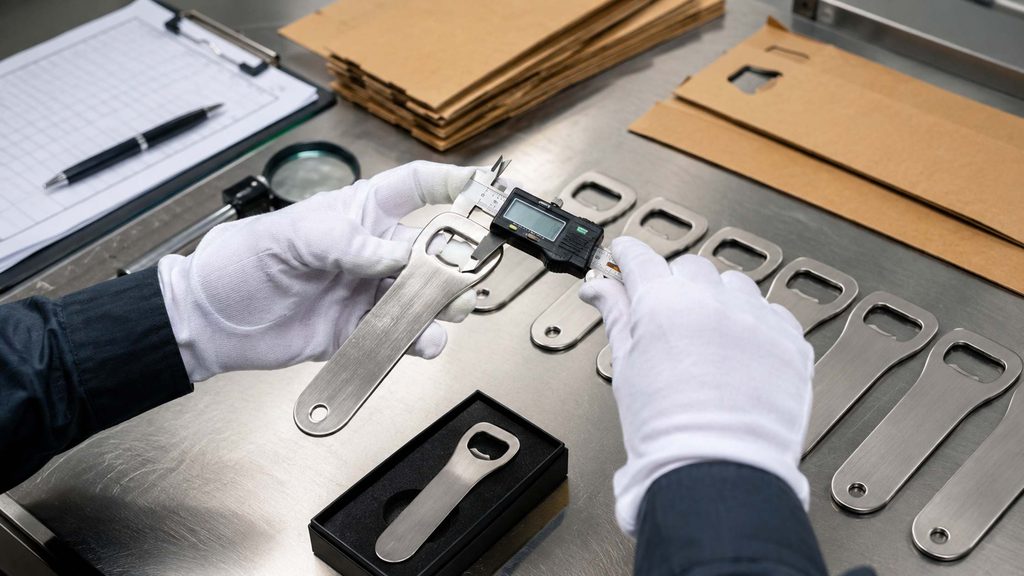
Use an approved physical sample as the reference for mass production. Your inspection plan should cover appearance and function.
Functional Checks
- Test the opener on the intended cap or closure.
- Check the opening edge for slipping, bending, or rough burrs.
- Operate hinges, levers, blades, and spirals repeatedly.
- Test keyrings, magnets, bonded handles, and wall-mount hardware.
- Confirm that the tool is comfortable and does not expose unintended sharp edges.
Appearance Checks
- Compare logo position, size, spelling, and orientation with the approved proof.
- Review color under consistent lighting and against the agreed reference.
- Inspect printing, engraving, enamel fill, plating, polishing, and wood surfaces.
- Check for scratches, pits, color bleed, uneven coating, glue marks, and loose parts.
- Verify packaging, labels, barcodes, and assortment quantities.
For metal products, relevant supplier-side tests may include coating-adhesion checks, corrosion testing appropriate to the finish and intended environment, and pull testing for attached components. The correct method and acceptance limit should be agreed for the specific product rather than copied from an unrelated item (example of custom-metal inspection stages).
What to Include in a Request for Quotation
A complete RFQ makes supplier quotations easier to compare. Include:
- product format and intended use;
- target material, size, weight, and finish;
- logo artwork and official color references;
- decoration method or desired visual result;
- order quantity and acceptable overrun or underrun policy;
- individual and master packaging requirements;
- barcode, warning, labeling, or retailer specifications;
- target delivery location and required arrival date;
- sample and proof requirements;
- functional tests and appearance tolerances;
- inspection, shipment, and documentation expectations.
Ask suppliers to separate tooling, setup, sampling, unit price, packaging, inspection, and freight where possible. This prevents a low headline unit price from hiding other project costs.
A Practical Supplier-Selection Process
- Send the same brief to shortlisted suppliers. Comparable specifications produce more meaningful quotations.
- Review design-for-manufacture feedback. A capable supplier should identify weak details, restricted decoration areas, or mechanical risks before tooling.
- Approve dimensions and artwork. Check spelling, orientation, finish, color callouts, and packaging information.
- Evaluate a physical sample. Test the opening action, grip, attachments, decoration, and packaging.
- Define the production standard. Record approved materials, appearance limits, functional checks, and packing method.
- Inspect before shipment. Use the approved sample and written specification as the basis for acceptance.
Do not judge a supplier only by a rendered mockup. The opener is a mechanical product, and brand value depends on whether it works reliably after delivery.
Frequently Asked Questions
What is the best material for a promotional bottle opener?
There is no universal best material. Aluminum works well when low weight matters, stainless steel suits slim and durable formats, zinc alloy supports custom shapes, and wood creates a warmer gift or hospitality aesthetic. Choose according to use, design, budget structure, and shipping needs.
Is laser engraving better than printing?
Laser engraving is better for a durable, precise, usually single-tone mark. Printing is better when the design requires specific brand colors, gradients, or detailed illustrations. The substrate and surface finish also affect the result.
Should a branded wine key use a single or double hinge?
A double hinge is often the more practical choice for frequent service because it lifts the cork in two stages. A single-hinge model may suit a simpler, cost-sensitive promotion. In either case, test the spiral, blade, hinge, and bottle rest on a physical sample.
Why does a supplier need vector artwork?
Vector artwork can be resized without losing sharpness and can carry editable shapes and spot-color information. AI, EPS, and editable PDF files are commonly requested. Raster images may still help with initial discussion, but they can require redrawing before production.
What should buyers test on a magnetic opener?
Test whether it remains attached to the intended surface, is still easy to remove, and—if it includes a cap-catching feature—retains the cap during opening. Also confirm magnet placement and attachment security.
How can a buyer compare quotations fairly?
Give each supplier the same material, dimensions, finish, decoration, quantity, packaging, testing, destination, and delivery requirements. Request separate costs for tooling, samples, packaging, inspection, and freight.
Choose for Use First, Then Brand Impact
Start with the closure, user, and distribution setting. Then select the format, material, decoration, and packaging that support that use. A well-designed custom opener should look on-brand, feel appropriate for the campaign, and perform consistently.
Explore our promotional collection or request a quotation with your artwork, quantity, packaging needs, delivery destination, and target date. For wine programs, include the preferred corkscrew mechanism and any gift-set components in the brief.